The short answer
- Bagworms: pick off and destroy bags in fall through spring, cutting the silk band so it doesn't girdle the branch; spray Bt on young larvae at the end of June.[9]
- Emerald ash borer: healthy or newly infested ash can be protected with systemic insecticides, but treatment must be repeated regularly; trees with less than half their canopy left are better removed and replaced.[10]
- Codling moth: pick up dropped fruit, remove infested fruit, and bag young apples and pears 4 to 6 weeks after bloom.[11]
- Pheromone traps mostly tell you when to act; they aren't a reliable way to reduce damage on their own.[11][20]
More tree, shrub, vine and rose pest profiles
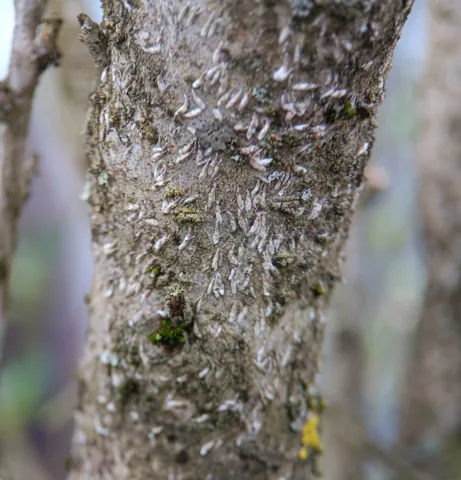 Japanese Maple Scale
Lopholeucaspis japonica
Japanese maple scale is an armored scale from Asia that settles on bark in crowds of tiny white covers and can cause leaf drop, branch dieback and even death of stressed trees.
 Redbay Ambrosia Beetle
Xyleborus glabratus
The redbay ambrosia beetle is a tiny invasive beetle from Asia that carries the fungus behind laurel wilt, a disease that kills redbay, sassafras and other trees in the laurel family. Forest Service researchers put the toll in the Southeast at hundreds of millions of trees.
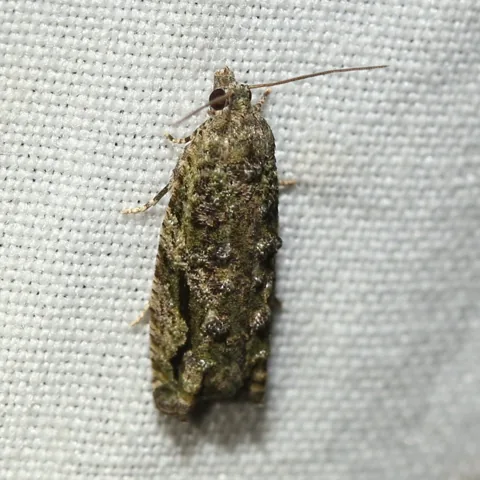 Maple Shoot Borer
Proteoteras aesculana
Maple shoot borer (also called maple tip moth, maple tip borer or maple twig borer) is a small moth whose larvae tunnel into young maple shoots in spring, killing the tip. When the central leader is hit the tree forks, which is why it matters most in nurseries growing young red maples.
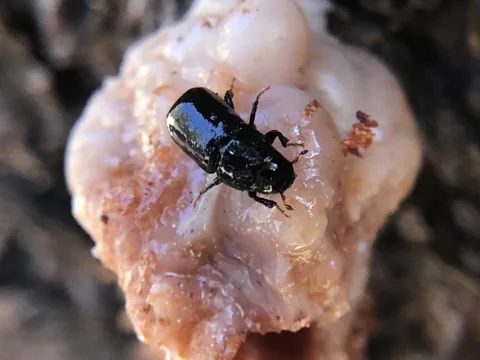 Mountain Pine Beetle
Dendroctonus ponderosae
Mountain pine beetle is a native bark beetle of western North America whose outbreaks can kill millions of pines; the Colorado State Forest Service notes it also plays a natural role by killing diseased and dying pines.
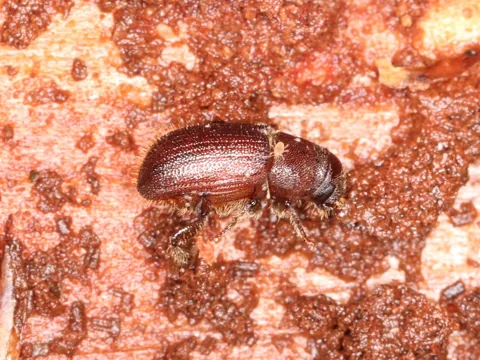 Red Turpentine Beetle
Dendroctonus valens
The red turpentine beetle is a native bark beetle that bores into the lower trunk, root collar and large roots of pines, leaving big pitch tubes. It rarely kills trees by itself, but its attacks often mark a stressed tree.
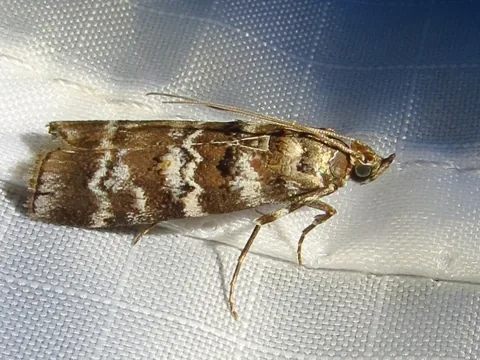 Zimmerman Pine Moth
Dioryctria zimmermani
Zimmerman pine moth caterpillars bore into pine trunks and branches, often where a branch meets the trunk. The wounds ooze pitch and weaken the wood until limbs die or snap, though trees are rarely killed.
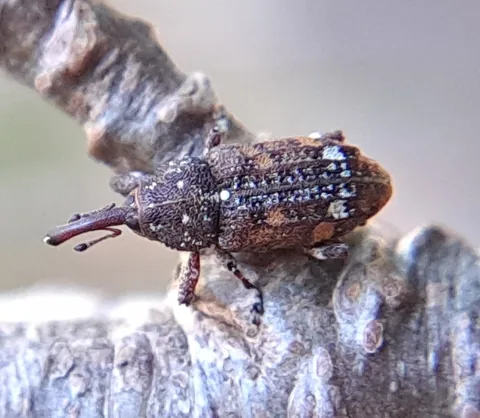 White Pine Weevil
Pissodes strobi
The white pine weevil is a native snout beetle whose grubs kill the leaders of young pines and spruces. The dead top wilts into a shepherd's crook, and side branches grow up to replace it, leaving crooked or multi-topped trees.
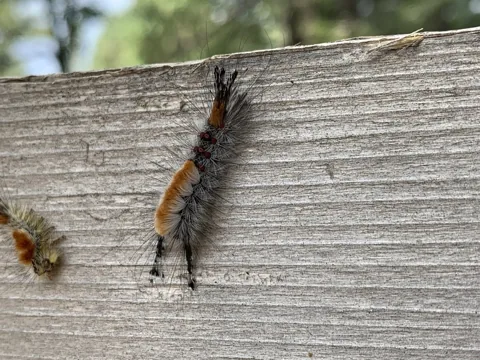 Douglas-fir Tussock Moth
Orgyia pseudotsugata
The Douglas-fir tussock moth is a native defoliator of Douglas-fir and true firs in western North America. In towns its hairy caterpillars often strip ornamental spruce and fir; along Colorado's Front Range, blue spruce suffers most. The hairs can cause itchy rashes and other reactions.
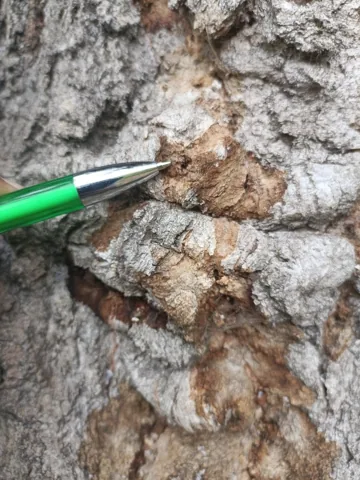 Invasive Shothole Borers
Euwallacea fornicatus and Euwallacea kuroshio
Invasive shothole borers are tiny ambrosia beetles that carry Fusarium dieback, a beetle-and-fungus disease that has killed tens of thousands of Southern California trees and is now turning up in Northern California.
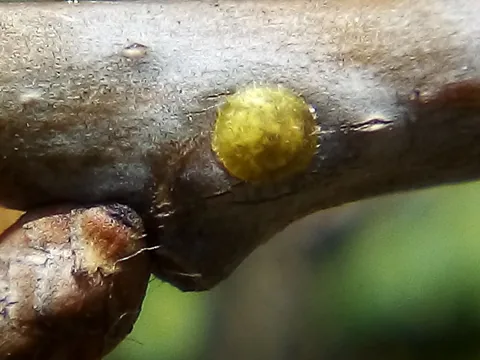 Oak Pit Scales
Asterodiaspis species
Oak pit scales are tiny, immobile scale insects that sit in pits on oak twigs and suck their juices, causing twig dieback that shows from mid- to late summer, especially on valley oak in California and Oregon white oak in Washington.
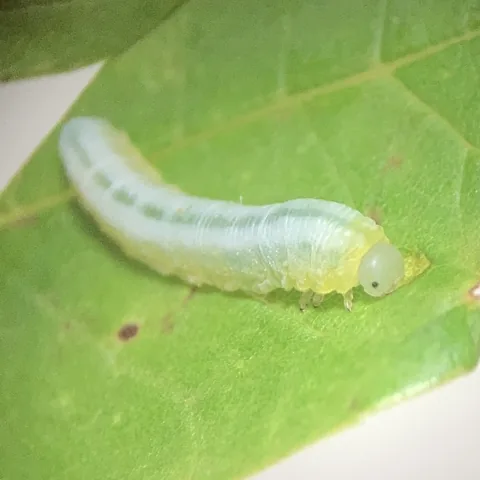 Brownheaded Ash Sawfly
Tomostethus multicinctus
Brownheaded ash sawfly larvae chew ash leaves in May and early June and can defoliate trees during outbreaks.
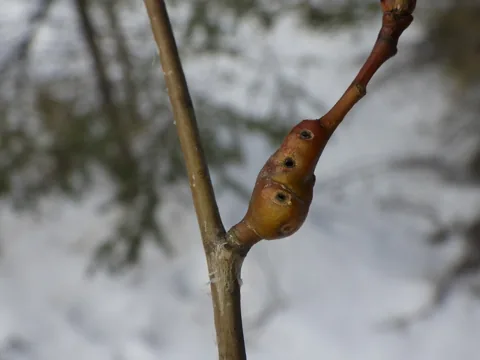 Poplar Twiggall Fly
Hexomyza schineri
Poplar twiggall fly larvae cause smooth, knot-like galls on aspen twigs that keep growing for years, but Colorado and Utah sources agree the galls don't threaten tree health.
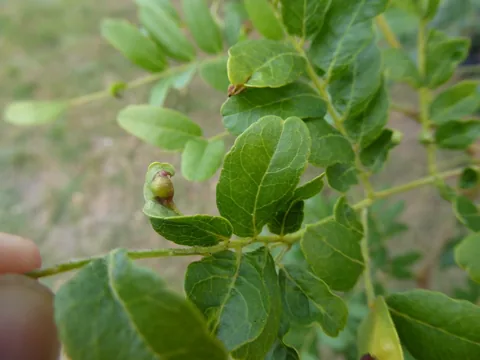 Honeylocust Podgall Midge
Dasineura gleditchiae
The honeylocust pod gall midge is a tiny fly whose larvae make new honeylocust leaflets curl and thicken into swollen, pod-like galls. Heavy infestations can wipe out a flush of new growth, but trees are seldom killed.
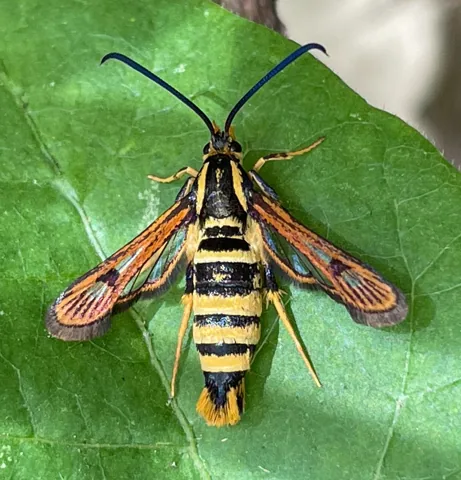 Sycamore Borer
Synanthedon resplendens
Sycamore borer is a clearwing moth common in sycamore in the southwestern US; sycamores tolerate extensive boring.
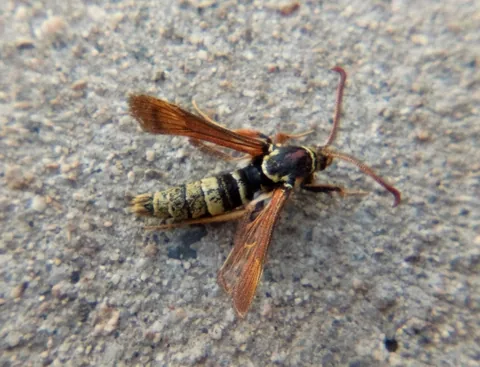 Western Poplar Clearwing
Paranthrene robiniae
The western poplar clearwing is a native, wasp-like moth whose larvae bore into poplar, willow, birch and aspen in the West. It's mostly a problem on stressed landscape and nursery trees, but it has also built up in commercial hybrid poplar plantings in the Pacific Northwest.
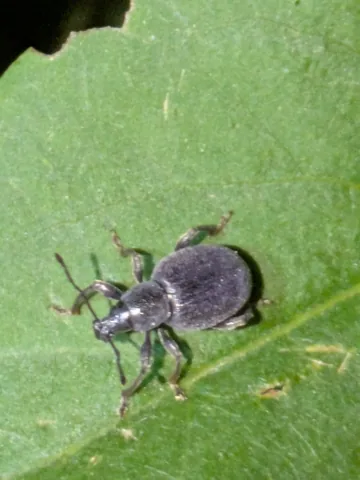 Lilac Root Weevil
Otiorhynchus meridionalis
Lilac root weevil adults chew notches in the leaf edges of lilac, privet, peony and euonymus at night, while their grubs feed on the roots.
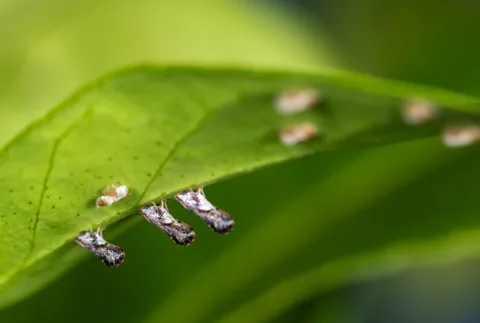 Asian Citrus Psyllid
Diaphorina citri
The Asian citrus psyllid is a tiny sap-feeding insect that spreads the bacterium behind huanglongbing (HLB), or citrus greening. UC IPM calls HLB the most serious threat to citrus trees worldwide, and USDA APHIS says there is no cure.
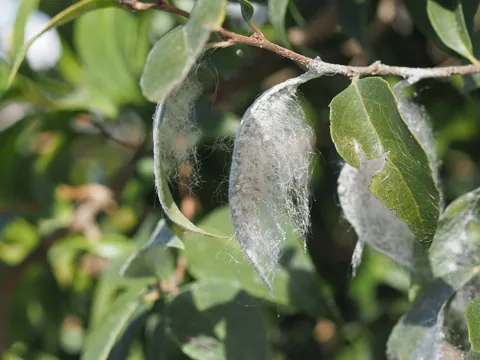 Giant Whitefly
Aleurodicus dugesii
Giant whitefly is a large whitefly from Mexico that leaves long, beard-like strands of wax under the leaves of hibiscus, bird of paradise and many other ornamentals.
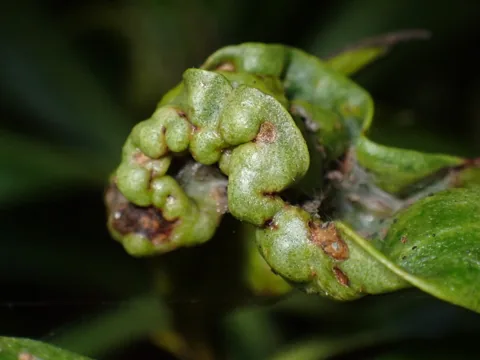 Myoporum Thrips
Klambothrips myopori
Myoporum thrips is an invasive thrips that distorts new growth of Myoporum and can kill well-established plants. UC IPM gives New Zealand as its home, while CDFA's 2022 rating proposal says it is native to Tasmania.
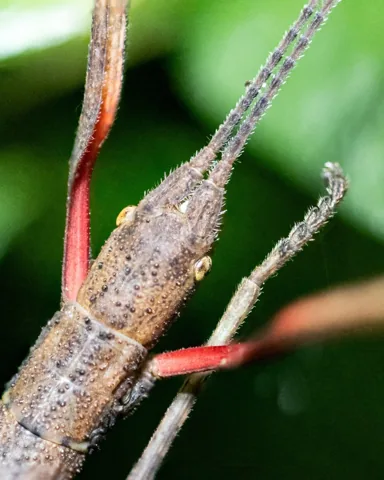 Indian Walking Stick
Carausius morosus
The Indian walking stick is a long, brownish, wingless insect that looks just like a twig. It escaped from captivity or was released as eggs, and it now lives wild along the California coast, eating leaves of ivy, privet, roses and many other garden plants. UC IPM calls it mostly a nuisance, though in some years and places it can seriously defoliate valued plants. UC IPM's suggested control is hand removal: pick them off, freeze them, then throw them away; it says pesticides generally are not recommended, since they might kill beneficial insects.
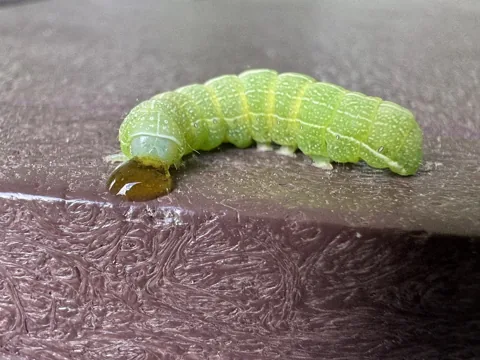 Green Fruitworms
Orthosia hibisci, Lithophane antennata, Lithophane unimoda
Green fruitworms are a group of native moth caterpillars that chew deep pits in young apples, pears, plums and peaches. They are sporadic, so outbreaks can skip many years.
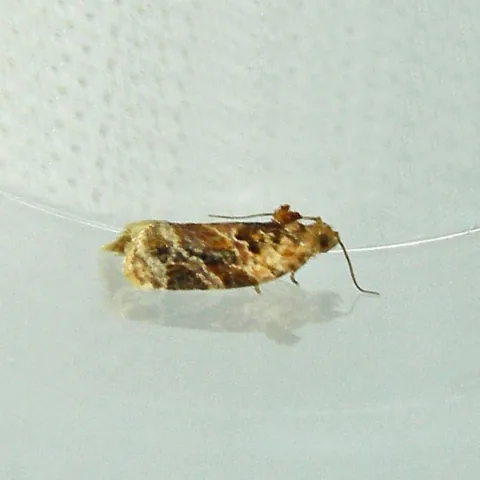 Redbanded Leafroller
Argyrotaenia velutinana
The redbanded leafroller is a small moth whose green caterpillars roll leaves with silk and scar apples. It strongly prefers apples, and the later generations of the season do the most fruit damage.
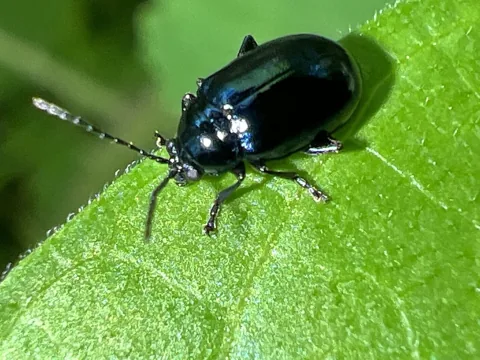 Grape Flea Beetle
Altica chalybea
Grape flea beetles are often the first insects to attack grapes in spring, hollowing out buds as they swell.
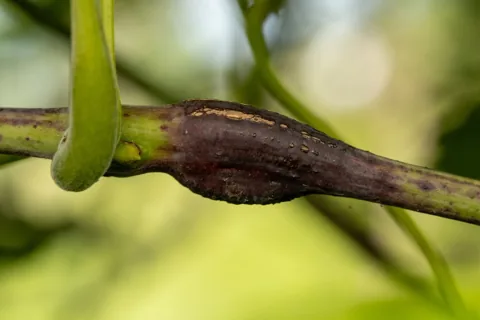 Grape Cane Gallmaker
Ampeloglypter sesostris
Grape cane gallmaker is a native weevil that lays eggs in new grape shoots, leaving red swellings just above the nodes. The galls look alarming but rarely reduce yield.
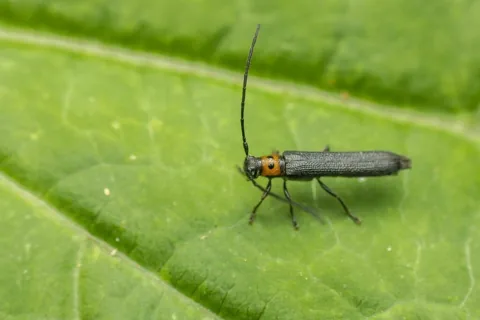 Raspberry Cane Borer
Oberea perspicillata
The raspberry cane borer is a slender long-horned beetle that girdles raspberry, blackberry and rose canes with two rings of punctures, so the tip wilts; its larva then tunnels down the cane over two years. Extension sources call it an occasional pest that pruning usually handles.
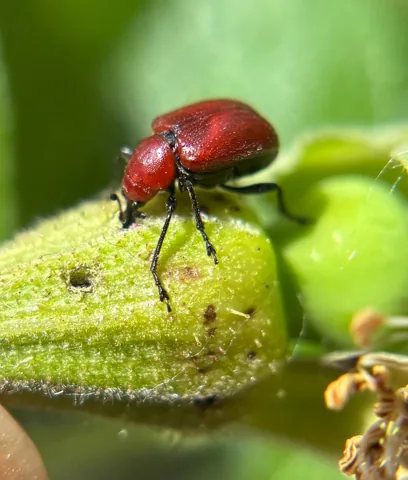 Rose Curculio
Merhynchites bicolor
The rose curculio is a small red-and-black snout weevil, about 1/4 inch long, that chews holes into rose buds. Damaged buds may drop or never open, and the ones that do open have holes in the petals. The PNW handbook says it does not usually threaten the overall health of the bush, and none of these sources reports any risk to people or pets. Hand-picking the weevils and clipping off damaged buds is usually enough.
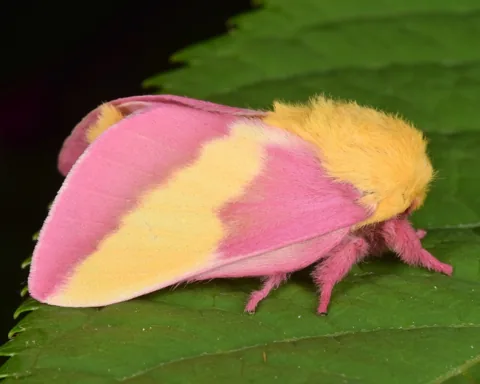 Rosy Maple Moth
Dryocampa rubicunda
The rosy maple moth (Dryocampa rubicunda) is a silk moth whose caterpillars, called greenstriped mapleworms, feed mainly on maples. Numbers are usually low enough to go unnoticed, but occasional outbreaks can strip a tree; healthy trees usually leaf out again.
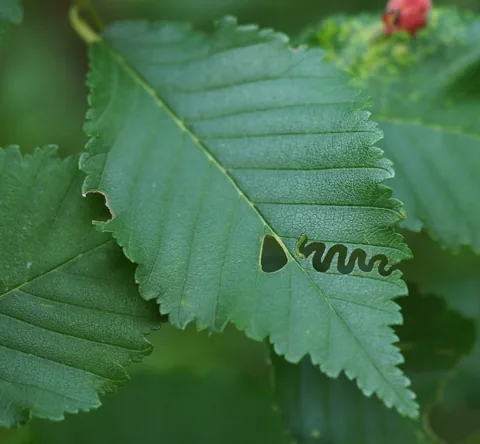 Elm Zigzag Sawfly
Aproceros leucopoda
Elm zigzag sawfly is an East Asian defoliator of elms that reached Québec in 2020 and Virginia in 2021. It has since turned up across the eastern and central U.S., as far west as Minnesota and Wisconsin.
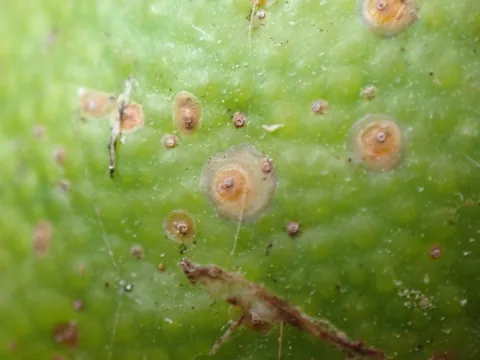 California Red Scale
Aonidiella aurantii
California red scale is an armored scale of citrus that is difficult to control with insecticides. It can infest every above-ground part of the tree, and in California it remains a key citrus pest.
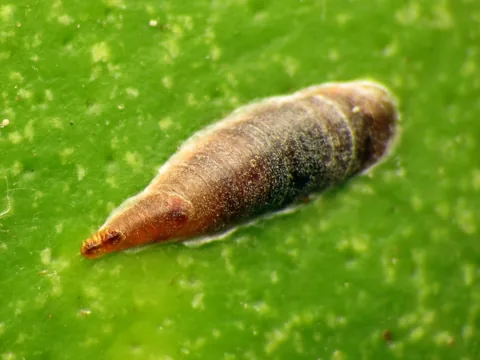 Purple Scale
Lepidosaphes beckii
Purple scale is an armored scale pest of citrus that infests leaves, fruit and stems. Clemson calls it a serious pest in South Carolina, while UC IPM rates it not damaging in California because a parasitic wasp keeps it under biological control.
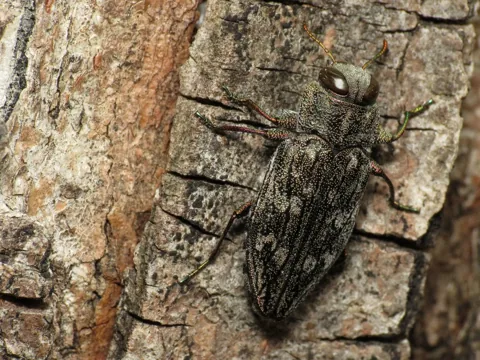 Flatheaded Appletree Borer
Chrysobothris femorata
The flatheaded appletree borer is a native metallic wood-boring beetle. Its larvae tunnel under the bark of the trunk and main branches of young, newly planted or stressed trees, apples and many shade trees alike, and can girdle and kill them.
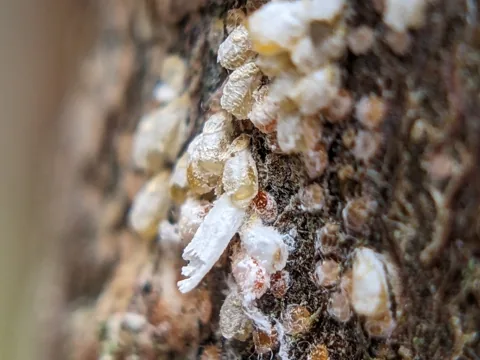 White Peach Scale
Pseudaulacaspis pentagona
White peach scale is an armored scale insect that crusts the bark of peach, cherry, mulberry and many other woody plants. Clemson calls it one of the most commonly seen scales on peaches, and heavy infestations can kill branches and whole trees.
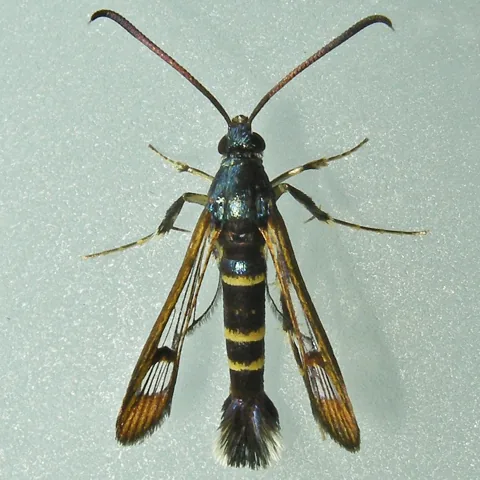 Rhododendron Borer
Synanthedon rhododendri
The rhododendron borer is a native clearwing moth whose larvae tunnel in rhododendron branches and stems, and sometimes in mountain laurel and deciduous azaleas growing next to infested rhododendrons.
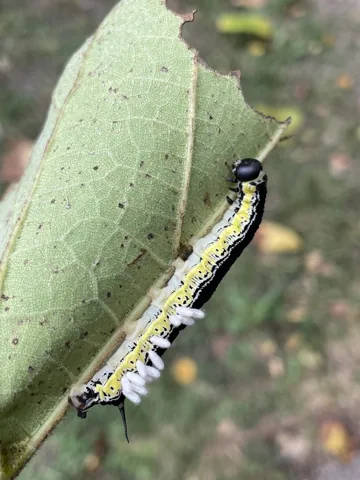 Catalpa Sphinx
Ceratomia catalpae
Catalpa worms are black-and-yellow, horned caterpillars of the catalpa sphinx moth that feed only on catalpa trees. Healthy trees survive complete defoliation and often grow new leaves, so control is often not needed; Penn State suggests picking off egg masses and young caterpillars, and spraying Bt only while the caterpillars are small.
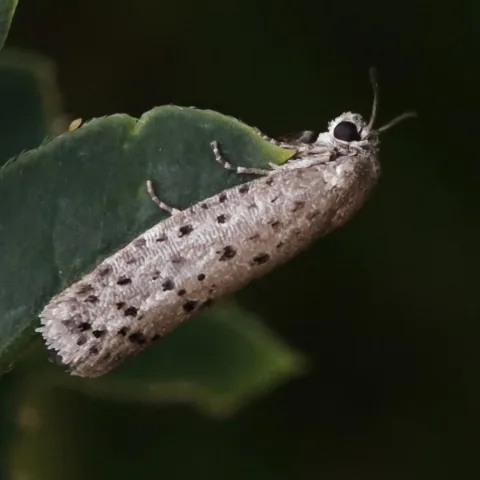 Mimosa Webworm
Homadaula anisocentra
Mimosa webworm caterpillars web together and skeletonize the leaves of honeylocust, especially thornless cultivars, and Persian silk tree (Albizia julibrissin). By late summer a badly infested tree can look completely brown.
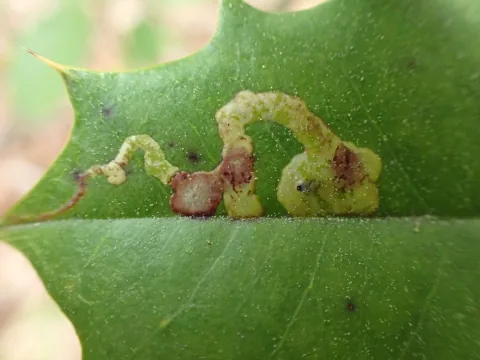 Native Holly Leafminer
Phytomyza ilicicola
The native holly leafminer is a tiny fly whose larvae mine American holly leaves, leaving yellow serpentine or blotch mines; it lays its eggs only in American holly.
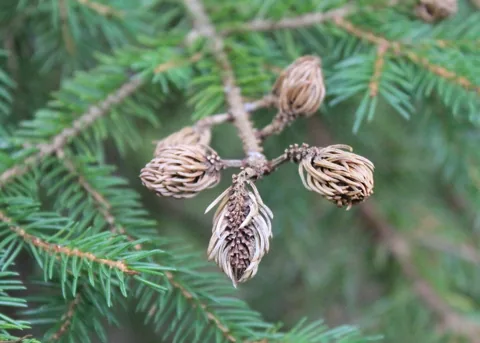 Eastern Spruce Gall Adelgid
Adelges abietis
The eastern spruce gall adelgid is a tiny insect from Europe that makes pineapple-shaped galls at the base of new spruce shoots. It is a key pest of Norway spruce in the Northeast.
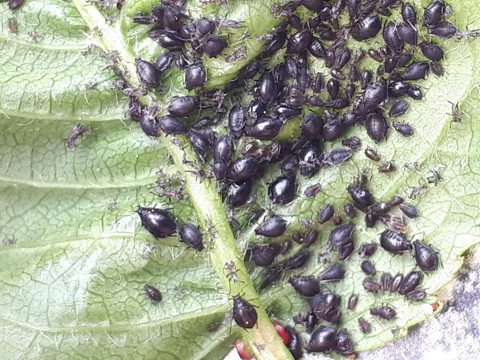 Black Cherry Aphid
Myzus cerasi
The black cherry aphid is a shiny black aphid that curls and stunts new cherry growth in spring; young trees can't tolerate even low numbers.
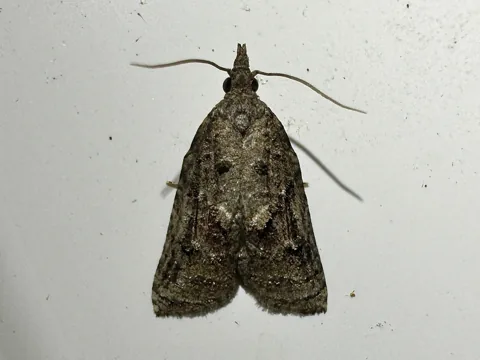 Tufted Apple Bud Moth
Platynota idaeusalis
The tufted apple bud moth is a leafroller whose larvae tie leaves to apples and feed on the fruit. Penn State says it has become a minor orchard pest, and NC State says significant damage is now uncommon in North Carolina.
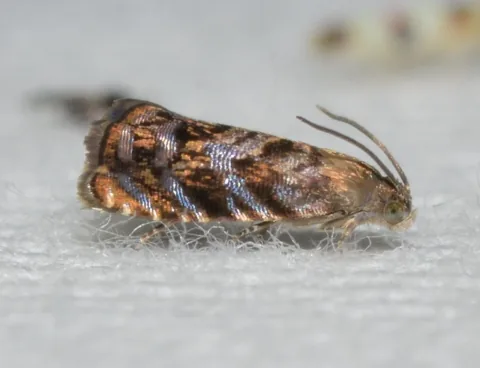 Lesser Appleworm
Grapholita prunivora
The lesser appleworm is a small native moth whose pinkish larvae mine just under the skin of apples, plums, cherries and other tree fruit. It is seldom a serious pest in managed orchards.
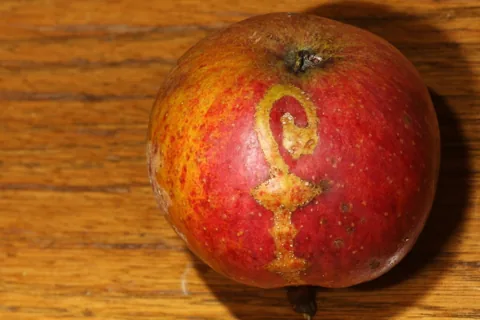 European Apple Sawfly
Hoplocampa testudinea
European apple sawfly larvae scar young apples with winding, ribbon-like trails, then bore into the seed cavity and make the fruit drop. It is an introduced pest that the University of Maine says was first detected in North America on Long Island in 1939 and on Vancouver Island in 1940.
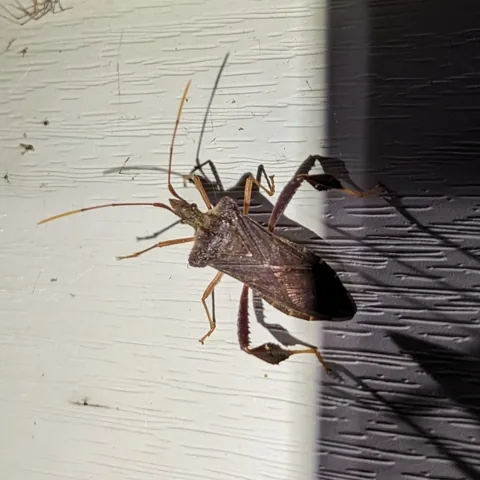 Magnolia Leaf-Footed Bug
Leptoglossus fulvicornis
Magnolia leaf-footed bugs feed only on magnolias, spotting the seeds without affecting tree health, so control is generally not needed.
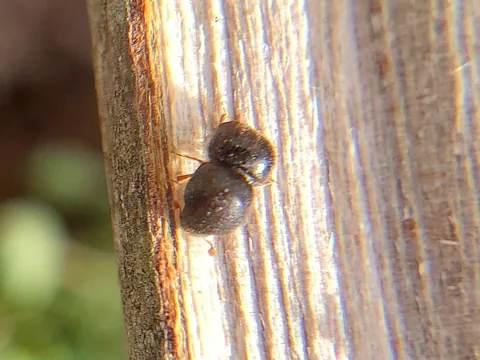 Camphor Shoot Borer
Cnestus mutilatus
The camphor shoot borer is an invasive ambrosia beetle from Asia that attacks stressed, weakened or dying trees and, drawn by ethanol, bores into plastic gas cans, hoses and tanks.
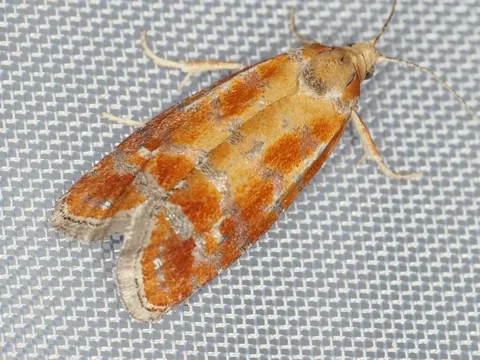 European Pine Shoot Moth
Rhyacionia buoliana
European pine shoot moth larvae bore into pine buds and new shoots, killing tips and leaving crooked trunks. Young plantation, nursery and Christmas trees take the worst of it, though trees rarely die.
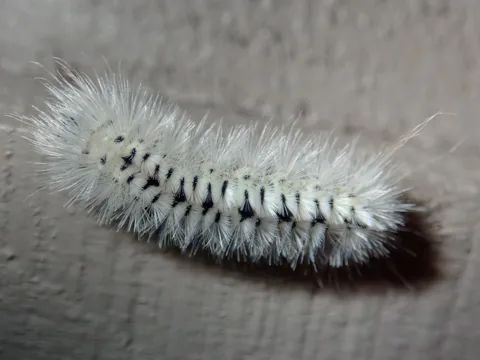 Hickory Tussock Moth
Lophocampa caryae
Hickory tussock moth caterpillars are fuzzy white and black caterpillars, often common in fall, whose loose, barbed hairs can lodge in skin and cause a local rash.
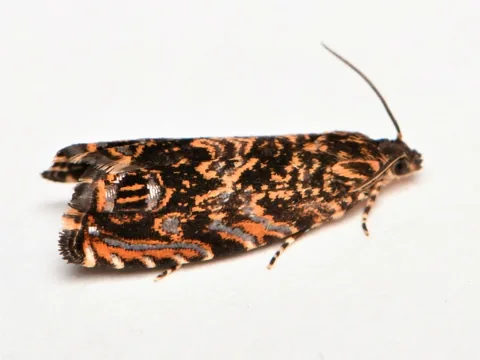 Cherry Bark Tortrix
Enarmonia formosana
The cherry bark tortrix is a moth from Eurasia whose larvae feed under the bark of cherries and other rose-family trees, especially at wounds, pruning cuts and graft unions. Infested trees ooze gum and show sawdust-like frass tubes, and heavy infestations can kill limbs or whole trees.
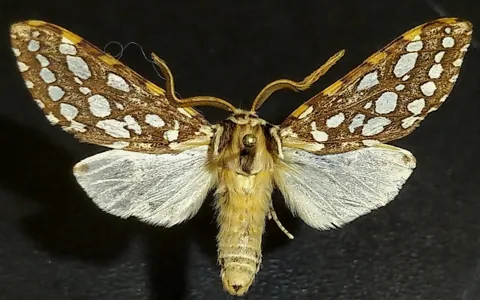 Silver-Spotted Tiger Moth
Lophocampa argentata
Silver-spotted tiger moth caterpillars feed in dirty-looking webbed tents on Douglas-fir and other conifers through fall and winter. The Oregon Department of Forestry says the damage is cosmetic, but the caterpillars' hairs can irritate skin.
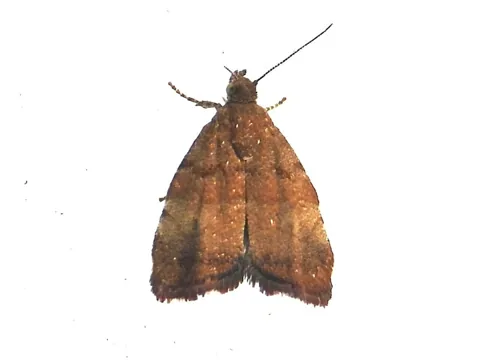 Apple-and-Thorn Skeletonizer
Choreutis pariana
Apple-and-thorn skeletonizer caterpillars skeletonize and roll the leaves of apple and related trees, turning them brown and papery; from a distance the leaf tips look burned.
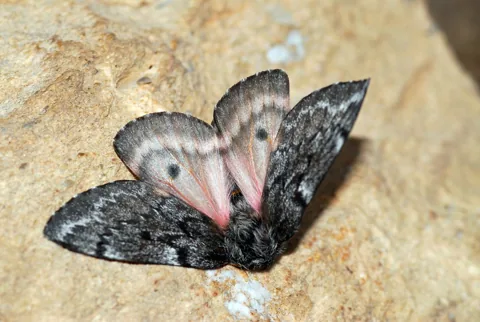 Pandora Moth
Coloradia pandora
Pandora moth is a native defoliator of western pine forests. Its caterpillars eat the needles of ponderosa, Jeffrey and lodgepole pines and can strip trees in sporadic outbreaks.
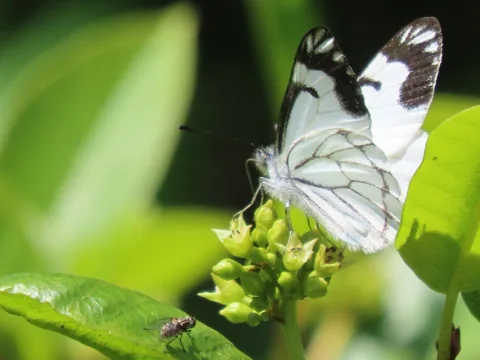 Pine White Butterfly
Neophasia menapia
The pine white (also called pine butterfly) is a native western butterfly whose green caterpillars eat pine needles high in the canopy. Numbers are usually low, but periodic outbreaks have stripped ponderosa pine over large areas of the Northwest.
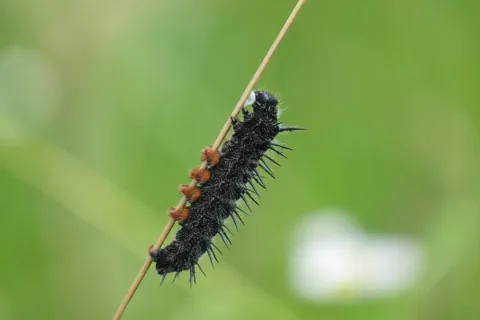 Spiny Elm Caterpillar (Mourning Cloak)
Nymphalis antiopa
The spiny elm caterpillar is the larva of the mourning cloak butterfly. Groups strip willow, elm and poplar branches, but they are usually not serious pests.
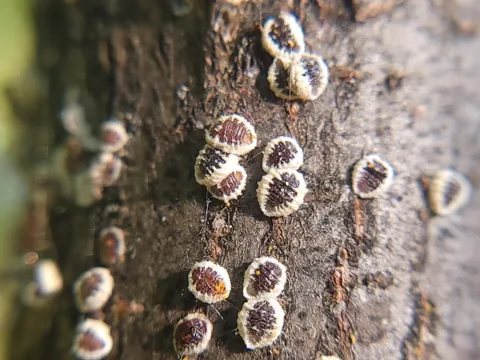 European Elm Scale
Gossyparia spuria
European elm scale is a European soft scale ringed with white wax. It sits in twig forks and bark cracks on elms, drips honeydew and, in heavy infestations, kills twigs.
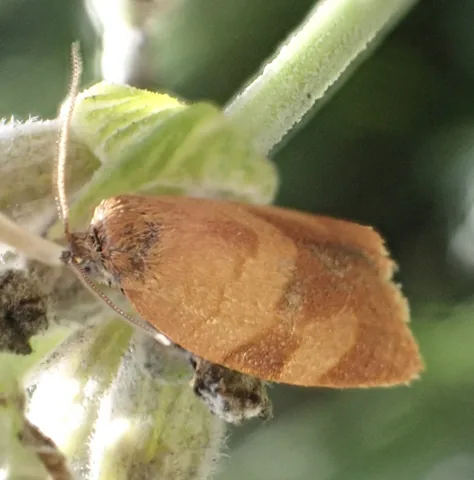 Carnation Tortrix
Cacoecimorpha pronubana
The carnation tortrix is a small imported leafroller moth. Its caterpillars roll and web the leaves of Portuguese laurel and a long list of other plants, though in Pacific Northwest landscapes it seldom does serious harm.
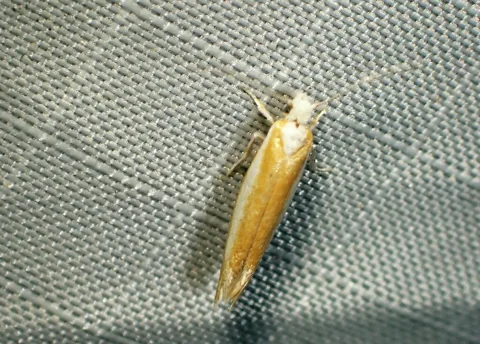 Pine Needle Sheathminer
Zelleria haimbachi
The pine needle sheathminer is a small native moth whose larvae mine pine needles and then feed inside the papery sheaths at their bases, so new needles fade, droop and drop. It's chiefly a pest of young pines, and the USDA Forest Service says severe outbreaks are uncommon.
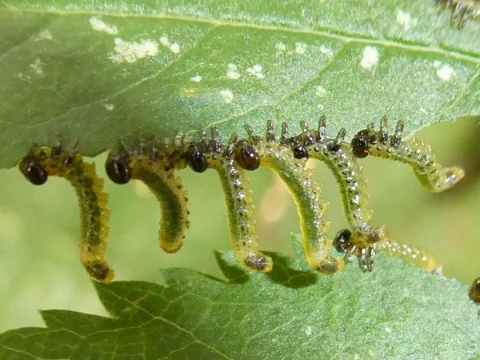 Mountain Ash Sawfly
Pristiphora geniculata
Mountain ash sawfly larvae feed in groups on mountain ash, eating leaflets down to the midveins. The damage can be fast and heavy, but UMass and the Canadian Forest Service say it rarely kills trees, and removing the leaves that young larvae are on usually limits the damage.
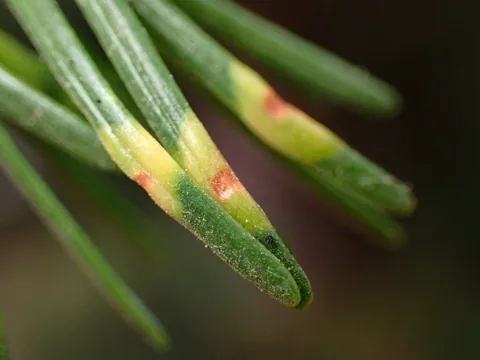 Douglas-Fir Needle Midges
Contarinia species (three midges on Douglas-fir; shown: C. pseudotsugae)
Douglas-fir needle midges are tiny flies whose white larvae mine new Douglas-fir needles, which yellow, bend and drop; they matter most in Christmas tree plantations.
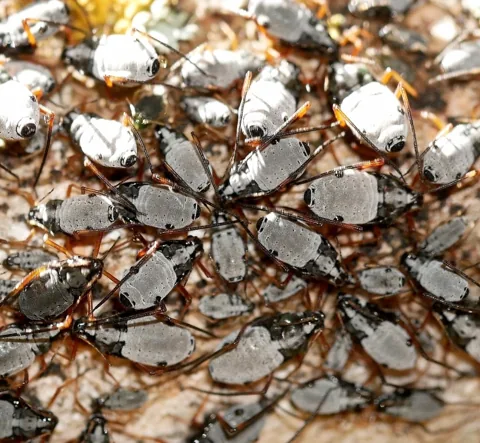 Giant Conifer Aphids
Cinara species
Giant conifer aphids (Cinara species) are large, dark aphids that cluster on the branches and trunks of conifers. Their copious honeydew attracts yellowjackets and grows black sooty mold, but trees usually tolerate them.
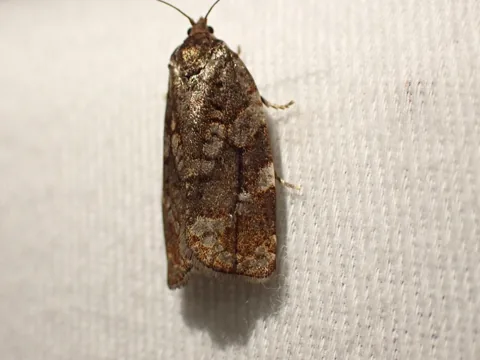 Western Spruce Budworm
Choristoneura occidentalis (also listed as C. freemani)
Western spruce budworm caterpillars feed on the buds and new needles of Douglas-fir, true firs and spruce, tying shoot tips together with webbing. The Forest Service calls it the most widely distributed and destructive defoliator of western conifer forests.
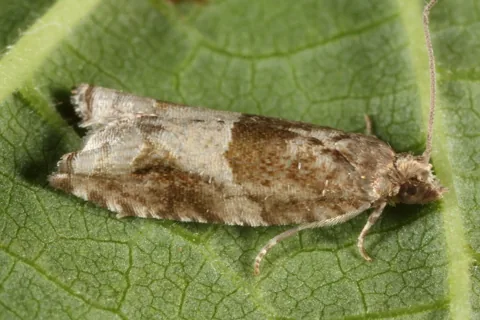 Holly Bud Moth
Rhopobota naevana
Holly bud moth larvae roll and web the new leaves of holly, distorting the growing tips. The same insect is called the blackheaded fireworm on cranberry, where UMass calls it a key pest throughout North American cranberry regions; it also feeds on blueberry, apple and cherry.
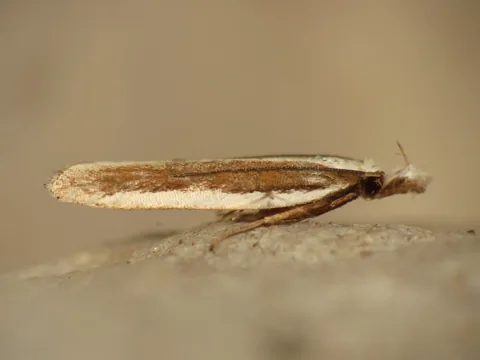 Juniper Webworm
Dichomeris marginella
Juniper webworm caterpillars feed deep inside junipers, webbing foliage into brown, dirty-looking nests that often go unnoticed until spring.
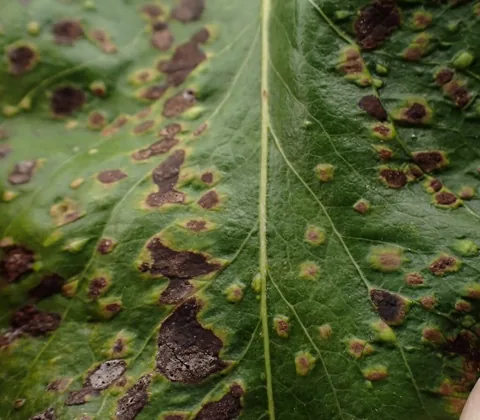 Pearleaf Blister Mite
Eriophyes pyri
Pearleaf blister mites are microscopic mites that feed inside pear leaves, raising pale green, pinkish or reddish blisters that turn brown or black as the tissue dies.
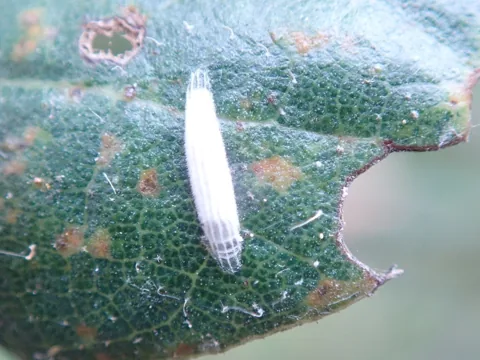 Oak Skeletonizer
Bucculatrix albertiella
The oak ribbed casemaker, also called the oak skeletonizer or oak-ribbed skeletonizer, is a tiny moth whose larvae mine and skeletonize oak leaves until they look brown and see-through.
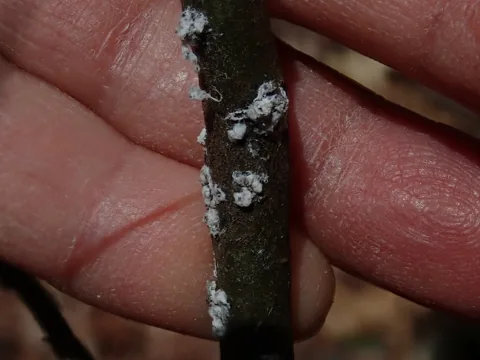 Pine Bark Adelgid
Pineus strobi
Pine bark adelgids are tiny sap-feeding insects that hide under white, cottony wax on pine bark; on a heavily infested trunk it looks like snow or white paint. Eastern white pine is the usual host. Healthy, established trees seldom need treatment, but young or stressed trees can be stunted.
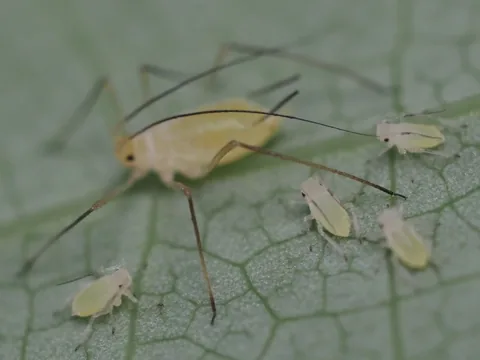 Tuliptree Aphid
Illinoia liriodendri
Tuliptree aphids cluster under tulip tree leaves at the branch tips and drop copious honeydew on whatever sits below; tulip tree is the only host they're known to use.
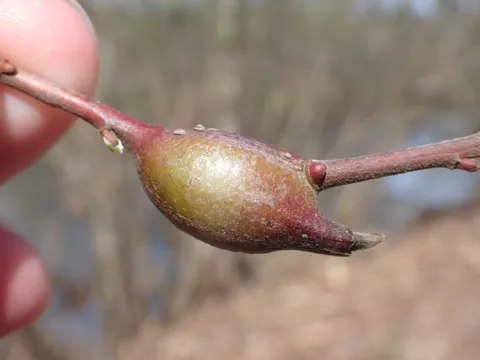 Willow Beaked-Gall Midge
Rabdophaga rigidae
The willow beaked-gall midge is a tiny black fly whose larvae turn willow buds into hard, red galls shaped like a beak. The galls look odd, but they rarely do a tree serious harm.
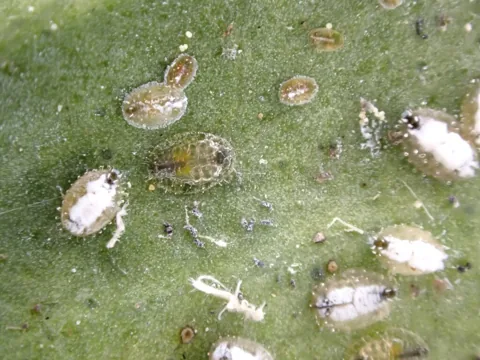 Ash Whitefly
Siphoninus phillyreae
The ash whitefly is an invasive whitefly first found in California in 1988 and in Oregon by 2014. Clouds of it appear in late summer and fall on ash, pear, hawthorn, pomegranate and many other trees, though a parasitic wasp now keeps it scarce in California.
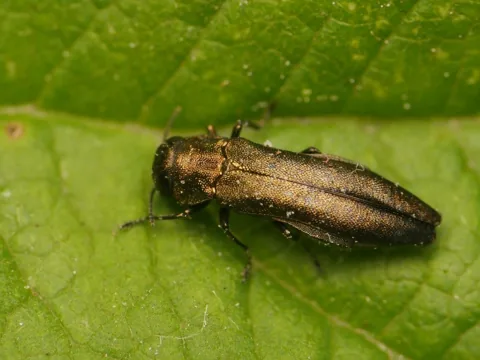 Rose Stem Girdler
Agrilus cuprescens
The rose stem girdler is a small metallic beetle, copper or copper-green, whose larvae tunnel inside raspberry, blackberry and rose canes, girdling them and cutting berry yields. The main tools are pruning out damaged canes and, where needed, spraying the adult beetles while they are active, before they lay eggs.
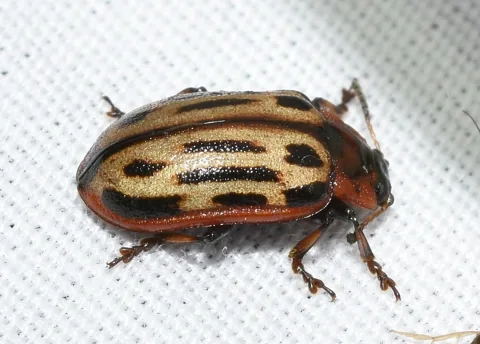 Cottonwood Leaf Beetle
Chrysomela scripta
The cottonwood leaf beetle (Chrysomela scripta) is a leaf beetle whose adults and larvae eat the leaves of cottonwood, aspen, other poplars and willows. Young larvae skeletonize the leaves, and a USDA Forest Service report calls it one of the most serious pests of young cottonwoods in nurseries and plantations.
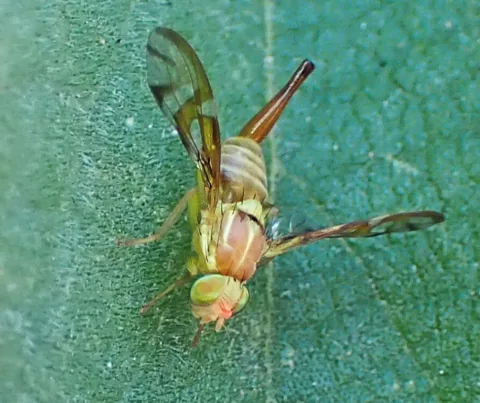 Mexican Fruit Fly
Anastrepha ludens
The Mexican fruit fly, or Mexfly, is a serious fruit pest whose maggots feed inside citrus, mango and many other fruits, making them inedible and unmarketable. Repeated finds in Texas and California bring quarantines and eradication programs.
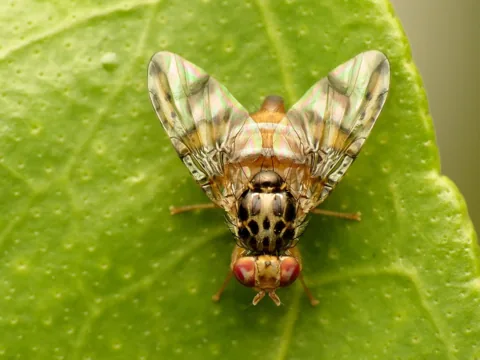 Mediterranean Fruit Fly (Medfly)
Ceratitis capitata
The Mediterranean fruit fly, or medfly, is a small fly whose maggots feed inside more than 250 kinds of fruits and vegetables. In the United States, USDA lists it as currently found in Hawaii, and when it turns up on the mainland, state and federal agriculture officials take over with quarantines and eradication.
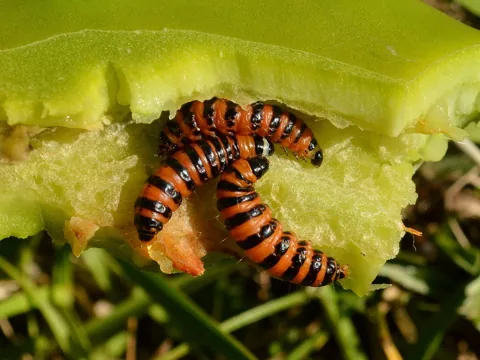 Cactus Moth
Cactoblastis cactorum
The cactus moth is a South American moth whose caterpillars feed inside the pads of prickly pear cactus. First detected in the Florida Keys in 1989, it has spread through coastal areas of the Southeast, and state agriculture agencies treat it as a serious threat to native prickly pears.
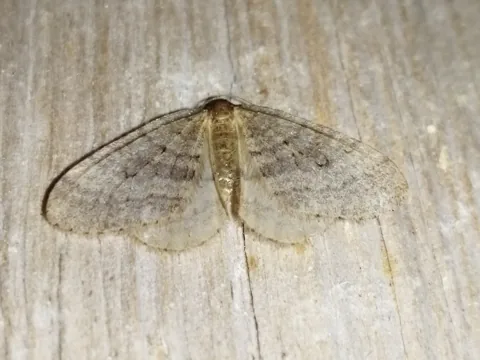 Winter Moth
Operophtera brumata
The winter moth is an invasive European moth whose pale green inchworms feed on buds, blooms, leaves and fruit in spring. It's a pest of blueberries in the Pacific Northwest and of oaks, maples, apples and many other trees and shrubs in Massachusetts.
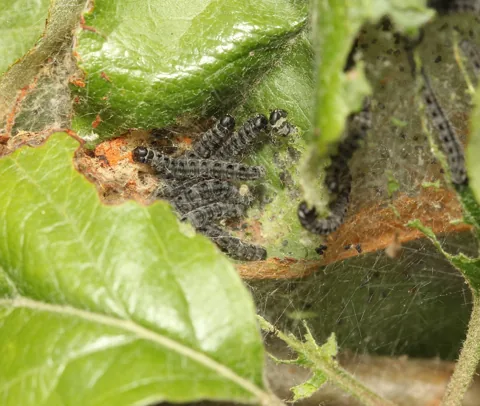 Apple Ermine Moth
Yponomeuta malinellus
The apple ermine moth is an invasive Eurasian moth whose caterpillars feed in small communal webs on apple trees, mostly unmanaged ones. It has been in Washington, Oregon and British Columbia since the 1980s, at low numbers.
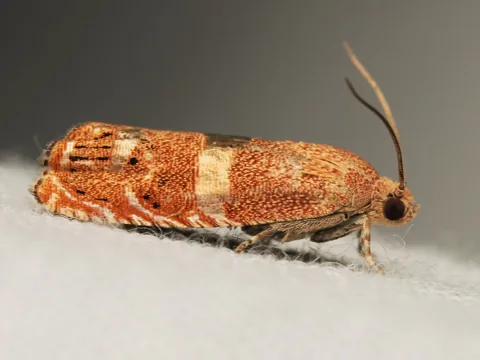 Filbertworm
Cydia latiferreana
The filbertworm is a moth whose larvae bore into hazelnuts and destroy the kernel; it's the key hazelnut pest in the Pacific Northwest and is also common in acorns and chinkapin there.
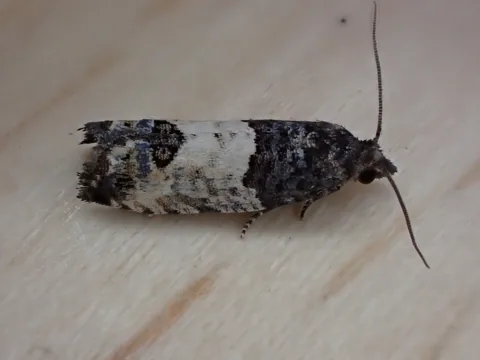 Eyespotted Bud Moth
Spilonota ocellana
The eyespotted bud moth is a small tortricid moth whose larvae feed on the buds, leaves and blossoms of apple and cherry in spring, webbing them together. On home apple trees it usually doesn't need control, but UC IPM says it has become a pest in some organic apple orchards in coastal California.
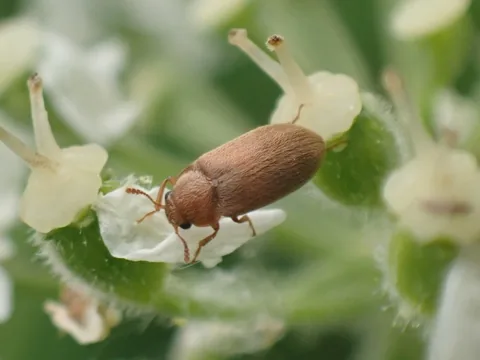 Western Raspberry Fruitworm
Byturus unicolor
The western raspberry fruitworm, or raspberry beetle, is a small beetle that feeds on raspberry buds and blossoms; its larvae feed inside the fruit and often remain in it at harvest.
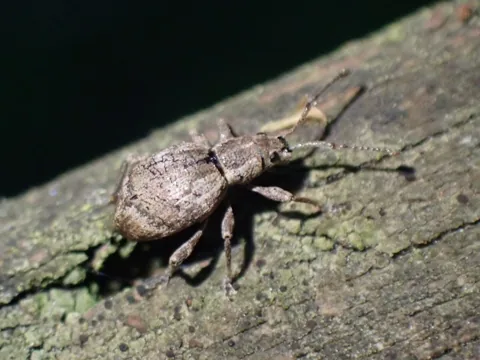 Obscure Root Weevil
Sciopithes obscurus
The obscure root weevil is a small, flightless, gray to brown weevil that notches leaves at night; its larvae feed on the roots of blueberries, rhododendrons, azaleas and many other plants in the Pacific Northwest.
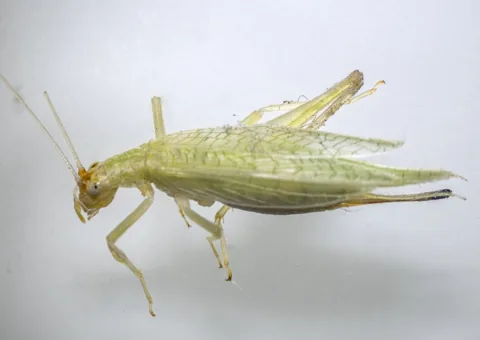 Snowy Tree Cricket
Oecanthus fultoni
The snowy tree cricket is a slender, pale green cricket best known for its steady, musical chirp. Females push their eggs into canes and twigs, but it is a minor pest, and Michigan State says tree crickets are generally considered beneficial because they eat aphids and scale.
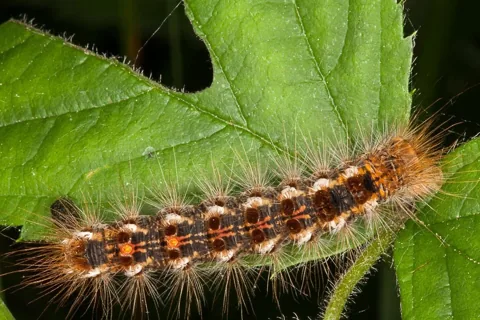 Browntail Moth
Euproctis chrysorrhoea
The browntail moth is an invasive moth whose caterpillars and cocoons carry toxic hairs that cause skin rashes and, if breathed in, breathing problems. The National Park Service calls it a pest of both human and forest health; Maine has had outbreaks for about a decade.
No photo yet
Walnut Scale
Diaspidiotus juglansregiae
Walnut scale is a gray armored scale that feeds on walnut, red maple, boxwood, holly and many other trees and shrubs. Heavy infestations cause twig and branch dieback, though on landscape plants natural enemies usually keep it in check.
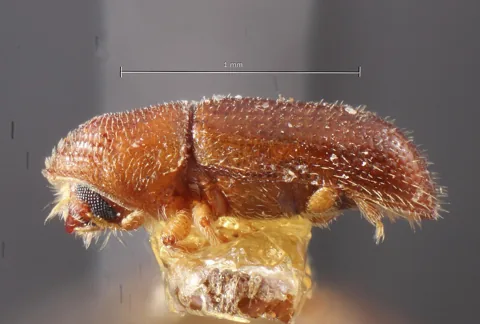 Walnut Twig Beetle
Pityophthorus juglandis
The walnut twig beetle is a tiny bark beetle that carries Geosmithia morbida, the fungus behind thousand cankers disease. The disease has killed many black walnuts in the West, but in the East it has done less harm than feared, and most states have dropped their quarantines.
No photo yet
Raspberry Horntail
Hartigia cressoni (iNaturalist genus: Phylloecus)
The raspberry horntail is a narrow black wood wasp whose white larvae tunnel inside the canes of raspberries, blackberries and roses. The tunneling makes cane tips soften, wilt and die back, which cuts raspberry yields and reduces the second cycle of rose blooms. It feeds only on plants, and neither UC IPM nor Utah State lists any risk to people. The best control is cutting off wilted tips well below the larva, about 6 inches down, as soon as you see them; sprays only help if timed for the adults in early spring.
No photo yet
Honeylocust Spider Mite
Platytetranychus multidigituli
Honeylocust spider mites build up in midsummer on honeylocust, bronzing the foliage and causing early leaf drop.
No photo yet
Striped Pine Scale
Toumeyella pini
Striped pine scale is a soft scale (family Coccidae) that has greatly increased along Colorado's Front Range. It mainly damages Scotch pine, coating twigs and needles with sticky honeydew and sooty mold.
No photo yet
Cranberry Rootworm Beetle
Rhabdopterus picipes
The cranberry rootworm beetle is a small leaf beetle that feeds at night on azalea, camellia, holly and other shrubs, chewing curved or straight narrow holes in new leaves; its grubs feed on roots.
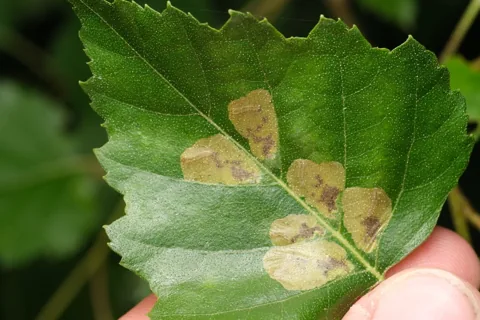 Birch Leafminer
Fenusa pumila
Birch leafminer is a key pest of gray and paper birch, mining the leaves and browning the crown.
No photo yet
Eugenia Psyllid
Trioza eugeniae
Eugenia psyllid feeds only on eugenia (Syzygium paniculatum), a common hedge plant in California. Its nymphs leave a pit in the leaf wherever they settle, and new shoots turn red and distorted.
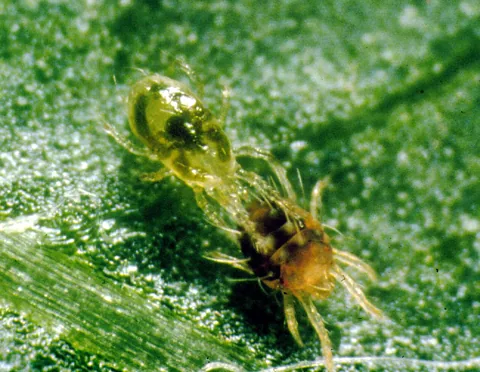 European Red Mite
Panonychus ulmi
The European red mite is a tiny red spider mite that feeds on fruit tree leaves. Heavy feeding bronzes the foliage and weakens next year's fruit buds, though it is mostly a problem where sprays have killed its predators.
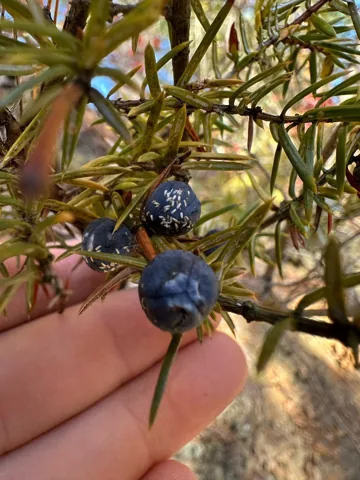 Juniper Scale
Carulaspis juniperi and C. minima
Juniper and minute cypress scales are armored scales of junipers, cypresses, arborvitae and related plants. Penn State says infestations are generally light and don't affect healthy plants, but heavy ones can cause needle drop and branch dieback or kill whole plants.
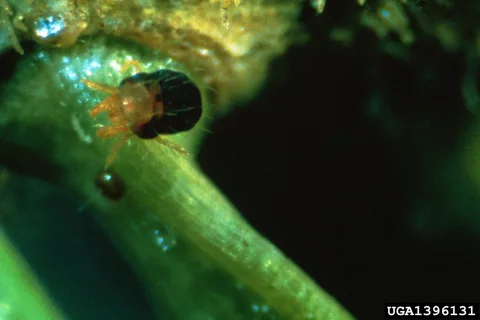 Spruce Spider Mite
Oligonychus ununguis
The spruce spider mite is one of the most destructive spider mites in the US, speckling and browning the needles of spruce, arborvitae, juniper, hemlock and other conifers.
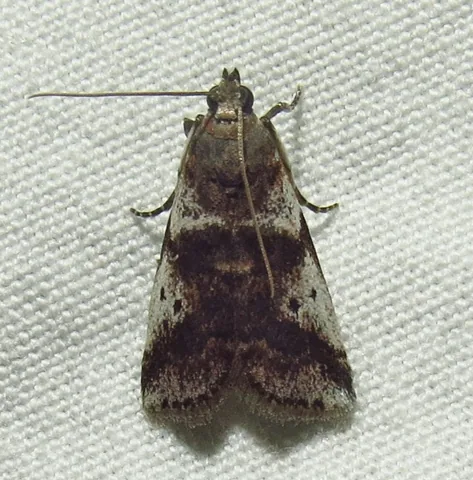 Cranberry Fruitworm
Acrobasis vaccinii
The cranberry fruitworm is a small brown moth whose larvae bore into young blueberries and cranberries. Each larva webs several berries together and feeds inside them, up to five or six berries in all.
No photo yet
Peach Bark Beetle
Phloeotribus liminaris
The peach bark beetle is a tiny bark beetle that attacks black cherry, peach and plum trees, which respond by oozing heavy gum and can be left with gum spots that lower the value of the wood.
No photo yet
Rose Midge
Dasineura rhodophaga (iNaturalist genus: Dasineura)
The rose midge is a tiny fly whose maggots feed inside new rose buds and shoot tips, deforming and killing them; the damaged tissue turns brown, then black, and some shoots never form flowers. It does not harm people. Trim and destroy damaged buds every few days; NC State and Colorado State add that a soil-active insecticide such as imidacloprid can help in badly infested gardens.
No photo yet
Rhododendron Whitefly
Massilieurodes chittendeni (syn. Dialeurodes chittendeni)
The rhododendron whitefly is a small whitefly that mottles and curls the young leaves of rhododendrons. The PNW Insect Management Handbook calls it mainly an aesthetic pest, though heavy infestations can damage susceptible plants; UMass Extension says it can be a significant pest of rhododendron in the US.
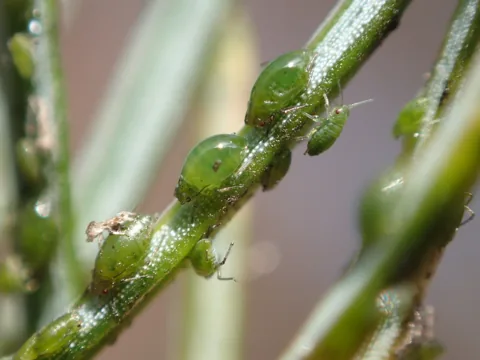 Spruce Aphid
Elatobium abietinum
The spruce aphid, or green spruce aphid, is a small green aphid that feeds on older spruce needles in fall, winter and early spring, yellowing and dropping them so trees end up bare inside with green tips.
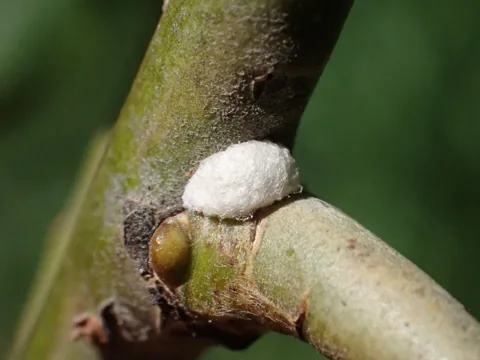 Azalea Bark Scale
Acanthococcus azaleae (formerly Eriococcus azaleae)
Azalea bark scale is a soft scale insect whose females form white, felt-like egg sacs on the twigs of azaleas, rhododendrons, Pieris and other shrubs, often in branch forks.
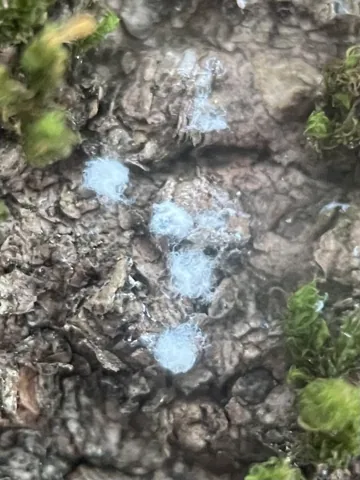 Balsam Woolly Adelgid
Adelges piceae
The balsam woolly adelgid is a tiny insect from Europe that feeds under the bark of true firs. Infested trees swell at nodes and branch tips, thin out and can die within a few years.
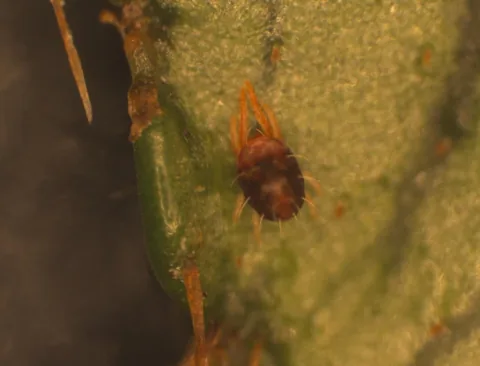 Southern Red Mite
Oligonychus ilicis
The southern red mite is a cool-season spider mite of broadleaf evergreens such as azalea, camellia, holly and rhododendron. It sucks fluid from leaf cells, leaving leaves stippled, dull and grayish.
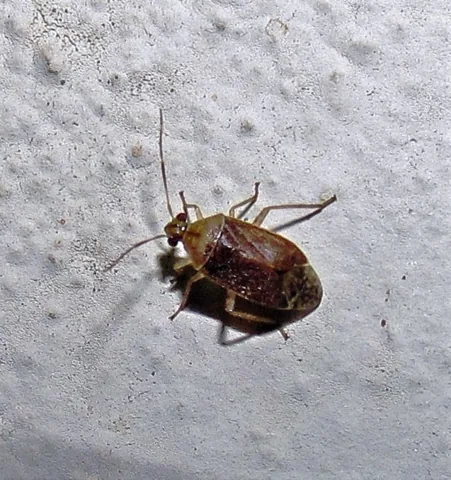 Ash Plant Bug
Tropidosteptes amoenus (shown: a Tropidosteptes species)
Ash plant bugs speckle and blotch ash leaves in spring and summer. On healthy trees the damage is cosmetic.
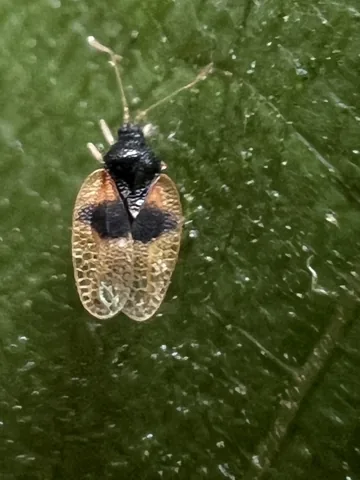 Avocado Lace Bug
Pseudacysta perseae
Avocado lace bugs feed in groups under avocado leaves. Low numbers are harmless, but heavy feeding browns and drops leaves, which can sunburn fruit and hurt later yields. Since reaching Hawaii it has become a pest across the islands.
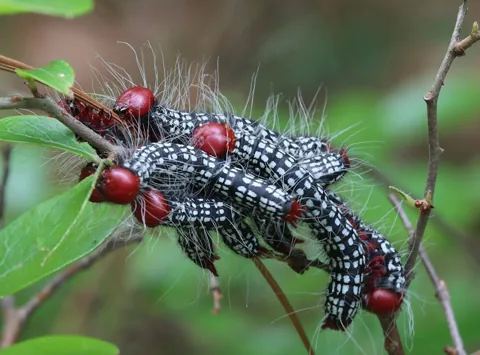 Azalea Caterpillar
Datana major
Azalea caterpillars feed in groups and can strip whole sections of an azalea in late summer, with most damage in August and September. Disturbed caterpillars raise their heads and tails. UF/IFAS says that in Florida it is found on azaleas from July through October and often strips much of a plant before anyone notices.
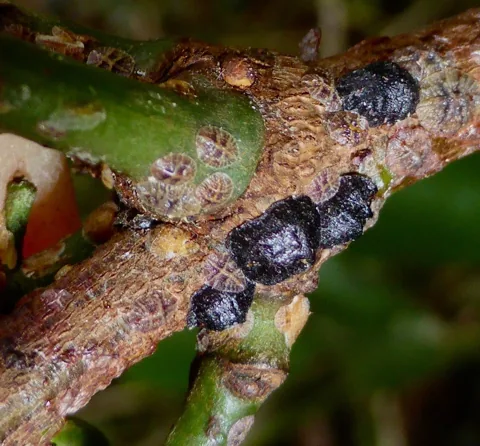 Black Scale
Saissetia oleae
Black scale is a dark soft scale whose honeydew blackens olive, citrus and many shrubs with sooty mold; UC IPM ranks it among California's more damaging soft scales.
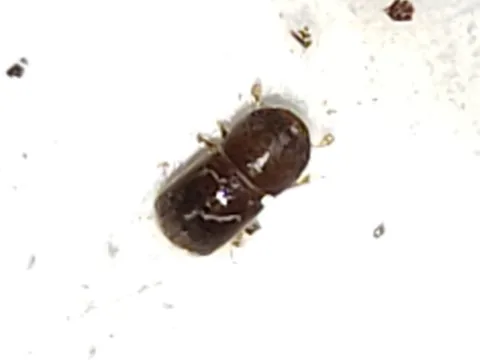 Black Twig Borer
Xylosandrus compactus
The black twig borer is a shiny black ambrosia beetle about 1/16 inch long that bores into small twigs and branches of more than 200 kinds of plants. Unlike most ambrosia beetles, it attacks healthy as well as stressed plants.
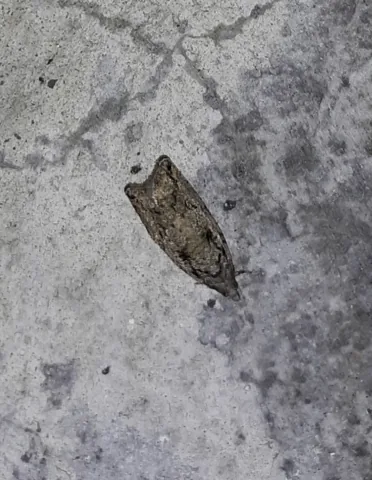 Boxelder Twig Borer
Proteoteras willingana
Boxelder twig borer caterpillars destroy buds and new shoots of boxelder and red maple, so trees grow bushy and lose their shape. Agriculture and Agri-Food Canada says it isn't likely to kill a tree.
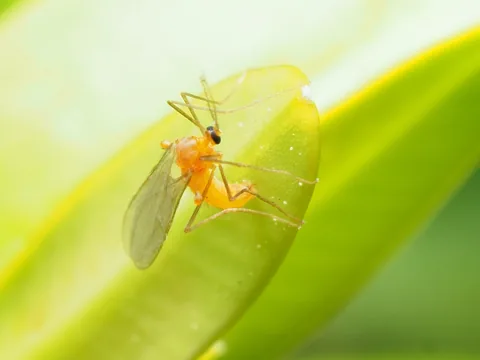 Boxwood Leafminer
Monarthropalpus flavus
Swarms of tiny orange gnatlike flies around boxwoods in spring, and puffy, blistered, yellowing leaves later, point to the boxwood leafminer, the most serious insect pest of boxwood.
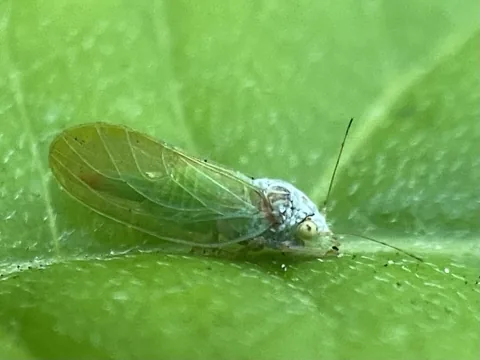 Boxwood psyllid
Psylla buxi
Boxwood psyllids are tiny sap-feeding insects whose nymphs cup and curl new boxwood leaves in spring. The damage is mostly cosmetic, and plants tend to outgrow it by midsummer.
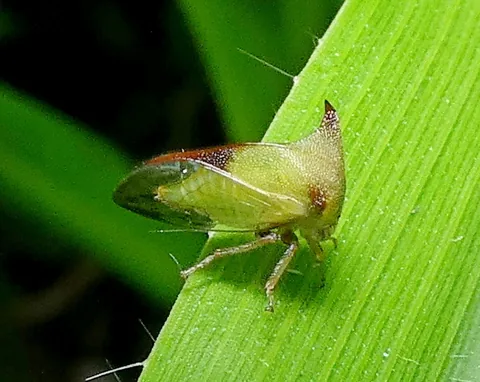 Buffalo Treehopper
Stictocephala bisonia
Buffalo treehoppers are small, green, triangular sap feeders. Their feeding rarely matters, but the slits females cut to lay eggs can scar and stunt young twigs, and young fruit trees take the worst of it.
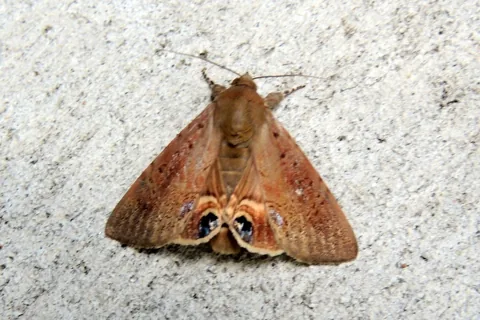 Cabbage Palm Caterpillar
Litoprosopus futilis
Cabbage palm caterpillars hide deep in the developing flower spikes of cabbage palms and saw palmettos, sometimes destroying every bud. They are not known to bite or sting, but grown caterpillars wander in search of a place to spin a cocoon and may shred fabrics or chew drywall indoors. Pruning out infested stalks is the first fix; sprays are timed for the next spring, before the buds open.
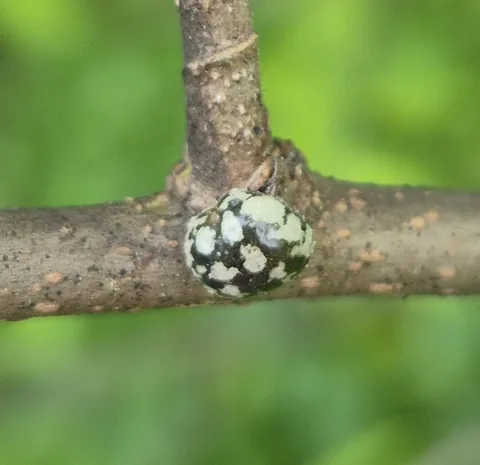 Calico Scale
Eulecanium cerasorum
Calico scale's most obvious sign is heavy, sticky honeydew and black sooty mold on trees and anything beneath them.
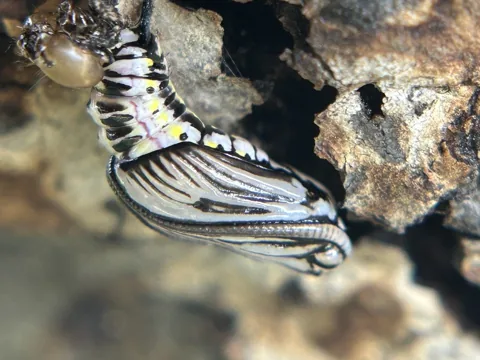 California Oakworm
Phryganidia californica
The California oakworm is the most important oak-feeding caterpillar along the California coast, but healthy oaks tolerate even heavy defoliation.
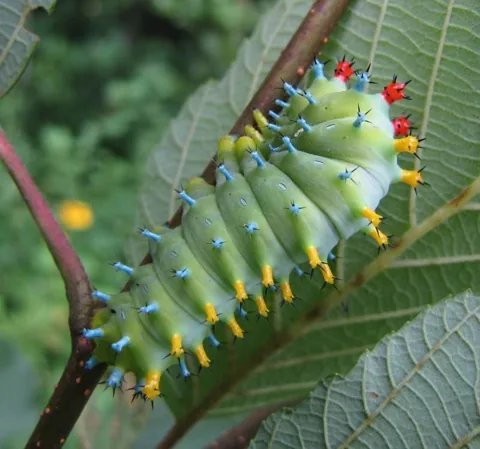 Cecropia Moth
Hyalophora cecropia
The cecropia moth is the largest moth native to North America. Its big green caterpillars feed on maples, cherries, birches and many other trees but are rarely abundant enough to cause noticeable damage, so control usually isn't needed.
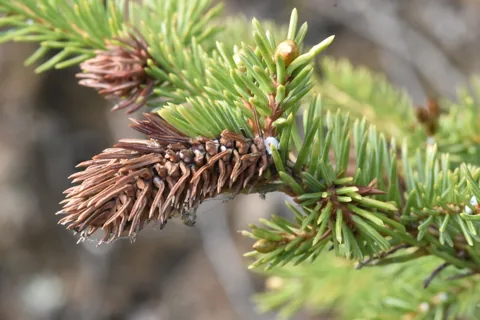 Cooley Spruce Gall Adelgid
Adelges cooleyi
Pineapple- or cone-shaped galls on spruce shoot tips are made by the Cooley spruce gall adelgid, which alternates between spruce and Douglas-fir.
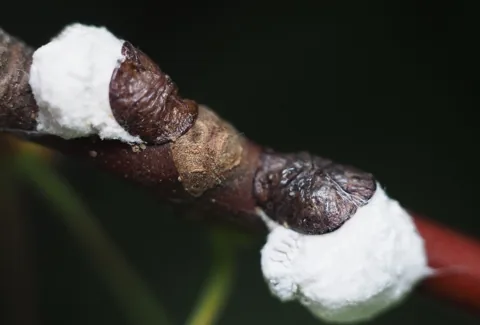 Cottony Maple Scale
Neopulvinaria innumerabilis (long known as Pulvinaria innumerabilis)
Cottony maple scale is one of the largest soft scales, and its females push out white, cottony egg sacs on twigs in early summer, most often on silver maple. Minnesota Extension says natural enemies usually keep it in check, while Penn State warns heavy infestations can cause twig and branch dieback.
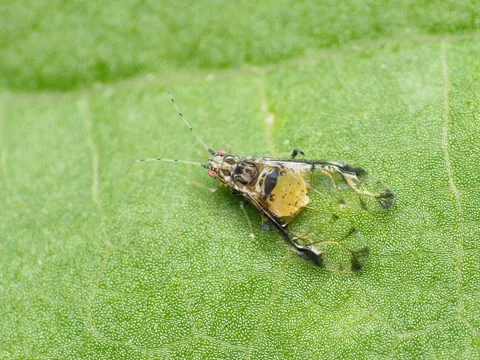 Crapemyrtle Aphid
Tinocallis kahawaluokalani (iNaturalist: Sarucallis kahawaluokalani)
The crapemyrtle aphid lives only on crape myrtle and is the most common insect pest of that tree in South Carolina; heavy populations cover the leaves with sticky honeydew and black sooty mold. UF/IFAS calls it the most important insect pest of crapemyrtle in the United States, though its feeding hasn't been shown to have long-term effects on plant health.
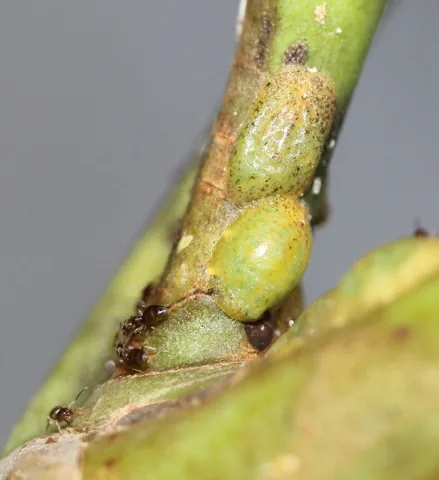 Croton Scale
Phalacrococcus howertoni
Croton scale (Phalacrococcus howertoni), first found in Florida in 2008, is a soft scale that feeds on croton and dozens of other plants and coats them in honeydew and sooty mold.
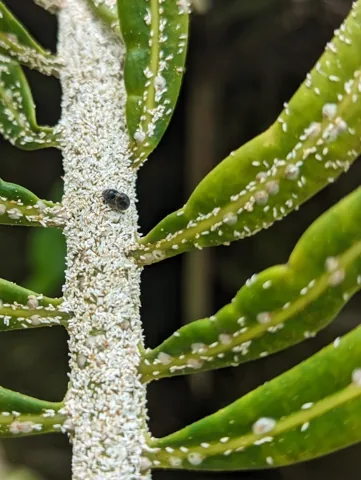 Cycad Aulacaspis Scale
Aulacaspis yasumatsui
Cycad aulacaspis scale, also called Asian cycad scale, can coat a sago palm in a white crust, and heavily infested fronds turn yellow, then brown, and die. It attacks only cycads, which despite names like sago palm are not true palms.
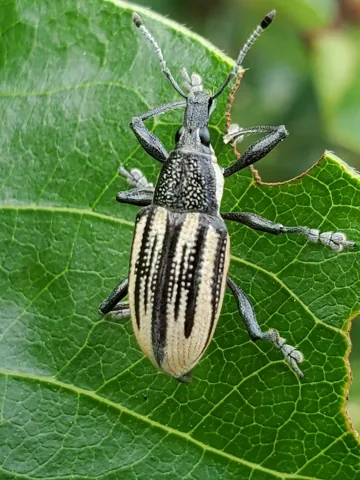 Diaprepes Root Weevil
Diaprepes abbreviatus
Diaprepes root weevil adults notch the edges of young leaves, but the serious damage comes from the legless grubs in the soil, which feed on and girdle the roots of citrus, ornamentals and many other plants. UF/IFAS calls it one of the most economically important pests in the Caribbean, where at least 19 other Diaprepes species are known.
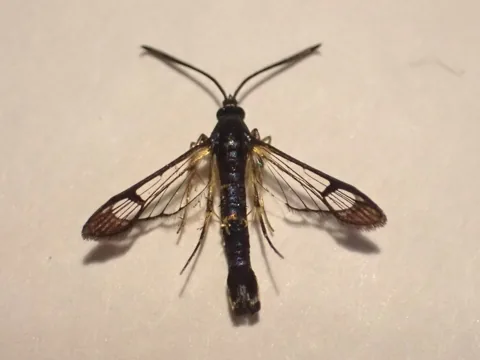 Dogwood Borer
Synanthedon scitula
Dogwood borer caterpillars can only get established where there is a wound or opening in the bark (or, on apple trees, a burr knot), so preventing mower and string-trimmer injury is the main defense for landscape dogwoods.
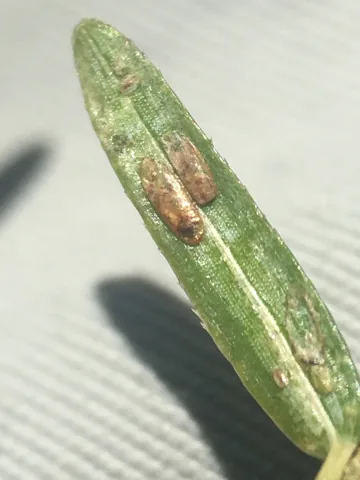 Elongate Hemlock Scale
Fiorinia externa
Elongate hemlock scale is an invasive armored scale from Japan that yellows evergreen needles, causes needle loss and dieback, and can kill heavily infested trees. Penn State calls it a serious pest of ornamental and forest hemlocks.
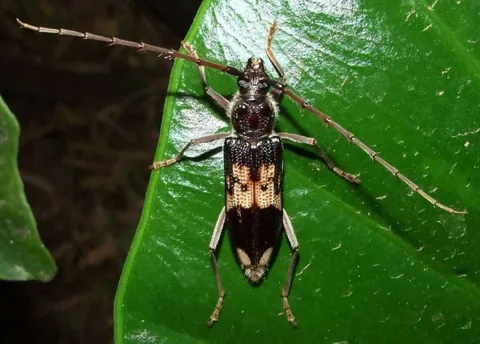 Eucalyptus Longhorned Borer
Phoracantha semipunctata and P. recurva
Two Australian longhorned beetles, Phoracantha semipunctata and P. recurva, bore under the bark of drought-stressed eucalyptus and freshly cut logs. Keeping trees watered and handling cut wood properly are the main defenses.
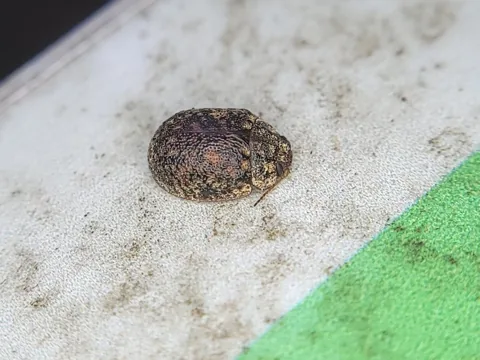 Eucalyptus Tortoise Beetle
Trachymela sloanei
Eucalyptus tortoise beetles are two Australian leaf beetles introduced into California. Notched, tattered eucalyptus leaves are usually the only sign, and well-kept trees appear to tolerate the feeding.
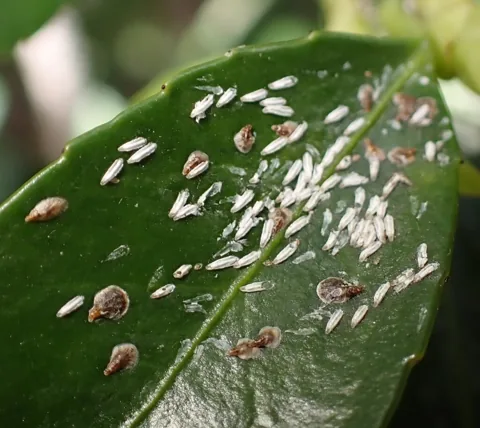 Euonymus Scale
Unaspis euonymi
Euonymus scale is a key pest of euonymus, pachysandra and bittersweet. Vine-type euonymus are extremely susceptible, and years of heavy infestation can kill plants.
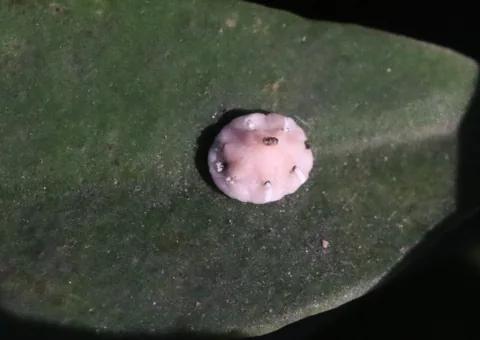 Florida Wax Scale
Ceroplastes floridensis
Pinkish-white waxy domes on holly, citrus or other shrubs are likely Florida wax scale. CDFA calls it one of the most commonly encountered soft scales in the southern United States and a serious pest of citrus and several ornamentals. UF/IFAS says the same.
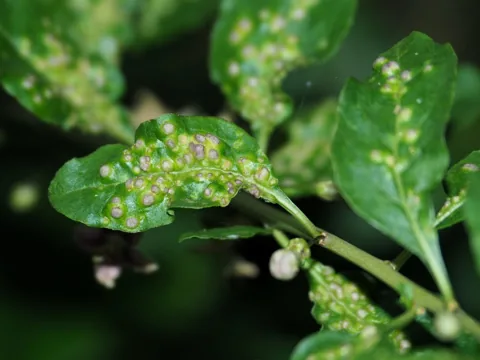 Gall and Bud Mites
Eriophyidae (eriophyid mites)
Bladder galls on maple leaves, felty patches on viburnum and swollen ash flowers are made by eriophyid mites too small to see without magnification. The galls look alarming but rarely hurt the plant.
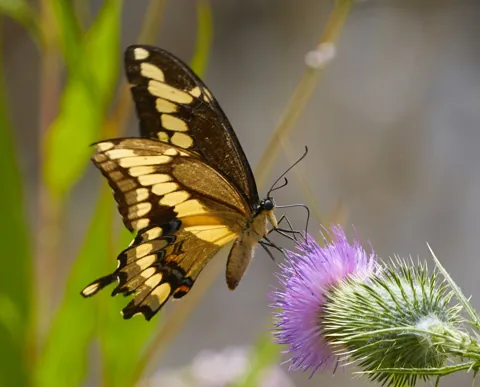 Giant Swallowtail
Papilio cresphontes
Orangedogs, the caterpillars of the giant swallowtail, look like bird droppings and feed on citrus and related plants. They can be a pest of young citrus trees, but mature trees tolerate a fair amount of feeding, and the adult is the largest butterfly in the U.S. and Canada.
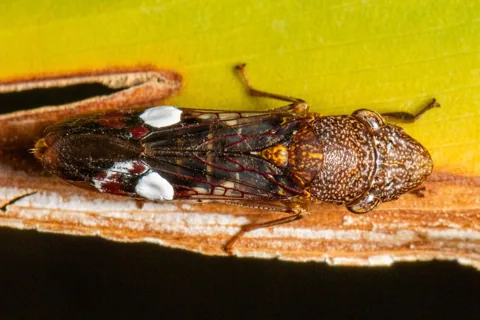 Glassy-winged Sharpshooter
Homalodisca vitripennis (formerly H. coagulata)
The glassy-winged sharpshooter itself rarely causes much feeding damage. The problem is that it spreads Xylella fastidiosa, the bacterium behind Pierce's disease of grape, oleander leaf scorch and other plant diseases that can't be cured. UF/IFAS Featured Creatures notes it is usually not a serious pest in its native Southeast but became a serious threat to California grape growing after it was introduced there.
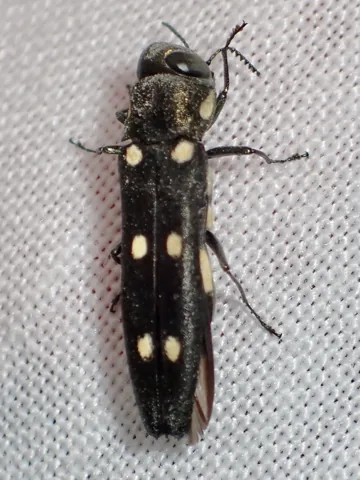 Goldspotted Oak Borer
Agrilus auroguttatus
Goldspotted oak borer was first collected in San Diego County in 2004 and tied to oak deaths there in 2008. Infestations have since been found in Riverside, Orange, Los Angeles, San Bernardino and Ventura counties, most likely carried in firewood.
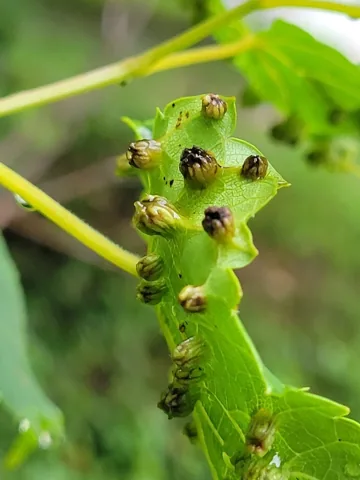 Grape Phylloxera
Daktulosphaira vitifoliae
Grape phylloxera are tiny aphid relatives that feed on grape roots, and in some forms on leaves, stunting or killing susceptible vines. UC IPM says resistant rootstocks or sandy soil are the only completely effective controls, and Oregon State says it can't be eradicated from an infested vineyard.
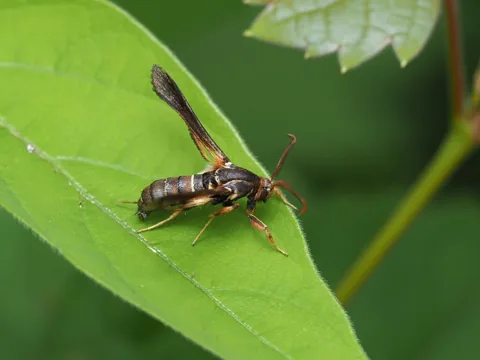 Grape Root Borer
Vitacea polistiformis
Grape root borer larvae feed on grapevine roots below ground, so damage often goes unnoticed until vines decline.
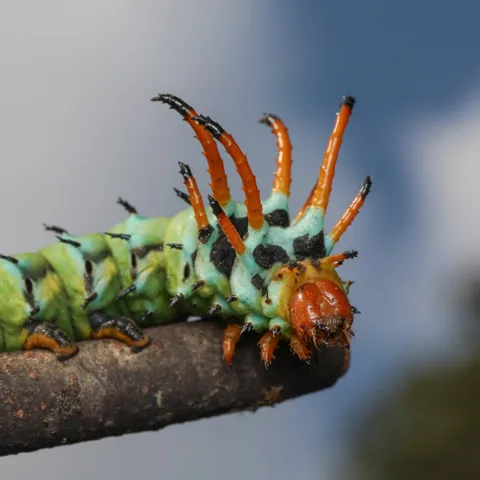 Hickory Horned Devil
Citheronia regalis
The hickory horned devil is the caterpillar of the regal moth, and at up to 5 1/2 to nearly 6 inches long it is, in NC State's words, our largest caterpillar. Despite its long orange, black-tipped horns, it is harmless.
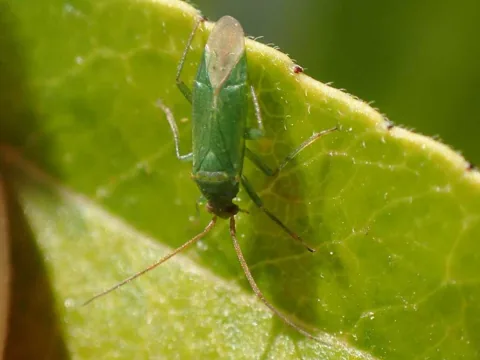 Honeylocust Plant Bug
Diaphnocoris chlorionis (GBIF: Blepharidopterus chlorionis)
The honeylocust plant bug is a small green plant bug that feeds on new honeylocust leaves in spring, leaving them speckled, small and twisted. Penn State calls it a key pest of honeylocust, but Minnesota Extension says the damage is mostly cosmetic.
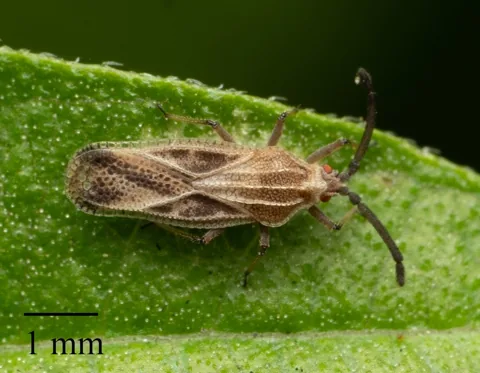 Lantana Lace Bug
Teleonemia scrupulosa
Lantana leaves that turn pale and speckled, then brown and dry from the tips, with dark specks of excrement on the undersides, usually mean lantana lace bugs. Adults and nymphs feed under the leaves and also attack flower buds.
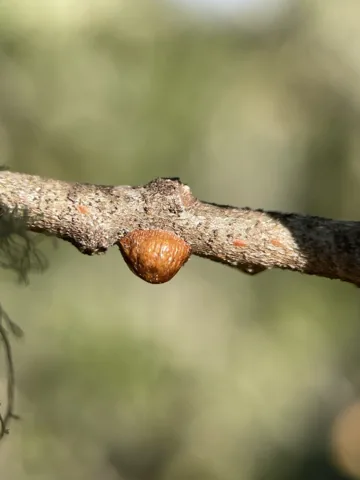 Lecanium Scale
Parthenolecanium species (e.g., P. corni)
Shiny brown bumps along oak, maple or crabapple twigs are often lecanium scales. Their honeydew coats cars and patios below, and heavy infestations kill twigs and branches.
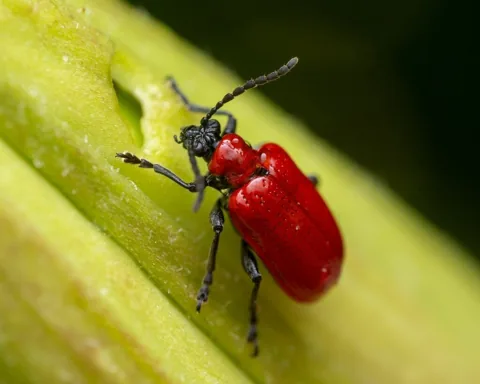 Lily Leaf Beetle
Lilioceris lilii
The lily leaf beetle is a bright red beetle from Europe that feeds on true lilies and fritillaria. Adults and especially the larvae chew leaves, buds and flowers, and an unchecked infestation can leave nothing but bare stems.
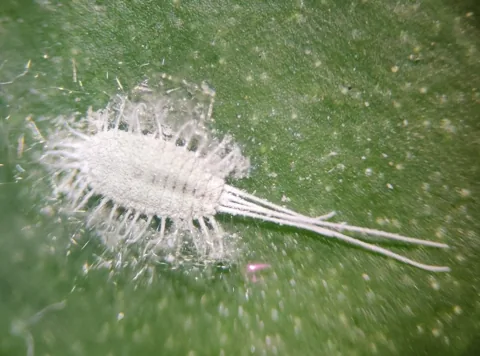 Longtailed Mealybug
Pseudococcus longispinus
The longtailed mealybug is a white, waxy mealybug named for the pair of tail filaments that are as long as or longer than the adult female's body. It is a common pest of houseplants and greenhouse plants, especially dracaena, and also turns up in some California vineyards. UF/IFAS calls it a widely distributed pest of many economically important hosts, particularly tropical fruits and ornamentals.
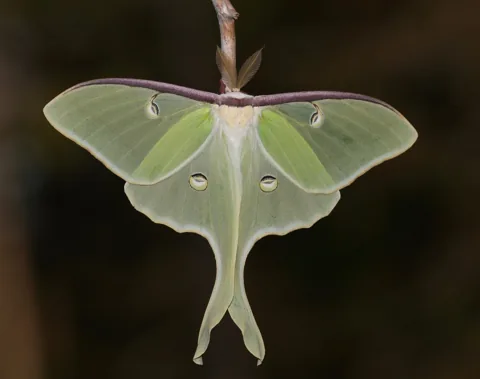 Luna Moth
Actias luna
The luna moth's pale green wings and long, curving hindwing tails make it one of North America's most recognizable moths. It is harmless: adults don't even feed, and the caterpillars eat tree leaves without causing reported damage.
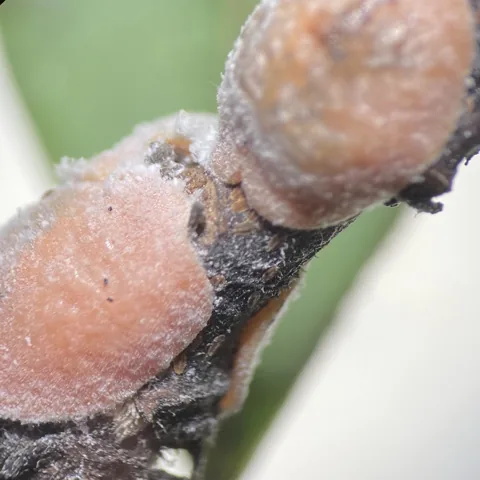 Magnolia Scale
Neolecanium cornuparvum
Magnolia scale is a native soft scale and, at about 1/2 inch across, one of the largest scale insects in the United States. It feeds only on magnolia, and heavy infestations can seriously injure or kill branches and whole trees.
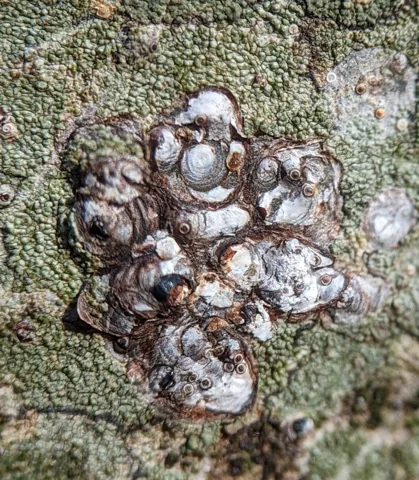 Obscure Scale
Melanaspis obscura
Obscure scale is a small, gray armored scale named for being hard to see. Penn State calls it a key pest of oaks in Pennsylvania, and infestations cause leaf drop, branch dieback and sunken, disfigured bark.
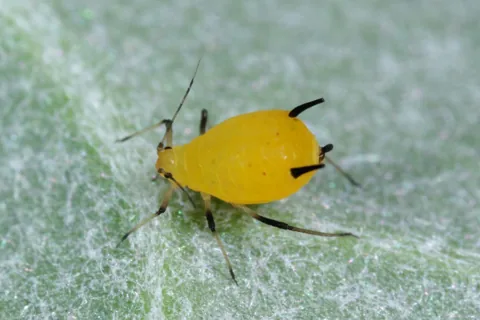 Oleander Aphid
Aphis nerii
Bright yellow aphids crowding the new growth of milkweed, butterfly weed or oleander are oleander aphids, also called milkweed aphids. On milkweed grown for monarchs, skip insecticides and use simple hand methods instead.
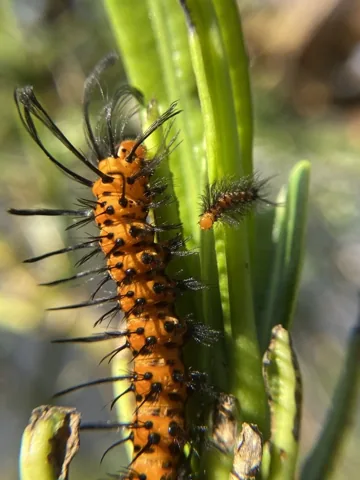 Oleander Caterpillar
Syntomeida epilais
The orange, black-tufted oleander caterpillar is the larva of the polka-dot wasp moth and a pest of cultivated oleander. It eats the leaf tissue between the veins and does best in southern Florida. UF/IFAS calls it the only caterpillar pest of concern on oleander and says it can cause considerable defoliation in southern Florida.
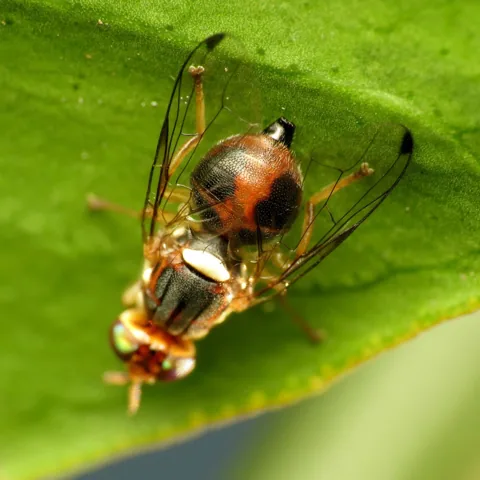 Olive Fruit Fly
Bactrocera oleae
The olive fruit fly, the major pest of olives worldwide, reached California in 1998 and now occurs in all of the state's olive-growing areas. Its maggots rot the fruit of both commercial and ornamental trees.
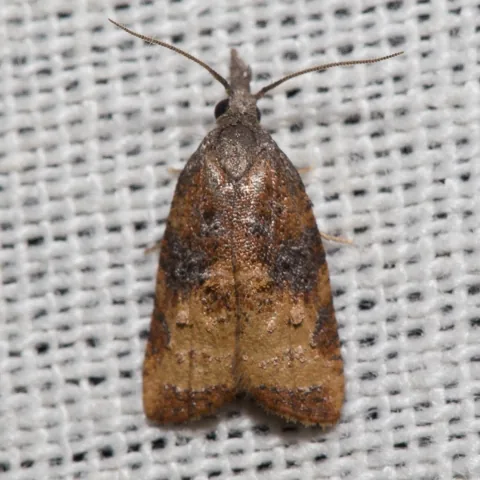 Omnivorous Leafroller
Platynota stultana
The omnivorous leafroller is a small moth whose caterpillars tie leaves together with silk and feed inside. It eats hundreds of plants, and where larvae tie leaves to fruit they scar it; in vineyards their feeding opens grape clusters to bunch rot.
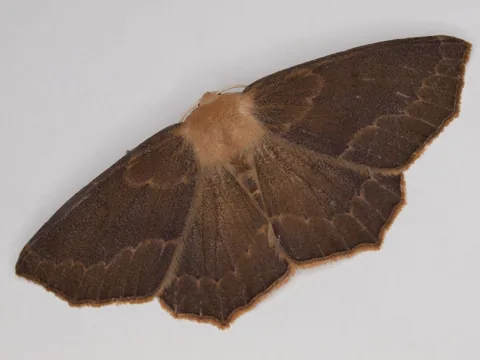 Omnivorous Looper
Sabulodes aegrotata
Omnivorous loopers are inchworms that chew leaves and scar fruit on dozens of trees and shrubs; UC IPM says natural enemies usually keep them below damaging levels.
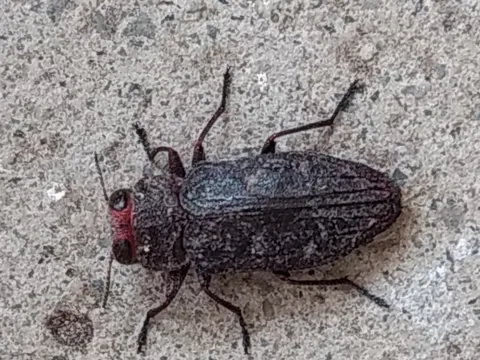 Pacific Flatheaded Borer
Chrysobothris mali
Pacific flatheaded borer is a native metallic wood-boring beetle of western North America. It lays eggs on stressed, sunburned or wounded trees, and its larvae tunnel under the bark, so good care and trunk protection are the best defense.
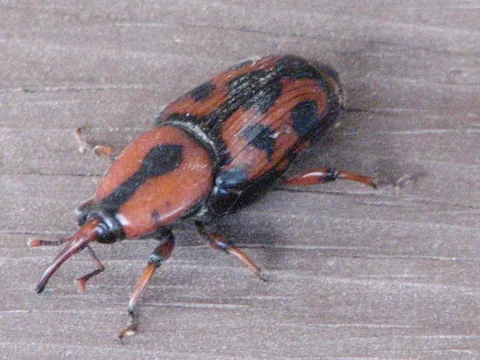 Palmetto Weevil
Rhynchophorus cruentatus
The palmetto weevil is a large weevil native to the southeastern United States. Its larvae feed hidden inside palms, so the damage often isn't noticed until the palm can't be saved. Florida's Division of Plant Industry says its native host is the cabbage palm (Sabal palmetto) and that it mostly attacks wounded or dying palms. UF/IFAS calls it the largest weevil in North America.
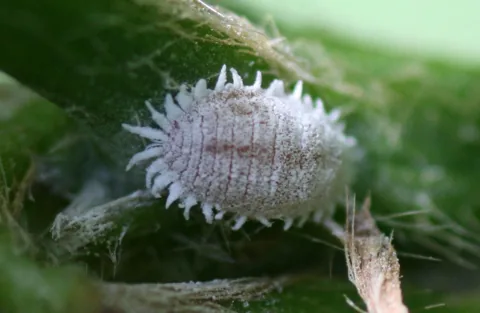 Papaya Mealybug
Paracoccus marginatus
Papaya mealybugs show up as cotton-like clusters on stems, leaves and fruit. Their feeding can yellow, stunt and deform plants, drop leaves and fruit early, and in bad cases kill the plant.
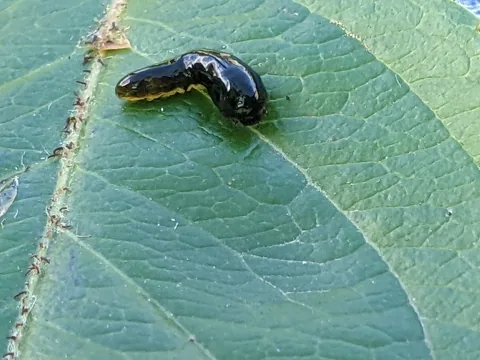 Pear Slug
Caliroa cerasi (pear sawfly, cherry slug)
Pear slugs aren't slugs at all. They're sawfly larvae coated in olive-green slime that skeletonize cherry and pear leaves.
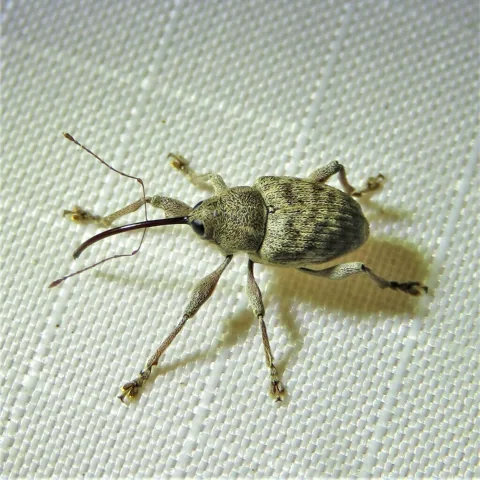 Pecan Weevil
Curculio caryae
The pecan weevil is a snout beetle whose grubs eat developing pecan and hickory kernels. Missouri Extension calls it the most serious late-season pecan pest, and the damage often isn't noticed until the nuts are cracked.
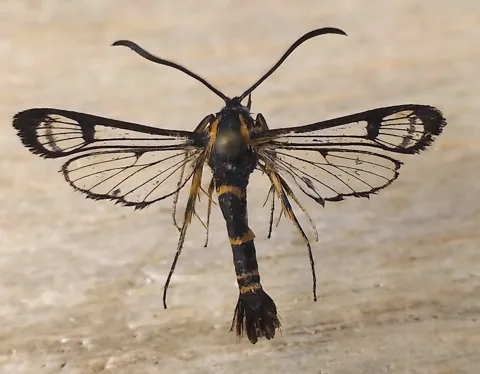 Pitch Moths
Synanthedon sequoiae and S. novaroensis (shown: Douglas-fir pitch moth)
Large gummy pitch masses on pine trunks usually mark pitch moth larvae feeding beneath them. They rarely kill trees, and egg-laying moths are drawn to pruning cuts and other wounds.
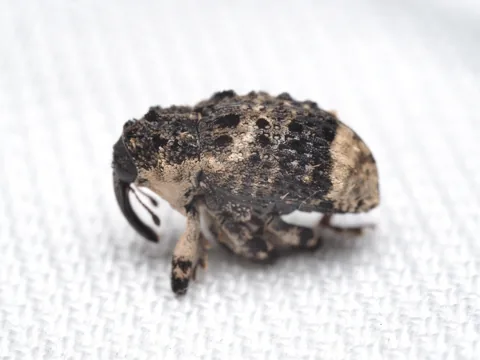 Poplar and Willow Borer
Cryptorhynchus lapathi
The poplar and willow borer is a weevil whose larvae girdle and tunnel in willow, poplar, alder and birch stems, killing small limbs.
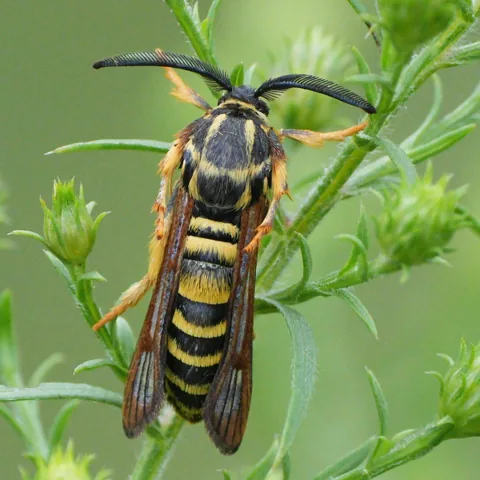 Raspberry Crown Borer
Pennisetia marginatum
Raspberry crown borer larvae tunnel in the crowns and roots of raspberries and blackberries, killing or weakening canes. Kentucky calls it the most devastating pest of blackberry and raspberry in the state; Utah State says infestations are usually not severe but build up slowly over several years.
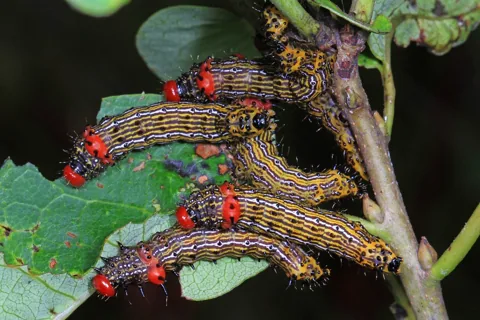 Redhumped Caterpillar
Schizura concinna (iNaturalist: Oedemasia concinna)
Redhumped caterpillars feed in groups and can strip branches of sweetgum, plum and walnut. UC IPM says parasitic wasps and spot pruning of infested shoots are enough to manage them in most situations.
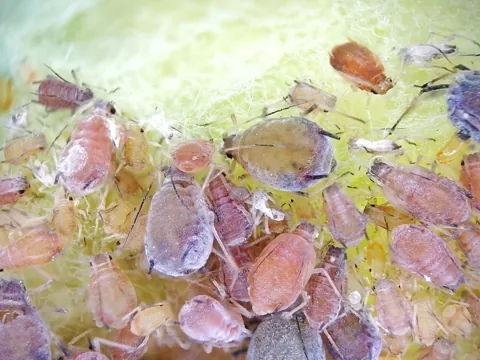 Rosy Apple Aphid
Dysaphis plantaginea
Rosy apple aphids inject a toxin with their saliva that curls leaves and distorts fruit. Kentucky calls them the most serious aphids on apples, and NC State the most destructive aphid on apple in the Southeast.
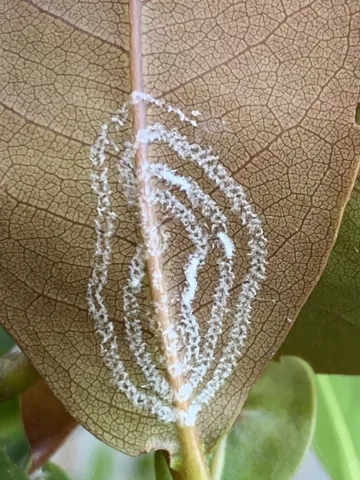 Rugose Spiraling Whitefly
Aleurodicus rugioperculatus
Since it was found in Miami-Dade County in 2009, the rugose spiraling whitefly has become an escalating problem for South Florida homeowners and landscapers, mostly because of its wax, honeydew and sooty mold. UF/IFAS notes it was first called the gumbo limbo spiraling whitefly.
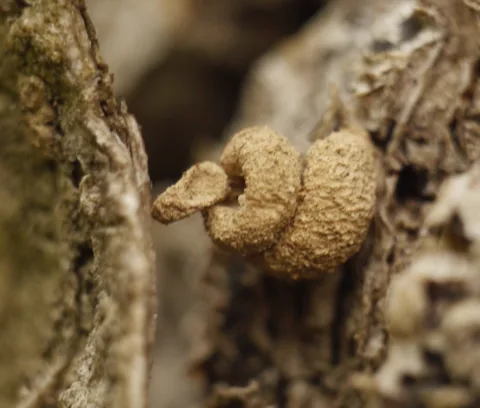 Snailcase Bagworm
Apterona helix
Snailcase bagworms are tiny caterpillars from Europe that live in coiled, snail-like cases of silk and soil. They feed on many plants, but they're best known for crawling onto houses, fences and vehicles to pupate.
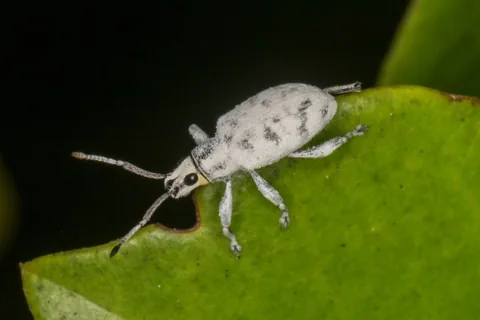 Sri Lankan Weevil
Myllocerus undecimpustulatus undatus
Notched and chewed leaves on citrus, fruit trees and ornamentals in Florida may be the work of the Sri Lankan weevil, a leaf-feeding weevil from Sri Lanka. In the U.S. it was first identified on citrus in Pompano Beach, Broward County.
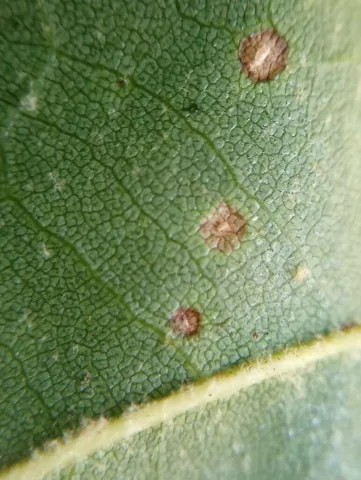 Sycamore Scale
Stomacoccus platani
Sycamore scale is the most damaging insect pest of sycamores in California, yet it's so tiny most people never see it. It spots and distorts leaves and can make young bark flake off.
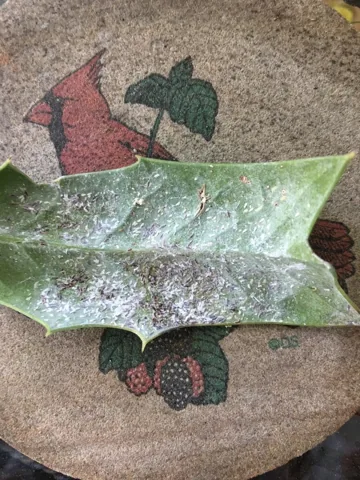 Tea Scale
Fiorinia theae
Tea scale is the most common insect pest of camellias in the Southeast and also attacks Chinese, Japanese and other hollies. It lives on the undersides of the leaves, and its feeding shows as yellow blotches on the upper surface.
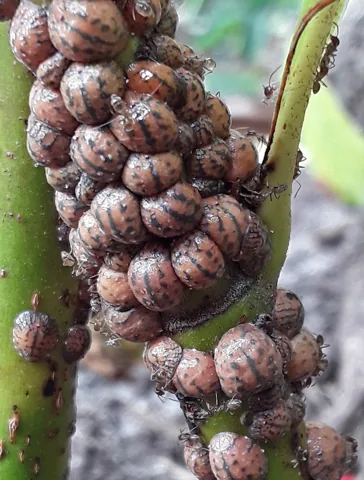 Tuliptree Scale
Toumeyella liriodendri
Tuliptree scale is a large soft scale that infests tulip poplar (yellow poplar), magnolia, linden and a few other trees. Heavy infestations make twigs look warty, coat branches in sticky honeydew and black sooty mold, and can weaken young trees.
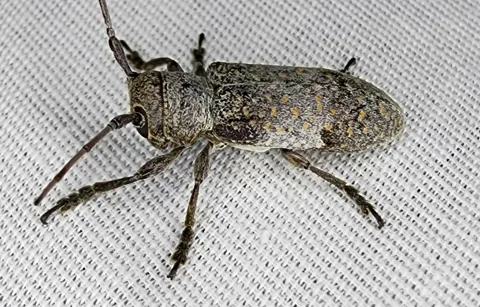 Twig Girdler
Oncideres cingulata
If pencil-sized twigs with neat, cleanly cut ends pile up under a pecan, hickory or persimmon in late summer or fall, a female twig girdler most likely cut them so her eggs could develop in dead wood.
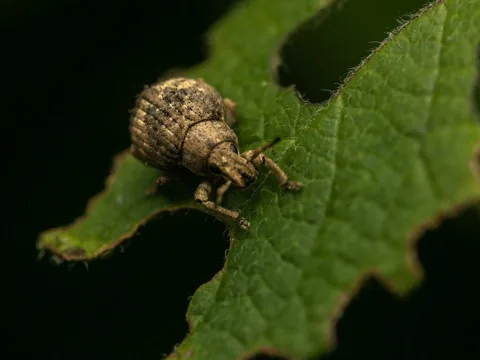 Twobanded Japanese Weevil
Pseudocneorhinus bifasciatus
The twobanded Japanese weevil is a small, flightless East Asian weevil that has been in the U.S. for over a century. Adults chew notches into the leaf edges of many common landscape shrubs, sometimes down to the midrib, and the larvae feed on roots in the soil. It is harmless to people, the leaf damage is mostly cosmetic, and if you want to act, the simplest step is shaking the weevils onto a white sheet and dropping them into soapy water.
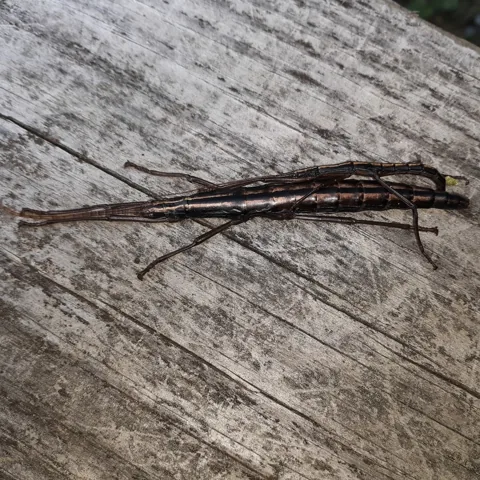 Twostriped walkingstick (devil rider)
Anisomorpha buprestoides
The twostriped walkingstick is a wingless stick insect of the southeastern United States that sprays a smelly defensive chemical from glands behind its head. It aims accurately, and in the eye the spray has caused painful injuries, from conjunctivitis to corneal ulcers.
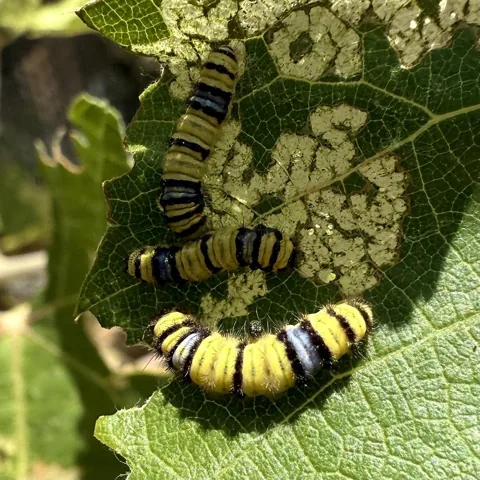 Western Grapeleaf Skeletonizer
Harrisina metallica
The western grapeleaf skeletonizer is a small metallic blue-black moth whose yellow-and-purple banded caterpillars line up side by side under grape leaves, skeletonize them, and can defoliate vines. It also feeds on Virginia creeper and Boston ivy. The caterpillars' hairs irritate skin, so wear gloves when you handle infested vines. In home vineyards, hand-pick larvae or eggs, remove badly infested leaves and fallen debris, let the natural virus and parasites work, and if larvae are abundant spray Bt (kurstaki) or spinosad under the leaves while the caterpillars are small.
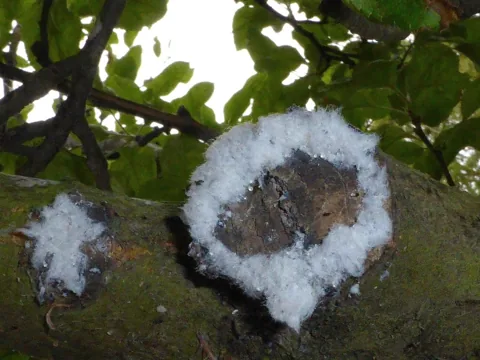 Woolly Apple Aphid
Eriosoma lanigerum
Fluffy white wax on apple bark and pruning wounds usually means woolly apple aphid. The colonies above ground look worse than they are; the real harm comes from galls on the roots, especially on young trees.
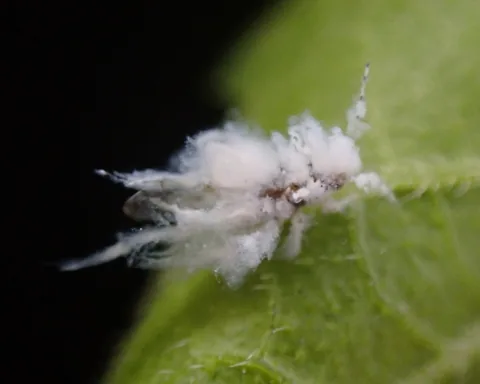 Woolly Hackberry Aphid
Shivaphis celti
Woolly hackberry aphids make a sticky mess of honeydew and black sooty mold under hackberry trees, but years of infestation have not been found to seriously harm the trees.
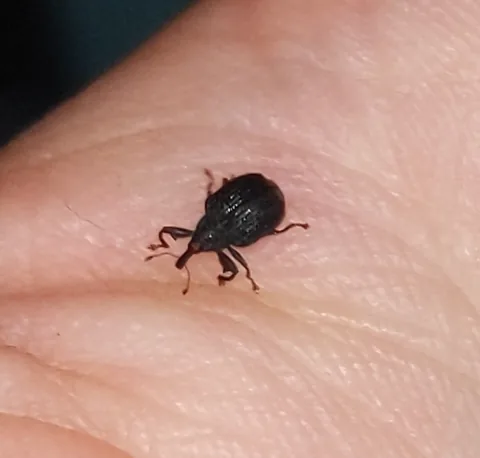 Yellow Poplar Weevil
Odontopus calceatus
Yellow poplar weevils are tiny black snout beetles that chew holes shaped like curved rice grains in the leaves of tulip poplar, sassafras and magnolia. Their grubs mine the leaves from inside, and a bad year can leave a tree looking scorched.
No photo yet
Maple Petiole Borer
Caulocampus acericaulis
The maple petiole borer is a small, non-stinging sawfly whose larvae tunnel inside maple leaf stems (petioles), making green leaves drop suddenly in late May or June. Sugar maple is the usual host. The leaf drop looks alarming, but it doesn't harm the tree and no spraying is needed.
No photo yet
Fletcher Scale
Parthenolecanium fletcheri
Fletcher scale, also called arborvitae soft scale, is a native soft scale that sucks sap from twigs and needles of yew, arborvitae, juniper and other conifers, coating them with sticky honeydew and black sooty mold.
No photo yet
Pink Hibiscus Mealybug
Maconellicoccus hirsutus
The pink hibiscus mealybug is an invasive mealybug, native to southern Asia, that feeds on more than 200 kinds of plants, from hibiscus and citrus to grape, cotton and soybean. Its toxic saliva twists leaves and shoots into stunted, bunchy growth.
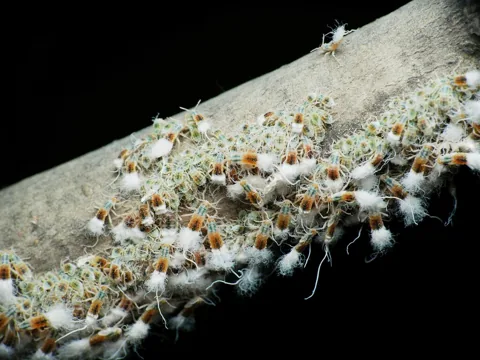 Beech Blight Aphid
Grylloprociphilus imbricator
Beech blight aphids form white, fluffy colonies on American beech branches; when disturbed the nymphs wave their abdomens in unison, earning them the name boogie-woogie aphids, and their honeydew grows thick black sooty mold below.
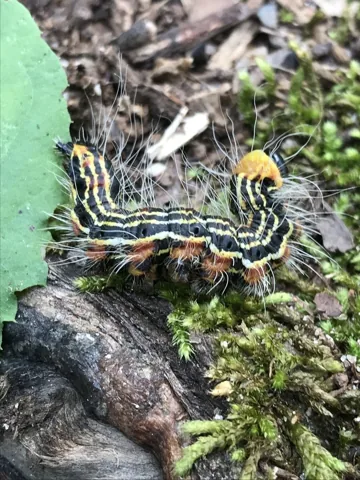 Yellownecked Caterpillar
Datana ministra
Yellownecked caterpillars are striped caterpillars with a yellow-orange patch behind the head that feed in groups on oaks, maples, birches, fruit trees and other woody plants in late summer and rear up together when disturbed.
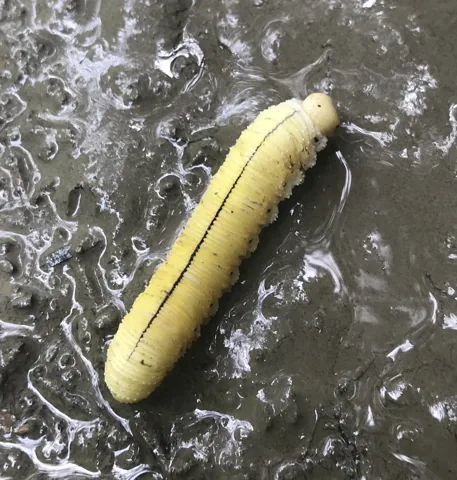 Elm Sawfly
Cimbex americana
The elm sawfly is the largest sawfly in North America: a big, blue-black, wasp-like insect whose larvae look like fat yellow caterpillars with a black stripe down the back and eat the leaves of elm and willow. Iowa State and South Dakota State describe sawflies as non-stinging wasp relatives. Trees usually suffer little, though large numbers can defoliate a tree and small trees may be stunted. Larvae can be picked off small trees by hand; South Dakota State says larger trees could warrant an insecticide specifically labeled for sawflies.
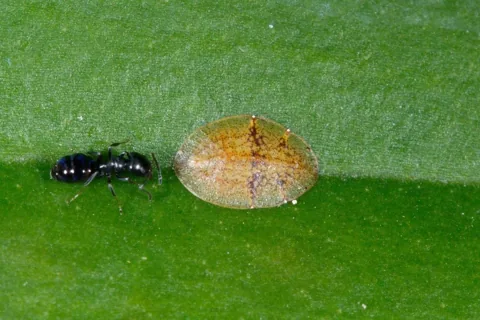 Brown Soft Scale
Coccus hesperidum
Brown soft scale is a small, oval, yellowish-brown scale insect that settles on stems and leaf veins of houseplants such as ficus, schefflera, English ivy and citrus, coating leaves with sticky honeydew.
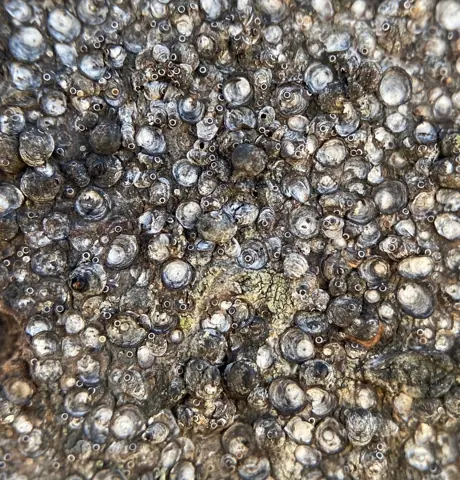 Gloomy Scale
Melanaspis tenebricosa
Gloomy scale is a native armored scale insect that encrusts the bark of red maples and other trees; heavy infestations cause branch dieback, a thinning canopy and eventually death, mostly on trees in hot, paved urban sites.
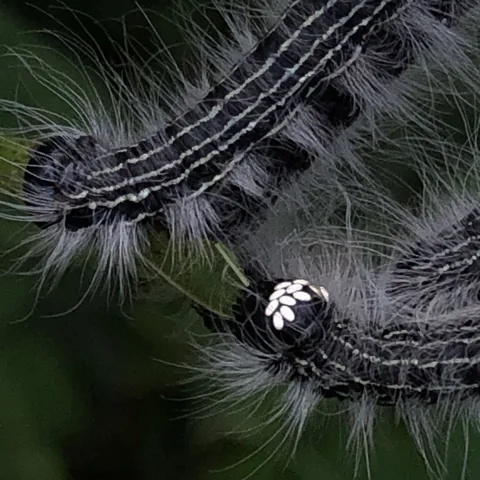 Walnut Caterpillar
Datana integerrima
Walnut caterpillars feed in groups on walnut, pecan and hickory leaves and are often first noticed when a fuzzy gray mass of them crawls down the trunk to molt, leaving a clump of shed skins behind.
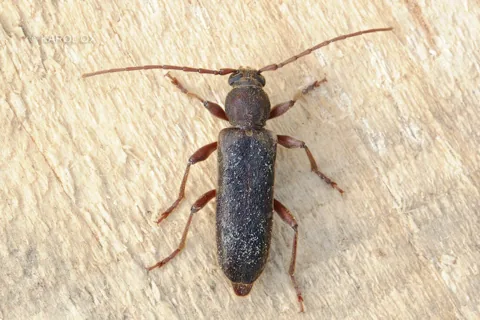 Velvet Longhorned Beetle
Trichoferus campestris
The velvet longhorned beetle is an invasive wood borer from Asia whose larvae tunnel in apple, cherry, mulberry, peach and other trees, and in cut and even dried wood. It is now considered established in Utah, Illinois and Minnesota.
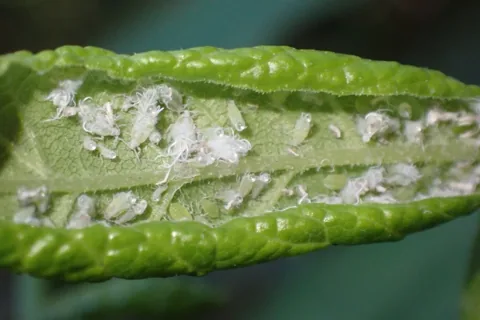 Leafcurl Ash Aphid
Prociphilus fraxinifolii
Leafcurl ash aphids are small, woolly aphids that feed on the undersides of new ash leaves, twisting the branch tips into tight, gnarled coils; the damage is cosmetic on healthy trees.
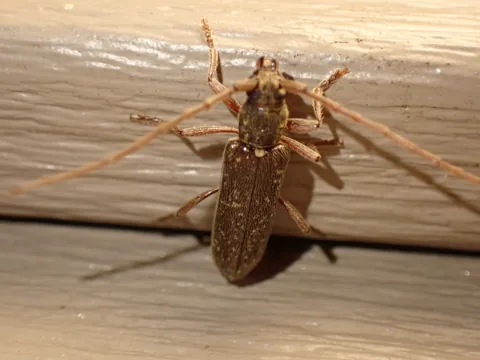 Twig Pruner
Anelaphus villosus (also listed as Elaphidionoides villosus)
The twig pruner is a longhorned beetle whose grub tunnels inside a twig and then cuts it from within, so small branches of oak, hickory, maple and many other trees drop to the ground with the grub still inside. NC State calls it a secondary invader of declining trees and shrubs, and UMass says twig pruners are not the primary cause of concern for tree health. NC State says to rake up the fallen branches and destroy them or send them to a landfill, because the overwintering grubs are inside.
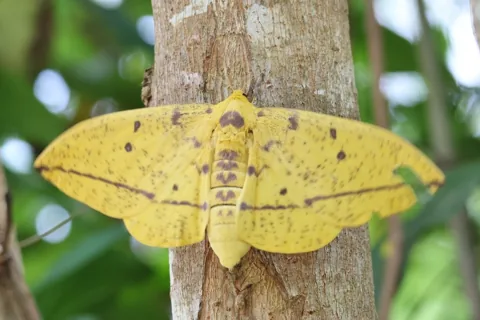 Imperial Moth
Eacles imperialis
The imperial moth (Eacles imperialis) is one of the largest moths in the Southeast, mostly yellow with brown or purplish spots and splotches. Its caterpillars grow 3 to 5 inches long on pines, oaks, maples and many other trees but are rarely common enough to matter, and they have no stinging hairs.
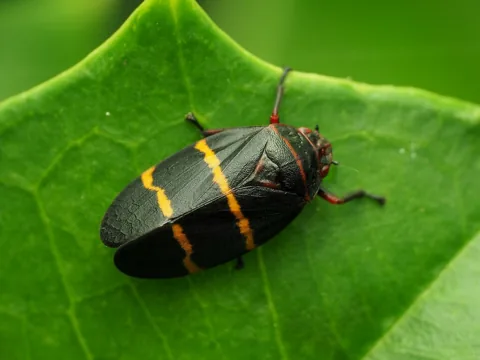 Twolined Spittlebug
Prosapia bicincta
The twolined spittlebug is a small black bug with two red, orange or yellow bands across its wings. Its nymphs feed at the base of lawn grasses, especially centipedegrass and St. Augustinegrass, inside frothy spittle, and the adults also damage holly leaves. Heavy infestations can turn turf yellow, then brown.
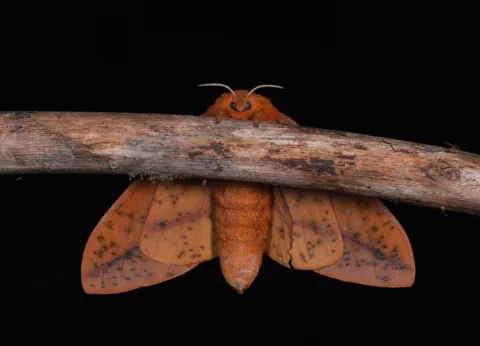 Orangestriped Oakworm
Anisota senatoria
Orangestriped oakworms are 2-inch black caterpillars with yellow to orange stripes that feed on oaks in late summer, sometimes stripping small trees, and then wander across sidewalks and driveways looking for soil to pupate in.
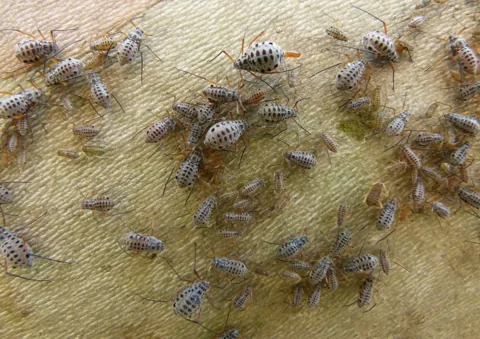 Giant Bark Aphid
Longistigma caryae
The giant bark aphid is the largest aphid in North America: about 1/4 inch long, gray with black spots, crowding on the bark of twigs and branches in late summer and dripping honeydew that grows black sooty mold.
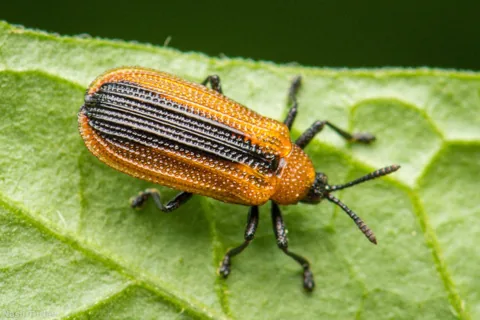 Locust Leafminer
Odontota dorsalis
The locust leafminer is a small, flat orange-and-black beetle whose larvae tunnel inside black locust leaves, turning trees brown and scorched-looking by midsummer; trees rarely die.
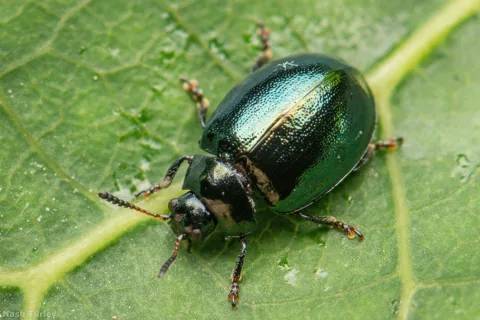 Imported Willow Leaf Beetle
Plagiodera versicolora
The imported willow leaf beetle is a small, shiny, black to bluish-green European beetle that looks like an all-black lady beetle. Adults and larvae chew and skeletonize willow, poplar and cottonwood leaves through the summer.
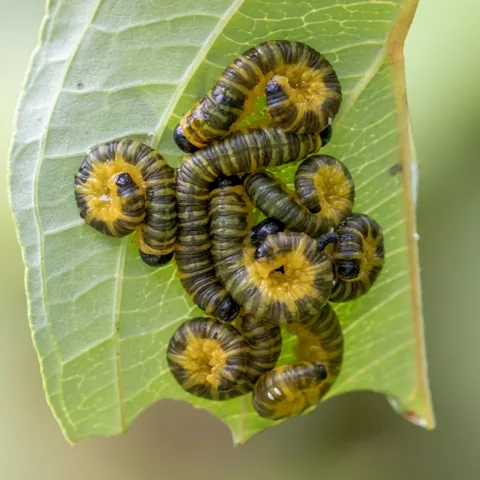 Dogwood Sawfly
Macremphytus tarsatus
Dogwood sawfly larvae feed in groups on dogwood leaves and change looks as they grow, from white and waxy, like bird droppings, to cream with black spots and finally yellow and black; full-grown larvae may bore into soft wood to overwinter.
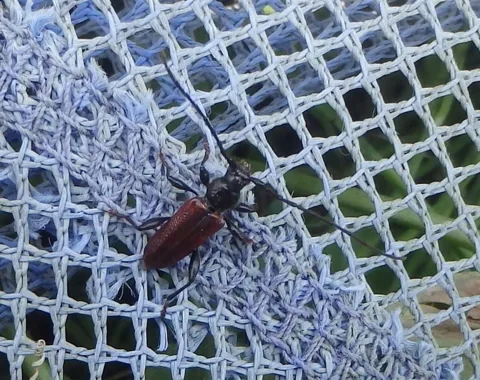 Japanese Cedar Longhorned Beetle
Callidiellum rufipenne
The Japanese cedar longhorned beetle is a small longhorned beetle from East Asia whose grubs tunnel under the bark and into the wood of arborvitae, juniper, cypress and other cypress-family trees.
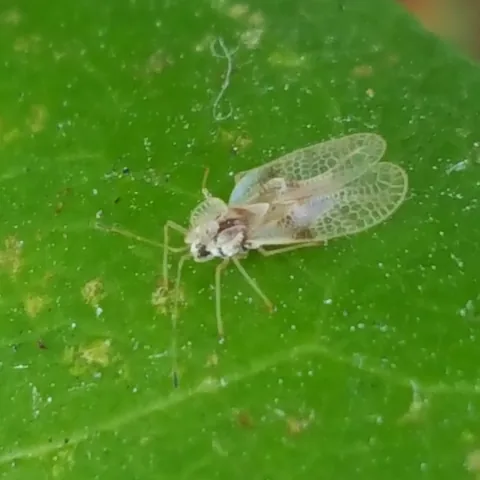 Rhododendron Lace Bug
Stephanitis rhododendri
The rhododendron lace bug is a tiny, pale insect with lacy wings that feeds on the undersides of rhododendron and mountain laurel leaves, leaving pale speckles on top and black tar-like spots and shed skins underneath.
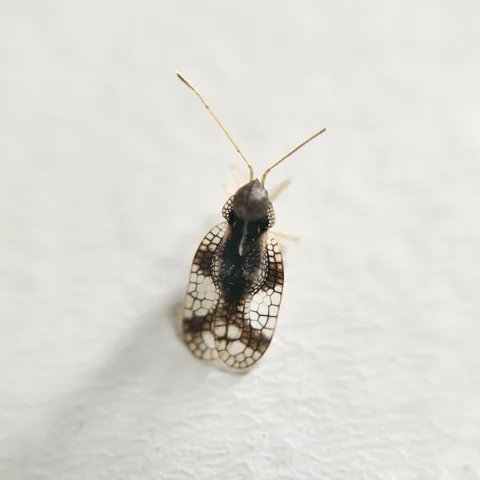 Andromeda Lace Bug
Stephanitis takeyai
The andromeda lace bug is a small, showy lace bug, marked black and clear, that feeds under the leaves of Japanese andromeda (Pieris japonica), turning the tops yellow to gray with stippling.
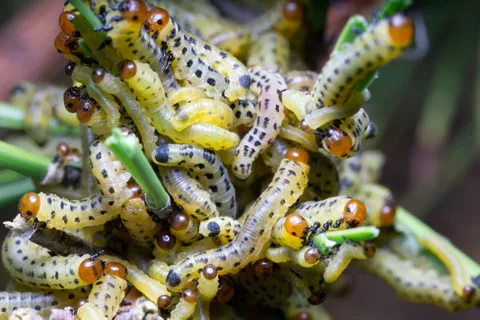 Redheaded Pine Sawfly
Neodiprion lecontei
The redheaded pine sawfly is a native insect whose yellow, black-spotted larvae with red heads feed in groups on pine needles. It does not harm people or pets, but it can strip and kill small pines. Pick or shake colonies off small trees and crush them, or spray young larvae with spinosad; Bt products for caterpillars do not work on sawflies.
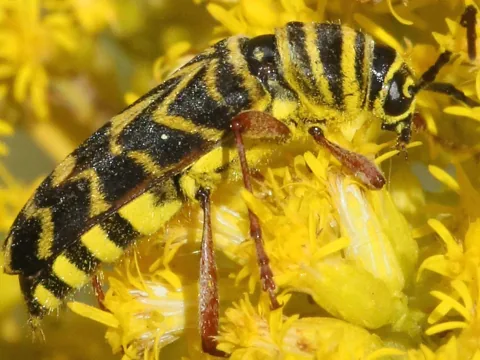 Locust Borer
Megacyllene robiniae
The locust borer is a native longhorned beetle, black with bright yellow bands, often seen on goldenrod in early fall; its larvae tunnel into the trunks and branches of black locust, weakening trees so they break in the wind.
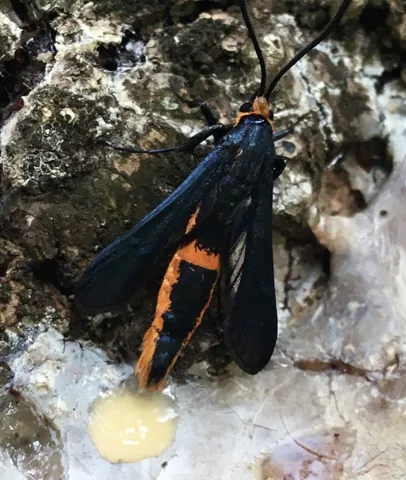 Pitch Mass Borer
Synanthedon pini
The pitch mass borer is a native, wasp-like clearwing moth whose larvae tunnel into the trunks of pines and spruces, causing large masses of pitch (sap) to form at the wound.
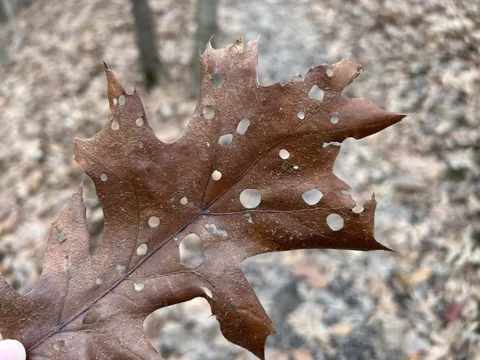 Oak Shothole Leafminer
Japanagromyza viridula (formerly Agromyza viridula)
The oak shothole leafminer is a tiny native fly. Females puncture oak buds and young leaves in spring, the punctures grow into round holes as the leaves expand, and the maggots make blotch mines that later fall out. Most years it goes unnoticed, but outbreaks in 2019 and 2020 hit oaks hard across the mid-Atlantic and Northeast.
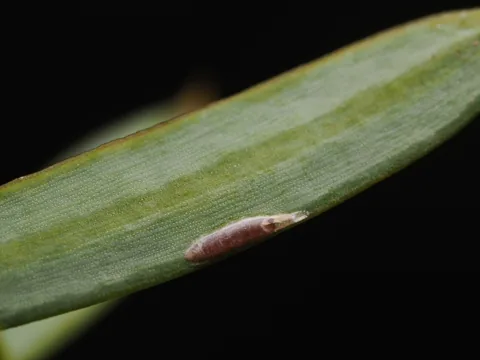 Maskell Scale
Lepidosaphes pallida (NC State lists it as L. maskelli)
Maskell scale is a tiny brown armored scale shaped like an oyster shell that settles on the needles of junipers, Japanese cedar (Cryptomeria) and other conifers. It is small and easily overlooked, but it can cause browning and twig dieback and sometimes becomes a serious pest of junipers.
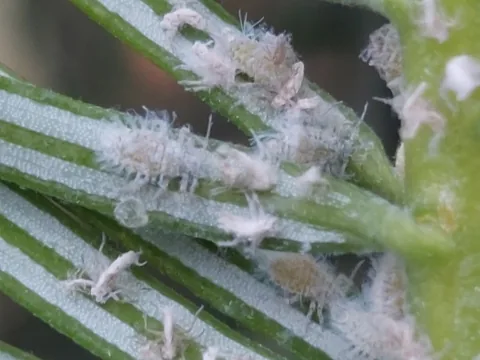 Balsam Twig Aphid
Mindarus abietinus
Balsam twig aphids are tiny, waxy aphids that feed on buds and new needles of firs and some spruces in early spring, twisting and curling the needles and coating them with sticky honeydew and sooty mold.
No photo yet
Hemlock Rust Mite
Nalepella tsugifoliae
The hemlock rust mite is a microscopic, four-legged eriophyid mite that feeds on hemlock needles in spring, turning heavily infested foliage grayish or bluish, then yellow, before needles drop.
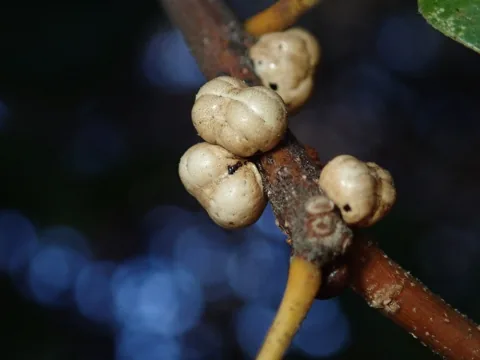 Kermes Scales
Kermesidae (e.g., Allokermes and Nanokermes species)
Kermes scales are round, smooth scale insects on oak twigs and leaves that look like buds or small galls. Heavy infestations deform and stunt new growth and can kill twigs.
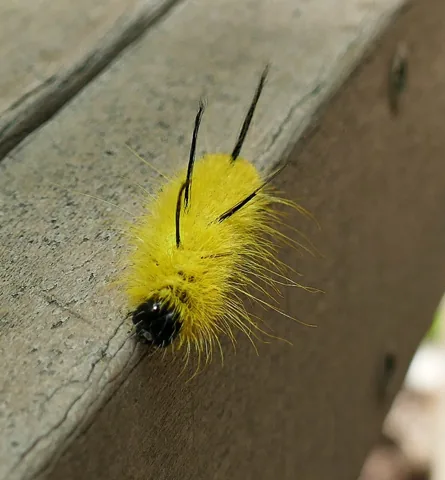 American Dagger Moth
Acronicta americana
The American dagger moth caterpillar is a fuzzy yellow, greenish or white caterpillar with slender black hair tufts; it feeds on the leaves of shade trees and is most often seen wandering in late summer and fall.
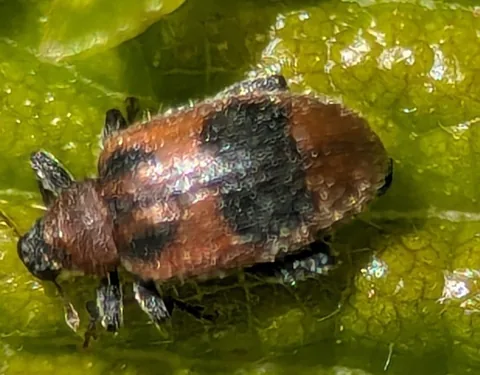 European Elm Flea Weevil
Orchestes alni
The European elm flea weevil is a tiny invasive jumping weevil: its larvae make blotch mines at elm leaf tips and adults chew small holes from the underside of leaves, mainly on Siberian and Chinese elms.
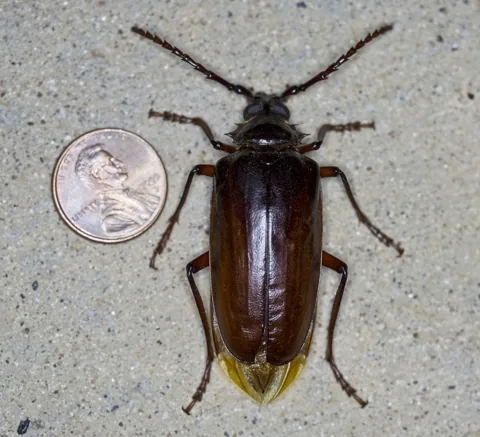 Prionus Root Borers
Prionus spp. (e.g., Prionus californicus, the California prionus)
Prionus root borers are very large brown longhorned beetles whose cream-colored grubs spend three or more years tunneling in roots. The California prionus attacks stone fruits, hops, cottonwoods and other woody plants in the West, while eastern species such as the broad-necked root borer and tilehorned prionus damage apple, cherry and other trees.
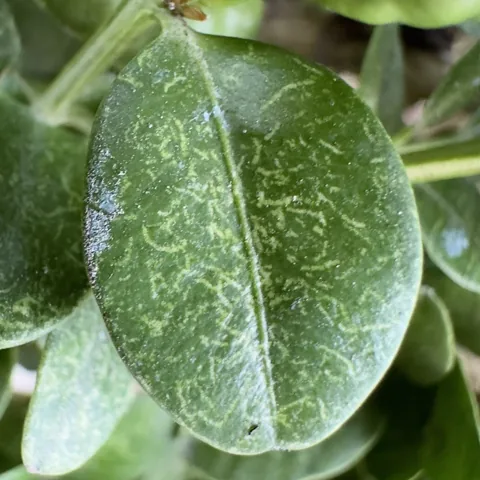 Boxwood Mite
Eurytetranychus buxi
The boxwood mite is a tiny spider mite that feeds only on boxwood, leaving fine pale stippling or scratch-like streaks on the leaves.
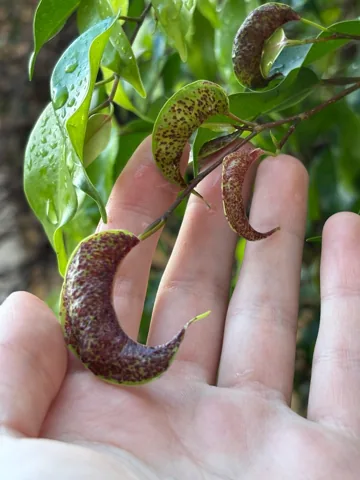 Cuban Laurel Thrips
Gynaikothrips ficorum (the weeping fig thrips, G. uzeli, is very similar)
Cuban laurel thrips are slender dark thrips that feed on new Ficus leaves, making the expanding leaves fold or curl into discolored pocket galls where the thrips feed and develop.
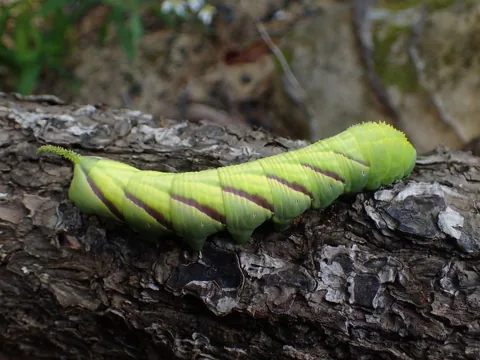 Rustic Sphinx
Manduca rustica
The rustic sphinx is a large hawk moth whose green, diagonally striped hornworm caterpillars feed on shrubs such as American beautyberry, jasmine, ligustrum and lantana. NC State calls it a sporadic pest. UF/IFAS Featured Creatures notes that hawk moths visit night-blooming flowers and pollinate them, and their size and fast flight make them easy to mistake for hummingbirds.
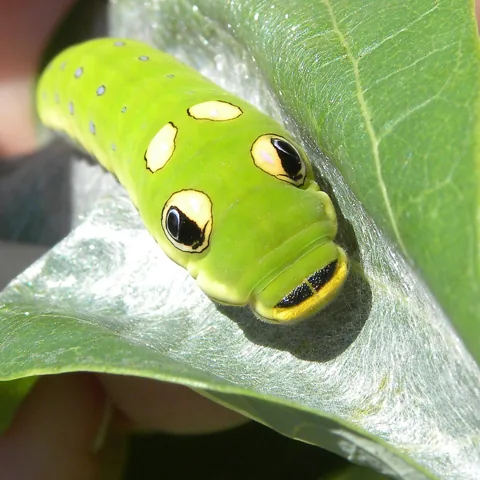 Spicebush Swallowtail
Papilio troilus
The spicebush swallowtail is a black swallowtail butterfly whose green caterpillars carry big fake eyespots and look like a tiny snake or tree frog. They feed on spicebush, sassafras, sweet bay and tulip tree, and NC State says their feeding is usually minor enough to go unnoticed.
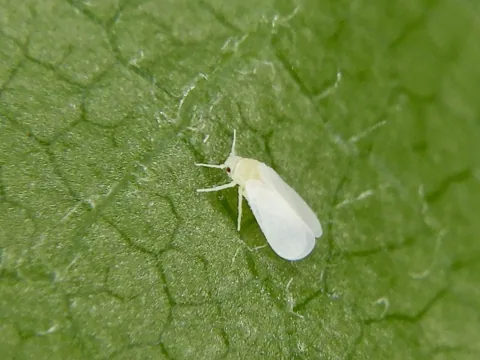 Citrus Whitefly
Dialeurodes citri
The citrus whitefly is a tiny, moth-like insect covered in a snow-white waxy bloom. Its flat, scale-like young suck sap from the undersides of gardenia, citrus, privet and other shrub leaves, and the honeydew they excrete turns the leaves black with sooty mold.
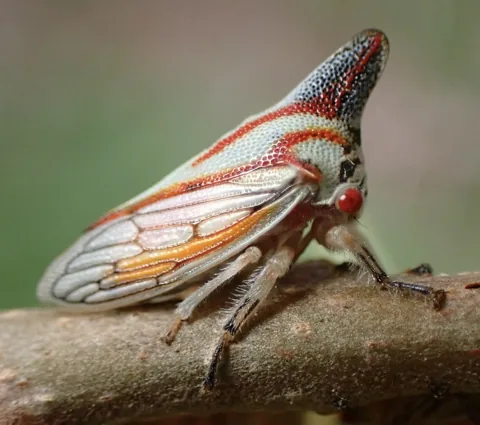 Oak Treehopper
Platycotis vittata
Oak treehoppers are sap-feeding bugs that feed in groups on oak twigs. Despite the crowds, they usually cause little damage to shade trees.
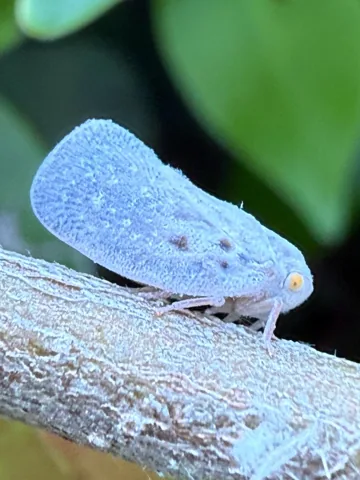 Citrus Flatid Planthopper
Metcalfa pruinosa
The citrus flatid planthopper is a small, wedge-shaped bug coated in white wax. Its nymphs hide under white cottony fluff on twigs that is often mistaken for mealybugs, but it seldom harms healthy plants.
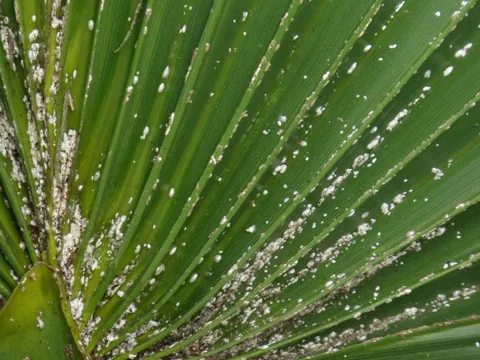 Palmetto Scale
Comstockiella sabalis
Palmetto scale is a tiny armored scale insect that speckles palm leaves with white, roughly round armor, often in large numbers. It is not particularly damaging where its parasites are present, and the Florida Department of Agriculture notes that cabbage palms are mainly at risk when stressed, for example after transplanting.
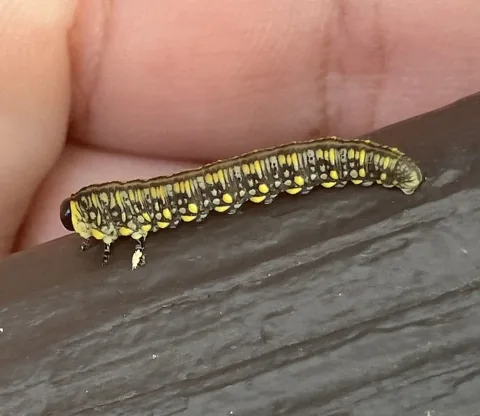 Introduced Pine Sawfly
Diprion similis
The introduced pine sawfly is a European sawfly whose larvae feed on pine needles, especially eastern white pine, often stripping the upper half of the tree.
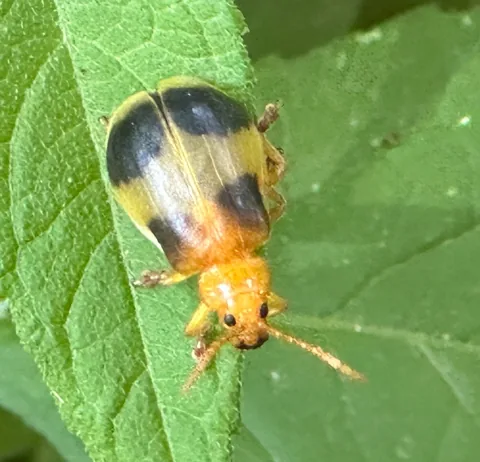 Larger Elm Leaf Beetle
Monocesta coryli
The larger elm leaf beetle is one of our largest leaf beetles. It often appears suddenly in great numbers, defoliates elms heavily for a year or two, then disappears for years. UF/IFAS calls it one of the most conspicuous leaf beetles in Florida, usually uncommon there but occasionally abundant enough to defoliate native and exotic elms.
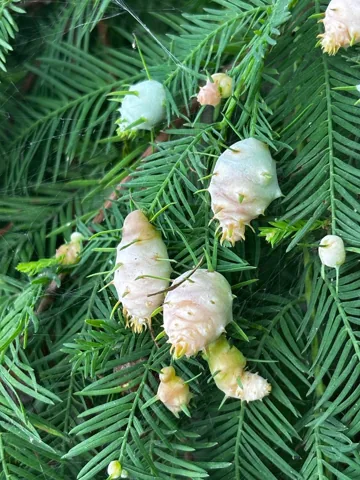 Cypress Twig Gall Midge
Taxodiomyia cupressiananassa
The cypress twig gall midge is a tiny fly whose maggots make spongy galls on bald cypress and pond cypress. The galls are often mistaken for cones and are unsightly, but they don't really harm the tree, and insecticides aren't recommended.
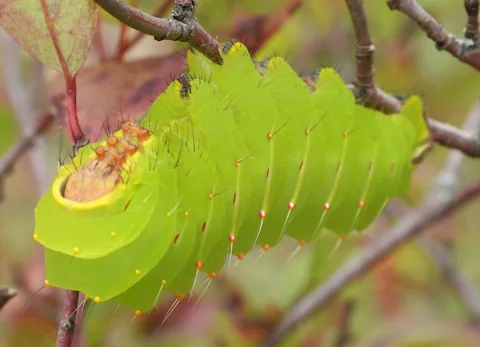 Polyphemus Moth
Antheraea polyphemus
The polyphemus moth is a giant silk moth, the second largest moth in Missouri, with a very large eyespot in the middle of each hind wing. Its plump, bright green caterpillar eats the leaves of many trees but is rarely numerous enough to need control.
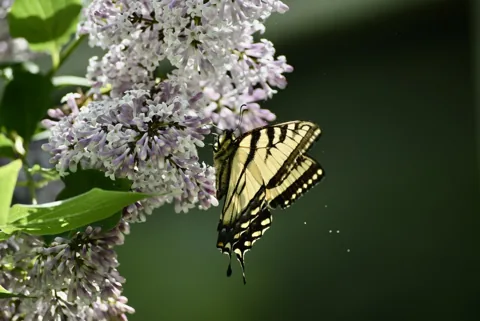 Eastern Tiger Swallowtail
Papilio glaucus
The eastern tiger swallowtail is a large yellow butterfly with black tiger stripes. Its smooth green caterpillars carry a pair of false eyespots and feed on the leaves of trees such as tulip tree, cherry and ash; MU Extension counts very few swallowtails as important pests.
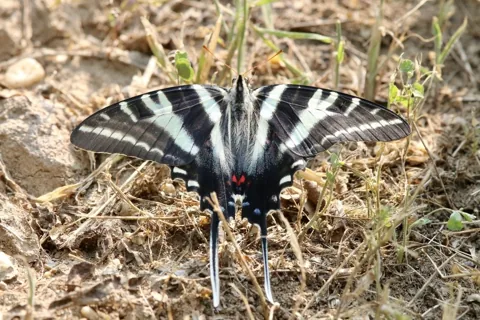 Zebra Swallowtail
Protographium marcellus (iNaturalist: Eurytides marcellus)
The zebra swallowtail is a pale butterfly with black stripes and long hindwing tails. Its caterpillars feed only on pawpaw, usually without harming the shrub much, so it isn't treated as a pest. It is harmless to people and pets, and gardeners who want to see it are encouraged to plant pawpaw.
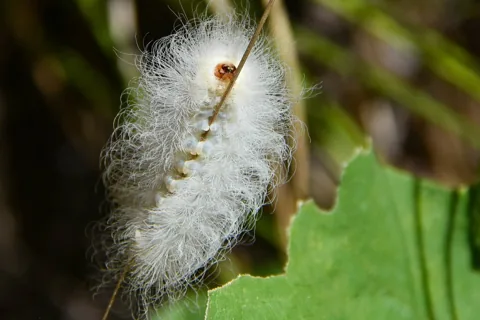 Black-waved Flannel Moth
Megalopyge crispata (also listed as Lagoa crispata)
The black-waved, or crinkled, flannel moth caterpillar is a fuzzy caterpillar that looks a lot like the puss caterpillar. Its coat of long, soft hairs hides short venomous spines that sting if you brush against it or pick it up.
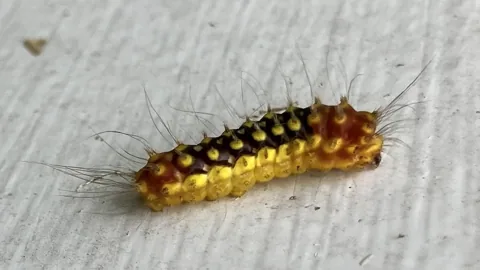 White Flannel Moth
Norape ovina
The white flannel moth caterpillar, also called the hackberry leafslug, is a stinging caterpillar that NC State says turns up more often on redbud than on hackberry. Brushing bare skin against it breaks off stinging hairs, and the sting is about like a bee's or wasp's.
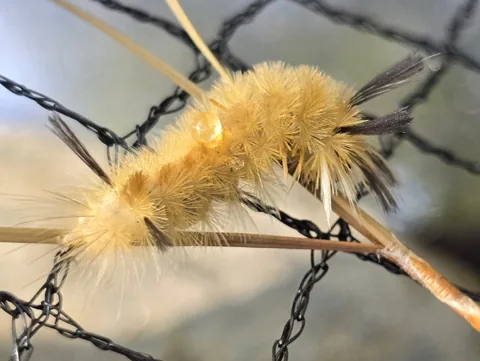 Banded Tussock Moth
Halysidota tessellaris
The banded tussock moth caterpillar, also called the pale tussock moth caterpillar, is a fuzzy tan to gray caterpillar with long black and white hair pencils at both ends. It is a tiger moth, not one of the true tussock moths, and it feeds on the leaves of many hardwood trees.
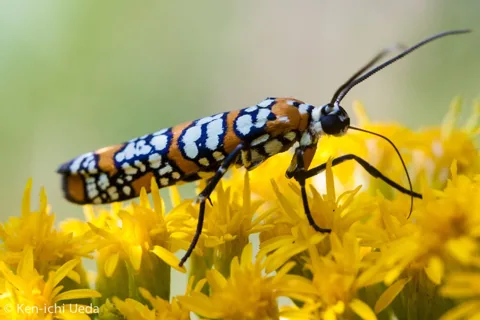 Ailanthus Webworm
Atteva aurea
The ailanthus webworm is a small, narrow orange moth with white black-ringed spots that visits flowers by day; its caterpillars live together in flimsy webs on tree-of-heaven (ailanthus). It is rarely numerous enough to defoliate its host.
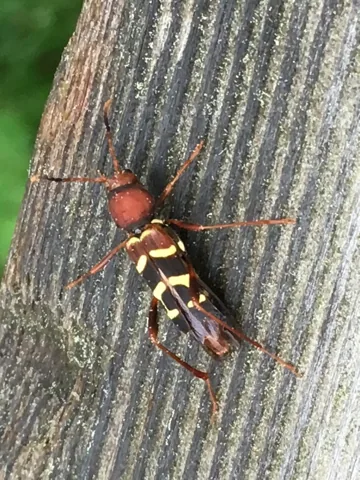 Redheaded Ash Borer
Neoclytus acuminatus
The redheaded ash borer, Neoclytus acuminatus, is a slender longhorned beetle about 1/2 to 5/8 inch long with a reddish head and thorax and yellow bands across dark wing covers; MDC says adults resemble wasps. Its grubs bore in newly planted, stressed, dying or dead hardwoods and bark-covered logs. NC State says beetles that emerge from firewood indoors can be a nuisance, and Kentucky entomologists say firewood borers have a very low potential to infest structural wood in a home. NC State's prevention advice is to keep trees healthy, and NPIC and Kentucky say to inspect firewood before moving it or bringing it in.
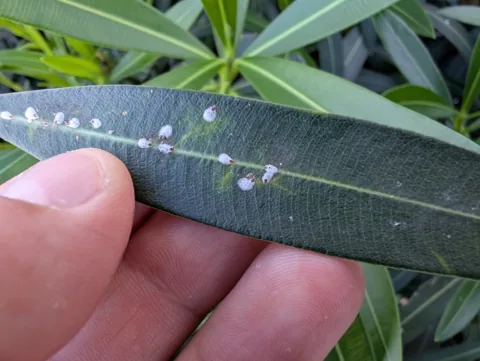 False Oleander Scale
Pseudaulacaspis cockerelli
False oleander scale is a non-native armored scale that dots the leaves of magnolia, sago palm, oleander and many other ornamentals with white covers and yellow spots. Heavy infestations make plants unsightly, drop leaves and slow growth.
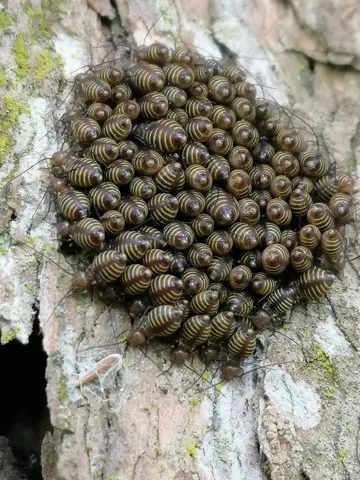 Barklice
Archipsocus nomas, Cerastipsocus venosus and other bark-dwelling psocids (order Psocodea)
Barklice are tiny, soft-bodied insects that live on tree bark. Some species blanket trunks and limbs in silky webbing or move over the bark in herds, but they feed on lichens, fungi and debris and do not harm the tree.
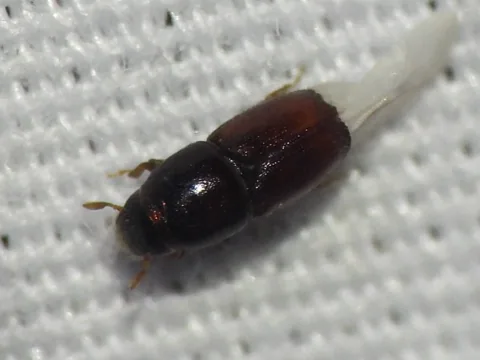 Elm Bark Beetles
Scolytus multistriatus, Scolytus schevyrewi and Hylurgopinus rufipes
Elm bark beetles are tiny reddish-brown to dark brown beetles, roughly 1/13 to 1/6 inch long depending on species, that breed under the bark of stressed, dying or dead elms and carry the Dutch elm disease fungus to healthy trees.
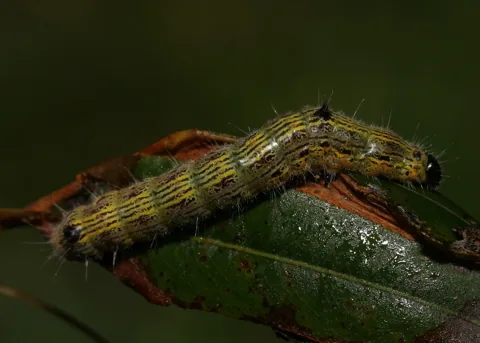 Poplar Tentmaker
Clostera inclusa
The poplar tentmaker is a hairy, yellow-striped caterpillar that lives in groups inside tents of leaves tied together with silk on poplar and willow, sometimes stripping trees by midsummer.
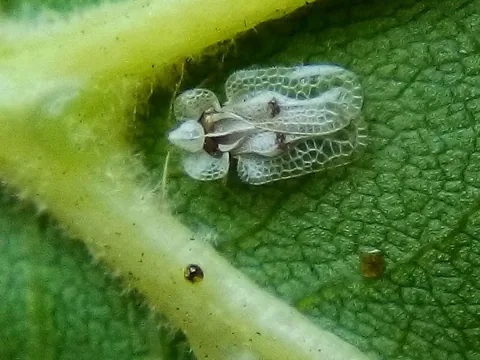 Sycamore Lace Bug
Corythucha ciliata
The sycamore lace bug (Corythucha ciliata) is a tiny, whitish, lacy-winged insect that feeds under sycamore leaves, stippling them white or yellow and leaving black varnish-like specks of excrement; heavy feeding can bronze the leaves and drop them in late summer.
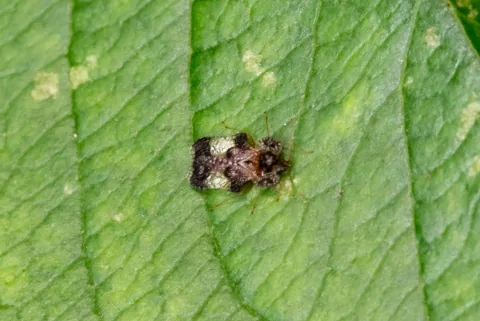 Hawthorn Lace Bug
Corythucha cydoniae
The hawthorn lace bug is a tiny insect with lacy, brown-spotted wings that feeds under the leaves of pyracantha, cotoneaster and hawthorn, leaving pale spots on top and dark specks of excrement below. NC State says it is native to the United States and was first recognized as a serious pest in the mid-1800s.
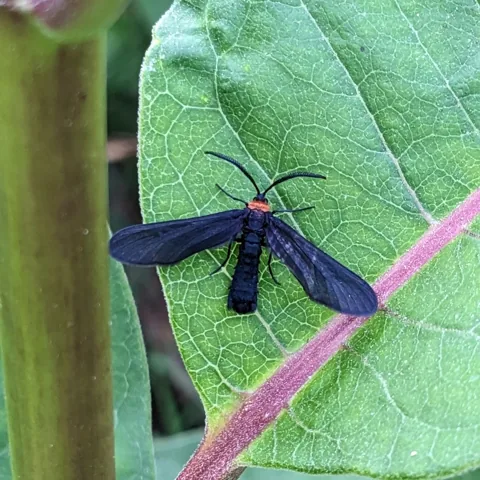 Grapeleaf Skeletonizer
Harrisina americana
The grapeleaf skeletonizer is a small black moth with an orange collar. Its yellow, black-marked caterpillars feed side by side in a row on the undersides of grape and Virginia creeper leaves, leaving only the veins.
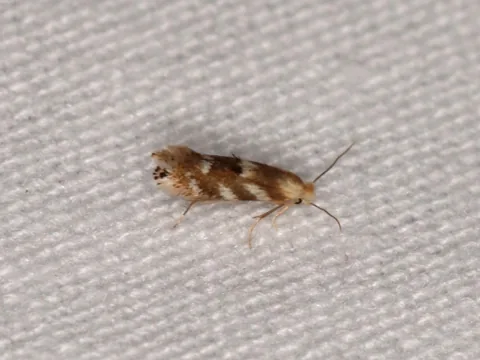 Birch Skeletonizer
Bucculatrix canadensisella
The birch skeletonizer is a tiny native moth whose caterpillars first mine and then skeletonize birch leaves in mid to late summer, leaving small, white, oval silk pads on the leaf undersides.
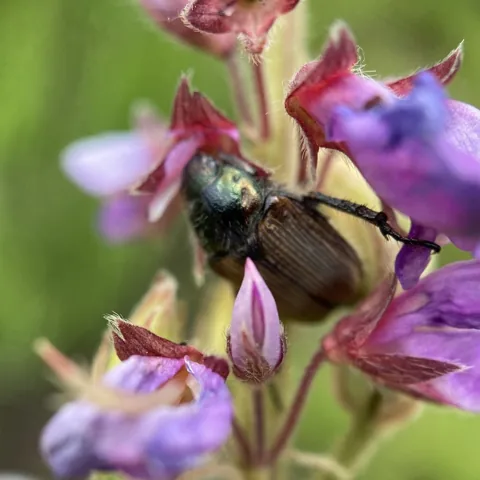 Spring Rose Beetle
Strigoderma arbicola (often written arboricola)
The spring rose beetle (false Japanese beetle) is a scarab about half an inch long that chews the flowers of roses, especially pale and white ones, and of iris, peony and lilies. Its grubs live in the soil and often attack crops grown in sandy soil, which is why it is also called the sand chafer.
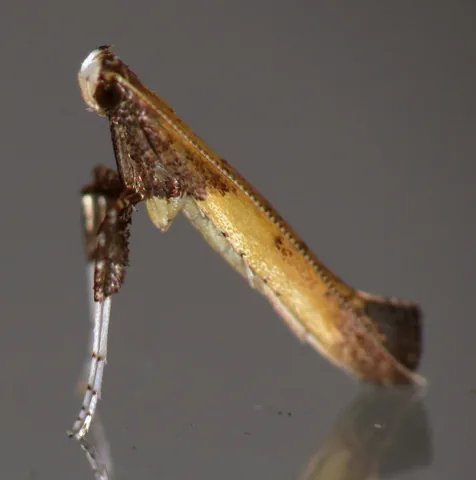 Azalea Leafminer
Caloptilia azaleella
The azalea leafminer is a tiny yellow moth with purplish wing markings. Its young caterpillars mine azalea leaves, making brown blisters, and older ones roll and tie the leaf tips with silk; azaleas are its only known host.
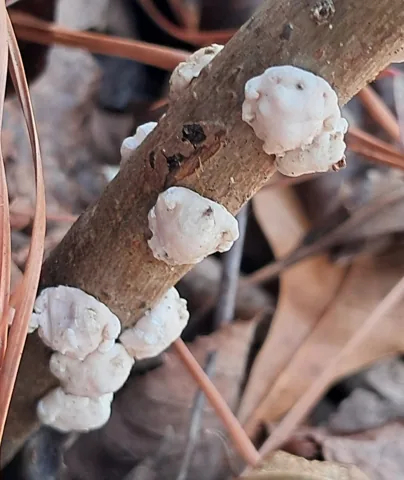 Indian Wax Scale
Ceroplastes ceriferus
Indian wax scale is a soft scale native to Asia. Its adult females are white, rounded wax lumps about 1/4 inch across that look like wads of gum on the twigs of hollies and other shrubs.
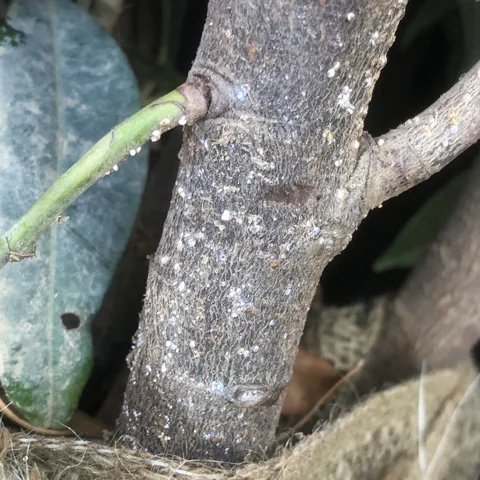 White Prunicola Scale
Pseudaulacaspis prunicola
White prunicola scale is a non-native armored scale that coats the twigs and branches of cherry laurel, flowering cherry, lilac and privet with tiny white covers, giving stems a snowy look and causing decline and dieback.
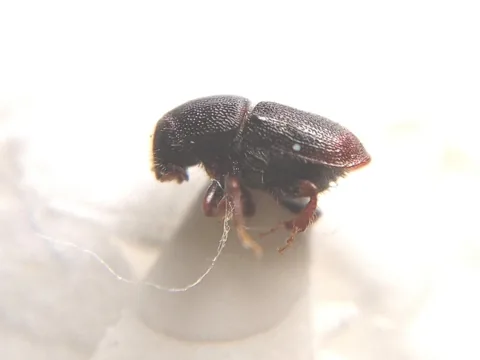 Shothole Borer
Scolytus rugulosus
The shothole borer is a tiny dark bark beetle, native to Europe, that riddles the bark of stressed fruit and ornamental trees with clusters of small round holes that often ooze gum. It's harmless to people and rarely kills a healthy tree, because healthy trees usually drown the beetles in resin or sap. To get rid of it, keep trees watered and healthy, prune out and destroy infested wood before spring, and don't leave fresh prunings or woodpiles near fruit trees; sprays are generally not recommended.
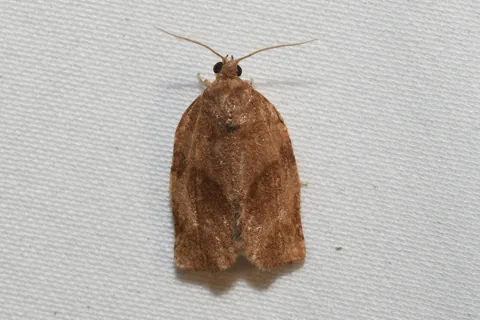 Obliquebanded Leafroller
Choristoneura rosaceana
The obliquebanded leafroller is a native moth whose green caterpillars, with brown to black heads, roll and tie leaves together with silk and feed on buds, blossoms, leaves and young fruit of apple and other fruit trees. Utah State says leafrollers often do not cause enough damage in most orchards or backyard trees to warrant treatment, and suggests checking shoot tips for rolled leaves or holes starting in mid-May and killing the caterpillars by hand or cutting out infested shoots. UMass says Bacillus thuringiensis kurstaki (Bt) may reduce larvae while they are still small.
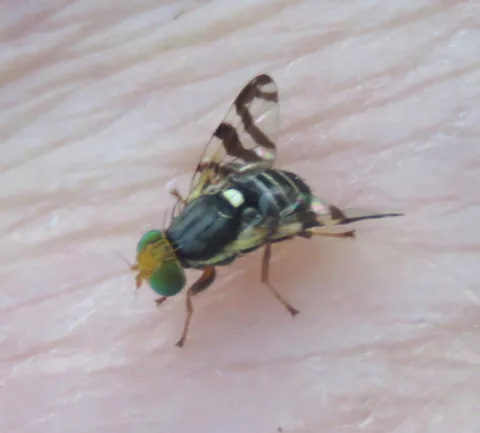 Western Cherry Fruit Fly
Rhagoletis indifferens
The western cherry fruit fly is a small fly, about 1/5 inch long with dark-banded wings, whose white maggots feed inside ripening sweet, tart and wild cherries in the western United States.
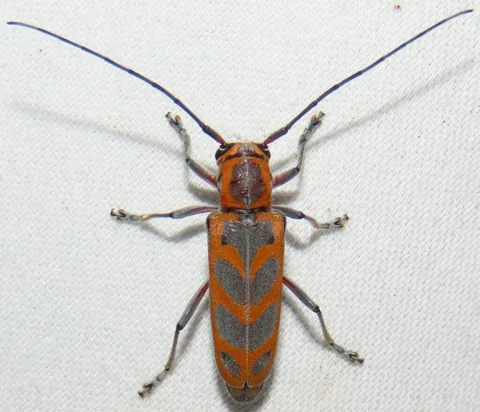 Elm Borer
Saperda tridentata
The elm borer is a gray-haired longhorned beetle with orange markings whose larvae bore under the bark of American and slippery elms, mostly trees or branches that are already weakened. Severe infestations can kill stressed elms, and the Missouri Department of Conservation says the beetle can transmit the Dutch elm disease fungus, though it is not the main carrier. A beetle that turns up indoors near the firewood most likely came out of the wood; the University of Kentucky says firewood borers have very low potential to infest structural wood, and it and NPIC both say not to spray firewood.
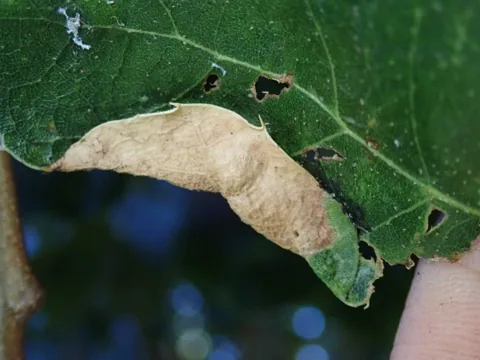 Woolly Oak Aphids
Stegophylla
Woolly oak aphids are small, pale aphids that cover themselves in fluffy white wax and feed on oak leaves, often inside leaves they curl into a shelter. They look alarming, but the damage is mostly cosmetic.
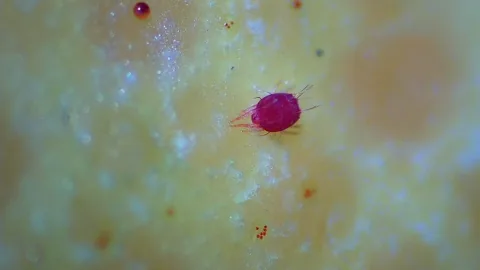 Citrus Red Mite
Panonychus citri
The citrus red mite is a tiny spider mite that feeds on the leaves, green twigs and fruit of citrus and also on roses, pears and a few ornamentals. Its feeding leaves a pale, silvery or grayish stipple.
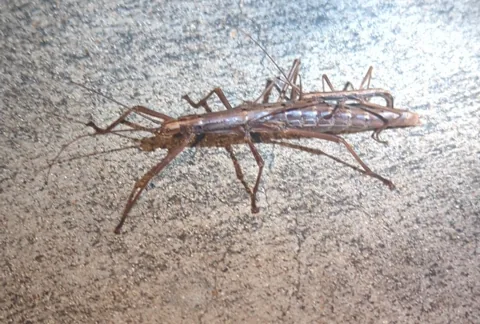 Northern Two-Striped Walkingstick
Anisomorpha ferruginea
The northern two-striped walkingstick, or musk mare, is a chunky, wingless brown stick insect of the southern and central United States. It can squirt a defensive spray from glands behind its head, and doctors have reported eye injuries from the spray of it and its southern relative.
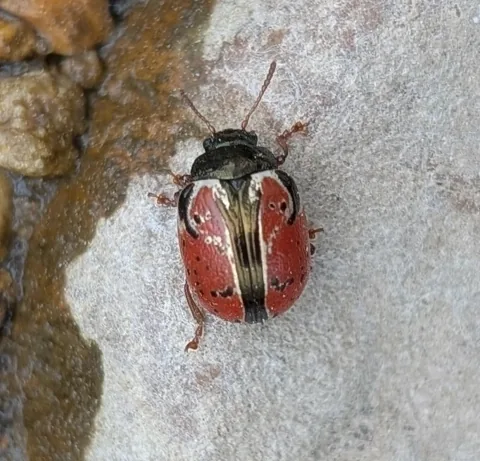 Ninebark Calligrapha
Calligrapha spiraeae
The ninebark calligrapha is a small, domed leaf beetle with ornate markings that eats the leaves of ninebark shrubs in late spring, sometimes chewing holes through much of the foliage.
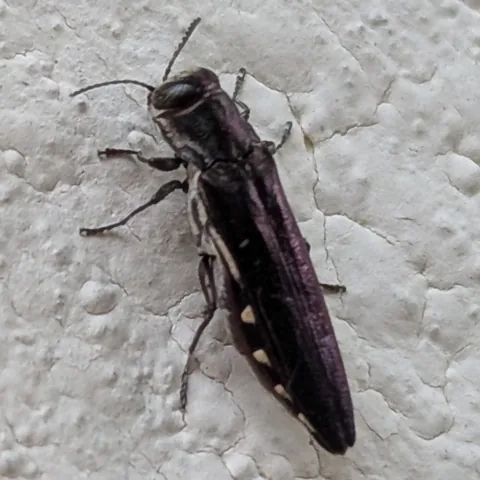 Honeylocust Borer
Agrilus difficilis
The honeylocust borer is a slender metallic wood-boring beetle whose larvae tunnel under the bark of honeylocust trees that are already stressed, leaving weeping wounds, D-shaped exit holes and branch dieback.
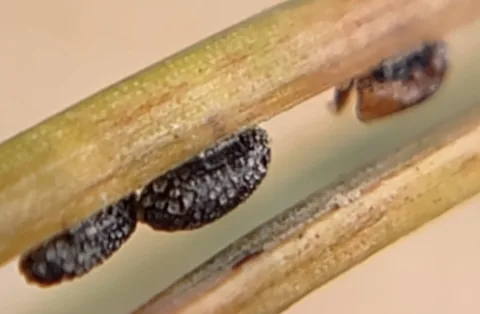 Pinyon Needle Scale
Matsucoccus acalyptus
Pinyon needle scale is a tiny native scale insect of pinyon pines in the Southwest. It feeds on older needles and thins trees until only tufts remain at the branch tips, and weakened trees are more open to pinyon ips.
No photo yet
Pinyon Ips
Ips confusus
The pinyon ips is a small engraver beetle that breeds under the bark of pinyon pines. It usually goes after stressed trees but in drought can kill healthy ones, and Colorado State says it kills more pinyon than any other pest.
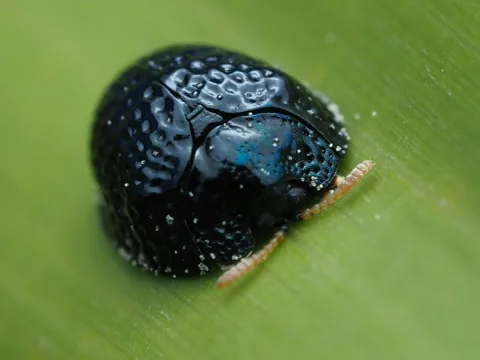 Palmetto Tortoise Beetle
Hemisphaerota cyanea
The palmetto tortoise beetle is a small, metallic dark blue-green beetle that lives on native palms in the coastal Southeast. It occasionally damages fronds but usually goes unnoticed. UF/IFAS, which calls it the Florida tortoise beetle, says it is the only tortoise beetle in its area that feeds on palms.
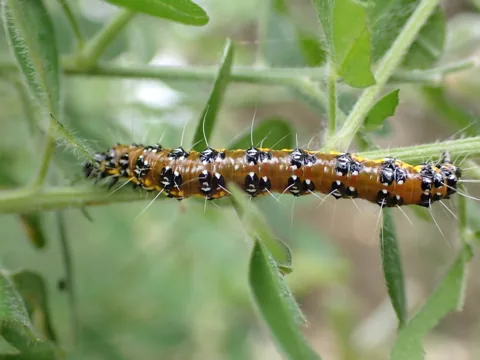 Genista Broom Moth
Uresiphita reversalis
The genista broom moth is a native moth whose black-spotted, yellow-patched caterpillars feed in groups and can strip the leaves of baptisia, brooms, Texas mountain laurel and other pea-family plants. The damage looks dramatic, but established plants usually recover. If you want to act, pick the caterpillars off into soapy water, or treat while they are still small; the caterpillars carry bitter plant alkaloids, so never eat them.
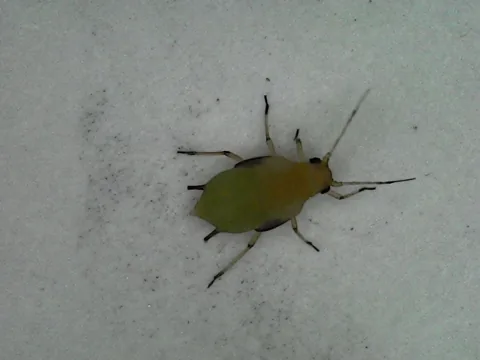 Spirea Aphid
Aphis spiraecola
The spirea aphid is a small green aphid that crowds the tender new shoots of spirea, apple, crabapple, pear, quince and hawthorn, curling leaves and leaving sticky honeydew.
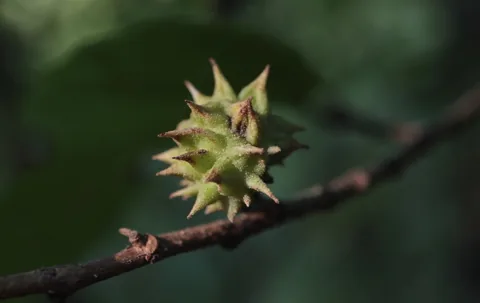 Spiny Witchhazel Gall Aphid
Hamamelistes spinosus
The spiny witchhazel gall aphid alternates between witchhazel, where it makes spiny bud galls, and birch, where it crinkles the leaves. Ohio State says river birch is its favorite birch.
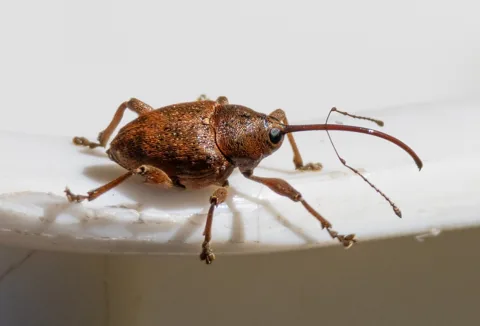 Acorn Weevils
Curculio
Acorn weevils are brown weevils with very long, slender snouts whose grubs develop inside acorns.
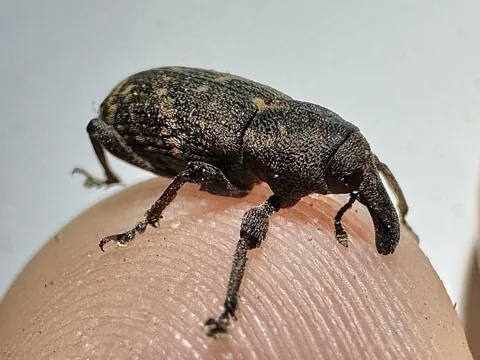 Pales Weevil
Hylobius pales
The pales weevil is a dark, night-feeding weevil that breeds in the roots of freshly cut pine stumps and chews the bark of nearby young conifers and twigs.
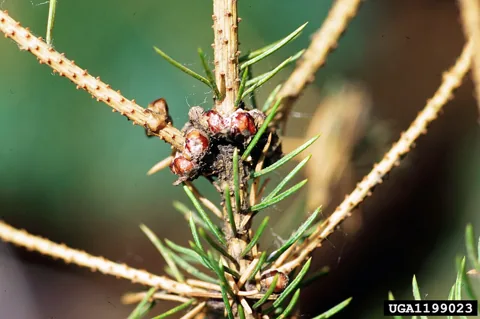 Spruce Bud Scale
Physokermes piceae
Spruce bud scale is a soft scale insect that clusters at the base of new spruce shoots, where the females look like buds.
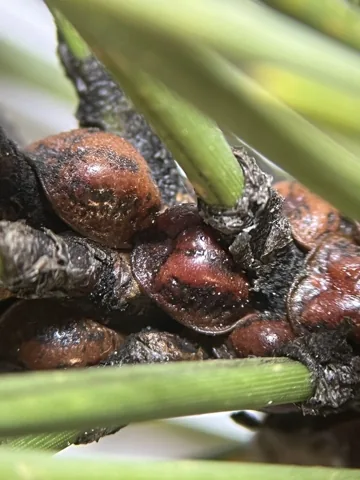 Pine Tortoise Scale
Toumeyella parvicornis
Pine tortoise scale is a soft scale insect native to North America that feeds on pine twigs and needles. Its honeydew grows black sooty mold, and it is one of the harder pests for Christmas tree growers to control.
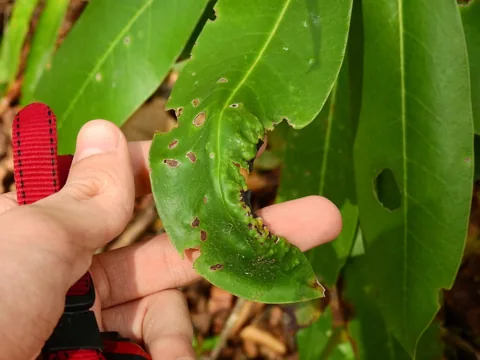 Rhododendron Gall Midge
Clinodiplosis rhododendri
The rhododendron gall midge is a tiny native fly whose maggots feed in the new growth of rhododendrons, curling and distorting the leaves.
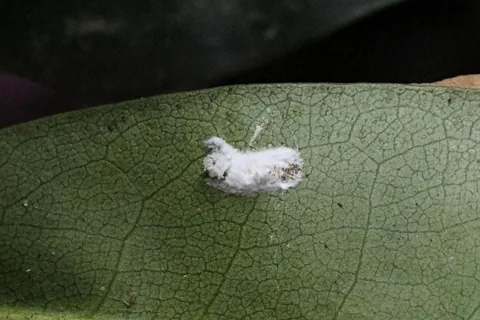 Cottony Camellia Scale
Pulvinaria floccifera
Cottony camellia scale, also called cottony taxus scale, is a soft scale whose females lay their eggs in long, fluffy white sacs under the leaves of camellia, yew, holly and many other shrubs.
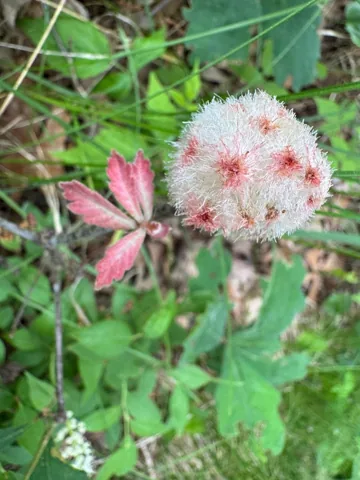 Wool Sower Gall Wasp
Callirhytis seminator
The wool sower gall wasp is a tiny gall wasp whose larvae make white oak twigs grow fluffy, cotton-ball galls in spring. The galls look odd, but NC State, Clemson and Illinois Extension all say they rarely harm the tree.
No photo yet
Apple Rust Mite
Aculus schlechtendali
The apple rust mite is a microscopic eriophyid mite that feeds on the undersides of apple leaves.
No photo yet
Bald Cypress Rust Mite
Epitrimerus taxodii
The bald cypress rust mite is a microscopic eriophyid mite that feeds only on bald cypress, turning the needles yellow and then rusty brown.
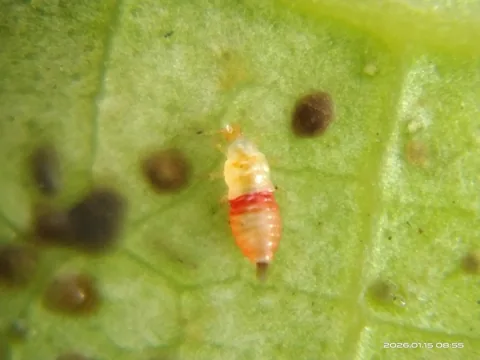 Redbanded Thrips
Selenothrips rubrocinctus
The redbanded thrips, also called the cocoa thrips, is a tiny tropical thrips that silvers and russets the leaves and fruit of mango, avocado, guava and many ornamental plants and leaves them spotted with black droppings. NC State says predators keep it in check most of the time; if it becomes too abundant, NC State says neem seed extracts, pyrethrums, pyrethroids and Orthene should all give adequate control.
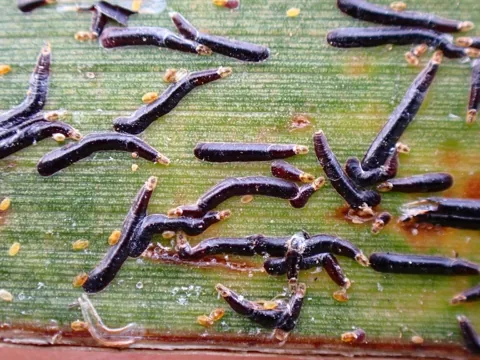 Black Thread Scale
Ischnaspis longirostris
Black thread scale (also called black line scale) is an armored scale insect whose long, thread-thin black covers line up on the leaves of palms, Swiss cheese plants and many other tropical plants. It sucks plant sap and is harmless to people. In large numbers the dark threads are conspicuous; inspect new plants, and treat infested plants with horticultural oil, which armored scales are susceptible to.
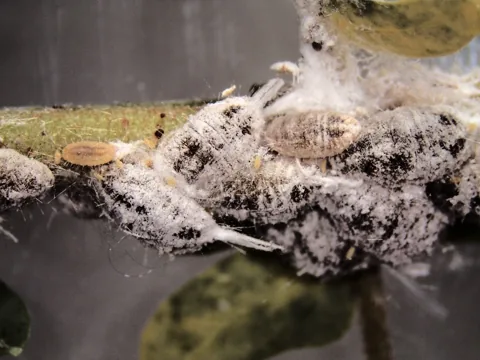 Striped Mealybug
Ferrisia virgata
The striped mealybug is a showy, sap-feeding mealybug marked by two dark stripes down its back. It feeds on an unusually wide range of ornamental, fruit, vegetable and field crops.
No photo yet
Rose Rosette Mite
Phyllocoptes fructiphilus
The rose rosette mite is a microscopic eriophyid mite that feeds on roses and carries rose rosette virus from plant to plant. The disease it spreads has no cure.
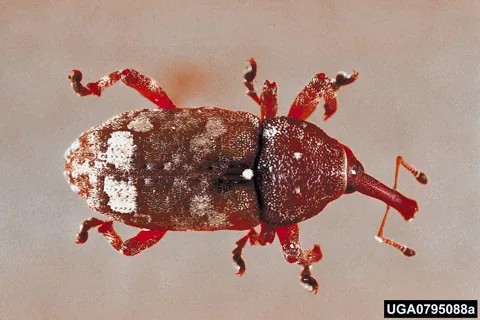 Deodar Weevil
Pissodes nemorensis
The deodar weevil, also called the eastern or northern pine weevil, is a native snout beetle whose grubs tunnel under the bark of stressed pines and other conifers.
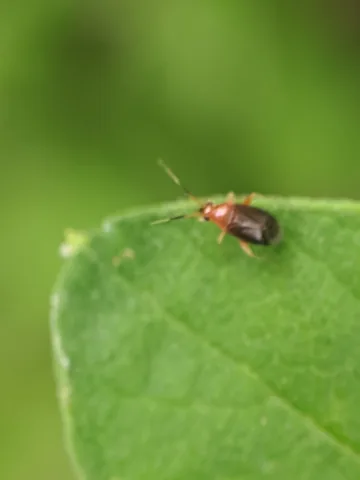 Azalea Plant Bug
Rhinocapsus vanduzeei
The azalea plant bug is a tiny native plant bug, about 1/8 inch long, that lives in azalea flowers in spring. It does little harm to the plants, slightly deforming some flowers and mattering mainly on azaleas grown for seed, but it often bites gardeners working in their azaleas, leaving a painful, chigger-like welt. Control is rarely needed; if it is, products labeled for plant bugs, such as carbaryl (Sevin) or pyrethrins, should work.
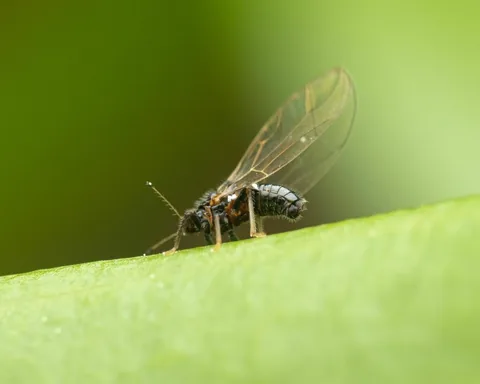 Persimmon Psyllid
Baeoalitriozus diospyri (syn. Trioza diospyri)
The persimmon psyllid is a tiny sap-feeding insect that curls and distorts the new leaves of Japanese, ornamental and native persimmons.
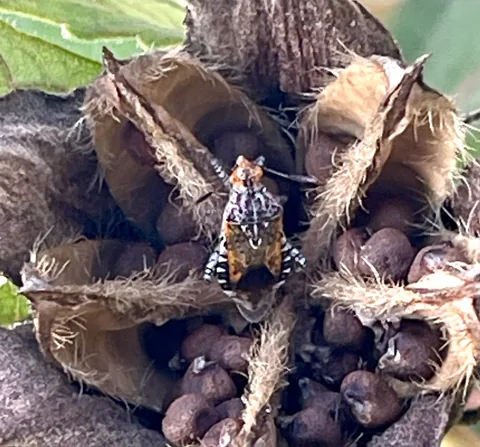 Hibiscus Scentless Plant Bug
Niesthrea louisianica
The hibiscus scentless plant bug is a small white-to-gray bug with black markings and a yellow-to-orange head that feeds on the buds and seeds of rose of Sharon, hibiscus, hollyhock and other mallows. Crowds of them on dry seed pods in late summer and fall can be startling, but they seldom hurt the plant, and control is usually not needed; picking them off by hand works if they bother you.
No photo yet
Purple Mite
Calacarus carinatus
The purple mite is a microscopic eriophyid mite that feeds on camellia and tea leaves, turning them purple, then bronze. The white cast skins it leaves behind are easier to see than the mites.
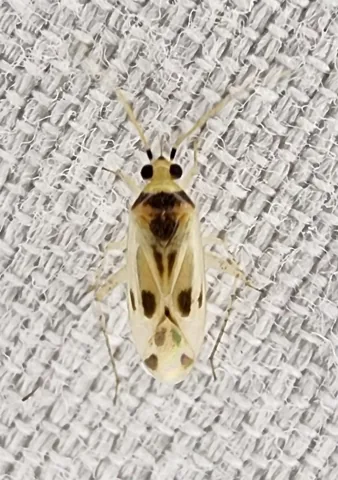 Sycamore Plant Bug
Plagiognathus albatus
The sycamore plant bug is a small plant bug whose nymphs and adults suck sap from young sycamore and London planetree leaves in spring, leaving spots that brown and fall out.
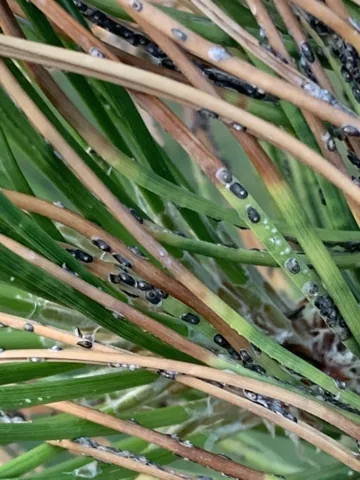 Black Pineleaf Scale
Dynaspidiotus californicus (formerly Nuculaspis californica)
Black pineleaf scale is a small native armored scale insect that feeds on the needles of pines and Douglas-fir.
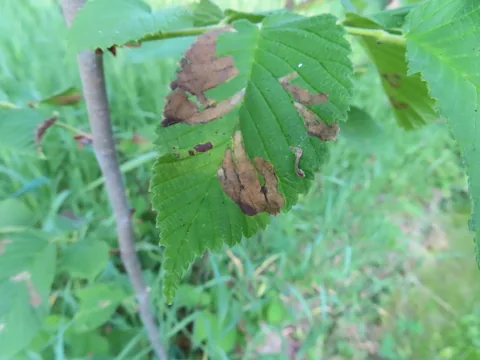 Elm Leafminer
Fenusa ulmi (syn. Kaliofenusa ulmi)
The elm leafminer is a small European sawfly whose larvae mine the leaves of elms in spring.
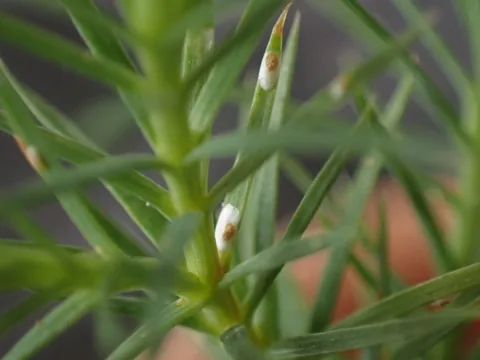 Minute Cypress Scale
Carulaspis minima
Minute cypress scale is a tiny armored scale that sucks sap from the needles and twigs of junipers, cypresses, arborvitae and other members of the cypress family. Light infestations usually go unnoticed, but heavy ones can cause needle drop, branch dieback and, on stressed plants, death.
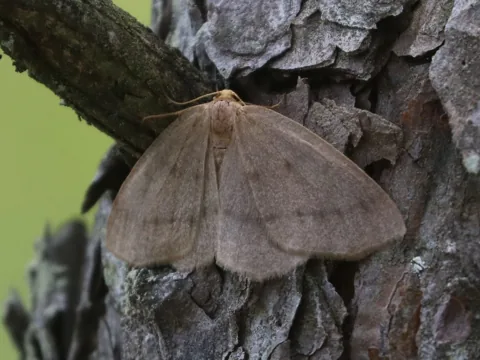 Eastern Pine Looper
Lambdina pellucidaria
The eastern pine looper, also called the pitch pine looper, is a native inchworm that chews the needles of pitch, red and other hard pines. Most years it goes unnoticed, but it has cyclical outbreaks.
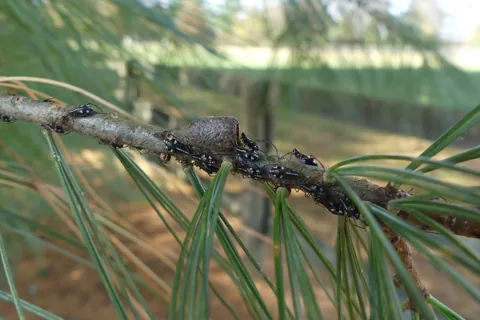 White Pine Aphid
Cinara strobi
The white pine aphid is a large, long-legged, shiny black aphid that feeds in dense clusters on the twigs, branches and trunks of eastern white pine, and sometimes crawls out of a white pine Christmas tree indoors. Light infestations do little harm, but heavy ones coat trees with honeydew and sooty mold and can stunt or kill twigs and small trees. To get rid of it, let natural enemies work, hose aphids off or remove the overwintering eggs, and if more than 30 percent of a tree's shoots have colonies, use insecticidal soap or horticultural oil.
No photo yet
Pine Root Collar Weevil
Hylobius radicis
The pine root collar weevil is a native weevil whose larvae feed on the inner bark at the root collar of pines, girdling young trees.
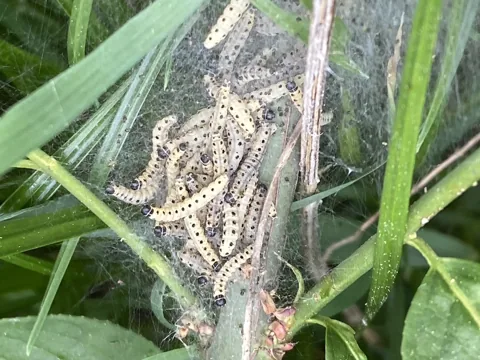 Euonymus Caterpillar
Yponomeuta cagnagella
The euonymus caterpillar is the larva of the spindle ermine moth, a European moth whose webbing caterpillars defoliate euonymus.
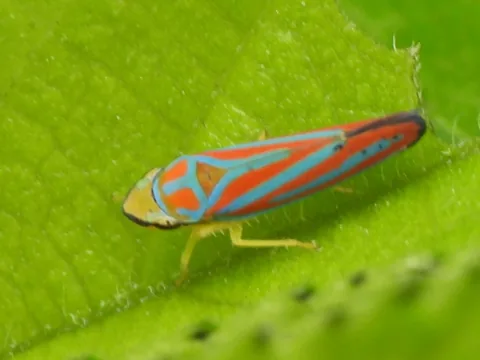 Redbanded Leafhopper
Graphocephala coccinea
The redbanded leafhopper, also called the candy-striped leafhopper, is a brightly striped sharpshooter that feeds on rhododendron, roses and many other plants. The damage is mostly cosmetic, and MDC notes that the vast majority of leafhoppers are not pests.
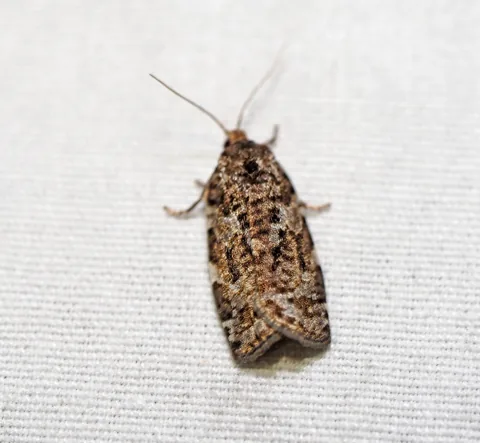 Eastern Spruce Budworm
Choristoneura fumiferana
The eastern spruce budworm is a native caterpillar that periodically defoliates balsam fir and spruce across northern North America; the USDA Forest Service calls it one of the most destructive native insects in northern spruce-fir forests.
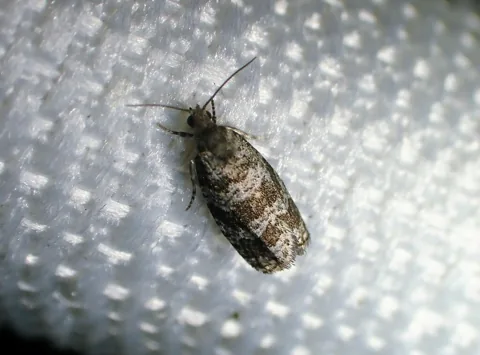 Spruce Needleminer
Taniva albolineana (formerly Endothenia albolineana)
The spruce needleminer is a small tortricid moth whose caterpillars hollow out spruce needles, cut them loose and tie the dead needles together with silk into clumps. The damage is usually cosmetic, though UMass says small trees are occasionally hurt badly.
No photo yet
Pear Thrips
Taeniothrips inconsequens
Pear thrips are tiny dark thrips, introduced from Europe, that feed inside the opening buds of sugar maple, fruit trees and other hardwoods each spring, leaving tattered, mottled, dwarfed leaves. UMass and Penn State describe them only as tree pests. On shade trees the usual answer is to wait: healthy maples that lose leaves can refoliate within weeks, outbreak years are followed by years of little damage, and sprays rarely reach thrips hidden in the buds.
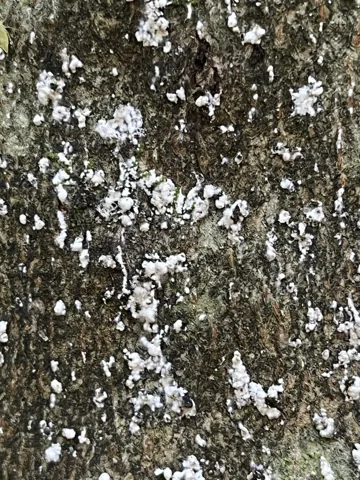 Beech Scale
Cryptococcus fagisuga
Beech scale (Cryptococcus fagisuga) is a tiny, non-native scale insect that covers beech bark with white wool. It does not harm people or pets, but its feeding opens the bark to Neonectria fungi, and together they cause beech bark disease, which can kill beech trees. On a single landscape tree the scales can be brushed or washed off, or treated while the crawlers are out; in forests, the long-term hope is resistant beech.
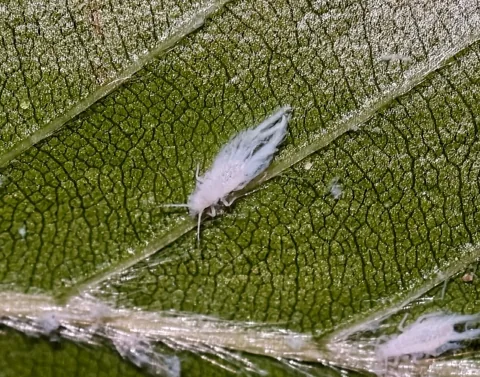 Woolly Beech Aphid
Phyllaphis fagi
The woolly beech aphid is a European aphid that feeds in white, waxy colonies under the leaves of European beech and drips sticky honeydew. Ohio State calls it obvious but not serious.
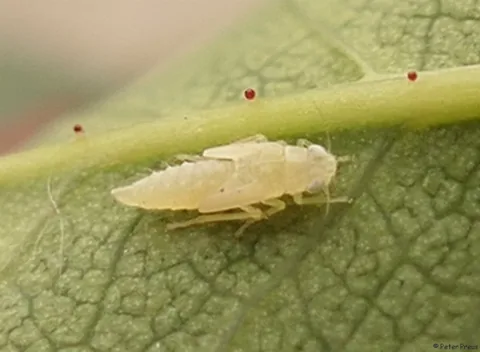 Rose Leafhopper
Edwardsiana rosae
The rose leafhopper is a small, pale, whitish-green leafhopper from Europe. It lays its overwintering eggs in rose and bramble canes, breeds on roses in spring and spends the summer on apple, dogwood, oak, maple and other trees, where its feeding leaves pale stippling on the leaves.
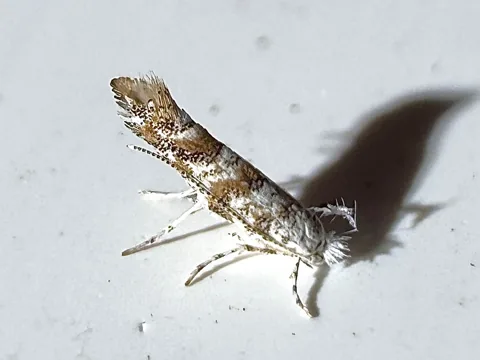 Solitary Oak Leafminer
Cameraria hamadryadella
The solitary oak leafminer is a tiny native moth whose caterpillars feed inside oak leaves, each in its own blotch mine. Heavy infestations brown the leaves, but the injury is largely cosmetic.
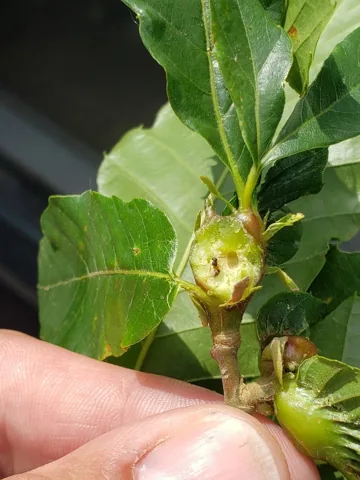 Asian Chestnut Gall Wasp
Dryocosmus kuriphilus
The Asian chestnut gall wasp is an invasive wasp from China whose larvae turn chestnut buds into galls, stunting shoots and cutting nut production.
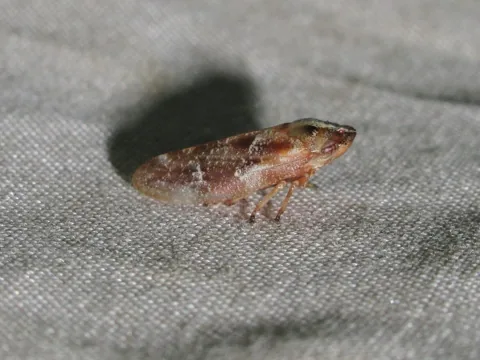 Saratoga Spittlebug
Aphrophora saratogensis
The Saratoga spittlebug is a native spittlebug whose nymphs feed on sweetfern and other ground plants while the adults feed on young pines, especially red pine. Michigan DNR says it causes growth loss, deformity and death in young plantation red pine in the Lake States.
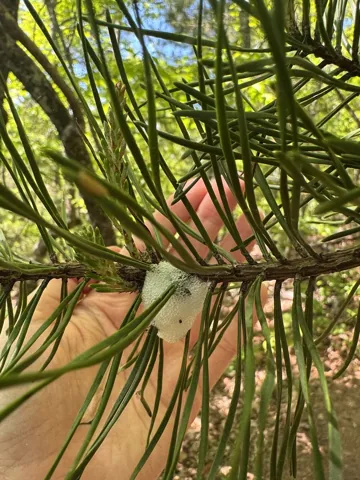 Pine Spittlebug
Aphrophora cribrata
The pine spittlebug is a sap-feeding froghopper of eastern North America whose nymphs hide under frothy spittle on pine twigs. Heavy, repeated infestations kill branches and can kill trees, especially in young plantations.
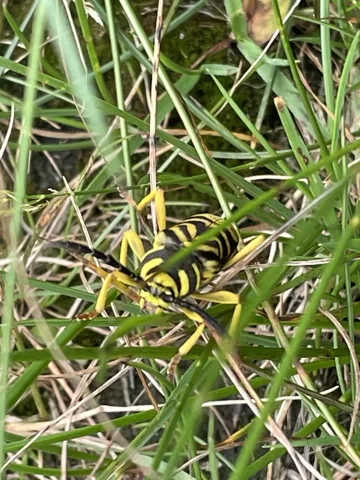 Sugar Maple Borer
Glycobius speciosus
The sugar maple borer is a native black-and-yellow longhorned beetle, about 1 inch long, whose larvae tunnel under the bark of living sugar maples for two years. It does not harm people or pets. It rarely kills a tree outright, though it can kill branches, weaken trees and leave long bark ridges and C-shaped scars, and Canada's forest service calls it the most destructive maple pest there. Keep maples healthy, check trunks in summer for wet spots and sawdust, and dig out young larvae; insecticides are usually unnecessary in home landscapes.
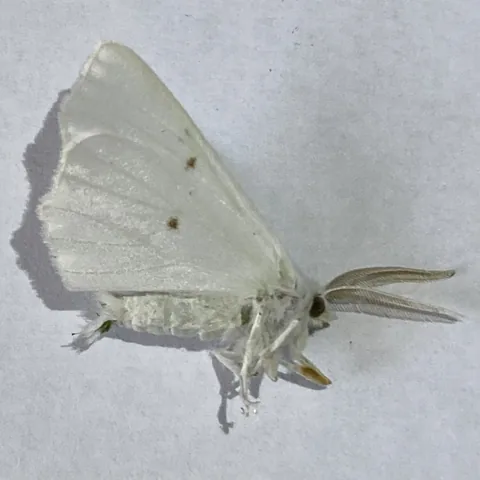 Elm Spanworm
Ennomos subsignaria
The elm spanworm is a native inchworm that feeds on many hardwoods besides elm and periodically defoliates large forest areas.
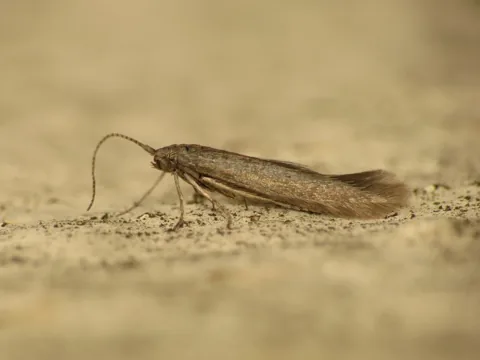 Larch Casebearer
Coleophora laricella
The larch casebearer is a European moth whose tiny caterpillars mine larch needles and carry cases made from hollowed-out needles.
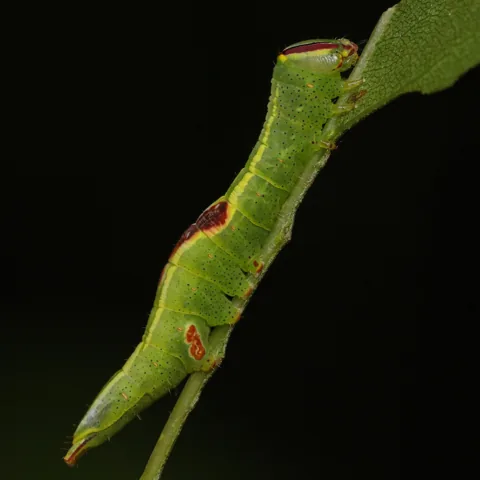 Saddled Prominent
Heterocampa guttivitta
The saddled prominent is a native moth whose caterpillars periodically defoliate beech, sugar maple and birch forests in late summer.
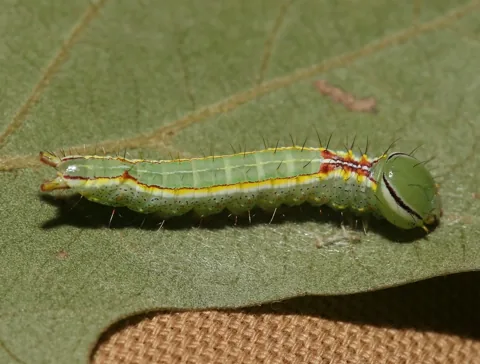 Variable Oakleaf Caterpillar
Lochmaeus manteo (formerly Heterocampa manteo)
The variable oakleaf caterpillar is a native caterpillar that defoliates oaks and other hardwoods in eastern North America, mostly late in the season.
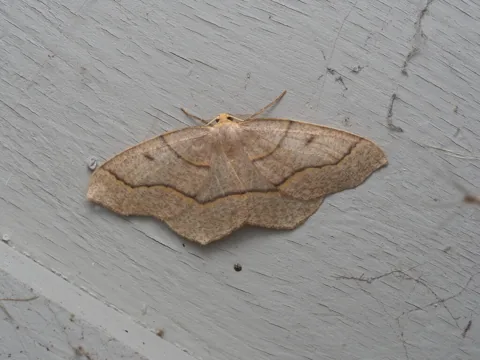 Hemlock Looper
Lambdina fiscellaria
The hemlock looper is a native inchworm that defoliates hemlock and balsam fir, and in an outbreak it can kill hemlock after a single year of defoliation.
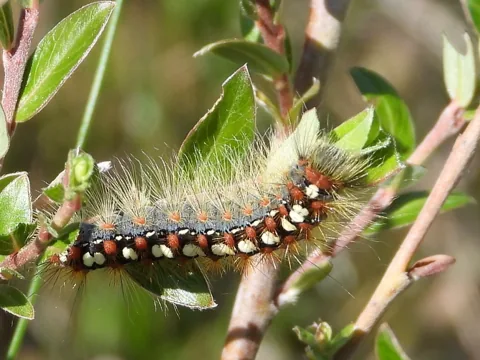 Satin Moth
Leucoma salicis
The satin moth is a tussock moth from Europe and Asia whose hairy caterpillars defoliate poplars, aspens and willows. It reached North America around 1920 and now occurs across southern Canada, the Northeast and much of the West.
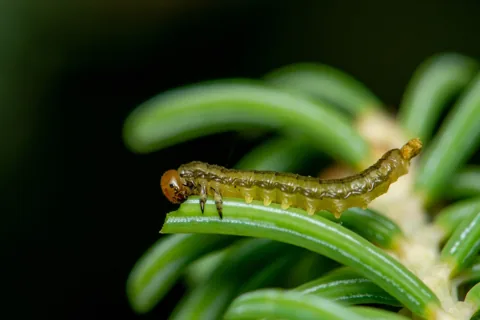 Yellowheaded Spruce Sawfly
Euura alaskensis (formerly Pikonema alaskensis)
The yellowheaded spruce sawfly is a native sawfly whose larvae defoliate spruce, especially open-grown yard trees, windbreaks and young plantations. Three or four years of heavy feeding in a row can kill a tree.
No photo yet
Azalea Sawfly
Euura azaleae (formerly Amauronematus azaleae)
Azalea sawflies are wasp relatives whose green larvae eat azalea leaves from the edges in late spring.
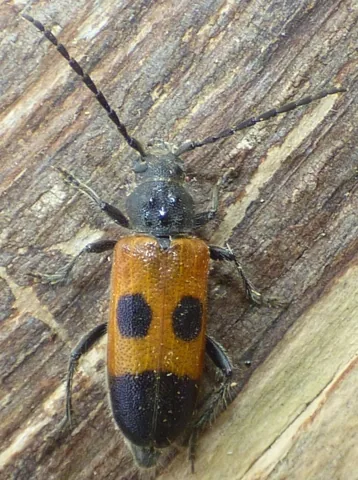 Cedar Tree Borer
Semanotus ligneus
The cedar tree borer, Semanotus ligneus, is a native longhorned beetle about 8-12 mm long whose larvae tunnel in juniper, cedar and arborvitae that are already stressed, dying or dead. It is a secondary pest, not the cause of a tree's decline, so UMass Extension does not recommend chemical treatment. Is it harmful? No: Kentucky entomologists say the wood borers that sometimes emerge from firewood brought indoors are harmless and very unlikely to infest structural wood. To deal with it, keep junipers and cedars healthy and inspect or shake firewood before bringing it inside.
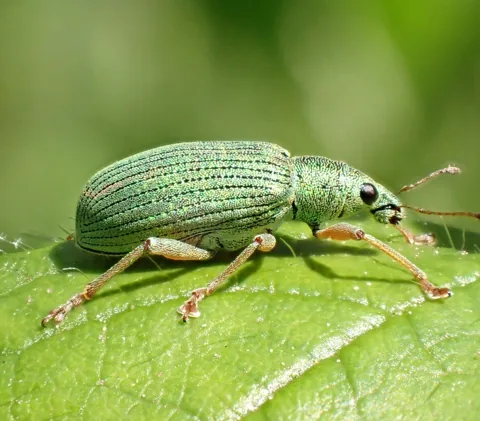 Polydrusus Weevils
Polydrusus formosus and P. impressifrons
Polydrusus weevils are small introduced weevils covered with iridescent green scales that feed on tree and shrub leaves in summer.
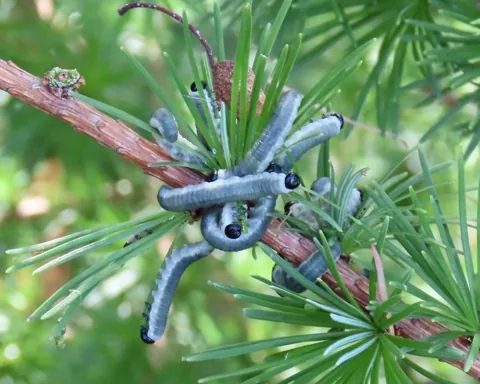 Larch Sawfly
Pristiphora erichsonii
The larch sawfly is a sawfly whose larvae feed in groups on the needles of tamarack and other larches.
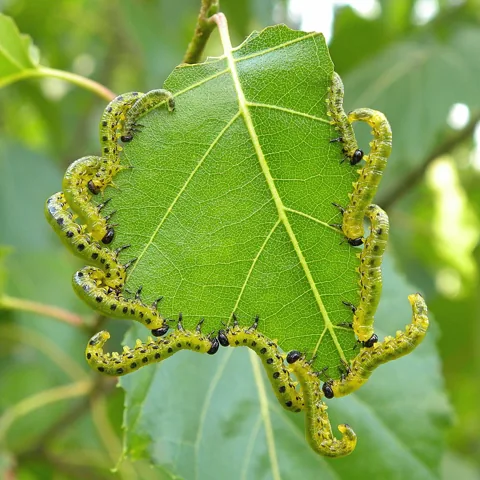 Dusky Birch Sawfly
Croesus latitarsus
The dusky birch sawfly is a native sawfly whose black-spotted larvae feed in groups along the edges of birch leaves. Defoliation can look alarming, but several sources say it rarely needs chemical control.
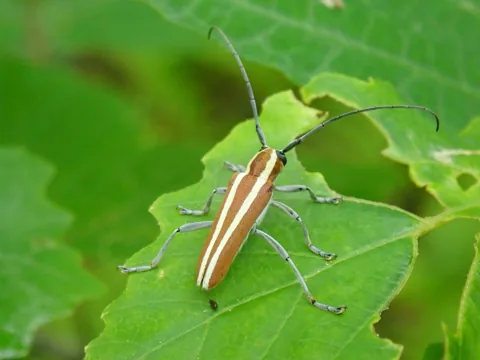 Roundheaded Appletree Borer
Saperda candida
The roundheaded appletree borer is a native longhorned beetle whose larvae tunnel in the lower trunks of apple and its relatives; UNH Extension calls it the most serious borer in New Hampshire apple trees.
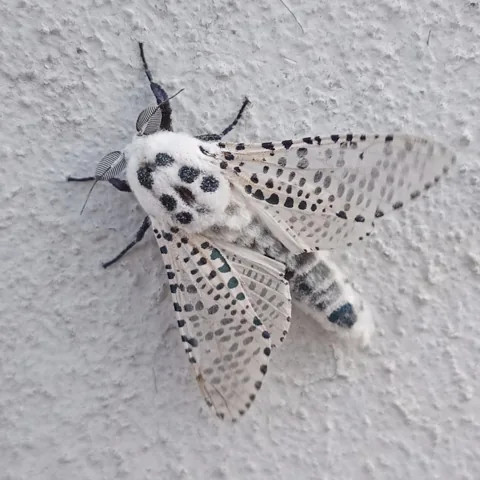 Leopard Moth
Zeuzera pyrina
The leopard moth is a European moth whose caterpillars bore into the wood of many hardwood trees and shrubs, girdling and breaking branches. In New England it is uncommon and usually minor.
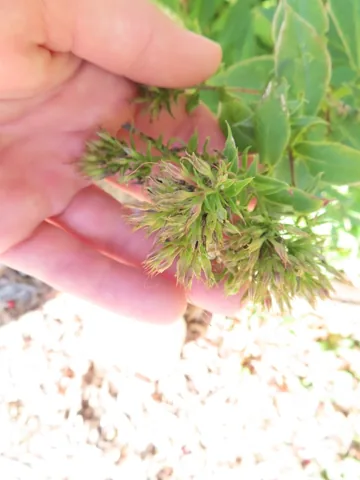 Honeysuckle Aphid
Hyadaphis tataricae
The honeysuckle aphid is a tiny European aphid whose feeding turns bush honeysuckle shoot tips into dense witches' brooms.
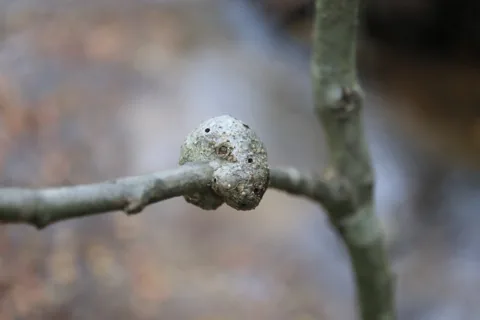 Gouty Oak Gall Wasp
Callirhytis quercuspunctata
The gouty oak gall is a woody twig gall caused by a tiny wasp, Callirhytis quercuspunctata, on pin and other red-group oaks.
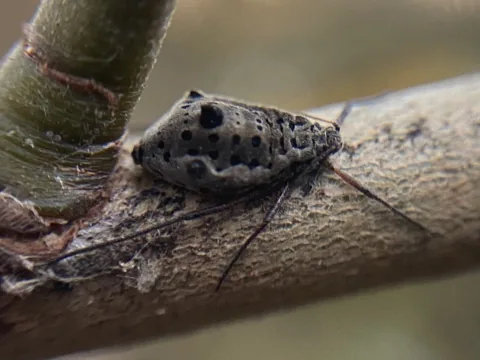 Giant Willow Aphid
Tuberolachnus salignus
The giant willow aphid is one of the largest aphids in the world: a brown, hairy aphid with a shark-fin bump on its back that forms dense colonies on the bark of willow twigs and stems in late summer and fall. UMass and PNW Handbooks say damage to the tree is usually minimal, but colonies drip honeydew that grows sooty mold, and UMass says the honeydew attracts stinging insects. UMass suggests pruning out heavily infested twigs while numbers are low or knocking aphids off with a strong jet of water.
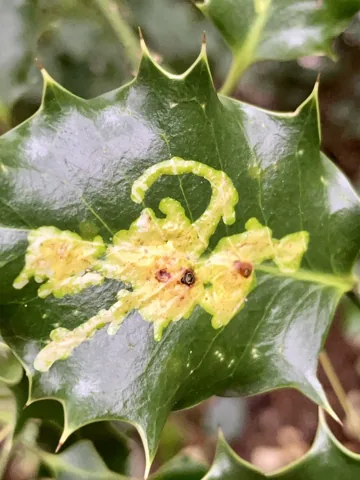 European Holly Leafminer
Phytomyza ilicis
The European holly leafminer is a tiny fly whose larvae mine the leaves of English holly.
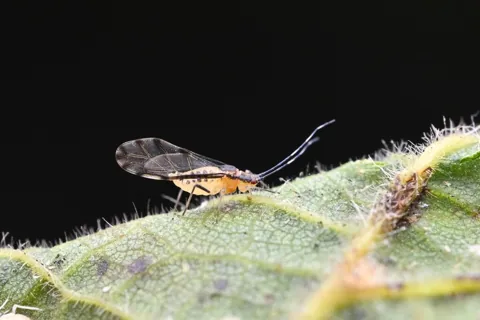 Linden Aphid
Eucallipterus tiliae
The linden aphid is a European aphid that feeds in colonies under linden leaves and is best known for the sticky honeydew it drips.
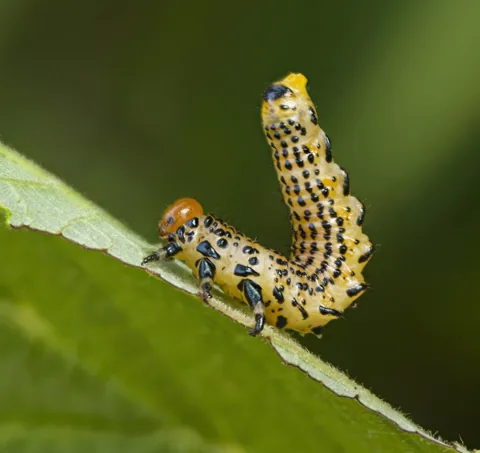 Birch Sawfly
Arge pectoralis
The birch sawfly is a native sawfly whose larvae feed in groups along the edges of birch leaves in summer.
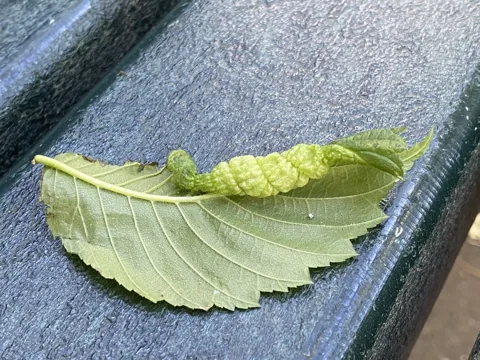 Woolly Elm Aphid
Eriosoma americanum
The woolly elm aphid curls American elm leaves in spring and spends the summer on serviceberry roots. On elm it's mostly a cosmetic problem.
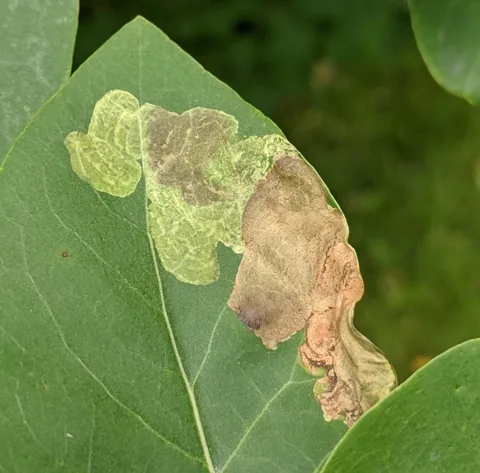 Lilac Leafminer
Gracillaria syringella (formerly Caloptilia syringella)
The lilac leafminer is a small European moth whose caterpillars mine, fold and skeletonize the leaves of lilac and privet. Usually only a few leaves are hit, and UVM says insecticides are rarely warranted.
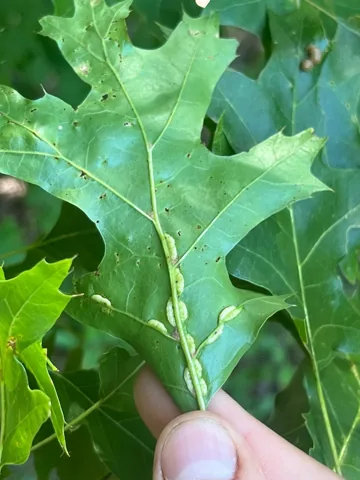 Oak Vein Pocket Gall Midge
Macrodiplosis qoruca (often written M. quercusoruca)
The oak vein pocket gall midge is a tiny fly whose maggots cause pocket-like swellings along the veins of pin oak and other red oak leaves in spring, sometimes on nearly every leaf of a tree.
No photo yet
Privet Rust Mite
Aculus ligustri
The privet rust mite is a microscopic eriophyid mite that feeds on privet, leaving leaves dull and distorted.
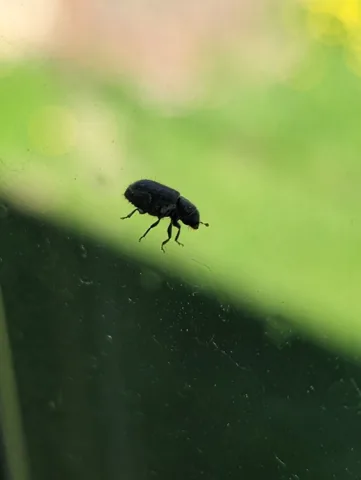 Spruce Beetle
Dendroctonus rufipennis
The spruce beetle is a native bark beetle and a major cause of spruce death in North America, especially in Alaska, western Canada and the Rocky Mountains.
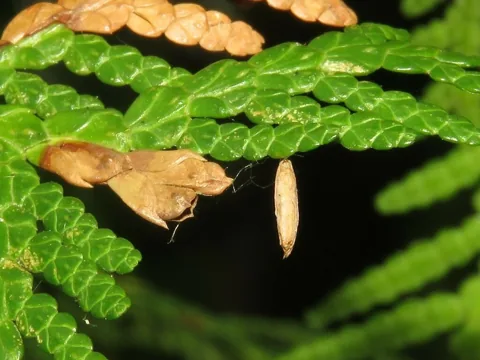 Arborvitae Leafminer
Argyresthia thuiella
The arborvitae leafminer is a tiny moth whose caterpillars mine arborvitae foliage, turning branch tips yellow and then brown.
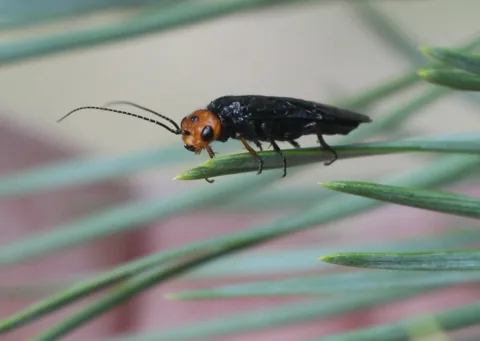 Pine False Webworm
Acantholyda erythrocephala
The pine false webworm is a sawfly from Europe and Asia whose larvae feed on pine needles from inside loose webs and silk tubes packed with clipped needles and frass. It is harmless to people and pets, but repeated heavy feeding can kill pines, especially young red and white pines. To get rid of it on landscape trees: prune out small infestations, watch for the adults in May, and if spraying is needed, time it to egg hatch before the webs get dense.
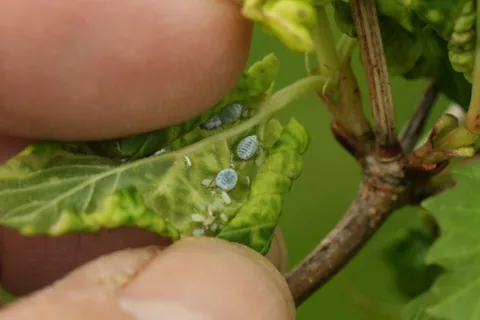 Snowball Aphid
Neoceruraphis viburnicola (UMass lists it as Ceruraphis viburnicola)
The snowball aphid is a powdery, bluish-gray aphid that twists, curls and cups the new leaves of some viburnums in spring, then leaves the shrub until fall.
No photo yet
Taxus Mealybug
Dysmicoccus wistariae (formerly Pseudococcus cuspidatae)
The taxus mealybug is a white, waxy mealybug that feeds on the inner bark of yew trunks and branches, leaving thin, yellowing shrubs coated in honeydew and sooty mold.
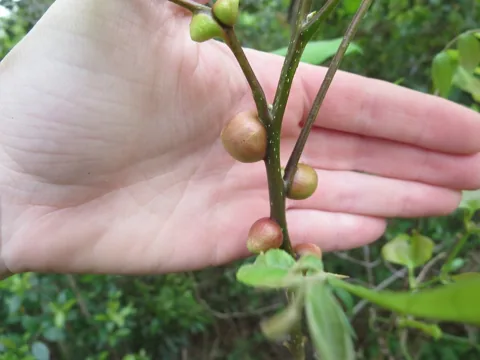 Hickory Gall Phylloxera
Phylloxera caryaecaulis
The hickory gall phylloxera is a tiny aphid relative whose spring feeding makes round galls up to about an inch across on hickory leaf stems, shoots and leaflet midribs.
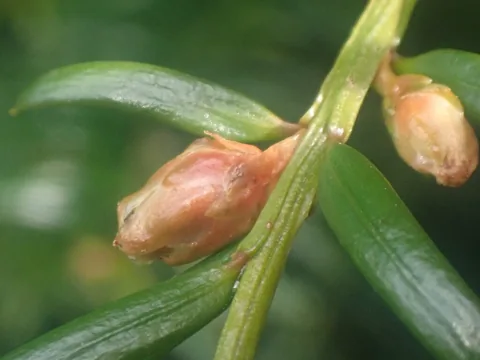 Taxus Bud Mite
Cecidophyopsis psilaspis
The taxus bud mite is a microscopic eriophyid mite that lives inside yew buds, making them swell and die or produce distorted needles and shoots.
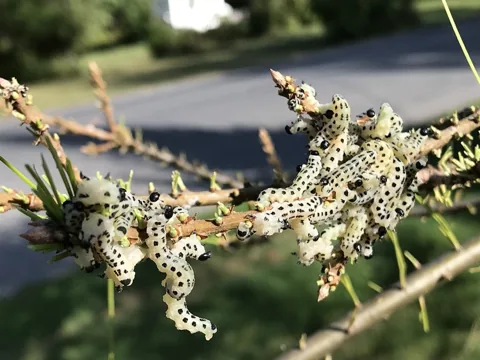 White Pine Sawfly
Neodiprion pinetum
The white pine sawfly is a sawfly whose pale yellow, black-spotted larvae feed in groups on eastern white pine and other pines in summer, eating both old and new needles.
No photo yet
Scarlet Oak Sawfly
Caliroa quercuscoccineae
The scarlet oak sawfly, also called the oak slug sawfly, has slimy, slug-like larvae that feed on the undersides of oak leaves, leaving see-through patches that turn brown.
No photo yet
Oak Spider Mite
Oligonychus bicolor
The oak spider mite is a tiny, dark reddish-brown mite that feeds on the upper surface of oak leaves, turning them stippled, dull yellow and bronze by mid to late summer.
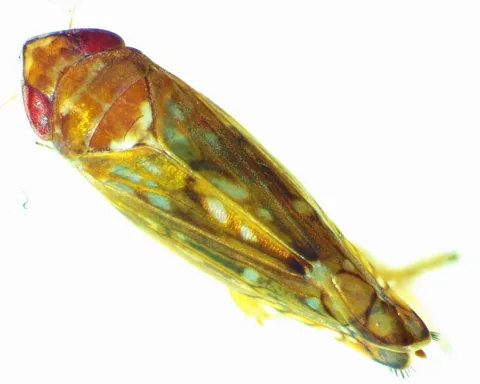 White-Banded Elm Leafhopper
Scaphoideus luteolus
The white-banded elm leafhopper is a small elm-feeding leafhopper whose own feeding does little harm, but it spreads elm yellows (elm phloem necrosis), a disease that kills American elms.
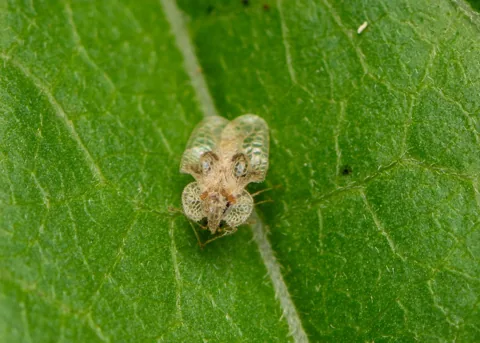 Oak Lace Bug
Corythucha arcuata
The oak lace bug is a small lace bug that feeds on the undersides of oak leaves, leaving the upper surface speckled with pale spots that can merge into bleached, white patches by late summer.
No photo yet
Elm Casebearer
Coleophora ulmifoliella
The elm casebearer is a small native moth whose caterpillars mine elm leaves and then feed from tiny brown cases on the leaf undersides, leaving brown patches between the veins.
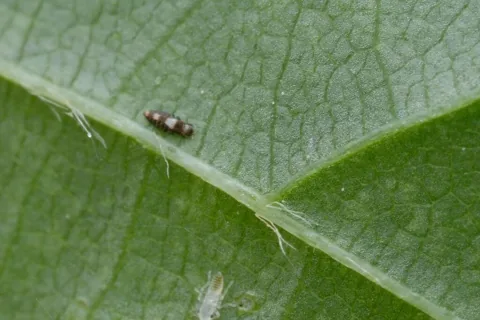 Privet Thrips
Dendrothrips ornatus
The privet thrips is a tiny thrips from Europe that feeds on the leaves of privet, lilac and possibly ash, leaving them speckled with pale spots that give the foliage a dusty gray look.
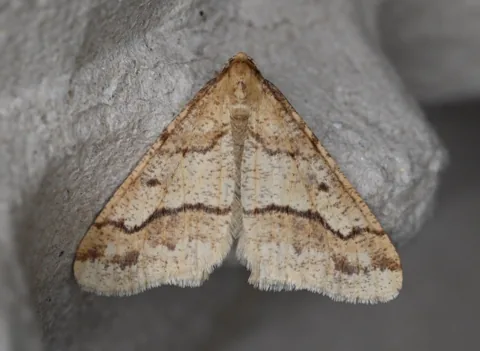 Linden Looper
Erannis tiliaria
The linden looper is a native inchworm whose yellow, pinstriped caterpillars eat the leaves of linden, oak, maple, elm, birch, apple and many other trees in spring; most years it goes unnoticed, but periodic outbreaks defoliate trees.
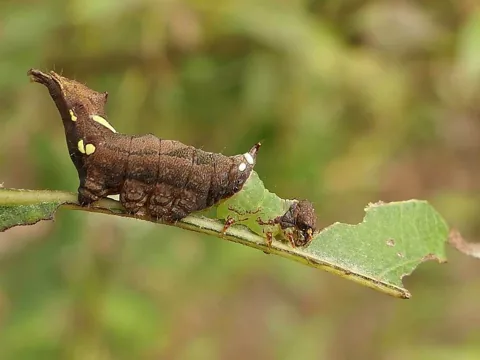 Unicorn Caterpillar
Schizura unicornis (now placed in Coelodasys by iNaturalist)
The unicorn caterpillar is the larva of a native prominent moth; it feeds alone on the leaves of many broadleaf trees and shrubs, and its mottled body with a horn-like hump resembles the edge of a partly eaten leaf.
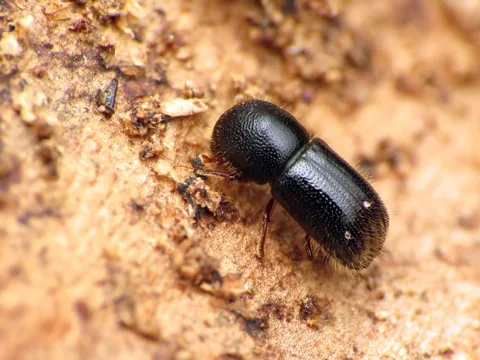 Black Stem Borer
Xylosandrus germanus
The black stem borer, also called the alnus ambrosia beetle, is a tiny invasive ambrosia beetle from eastern Asia. Females bore into the lower trunks of stressed young trees and grow a fungus in their tunnels, and attacks can lead to wilting, dieback and sometimes death.
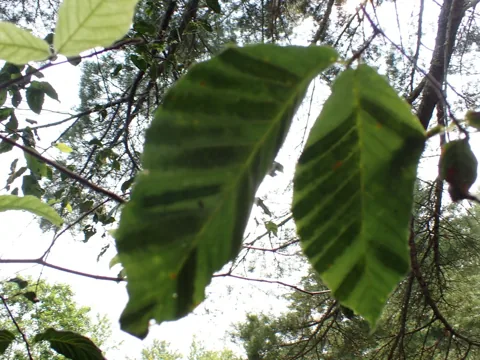 Beech Leaf Disease Nematode
Litylenchus crenatae subsp. mccannii
Beech leaf disease is caused by a microscopic, invasive leaf nematode, Litylenchus crenatae subsp. mccannii, that lives in the leaves and buds of beech trees, banding and distorting the leaves and killing buds until the tree declines.
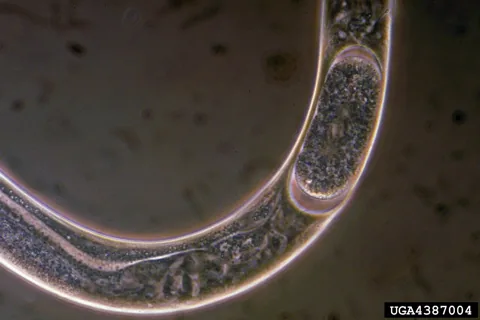 Pinewood Nematode
Bursaphelenchus xylophilus
The pinewood nematode is a microscopic worm, about 1 mm long, that causes pine wilt: carried into pines by pine sawyer beetles, it multiplies in the resin canals and water-conducting tissue and can kill a susceptible pine within weeks to a few months.
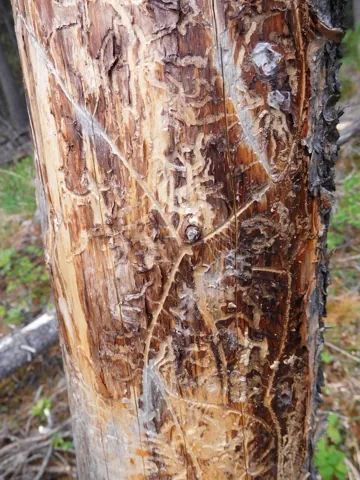 Pine Engraver
Ips pini
The pine engraver is a small bark beetle that breeds in freshly cut pine material and attacks stressed or newly transplanted pines, killing tops or whole trees; it almost never attacks healthy pines in periods of near-normal rainfall.
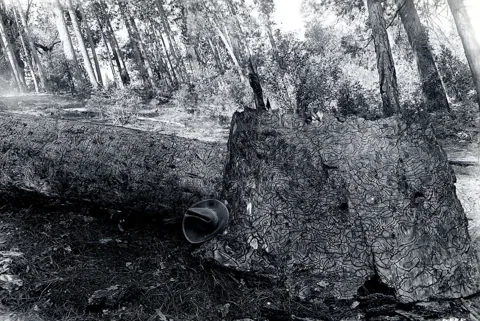 Western Pine Beetle
Dendroctonus brevicomis
The western pine beetle is a native bark beetle that attacks the trunks of ponderosa pines, killing trees weakened by drought, fire, disease or crowding, often in groups.
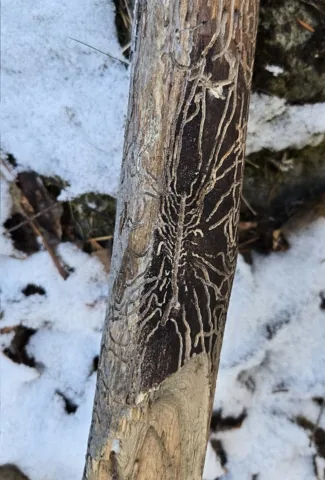 Douglas-fir Beetle
Dendroctonus pseudotsugae
The Douglas-fir beetle is a native bark beetle that breeds in windthrown, fire-scorched or weakened Douglas-firs; when downed or damaged trees are plentiful, populations build and spill over into healthy trees, killing them in groups.
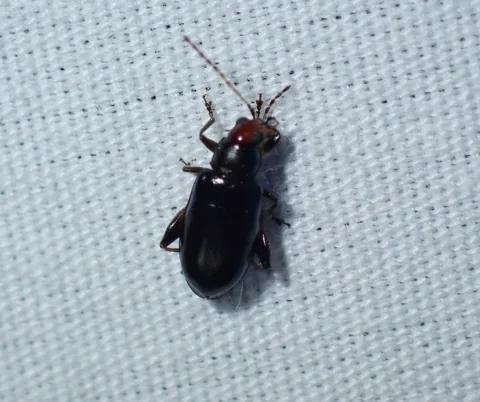 Redheaded Flea Beetle
Systena frontalis
The redheaded flea beetle is a tiny, native, shiny black beetle with a red head that jumps like a flea and chews many small holes in the leaves of panicle hydrangeas, itea, weigela, roses and many other shrubs, perennials and weeds. It harms plants, not people. Its grubs live in the soil and potting mix, so control means pulling weeds, checking plants weekly, treating the soil for larvae and, when adults are present, thorough sprays.
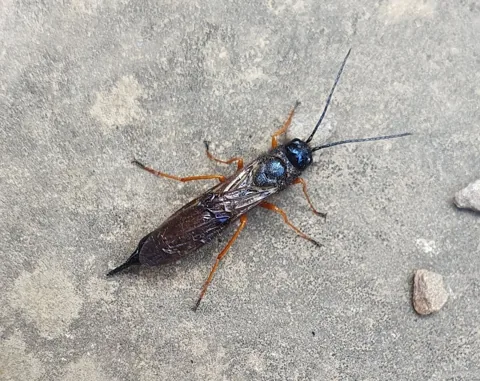 Sirex Woodwasp
Sirex noctilio
The Sirex woodwasp is an invasive wood wasp native to Europe, northern Africa and Asia. Females drill into pines and lay eggs along with a fungus and a toxic venom that together kill the tree, and unlike native woodwasps it can attack living trees.
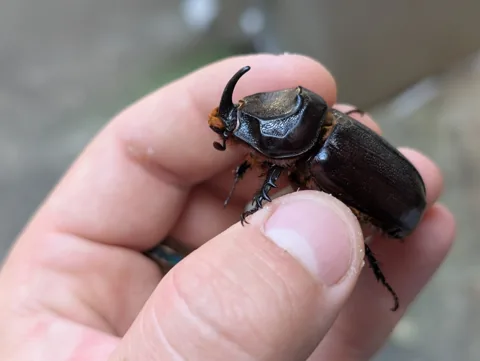 Coconut Rhinoceros Beetle
Oryctes rhinoceros
The coconut rhinoceros beetle is a large invasive scarab beetle that bores into the crowns of coconut and other palms to feed on sap, while its grubs develop in mulch, compost, green waste and decaying palm stumps; it has been spreading in Hawaii since it was first found on Oahu in 2013.
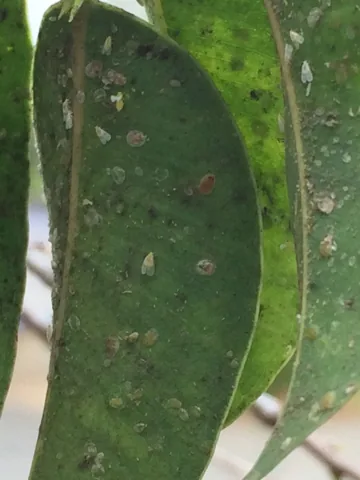 Ficus Whitefly
Singhiella simplex
The ficus whitefly is a small Asian whitefly, first found in North America in Florida in 2007, that develops only on ficus. It is harmless to people and pets, but heavy infestations turn leaves yellow, strip weeping fig hedges and trees bare and can cause branch dieback; in Los Angeles County, clouds of adults off street trees have bothered residents. To manage it: check ficus leaves for nymphs, prune less, bag clippings, protect the natural enemies that attack it, and on valuable plants use a systemic insecticide or a fungal biopesticide.
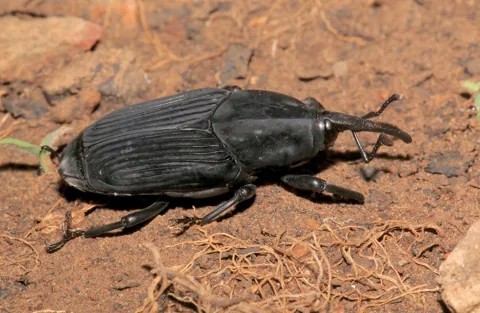 South American Palm Weevil
Rhynchophorus palmarum
The South American palm weevil is a large invasive weevil whose grubs feed in the crowns of palms and destroy the growing point; untreated infested palms die and become breeding sites that spread the weevil, which has established in southern San Diego County.
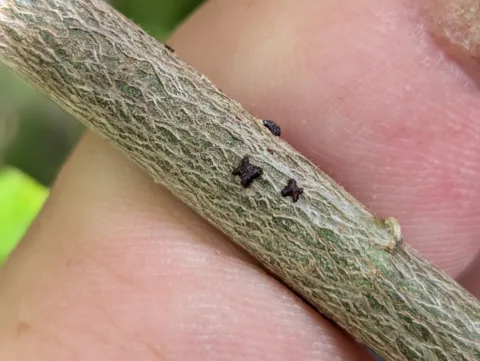 Lobate Lac Scale
Paratachardina pseudolobata (earlier reported as P. lobata lobata)
The lobate lac scale is an invasive scale insect first found in the US in Florida in 1999. It forms dark crusts on the young twigs of a very wide range of woody plants, is now a common landscape pest in South Florida, and heavy infestations can kill shrubs such as wax myrtle.
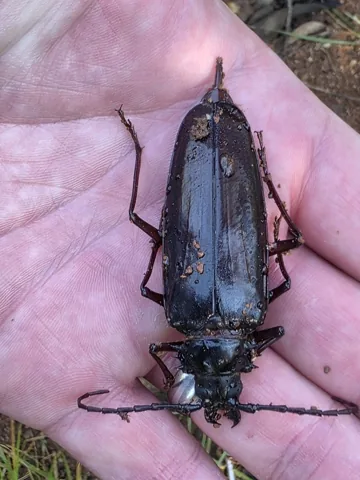 Palo Verde Root Borer
Derobrachus hovorei (formerly included in D. geminatus)
The palo verde root borer is a huge longhorned beetle that appears in the desert Southwest in summer; its grubs spend years feeding on the roots of palo verde and other broadleaf trees, but University of Arizona entomologists say it is often wrongly blamed for trees that die from stress.
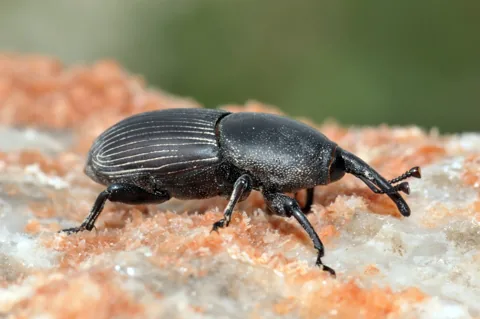 Agave Snout Weevil
Scyphophorus acupunctatus
The agave snout weevil, also called the sisal weevil, is a black weevil whose grubs tunnel into the base and roots of agaves; together with the rot that follows, the feeding usually makes infested plants collapse and die, often before anyone notices the insects.
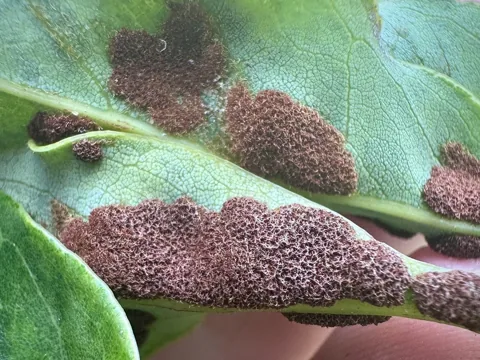 Lychee erinose mite
Aceria litchii
The lychee erinose mite is a microscopic mite that makes lychee leaves grow dense, felt-like patches of hairs called erinea. First found in Lee County, Florida, in 2018, it has since spread to every lychee-producing county in the state, and it can cut yields by up to 80 percent.
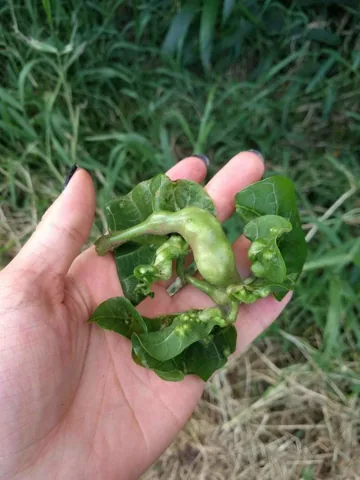 Erythrina gall wasp
Quadrastichus erythrinae
The erythrina gall wasp is a tiny invasive wasp that lays its eggs in the young leaves and stems of coral trees (Erythrina), turning shoots into masses of swollen galls; repeated attacks defoliate and can kill trees.
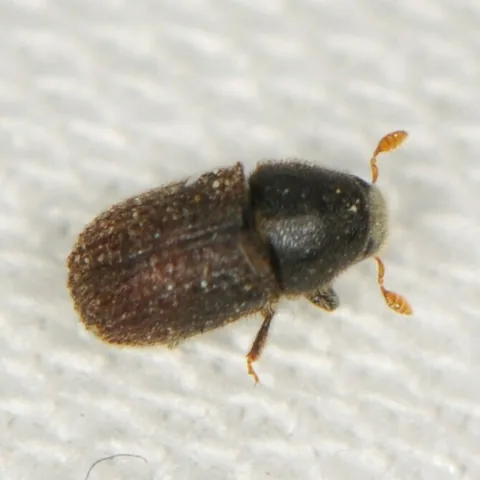 Cypress and cedar bark beetles
Phloeosinus species (e.g., P. cristatus)
Cypress and cedar bark beetles are tiny native beetles in the genus Phloeosinus that attack cypress, junipers and eastern red cedar. They seldom kill healthy trees, but in drought they can girdle and kill stressed ones, and planted Arizona and Leyland cypress that go without water are common victims.
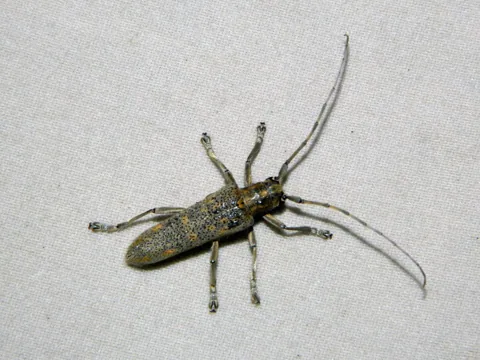 Poplar borer
Saperda calcarata
The poplar borer is a longhorned beetle whose larvae tunnel through the sapwood and heartwood of aspen, cottonwood, poplar and willow. Utah State calls it a major pest of aspen in landscapes and forests: the tunnels weaken trunks and limbs, and smaller trees can be killed.
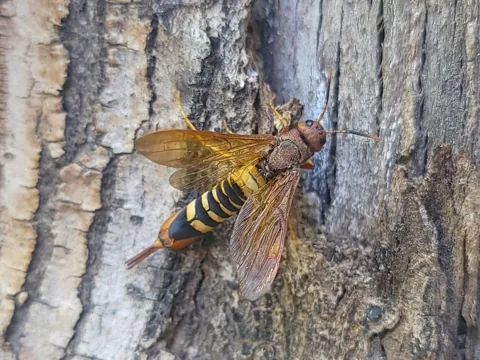 Pigeon tremex
Tremex columba
The pigeon tremex is a large, non-stinging wood wasp, a horntail, whose larvae tunnel in hardwood trees that are already dying or recently dead. It can't sting people or pets. Finding it, or its round exit holes, means that tree or limb is already in serious decline and may be a hazard. There is no spray that reaches the larvae and none is recommended: keep trees healthy, and have dead or dying limbs checked and removed if they could fall.
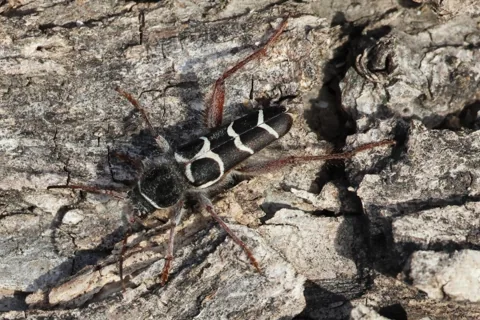 Banded ash borer
Neoclytus caprea
The banded ash borer is a black-and-yellow longhorned beetle whose larvae feed under the bark of dead, dying or stressed ash, elm and hickory and in freshly cut logs. If one shows up in your house in winter, it almost certainly came out of firewood. It can't harm people, pets or the house; sweep it up, and store firewood outdoors until you burn it.
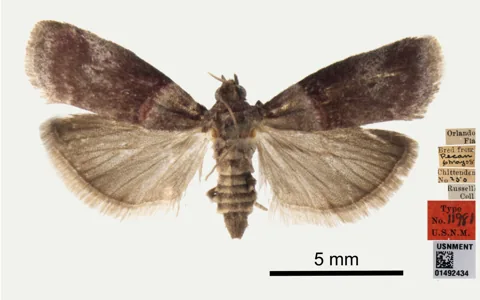 Pecan nut casebearer
Acrobasis nuxvorella
The pecan nut casebearer is a gray moth about 1/3 inch long whose larvae bore into young pecan nuts shortly after the trees pollinate. Oklahoma State ranks it among the most devastating nut-feeding insects of pecans, and a single larva may damage an entire nut cluster.
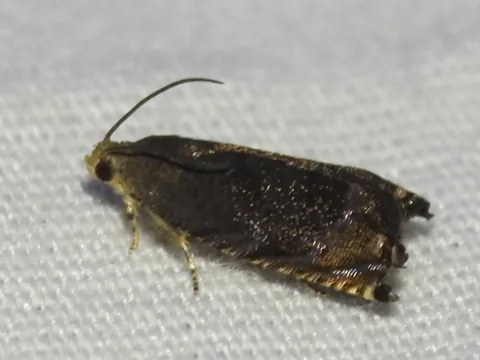 Hickory shuckworm
Cydia caryana
The hickory shuckworm is a small dark moth whose larvae tunnel into pecan nuts and their shucks. Kentucky calls it one of the more destructive pests of pecan: early feeding makes small nuts fall in midsummer, and later feeding keeps kernels from filling and leaves shucks stuck to the shells.
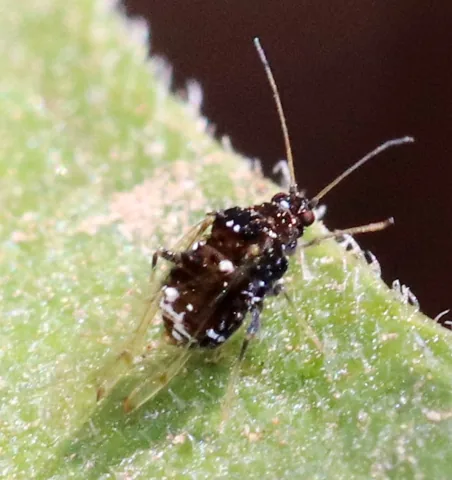 Black pecan aphid
Melanocallis caryaefoliae
The black pecan aphid feeds on the undersides of pecan leaflets, mostly late in the season. Aphid for aphid it does far more harm than the more numerous yellow pecan aphids, because its saliva is toxic: each feeding site turns into a bright yellow spot that later browns, and heavy infestations make trees drop their leaves early.
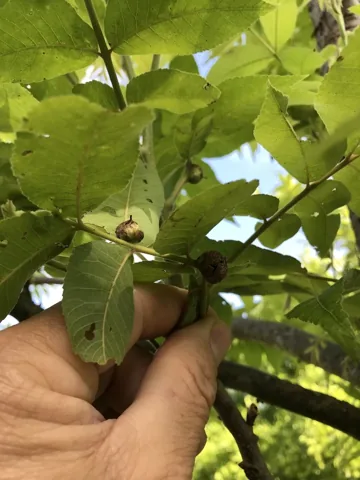 Pecan phylloxera
Phylloxera devastatrix
The pecan phylloxera, also called pecan stem phylloxera, is a small aphid-like insect whose feeding on new spring growth makes pecan twigs swell into hollow, knotty galls. By the time the galls show in April, the damage for that year is already done.
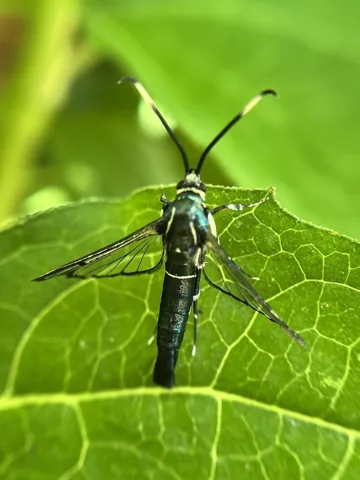 Viburnum borers
Synanthedon viburni (viburnum clearwing borer) and S. fatifera (lesser viburnum borer)
Viburnum borers are the caterpillars of two clearwing moths, the viburnum clearwing borer and the lesser viburnum borer. They tunnel under the bark at the base of viburnum shrubs, and heavy or repeated attack leads to branch dieback, decline and eventually a dead plant.
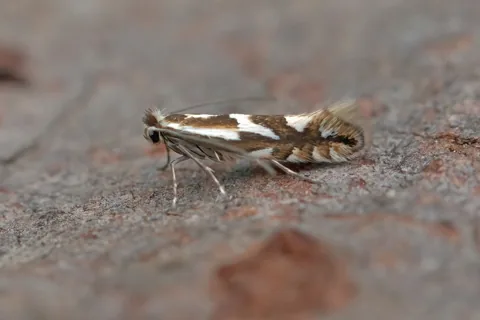 Spotted tentiform leafminer
Phyllonorycter blancardella
The spotted tentiform leafminer is a tiny European moth whose caterpillars live inside apple leaves, hollowing out oval mines that buckle into a small tent with pale spots on top. Wisconsin says it is common enough in home apple trees for the mines to be seen but rarely occurs at numbers that injure the tree or cost fruit, and that natural enemies reliably control it unless frequent broad-spectrum insecticide use interferes.
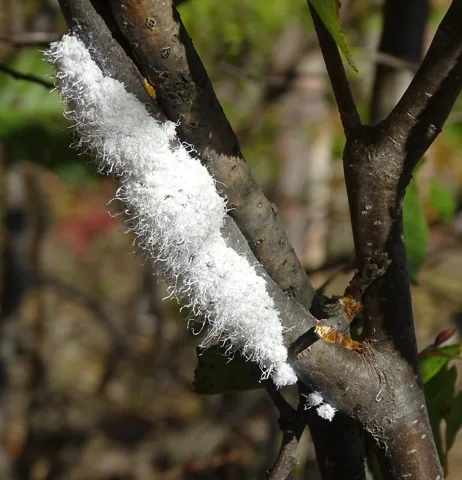 Woolly alder aphid
Prociphilus tessellatus
Woolly alder aphids live on silver maple, where they form dense white woolly masses on leaves and twigs in spring, and on alder, where they cover branches with white cottony fluff. Their winged adults look like tiny tufts of cotton flying under their own power. They look alarming but do no lasting harm, so most extension experts say to leave them for the lady beetles and other insects that eat them.
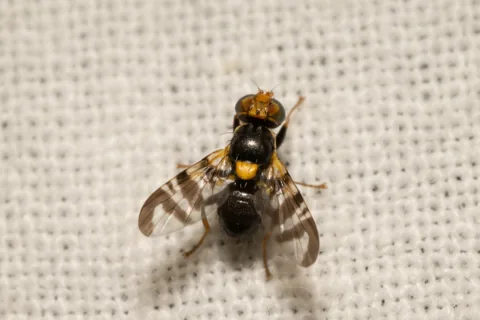 European cherry fruit fly
Rhagoletis cerasi
The European cherry fruit fly is a fruit fly from Europe and temperate Asia. The Canadian Food Inspection Agency confirmed it in Mississauga, Ontario, in June 2016, the first North American record, and reports later detections in New York State (2017) and Quebec (2022). Its maggots feed inside cherries, and it also breeds in honeysuckle berries, including invasive bush honeysuckles.
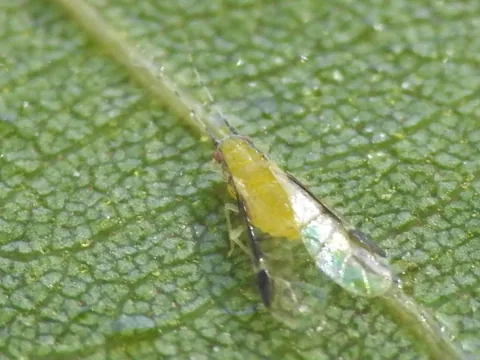 Yellow pecan aphids
Monellia caryella (blackmargined aphid) and Monelliopsis pecanis (yellow pecan aphid)
Two yellow aphids feed on pecan leaves: the blackmargined aphid and the yellow pecan aphid. Both suck sap from the leaf veins and drip sticky honeydew, which grows black sooty mold in humid weather. Blackmargined aphid outbreaks often fade within a few weeks, while yellow pecan aphids build later in the season and can strip leaves and cut the nut crop.
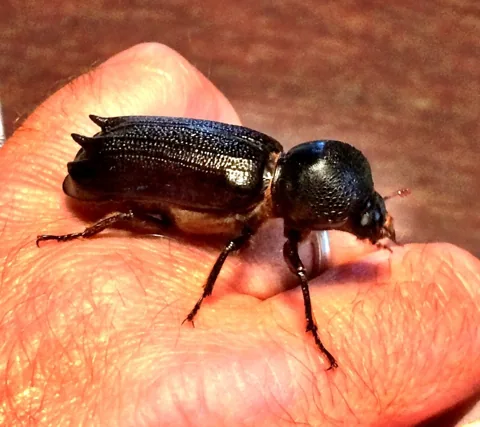 Giant palm borer
Dinapate wrightii
The giant palm borer is a dark beetle up to 2 inches long whose grubs tunnel through the trunks of California fan palms and date palms for years. It goes after palms that are already dead, dying or badly stressed, such as recently transplanted trees. Fronds of infested palms turn yellow, the palms often die early, and weakened trunks may blow over. UC IPM knows of no control other than good preventive care: keep palms healthy and remove dead or dying palms, in which the beetles breed.
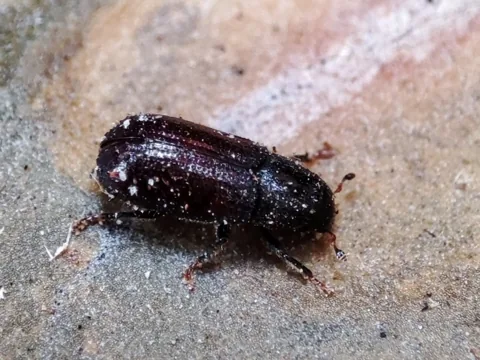 Pine shoot beetle
Tomicus piniperda
The pine shoot beetle is a small bark beetle native to Europe and Asia, first found in the United States in 1992 at a Christmas tree plantation in Ohio. It breeds under the bark of freshly cut pine stumps and logs, and the new adults fly to healthy pines and hollow out the shoots, which droop, turn yellow and eventually fall off.
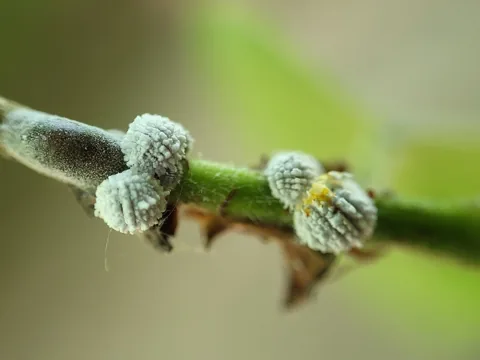 Hawthorn mealybug
Phenacoccus dearnessi
The hawthorn mealybug is a small red mealybug coated in white wax that feeds on the twigs of hawthorns and a few related trees in the rose family. A 2000 Colorado study called it very damaging on landscape hawthorns, though the sources differ on how serious it usually is: heavy infestations coat trees in sticky honeydew and black sooty mold and can cause leaf loss, twig dieback and occasionally the death of a tree. It spends the winter hidden in bark crevices on the trunk, which shapes how and when it can be controlled.
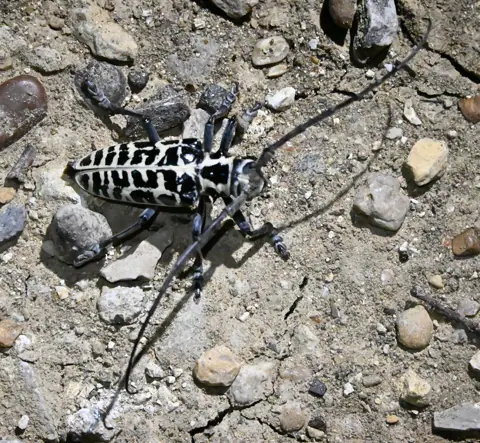 Cottonwood borer
Plectrodera scalator
The cottonwood borer is a large black-and-white longhorned beetle whose larvae tunnel into the bases and roots of cottonwoods, other poplars and willows. Severely infested young trees can be badly damaged or killed, while larger trees tolerate light to moderate infestations.
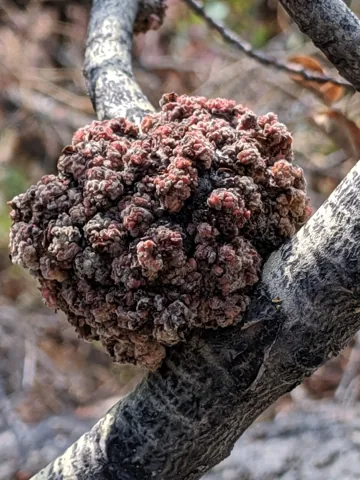 Poplar budgall mite
Aceria parapopuli
The poplar budgall mite is a microscopic eriophyid mite that turns the buds of poplars, cottonwoods and aspens into woody, cauliflower-like galls. The galls stay on the tree for years and look rough, but the damage is mainly cosmetic and the tree itself is seldom killed.
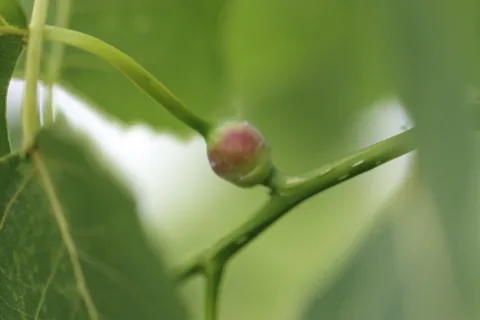 Poplar petiolegall aphid
Pemphigus populitransversus
The poplar petiolegall aphid is a small, waxy aphid that forms round galls on the leaf stems (petioles) of cottonwoods, poplars and aspens and spends part of the year on the roots of cabbage-family plants. Colorado State and Utah State describe the aphids leaving the galls around midsummer and returning to poplars in late summer or fall; Mississippi State describes them flying to brassicas in late summer and fall and spending the winter on their roots. On trees the galls are mostly a cosmetic problem.
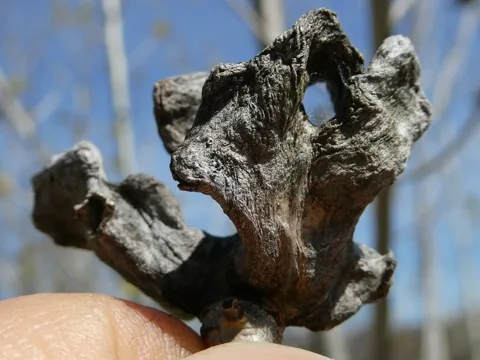 Vagabond gall aphid
Mordwilkoja vagabunda
The vagabond gall aphid, also called the poplar vagabond aphid, lives inside galls it causes at the tips of cottonwood and aspen branches, leaving only to spend part of the summer on a secondary host. The galls are conspicuous and often plentiful, especially after leaf fall, but apart from their looks they do the tree no appreciable harm.
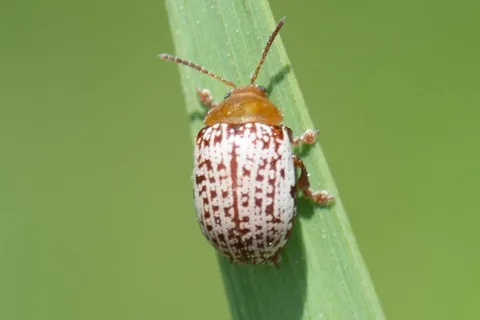 Sumac flea beetle
Blepharida rhois
The sumac flea beetle is a leaf beetle of sumacs, including skunkbush sumac, and of smokebush. Its larvae feed in small groups in late spring under shields made of their own droppings, chewing the leaves ragged and sometimes defoliating plants, but pesticides are not usually needed.
No photo yet
McDaniel spider mite
Tetranychus mcdanieli
The McDaniel spider mite is a tiny web-spinning mite found mostly on fruit trees. It harms plants, not people or pets. In hot, dry weather it can build up fast, stippling and bronzing the leaves, but predatory mites usually hold it down unless broad-spectrum sprays kill them off, so the first steps are water, less dust and fewer sprays.
No photo yet
Western ash bark beetle
Hylesinus californicus
The western ash bark beetle is a tiny bark beetle that breeds in the inner bark of ash. It usually stays in injured or weakened branches, but after storms or drought leave a lot of weakened wood, numbers can build until many branches die, and an attack on the main stem can kill the tree.
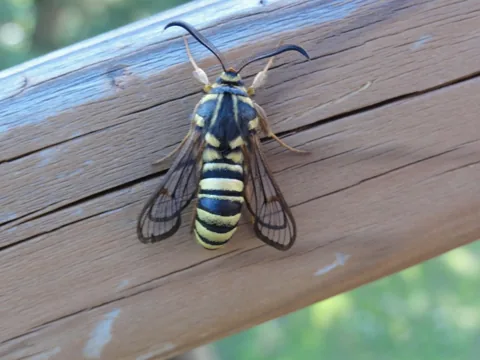 American hornet moth
Sesia tibiale (Arizona Extension and the Canadian Forest Service write S. tibialis)
The American hornet moth, also called the cottonwood crown borer, is a clearwing moth that looks like a hornet. Its larvae spend two years boring in the lower trunk, root crown and exposed roots of poplars, aspen and willows, weakening trees so they break or blow over in storms and sometimes killing them.
No photo yet
California fivespined ips
Ips paraconfusus
The California fivespined ips is a small bark beetle of pines west of the Sierra Nevada and Cascades. It breeds in fresh pine slash and usually kills only scattered weakened trees, but during droughts it kills and top-kills many pines, including ponderosa and Monterey pines planted as shade trees. To prevent losses, the Forest Service and UC IPM advise watering pines during drought, keeping fresh pine firewood and slash away from living trees, avoiding pruning while the beetles fly, and removing infested trees before the new brood emerges.
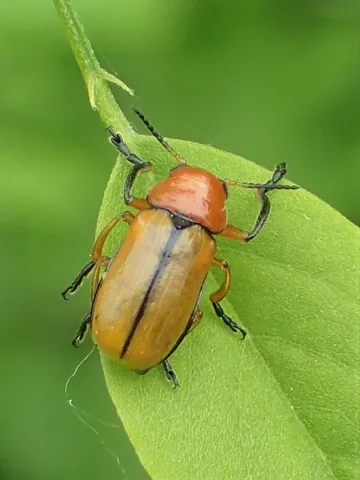 Clay-colored leaf beetle
Anomoea laticlavia
The clay-colored leaf beetle, also called the persimmon leaf beetle, is a small reddish-brown leaf beetle with a dark line along the edges of its wing covers. In North Carolina it turns up mostly on persimmon, in the Great Plains it seems to feed only on leadplant, and its larvae live inside cases made of their droppings and bits of leaf.
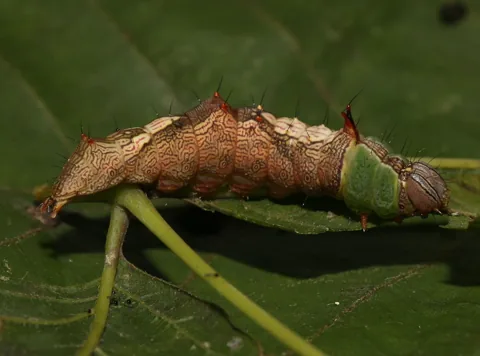 Morning-glory Prominent
Schizura ipomaeae
The morning-glory prominent is a common but easily overlooked woodland moth. Its tan-and-brown caterpillar eats the leaves of maples, oaks, elms, buckeyes and other trees, and when it rests along the edge of a leaf it has chewed it looks just like a curled, dead piece of that leaf. Is it harmful? The Missouri Department of Conservation says it can be a pest of garden plants and landscape trees but is hardly devastating, and neither it nor Clemson recommends treatment.
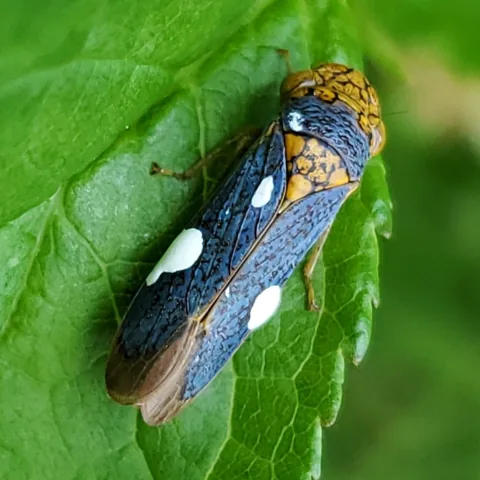 Broad-headed sharpshooter
Oncometopia orbona
The broad-headed sharpshooter is a leafhopper of the eastern United States, about 1/2 inch long, with an orange head and blue-and-black speckled wings. It feeds on a wide range of plants and can carry Xylella fastidiosa, the bacterium that causes Pierce's disease of grapevines. In North Carolina vineyards it was one of the four most abundant leafhoppers trapped, and lab tests showed it can pass the bacterium to grapevines.
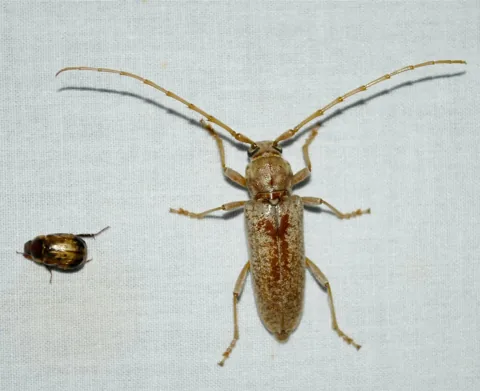 Red oak borer
Enaphalodes rufulus
The red oak borer is a native longhorned beetle whose larvae tunnel through the inner bark and wood of living oaks, mainly red oaks. It is usually present at low numbers, but around 2000 an unprecedented outbreak in the Ozark Mountains of Arkansas and Missouri accompanied widespread oak decline.
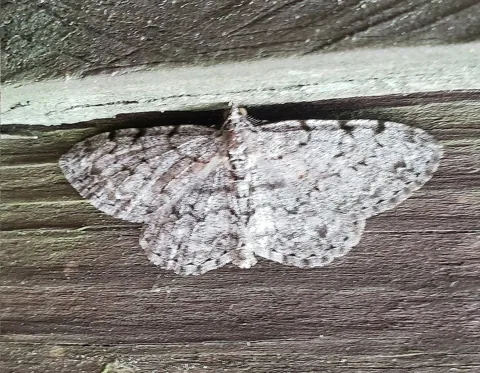 Porcelain Gray
Protoboarmia porcelaria
The porcelain gray is a gray, finely speckled geometrid moth that often turns up near lights at night. Its caterpillar, the dash-lined looper, looks like a small twig and feeds on eastern red cedar, pines, spruces, firs and several hardwoods. Canada's forest service describes it as a common but innocuous defoliator.
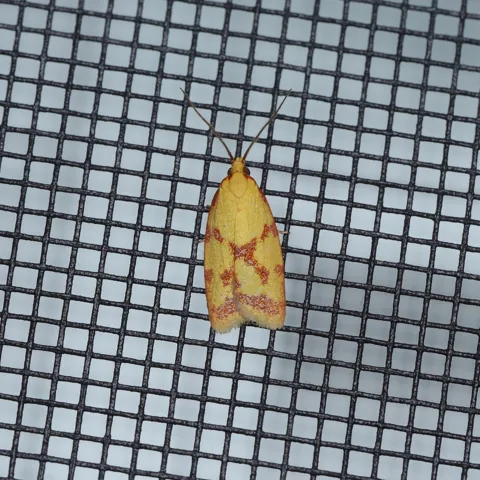 Sparganothis Fruitworm
Sparganothis sulfureana
Sparganothis fruitworm is a native moth in the leafroller family and one of the most damaging pests of cranberry. Its caterpillars web and skeletonize the leaves and eat the blossoms, and the summer brood bores into the berries. It also feeds on blueberries and on plants in nearly 20 other families.
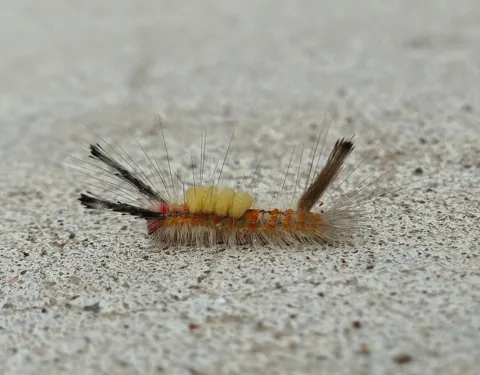 Fir Tussock Moth
Orgyia detrita
The fir tussock moth is a small tussock moth of the Coastal Plain, from Florida and the Gulf states west to Texas and north to Long Island. In Texas its caterpillar is called the live oak tussock caterpillar. Despite the name, its documented food plants are oaks, bald cypress, swamp loosestrife, white cedar and black tupelo, not firs. In some springs the hairy caterpillars break out in large numbers, and although they aren't considered stinging caterpillars, handling them can give some people a rash. UF/IFAS calls it the most common of Florida's three Orgyia tussock moths, ahead of the whitemarked and the rare definite tussock moth, and says the caterpillars become a problem in some years when they leave their host trees to spin cocoons.
 Blue-green sharpshooter
Graphocephala atropunctata
The blue-green sharpshooter is a leafhopper about 0.4 inch long, green to bright blue on top, that breeds in streamside vegetation and landscape plantings in coastal California. Its feeding does no harm to grapes, but it is the most important carrier of the Pierce's disease bacterium in coastal grape-growing areas.
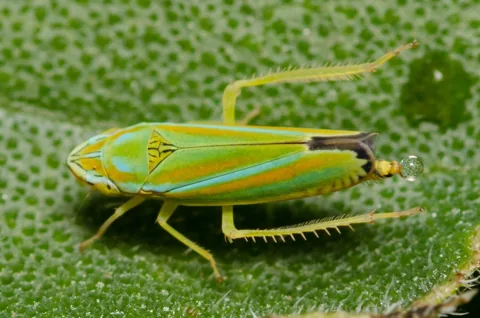 Versute sharpshooter
Graphocephala versuta
The versute sharpshooter is a leafhopper only about 3/16 inch long, green with a light blue stripe across each wing. It is the most common sharpshooter in Oklahoma vineyards, and in research trials insects collected in and near vineyards transmitted Xylella fastidiosa, the bacterium behind Pierce's disease, to susceptible plants.
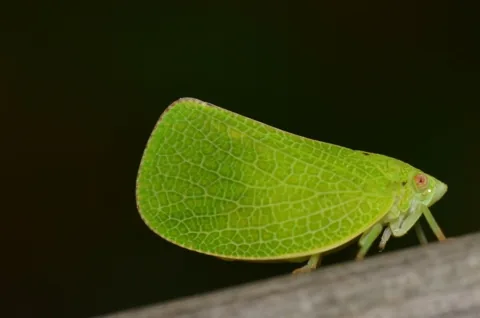 Green cone-headed planthopper
Acanalonia conica
The green cone-headed planthopper is a common native planthopper, a bright green bug less than half an inch long that feeds on a wide variety of herbs, shrubs and trees. Pressed against a stem, an adult looks a lot like a seed pod or leaf, and the nymphs often hide under white, fluffy wax. NC State calls it virtually harmless, though it can alarm gardeners; usually no control is needed.
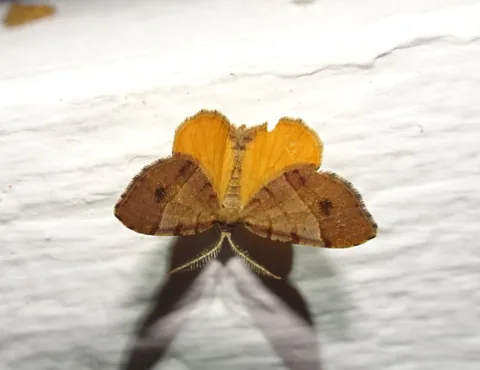 Orange Wing
Mellilla xanthometata
The orange wing is a small moth with bark-colored forewings and bright orange hindwings that show even in flight. Its caterpillars are green inchworms on honey locust, a tree that grows wild in old fields and along roadsides and, as a thornless variety, is popular for city landscaping and parking lots. Is it harmful? No: the Missouri Department of Conservation calls the caterpillars a natural pruning mechanism on honey locust and recommends no control. The USDA Forest Service's guide to geometroid caterpillars finds it in forests, parks and roadside plantings, and notes that although honey locust has been planted widely through the East, the moth has not yet spread into many states where the tree is now a common shade tree.
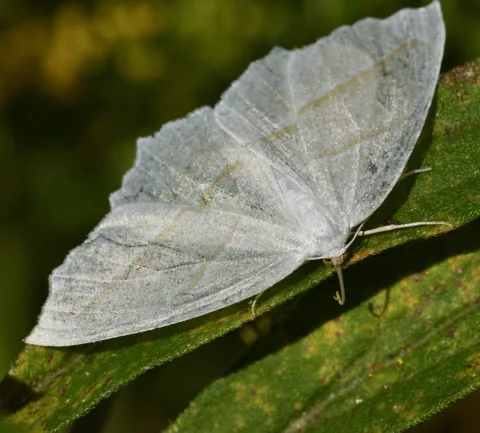 Pale Beauty
Campaea perlata
The pale beauty (Campaea perlata) is a light-colored geometrid moth whose caterpillar, the fringed looper, is a gray to brick-red inchworm found on maples and many other trees and shrubs. A fringe of pale hairs along its lower sides and an extra pair of prolegs set it apart from other inchworms. The caterpillars make hyperactive antifreeze proteins, and the moths choose resting backgrounds that match their light color.
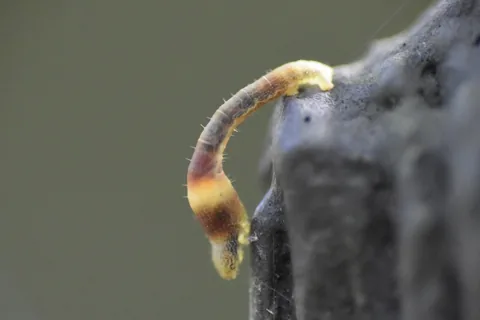 Tulip-tree Beauty
Epimecis hortaria
The tulip-tree beauty (Epimecis hortaria) is an inchworm moth of eastern forests and woodlands, and the largest geometrid moth in Ohio. Its caterpillar is a stocky inchworm with a swollen third thoracic segment that feeds on tulip-tree, sassafras, spicebush and many other hardwoods and often rests with its abdomen looped upward behind the thorax. No source treats it as a pest.
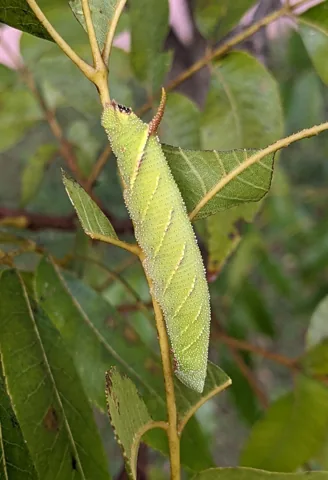 Walnut Sphinx
Amorpha juglandis
The walnut sphinx is a hawk moth whose caterpillar, a hornworm, feeds on walnuts, hickories, beeches and chestnuts. When something grabs it, the caterpillar whistles by forcing air out through a pair of enlarged breathing pores near its rear end, and the sound makes attacking birds flinch and back off.
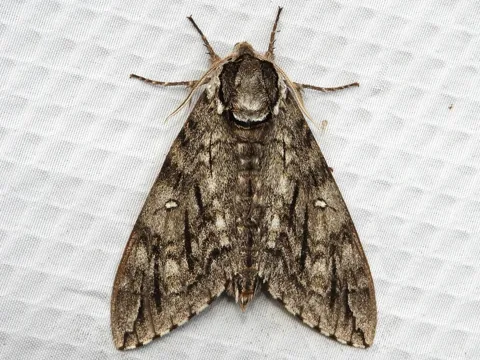 Waved Sphinx
Ceratomia undulosa
The waved sphinx is a hawk moth whose caterpillar, a large hornworm, feeds mostly on ash and also on lilac, privet, fringe tree, hawthorn and oak. It is a close relative of the catalpa sphinx, but it feeds on ash and other members of the olive family rather than catalpa. Colorado State Extension says most hornworm species cause insignificant plant injury, and no source recommends control.
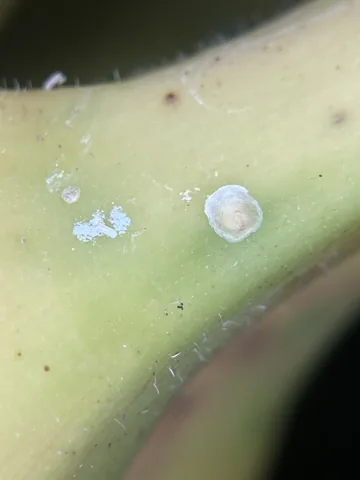 Boisduval scale
Diaspis boisduvalii
Boisduval scale is an armored scale insect and the most common armored scale pest of orchids in North Carolina; ScaleNet cites it as the most important insect pest of orchids in Florida and a serious pest of greenhouse orchids in California. It also lives on palms, banana and cacti, and a few scales are enough to damage a plant. UF/IFAS calls it one of the most common and damaging orchid pests and one of the most challenging to control.
No photo yet
Azalea whitefly
Pealius azaleae
The azalea whitefly is a tiny, snow-white insect that looks like a miniature moth and lives on the undersides of azalea leaves, and sometimes on rhododendrons. Its honeydew grows black sooty mold that can turn a shrub almost black, and clouds of adults fly up when an infested plant is brushed.
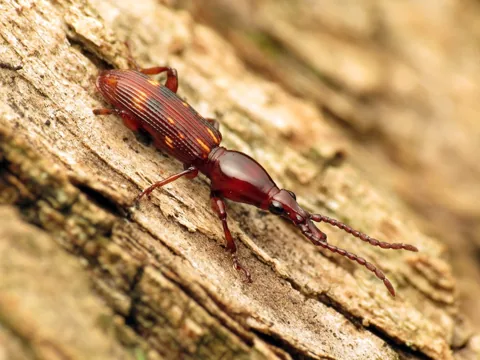 Oak timberworm
Arrenodes minutus
The oak timberworm, Arrenodes minutus (also spelled Arrhenodes minutus), is a long, slender snout beetle whose larvae tunnel into the wood of wounded oaks and other hardwoods. The small wormholes they leave reduce the value of lumber, and the beetle can also carry the oak wilt fungus.
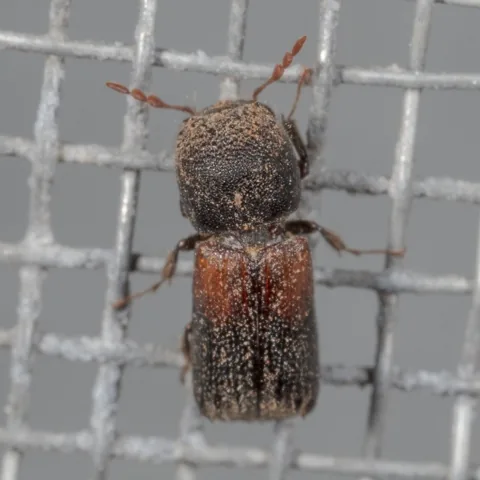 Red-shouldered bostrichid
Xylobiops basilaris
The red-shouldered bostrichid, Xylobiops basilaris, is a small wood-boring beetle of the eastern United States. It favors hickory, pecan and persimmon, mostly attacks stressed, dying or recently dead trees, and poses little threat to healthy ones.
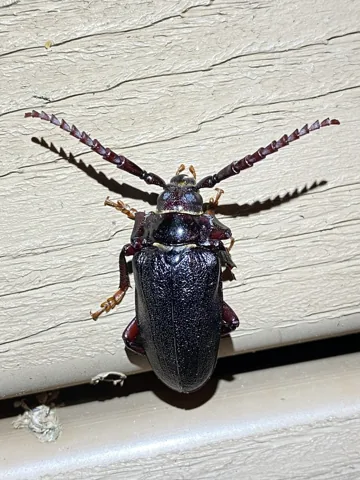 Broad-necked root borer
Prionus laticollis
The broad-necked root borer, Prionus laticollis, is a large, dark longhorn beetle of the eastern United States. Its grubs feed on roots for 3 to 4 years, girdling and hollowing them, and can kill orchard trees and open-grown trees in parks, pastures and along streets.
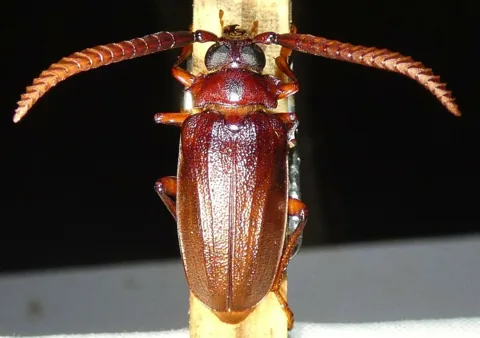 Tile-horned prionus
Prionus imbricornis
The tile-horned prionus, Prionus imbricornis, is a large root-boring longhorn beetle of the eastern and central United States. Its grubs feed on roots for 3 to 5 years, and it has been a major cause of pecan decline in Georgia.
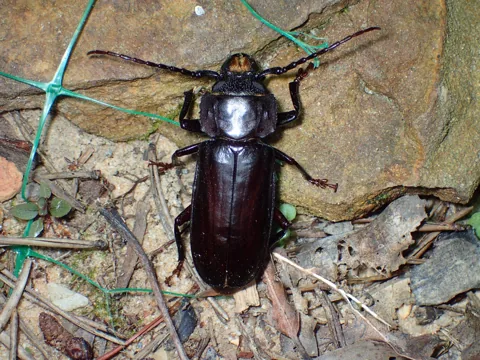 Hardwood stump borer
Mallodon dasystomus
The hardwood stump borer, Mallodon dasystomus (listed by the USDA Forest Service as Stenodontes dasytomus, and spelled Mallodon dasystomum in GBIF's taxonomy), is a large longhorn beetle of the southern United States and Mexico. Its grubs tunnel for 3 to 4 years through the sapwood and heartwood near the base of wounded hardwoods, and infestations often go unnoticed until weakened trees break.
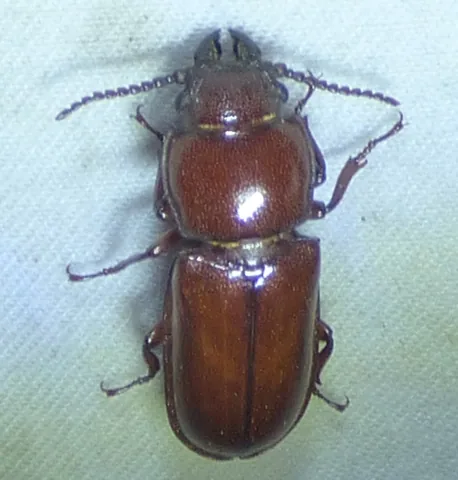 Pole borer
Neandra brunnea
The pole borer, Neandra brunnea (listed by the Forest Service as Parandra brunnea), is a wood-boring longhorn beetle found through most of eastern North America. Its larvae enter trees at wounds and dead spots and slowly honeycomb the wood, and they also damage poles, crossties and timbers in contact with the ground.
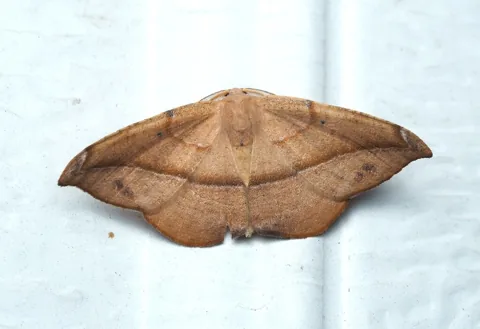 Juniper Geometer
Patalene olyzonaria
The juniper geometer, also called the juniper-twig geometer, is a small tan moth whose inchworm caterpillar lives on eastern red cedar and other junipers. The caterpillar is a twig mimic: its brown and gray diamond pattern copies the pattern and texture of a cedar twig, and it rests stiff and straight at an angle, so it is amazingly well camouflaged. It is a common native moth, and no source describes damage or recommends control. The USDA Forest Service's geometroid caterpillar guide says one could scarcely design an insect to match its background better.
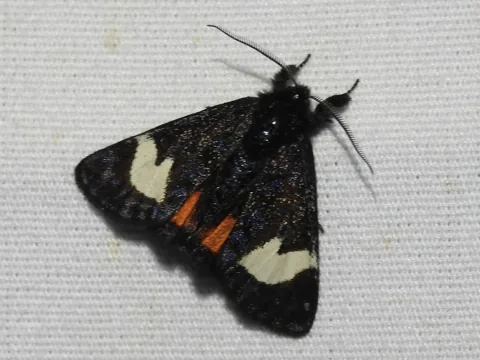 Grapevine Epimenis
Psychomorpha epimenis
The grapevine epimenis is a small, fast-flying moth that flies by day only in early spring, often around blooming wild plums. Its black, white and red-orange wings make it easy to mistake for a butterfly. The caterpillars feed on grape leaves and Virginia creeper inside folded-leaf shelters, but MDC says the species does not seem to be a major pest of cultivated grapes.
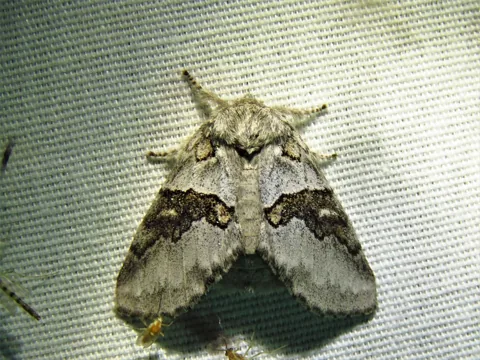 Common Gluphisia
Gluphisia septentrionis
The common gluphisia, also called the common pebble moth, is a small gray prominent moth whose caterpillars eat poplar leaves. In yards it is harmless, but outbreaks have stripped thousands of acres of hybrid poplar plantations in Oregon. Its males are famous for drinking from mud puddles for hours to gather sodium, which they pass to the female at mating.
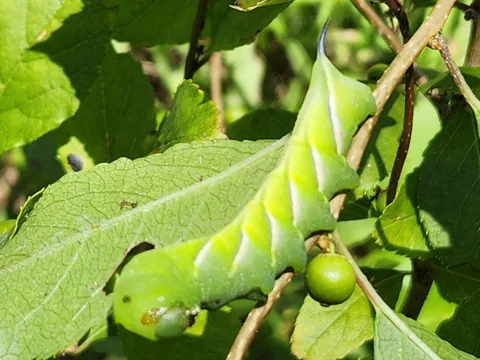 Pawpaw Sphinx
Dolba hyloeus
The pawpaw sphinx is a hawk moth (sphinx moth) of the eastern United States. Its caterpillar is a hornworm, with a horn at the end of the abdomen, and its recorded food plants are pawpaw, littleleaf sweetfern and two native hollies, possum haw and inkberry. Is it harmful? No source reports a bite, sting or other risk to people or pets, and Butterflies and Moths of North America lists no management needs. Getting rid of it is not usually called for; it is a native moth that comes and goes with its food plants. UF/IFAS also lists yaupon holly as a food plant.
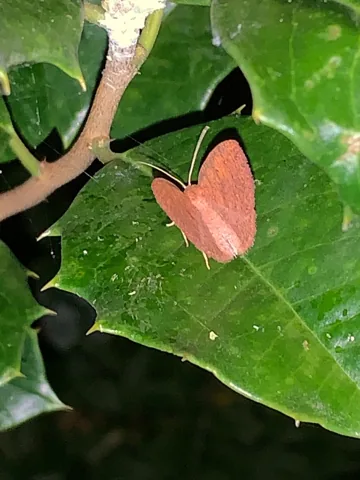 Holly Looper
Ilexia intractata
The holly looper is the caterpillar of the black-dotted ruddy moth (Ilexia intractata, formerly Thysanopyga intractata), a geometrid native to the southeastern United States. The plain green or brown inchworms chew notches in the leaf edges of evergreen hollies such as American holly and yaupon holly. UF/IFAS reports that caterpillars on yaupon holly are relatively uncommon and not known to cause significant damage.
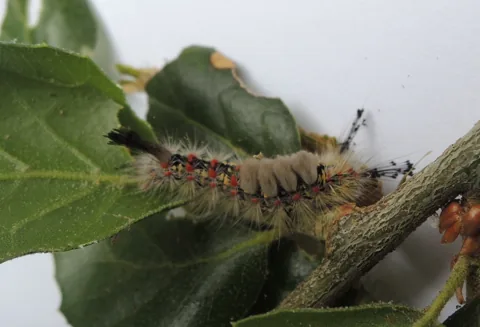 Western Tussock Moth
Orgyia vetusta
The western tussock moth, common throughout California, is a tussock moth whose colorful, tufted caterpillars feed on fruit and nut trees, oaks, willows and many landscape shrubs. Most years they are kept in check by natural enemies, but local outbreaks can strip trees, the caterpillars scar young fruit, and their hairs can irritate skin.
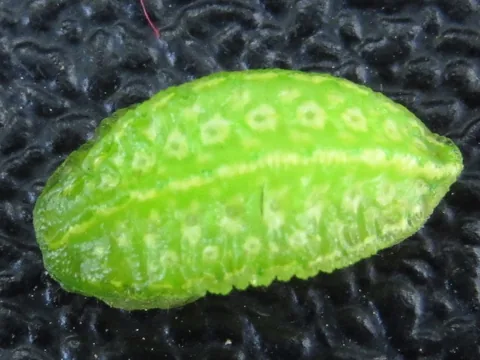 Yellow-shouldered Slug Moth
Lithacodes fasciola
The yellow-shouldered slug is the caterpillar of the yellow-shouldered slug moth (Lithacodes fasciola), one of the slug moths (family Limacodidae). The USDA Forest Service guide Caterpillars of Eastern Forests describes a green caterpillar with yellow markings whose short hairs are nonstinging and sunk into pits in its corrugated skin, found on many forest trees and shrubs from July to September. Researchers who study it say it commonly takes 60 to 80 days or more to develop.
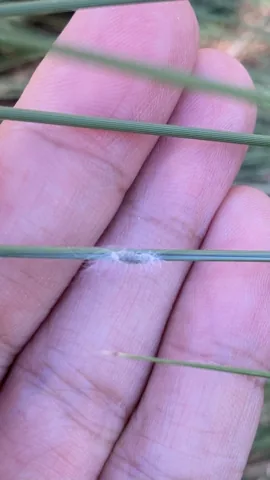 Muhlygrass mealybug
Stemmatomerinx acircula
The muhlygrass mealybug is a small, hairy-looking white mealybug that feeds on ornamental muhly grass. It is native to Florida and has turned up farther away: South Carolina in 2018, North Carolina by 2022 and Texas in 2024. Heavy infestations weaken plants and can delay or prevent the fall flower display. Inspect new plants, cut out and bag infested foliage, and use horticultural oil or a labeled insecticide on light infestations.
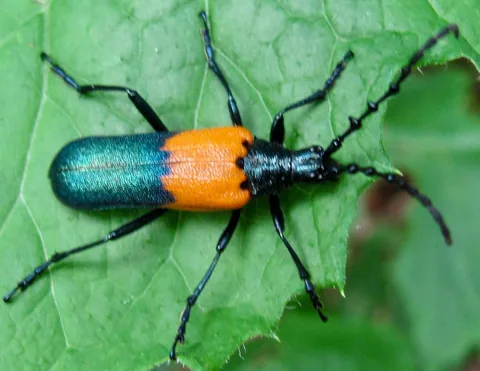 Elderberry borer
Desmocerus palliatus
The elderberry borer, Desmocerus palliatus, also called the elder borer, is a longhorn beetle of the eastern and central United States whose host is elder. Virginia Tech calls it the most important of the elderberry longhorn beetles; its larvae tunnel through the pith of stems and down into the roots.
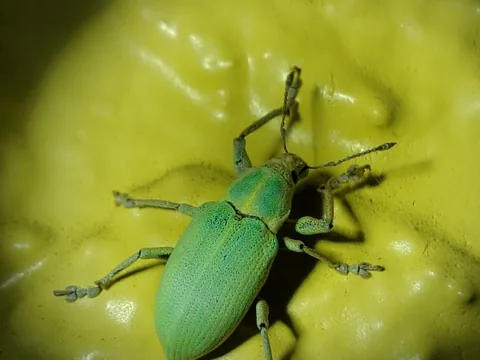 Southern blue-green citrus root weevil
Pachnaeus litus
Pachnaeus litus, the southern blue-green citrus root weevil, is one of two blue-green root weevils on Florida citrus and, with the Diaprepes root weevil, one of the most important root weevils there. Adults notch young leaves, but the soil-dwelling larvae do the real harm by feeding on roots.
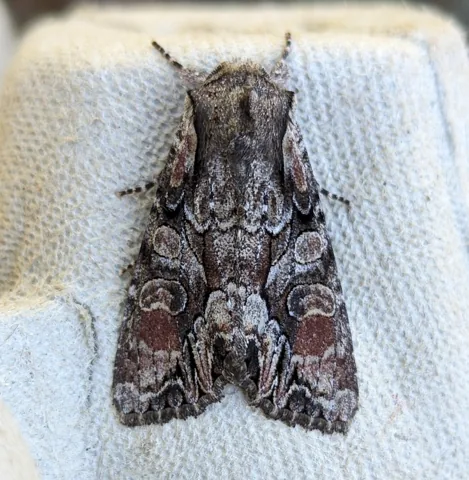 Lacanobia Fruitworm
Lacanobia subjuncta
The lacanobia fruitworm (Lacanobia subjuncta), also called the speckled cutworm moth, emerged as a new pest of Washington apple orchards. Its caterpillars feed heavily on leaves and can defoliate shoots in a few days, and the older ones also feed on the fruit, leaving damage that looks like a small scoop taken out of the apple.
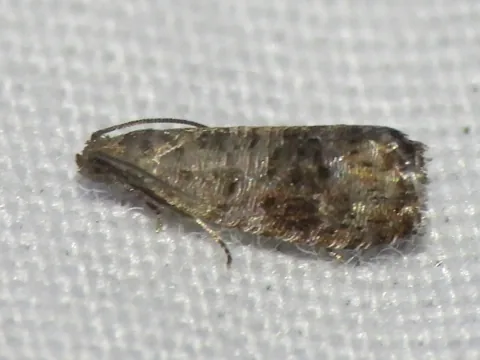 Cherry Fruitworm
Grapholita packardi (iNaturalist: Aspila packardi)
The cherry fruitworm (Grapholita packardi) is a small tortricid moth whose larvae feed inside the shoots and fruit of blueberry, cherry, apple, pear, plum, hawthorn and related plants. In blueberries the newly hatched larvae tunnel into the berries, and one larva can destroy an entire cluster.
No photo yet
Blueberry Gall Midge
Dasineura oxycoccana
The blueberry gall midge (Dasineura oxycoccana) is a tiny fly whose larvae feed inside blueberry buds. In rabbiteye blueberries in Florida, Georgia and Mississippi it is a serious pest of the flower buds, while in northern highbush blueberries it attacks only the growing shoot tips, which become distorted and bushy.
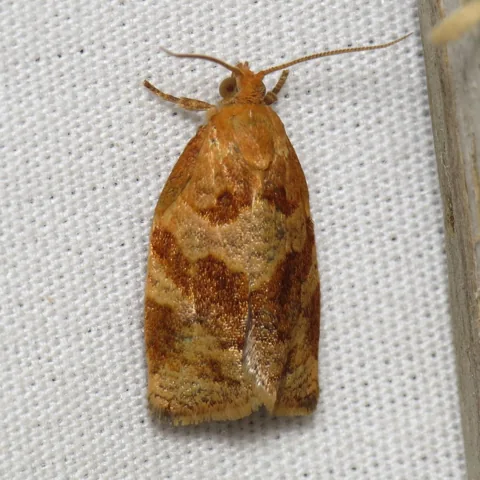 Filbert Leafroller
Archips rosana
The filbert leafroller (Archips rosana), also known as the rose tortrix, is a leafroller moth from Europe and Asia. Its green caterpillars roll and feed on the new leaves, buds, flowers and small fruits of hazelnuts, fruit trees and many other plants in spring. It is a plant pest only, and natural enemies usually keep it in check; in a home orchard, pick off rolled leaves, and if spraying is needed use Bt or another labeled product while the caterpillars are small.
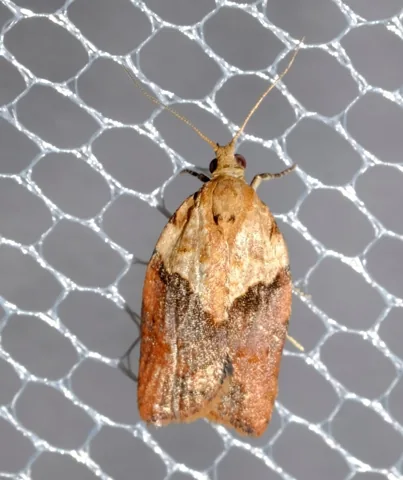 Light Brown Apple Moth
Epiphyas postvittana
The light brown apple moth (Epiphyas postvittana), often called LBAM, is a leafroller moth native to Australia. It was first found in California in 2006 and is now well established there. Its larvae have been recorded on more than 500 kinds of plants; they web leaves together or to fruit and feed on the fruit surface, leaving scars.
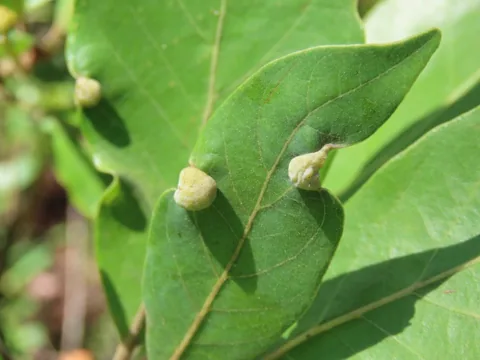 Redbay psyllid
Trioza magnoliae
The redbay psyllid is a tiny sap-feeding insect whose nymphs grow inside long, pocket-like galls formed from the curled edges of new bay leaves. It lives on red bay, silk bay and swamp bay, and although the galls look alarming they do little harm to a tree's health.
No photo yet
Oriental scale
Aonidiella orientalis
Oriental scale is a tiny armored scale insect, about 2 mm across, with a flat, round, yellowish to brown cover, that sucks sap from leaves, fruit and stems of papaya, palms, mango, citrus and many other plants. It is harmless to people. In the United States it is established in Florida and, since 2009, Hawaii. To get rid of it, prune out heavily infested parts, protect the parasitic wasps that usually keep it in check, and if needed use horticultural oil.
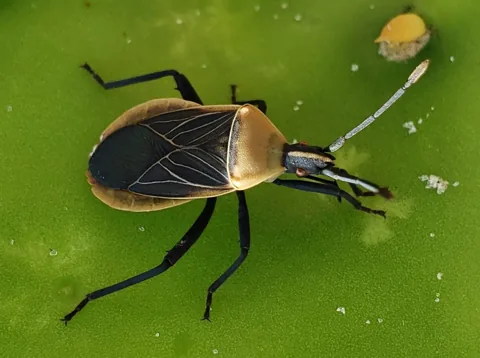 Cactus bug
Chelinidea vittiger
The cactus bug is a shield-shaped plant bug that lives on prickly pear cactus. Adults and nymphs feed in groups on the pads, and the first sign is a scatter of round, yellowish spots that can grow until a whole pad looks yellow and pitted.
No photo yet
Grape mealybug
Pseudococcus maritimus
Grape mealybug is a soft, waxy insect that spends the winter under loose bark and moves onto shoots, leaves and fruit as the season goes on. In vineyards it fouls grape clusters with cottony egg sacs, honeydew and sooty mold, and it can spread grapevine leafroll virus; it also infests pears.
No photo yet
Yellow scale
Aonidiella citrina
Yellow scale is a small armored scale insect whose round, flat, see-through cover looks yellow because the female's body shows through it. It is best known as a citrus pest but also infests dogwood, euonymus, ligustrum (privet) and many other woody plants, and heavy infestations cause leaf drop and twig dieback.
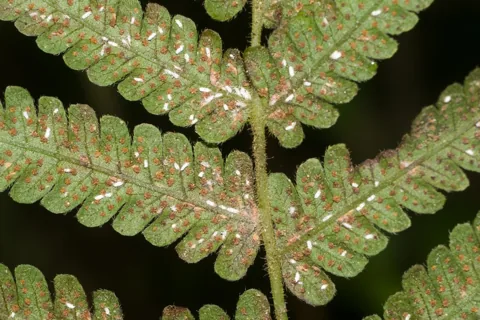 Fern scale
Pinnaspis aspidistrae
Fern scale is a small armored scale insect of ferns, liriope, palms and many foliage plants. The snow-white, ridged covers of the males stand out against dark green leaves, while the brown, oyster-shaped females are easy to overlook, and feeding can leave yellow spots.
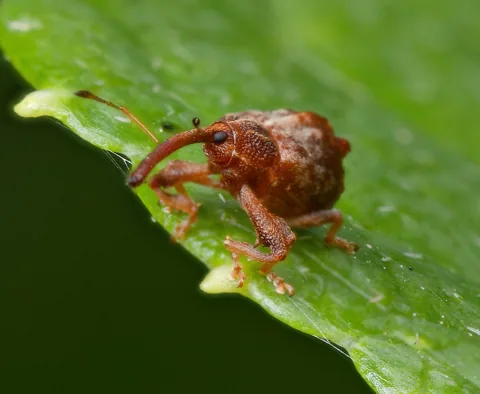 Apple curculio
Anthonomus quadrigibbus
The apple curculio, Anthonomus quadrigibbus, is a North American weevil that lays its eggs in young fruit of apple, pear, hawthorn, saskatoon, chokecherry and related plants. The grub stays inside and eats the seeds, and the adults leave small dark punctures on green fruit and shoot tips. In apple orchards it is an occasional pest, far less familiar than the plum curculio.
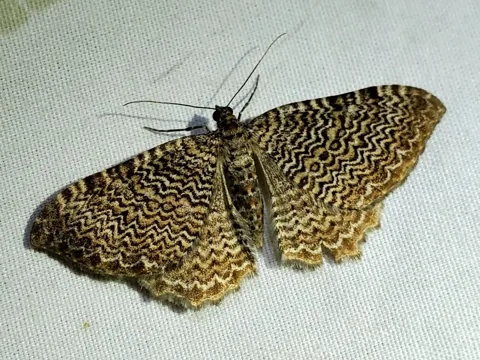 Cherry Scallop Shell Moth
Rheumaptera prunivorata
The cherry scallop shell (Rheumaptera prunivorata, also published as Hydria prunivorata) is a native moth whose inchworm caterpillars live in groups inside nests of leaves tied together with silk on black cherry and other cherries. Natural enemies usually keep it in check, but in some years it strips trees, and a USDA Forest Service study links outbreaks to dark rings that are a defect in black cherry veneer logs.
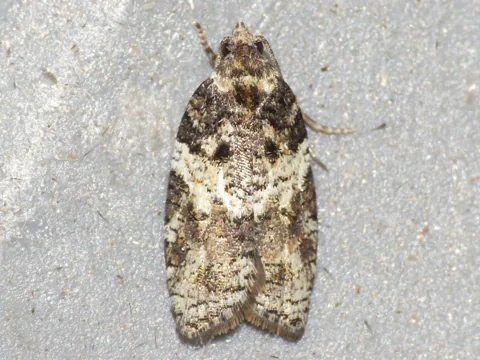 Eastern Blackheaded Budworm
Acleris variana
The eastern blackheaded budworm (Acleris variana) is a native moth whose caterpillars feed on the new needles of balsam fir and spruce. Since the first recorded outbreak in Nova Scotia in the late 1920s, outbreaks have come at about 10- to 15-year intervals and give the upper crowns a red tinge, but significant defoliation usually lasts no more than 2 years and trees seldom die from it alone.
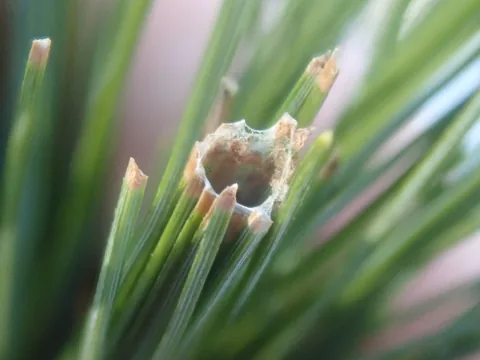 Pine Tube Moth
Argyrotaenia pinatubana
The pine tube moth (Argyrotaenia pinatubana) is a small native moth whose caterpillars web 5 to 20 eastern white pine needles together into a tube and feed inside it, eating the tube's end. It usually goes unnoticed, and UMass Extension says management is rarely, if ever, necessary.
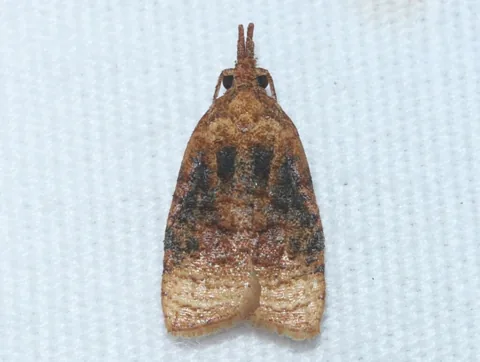 Variegated Leafroller
Platynota flavedana
The variegated leafroller (Platynota flavedana) is a small orange-brown moth of the eastern United States whose larvae fold and web leaves, then feed on blossoms and fruit. It is usually not a major pest of apples in North Carolina, but it has been reported damaging strawberry, peach and rose.
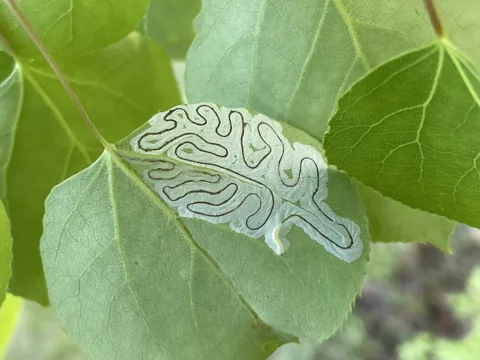 Aspen Leaf Miner
Phyllocnistis populiella
The aspen leaf miner (Phyllocnistis populiella), also called the aspen serpentine leafminer, is a tiny white moth whose larvae carve winding mines in the surface of aspen leaves and give whole stands a silvery look. Outbreaks in Alaska have covered more than 650,000 acres and have lasted for many years, and the insect also reaches outbreak levels in the western United States.
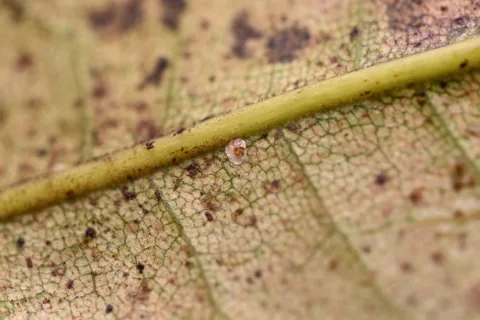 Greedy scale
Hemiberlesia rapax
Greedy scale is a tiny armored scale insect, a gray-to-white dot about 1 to 2 mm across, that sucks sap from hundreds of kinds of woody ornamentals, fruit trees and weeds. Tiny parasitic wasps help keep it in check; on badly crusted plants, NC State and UC IPM point to a thorough horticultural oil spray during the dormant season or when crawlers are active.
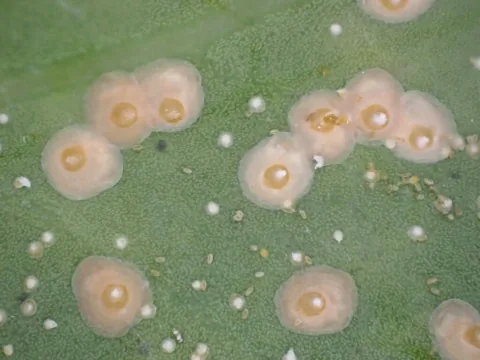 Oleander scale
Aspidiotus nerii
Oleander scale is a tiny armored scale insect that forms small, round, whitish covers on leaves, stems and fruit. It feeds on hundreds of plants but favors oleander, ivy, sago palm, aucuba and olive. UC IPM says even very high populations are harmless to most plants, while heavy infestations can cause wilting, yellowing and misshapen growth, and its hard cover makes it difficult to control.
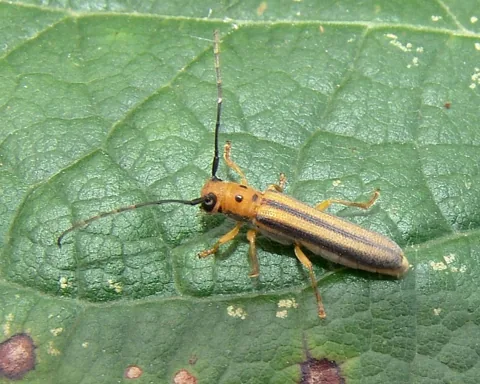 Dogwood twig borer
Oberea tripunctata
The dogwood twig borer, Oberea tripunctata, also called the elm twig girdler, is a slender longhorned beetle whose grubs bore down the middle of young shoots. Flowering dogwood is its main host, but elm, viburnum, azalea, blueberry and many other shrubs and trees are attacked.
No photo yet
Hickory spiral borer
Agrilus torquatus
The hickory spiral borer, Agrilus torquatus (listed in older references as Agrilus arcuatus torquatus), is a small flatheaded borer of hickory and pecan. Its larva cuts a spiral tunnel inward through a branch or young stem, and the severed stem usually breaks off at that spot.
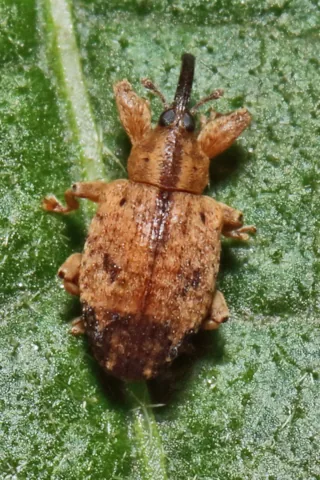 Ligustrum weevil
Ochyromera ligustri
The ligustrum weevil, Ochyromera ligustri, is a small snout beetle of privet. It was first found in Wake County, North Carolina, in 1959 and, according to UF/IFAS, is believed to have arrived from Asia in imported nursery stock. Adults chew holes in privet leaves, and the grubs develop inside the fruit and seeds.
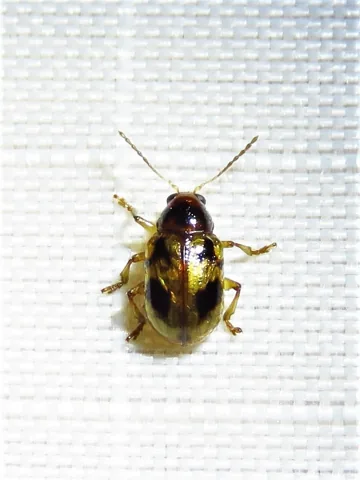 Strawberry rootworm
Paria fragariae
The strawberry rootworm, Paria fragariae, is a small brown leaf beetle that chews small round holes in strawberry and azalea leaves at night. Despite the name, NC State says its root-feeding grubs do negligible damage; the beetles cause the problem, and USDA ARS calls it an emergent pest of azalea nurseries in the southeastern US. USDA ARS and Alabama researchers say removing leaf litter in winter and controlling the beetles early in the season will help reduce the number of adults later in the season.
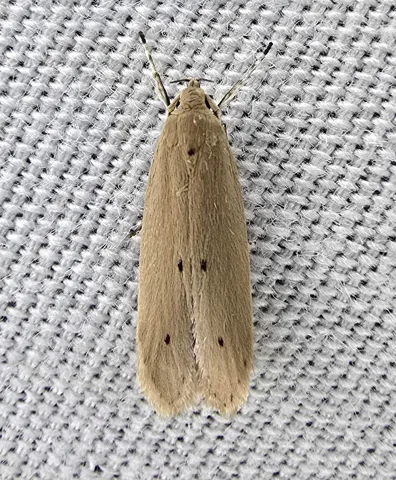 Palm Leaf Skeletonizer
Homaledra sabalella
The palm leaf skeletonizer (Homaledra sabalella) is a small native moth whose caterpillars feed only on palms in the southern United States. They live in groups under silk webbing packed with their own droppings on older fronds, and they sometimes cause serious, unsightly damage.
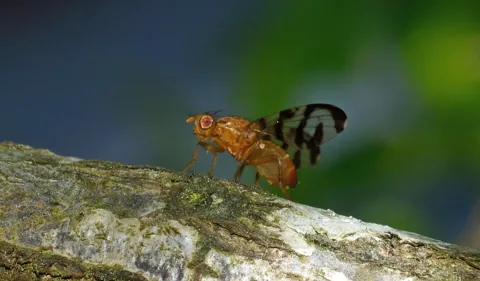 Currant Fruit Fly
Euphranta canadensis
The currant fruit fly (Euphranta canadensis), also called the gooseberry maggot, is a small yellow fly with banded wings. It lays its eggs under the skin of green currants and gooseberries, and the maggots feed inside, so infested berries color early, often drop, and are not fit to eat.
No photo yet
Western Tentiform Leafminer
Phyllonorycter elmaella
The western tentiform leafminer (Phyllonorycter elmaella) is a tiny moth whose larvae feed inside the leaves of apple and cherry trees. The mines cut into the leaf's ability to make food, which can reduce fruit size and quality, but naturally occurring parasitic wasps usually keep it under control.
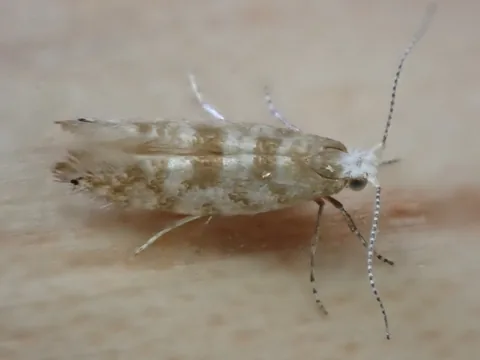 Cypress Tip Moth
Argyresthia cupressella
The cypress tip moth (Argyresthia cupressella), also called the cypress tipminer, is a tiny western moth whose larvae tunnel inside the shoot tips of arborvitae, cypress, juniper and related conifers. Damage is common on hedges and specimen trees in towns: the mined tips turn yellow, then brown, and look scorched by late winter or spring.
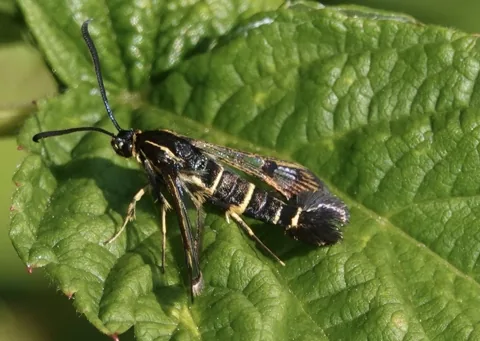 Currant Borer
Synanthedon tipuliformis
The currant borer (Synanthedon tipuliformis), also called the currant clearwing, is a small clear-winged moth whose larvae bore into the canes of currants and gooseberries. Infested shoots wilt and their fruit clusters fail to develop. Red currants are the most susceptible host.
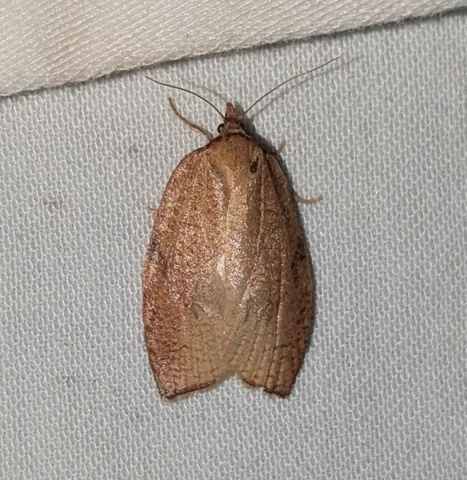 Western Avocado Leafroller
Amorbia cuneanum
The western avocado leafroller (Amorbia cuneana, listed on iNaturalist as Amorbia cuneanum), called amorbia on citrus, is a moth whose green caterpillars tie leaves and fruit together with silk and feed inside. It occurs in most California avocado groves; natural enemies usually keep it below damaging levels, but now and then numbers jump and the caterpillars scar enough fruit to cause severe losses.
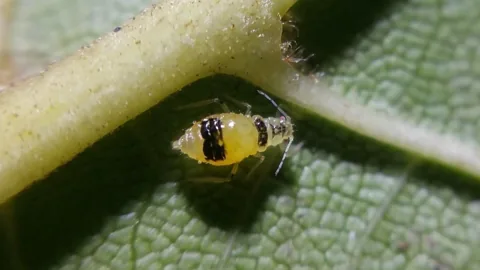 Walnut aphid
Chromaphis juglandicola
The walnut aphid is a tiny, pale yellow aphid that feeds scattered over the undersides of walnut leaves. It was once a major walnut pest, but an introduced parasitic wasp, Trioxys pallidus, now keeps it below damaging levels in most orchards, as long as broad-spectrum sprays don't wipe the wasp out.
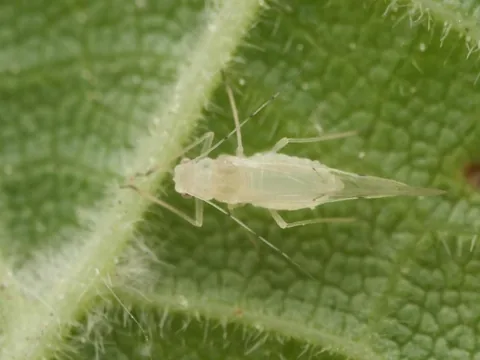 Filbert aphid
Myzocallis coryli
The filbert aphid is a small, light green to pale yellow aphid that lives only on hazelnuts (filberts), feeding along the veins on the undersides of the leaves. Heavy infestations reduce kernel fill and nut size, but an introduced parasitic wasp makes spraying unnecessary in many orchards.
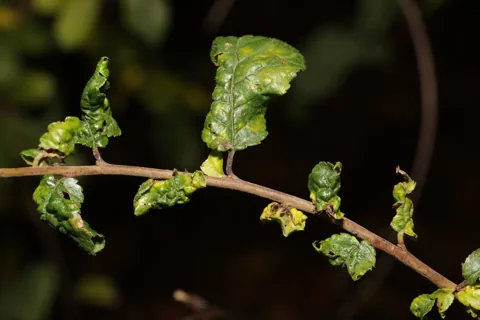 Leafcurl plum aphid
Brachycaudus helichrysi
The leafcurl plum aphid is a small aphid that ranges from shiny green to brownish green or brownish yellow. It attacks plum, prune and other stone fruits in spring, where its colonies hide inside curled leaves, and spends summer on plants in the daisy family such as chrysanthemum.
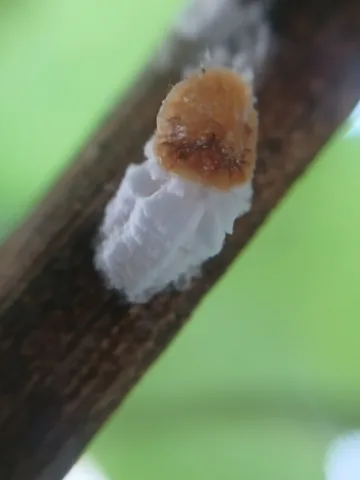 Cottony grape scale
Pulvinaria vitis
The cottony grape scale is a soft scale insect of grapevines. In late spring the mature females are easy to spot by the white, cottony egg sacs that stick out behind them, two to three times as long as the scale itself. It can weaken vines, kill twigs and transmit grapevine viruses.
No photo yet
Citrus thrips
Scirtothrips citri
Citrus thrips, Scirtothrips citri, is a tiny thrips native to the southwestern United States and northwestern Mexico. Its larvae feed under the sepals of young citrus fruit and leave a ring of grayish or silvery scar tissue on the rind. The damage is cosmetic, but it can lower the fruit's grade.
No photo yet
Avocado thrips
Scirtothrips perseae
Avocado thrips, Scirtothrips perseae, is a recent invasive pest of California avocados. It thrives in cool weather and feeds on tender leaves and very young fruit, leaving scabby brown scars that spread as the fruit grows. The fruit inside is fine, but scarred avocados are downgraded or culled.
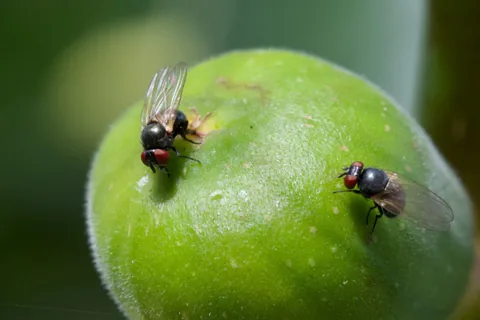 Black Fig Fly
Silba adipata
The black fig fly (Silba adipata) is an invasive fly that attacks only figs. Females lay eggs through the small opening at the tip of young figs, the maggots feed inside, and infested fruit usually drops early. It was found in California in 2021, and CDFA's 2024 pest rating proposal says it is established in ten California counties.
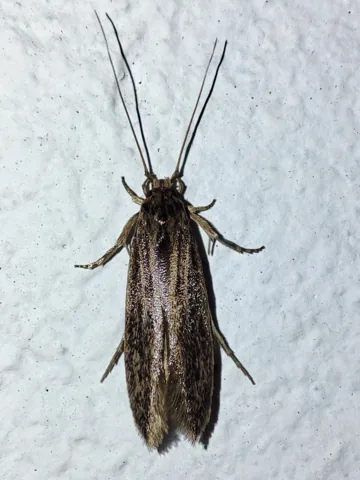 Banana Moth
Opogona sacchari
The banana moth (Opogona sacchari) is a small moth whose caterpillars tunnel inside plants. In California it attacks palms, especially queen palm, mostly in nurseries; elsewhere it damages crops such as bananas. Its larvae feed hidden in plant tissue, so the damage is usually the first sign.
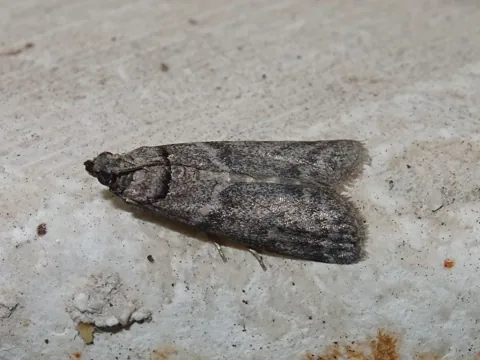 Carob Moth
Ectomyelois ceratoniae
The carob moth (Ectomyelois ceratoniae) is a small moth whose pink caterpillars bore into fruit and nuts. In the United States it is a pest of dates in the California and Arizona deserts, and abroad it damages crops such as pomegranates and pistachios.
No photo yet
Ficus Eye-Spot Midge
Horidiplosis ficifolii
The ficus eye-spot midge (Horidiplosis ficifolii) is a tiny gall midge from Asia whose larvae feed inside the leaves of Indian laurel fig (Ficus microcarpa), raising blister-like galls that later turn into brown, sunken spots. It was first found in North America in Florida in 2008 and reached Southern California around 2014.
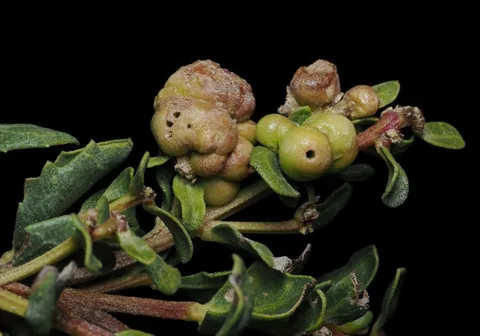 Coyote Brush Bud Gall Midge
Rhopalomyia californica
The coyote brush bud gall midge (Rhopalomyia californica), which UC IPM calls the baccharis gall fly, is a tiny fly whose larvae turn the shoot tips of coyote brush (Baccharis pilularis) into round, knoblike galls. The galls look odd but do not threaten the shrub, and no control is recommended.
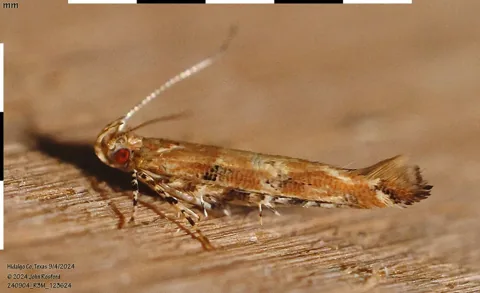 Pink Scavenger Caterpillar
Anatrachyntis rileyi
The pink scavenger caterpillar (Anatrachyntis rileyi, formerly Pyroderces rileyi) is the larva of a tiny moth. As its name says, it mostly feeds on dead, dry or rotting plant material, but in large numbers it will feed on sound fruit, and it has caused problems in citrus, banana and corn.
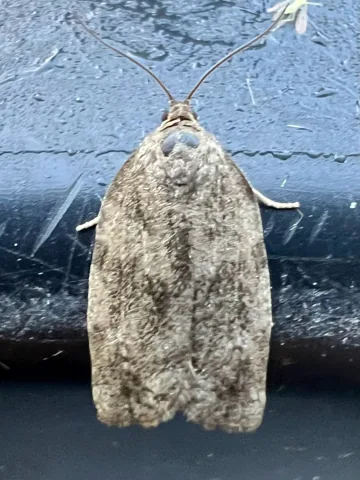 Large Aspen Tortrix
Choristoneura conflictana
The large aspen tortrix (Choristoneura conflictana) is a native moth whose caterpillars roll aspen leaves into silk-tied shelters and feed inside them. Outbreaks can strip whole aspen stands for two or three years and then collapse; healthy trees usually recover.
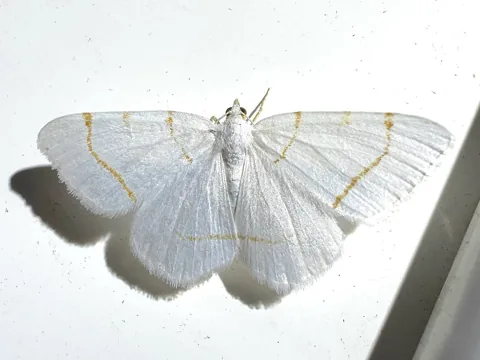 Lesser Maple Spanworm
Macaria pustularia
The lesser maple spanworm (Macaria pustularia, formerly Itame pustularia) is a small white moth whose green inchworm caterpillars feed on red maple. Natural Resources Canada says populations of this native insect stayed low until a serious eruption in central and southern New Brunswick in the mid-1970s badly defoliated red maples.
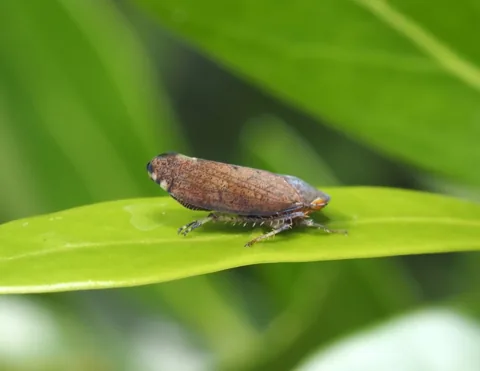 Cherry leafhopper
Fieberiella florii
The cherry leafhopper (Fieberiella florii) is a small, dark brown leafhopper shaped like a plant bud. It does not bite people or pets. It matters because it can spread X-disease (cherry buckskin), which ruins cherries and has no cure. To protect cherry trees, remove infected trees and nearby wild hosts, keep weeds down, and use insecticides only where X-disease is present.
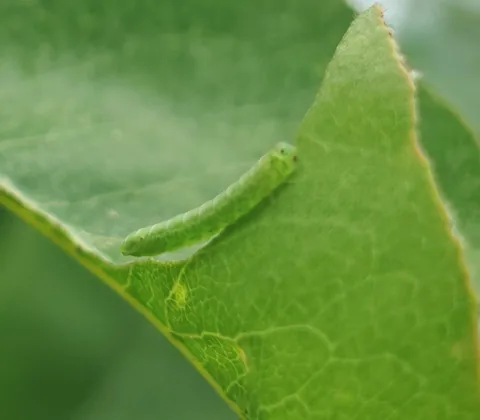 California pear sawfly
Pristiphora abbreviata
The California pear sawfly is a small, stout wasp whose bright green, caterpillar-like larvae chew round holes in pear leaves in spring. It is an occasional, minor pest: the larvae do not feed on fruit, and healthy trees tolerate a lot of leaf chewing.
No photo yet
Italian pear scale
Epidiaspis leperii
Italian pear scale is a small armored scale that lives on the bark of fruit and nut trees, hidden under moss and lichens. It is rarely a pest in commercial pear and apple orchards in California, but heavy infestations can pit, deform and kill branches, especially on pear and plum.
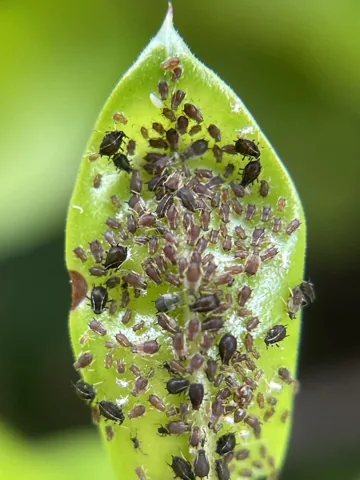 Black citrus aphid
Aphis aurantii (formerly Toxoptera aurantii)
The black citrus aphid is a small, shiny black aphid that feeds in colonies on the tender new growth of citrus, camellia and a very wide range of other plants. It is a tropical and subtropical species that also turns up in greenhouses in cooler regions.
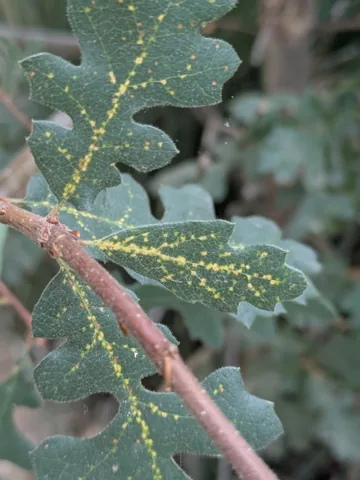 Oak leaf phylloxera
Phylloxera species on oak (e.g., P. davidsoni, P. querceti, P. glabra)
Oak leaf phylloxera are tiny, soft-bodied, aphid-like insects that feed on the undersides of oak leaves. Each feeding site turns into a small spot that is bright yellow at first and later brown. In California they are of minor importance and have no apparent effect on tree health, though defoliation can be heavier in the Pacific Northwest.
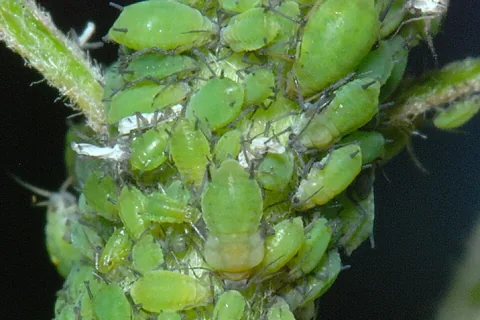 Green apple aphid
Aphis pomi
The green apple aphid is a small green aphid that crowds onto the tender shoot tips and water sprouts of apple, pear and related trees. Unlike the rosy apple aphid, it stays on apple all year. Heavy colonies curl young leaves and drip honeydew that grows sooty mold on leaves and fruit.
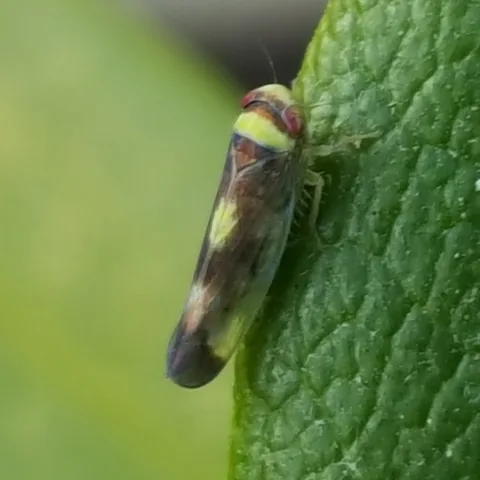 Mountain leafhopper
Colladonus montanus
The mountain leafhopper is a slender, dark brown leafhopper that breeds on clovers, alfalfa and weeds rather than on cherry trees. It matters because it carries the phytoplasma that causes X-disease (cherry buckskin), picking it up from infected cherries or weeds and passing it to healthy trees.
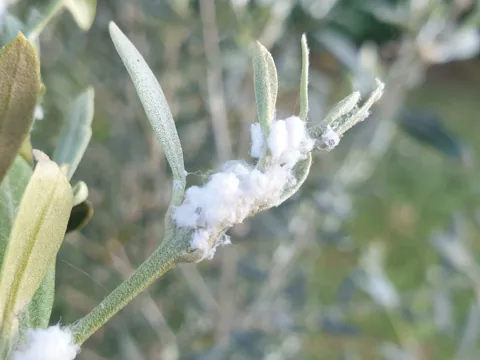 Olive psyllid
Euphyllura olivina
The olive psyllid is a small, light tan, jumping insect that has recently invaded coastal California. Its nymphs feed in colonies on olive buds, flowers and tender shoots under a white waxy coating, and heavy infestations can cut olive yields by 30% to 60%.
No photo yet
Citricola scale
Coccus pseudomagnoliarum
Citricola scale is a soft scale of citrus with a single generation a year and no males. Parasitic wasps control it so completely in Southern California that it is almost never seen there, but in the San Joaquin Valley it can be a serious pest whose honeydew and sooty mold cut yield and fruit quality.
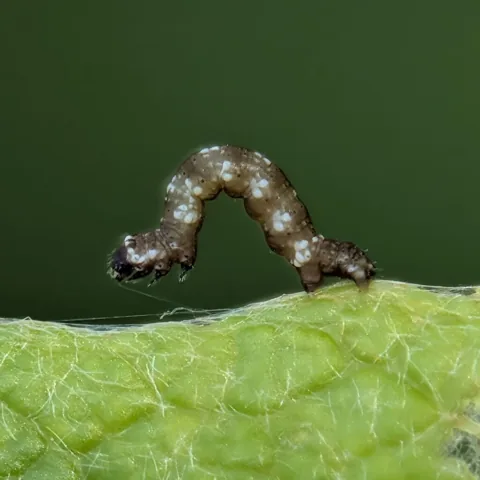 Saddleback Looper
Ectropis crepuscularia
The saddleback looper (Ectropis crepuscularia), which BAMONA lists as the small engrailed, is a gray to brown inchworm that the USDA Forest Service caterpillar guide calls an excellent twig mimic in form, coloration and posture. It feeds alone on the needles and leaves of many conifers and hardwoods. Natural Resources Canada calls it common and occasionally destructive.
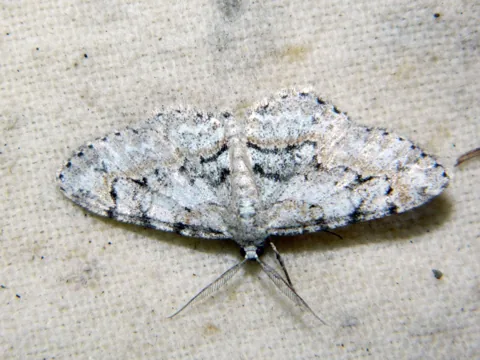 Pale-winged Gray
Iridopsis ephyraria
The pale-winged gray (Iridopsis ephyraria) is a native moth whose inchworm caterpillars feed on many broadleaf trees and shrubs and on balsam fir and eastern hemlock. It has only recently been seen damaging eastern hemlock: outbreaks start on understory trees and work up into the crowns, and at high numbers the caterpillars can strip and kill a tree within 2 years.
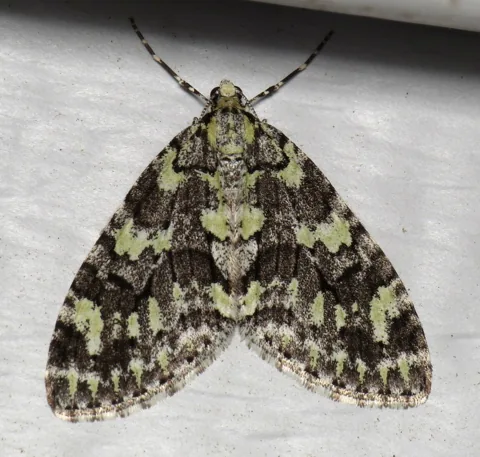 Yellowlined Forest Looper
Cladara limitaria
The yellowlined forest looper (Cladara limitaria), also called the yellow-lined conifer looper, is a green inchworm with yellow stripes that feeds on the needles of fir, spruce, hemlock, larch, Douglas-fir and other conifers from May to July. It rests with its head rolled under its body like a fist. BAMONA calls its moth the mottled gray carpet. Natural Resources Canada calls it a common, innocuous solitary defoliator.
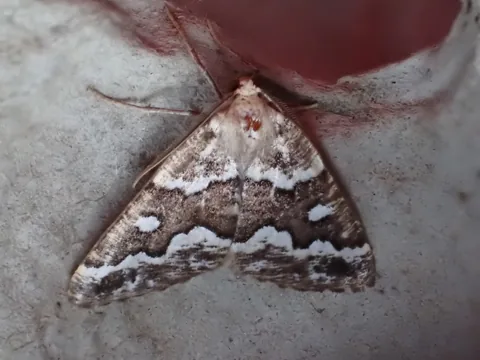 Gray Spruce Looper
Caripeta divisata
The gray spruce looper (Caripeta divisata) is a moth of conifer forests whose inchworms feed on firs, spruces, jack and shore pine, tamarack, western hemlock, western redcedar and Rocky Mountain Douglas-fir. The caterpillars are around late in the season, from July to mid-September in Canada. Natural Resources Canada calls it common and occasionally destructive.
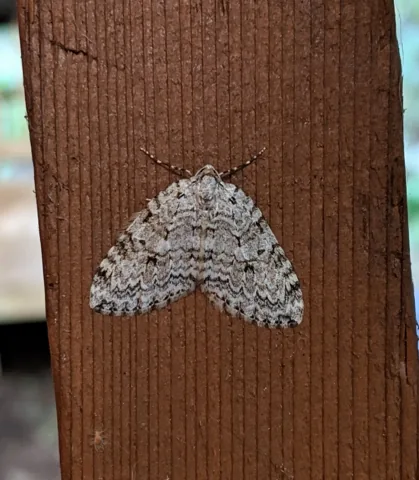 Autumnal Moth
Epirrita autumnata
The autumnal moth (Epirrita autumnata) is a pale gray moth of coniferous and mixed woods that BAMONA records across southern Canada and the northern United States, and in Eurasia. Its caterpillar, the green velvet looper, is a green inchworm that Natural Resources Canada calls common and on occasion locally abundant, but nondestructive.
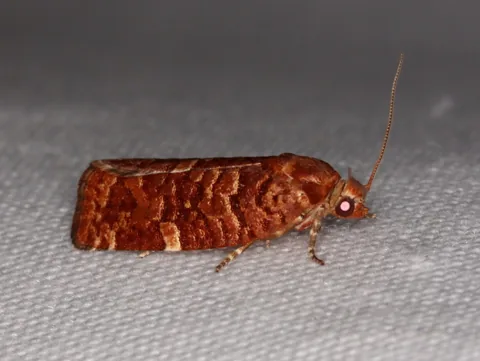 Jack Pine Budworm
Choristoneura pinus
The jack pine budworm (Choristoneura pinus) is the most common and widespread pine-feeding budworm native to North America. In late spring its caterpillars feed in the pollen cones and new shoots of jack pine and red pine, cutting needles off and tying them up in silk, and by midsummer infested trees look scorched red. Outbreaks last only a few years in one place but come back often.
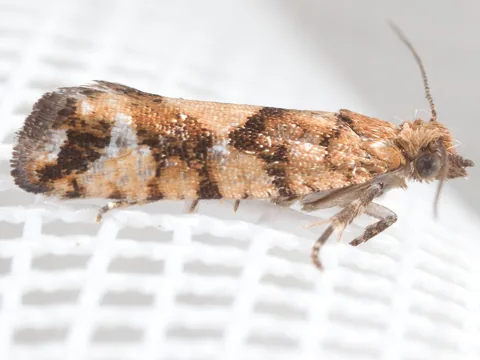 Spruce Bud Moth
Zeiraphera canadensis
The spruce bud moth (Zeiraphera canadensis) is a native moth whose small caterpillar feeds on the new shoots of spruce in spring. Its giveaway is the bud cap held on the tip of a new shoot with silk threads. Natural Resources Canada says it prefers open-growing spruce, and the USDA APHIS identification tool calls it a major pest of spruce in North America, especially of young trees in plantations.
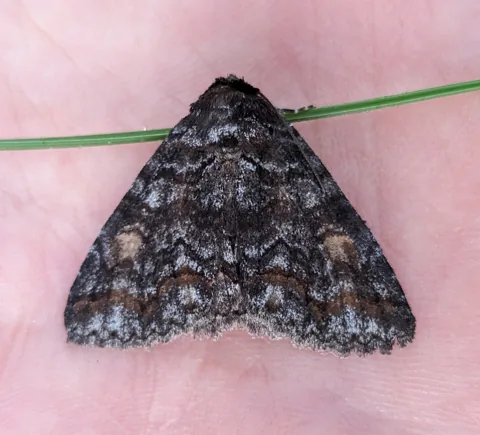 Pine False Looper
Zale duplicata
The pine false looper (Zale duplicata), which Natural Resources Canada calls the pine zale, is a moth whose caterpillars feed on pine needles from June to August. The grown caterpillar is rusty brown to dark gray. Natural Resources Canada calls it a common, innocuous solitary defoliator.
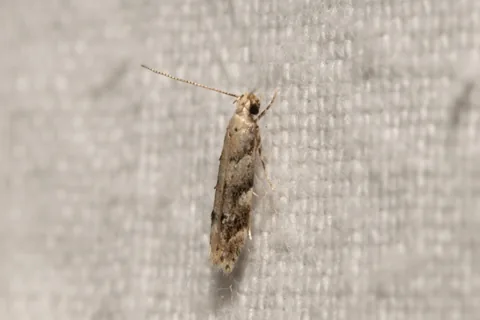 Orange Spruce Needleminer
Coleotechnites piceaella
The orange spruce needleminer (Coleotechnites piceaella, formerly Recurvaria piceaella) is a very small gelechiid moth whose reddish-brown caterpillars mine spruce needles. Each caterpillar hollows out several neighboring needles of the previous year's growth and ties them loosely together with silk, and it spends the winter inside a mined needle. It is usually not very harmful, though it can matter on ornamental spruce.
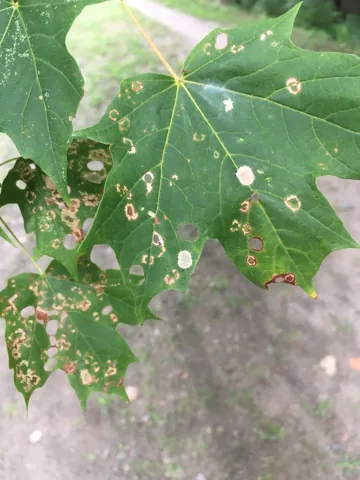 Maple Leafcutter
Paraclemensia acerifoliella
The maple leafcutter (Paraclemensia acerifoliella) is a tiny native moth whose caterpillar mines inside maple leaves and then cuts out oval disks to build a portable case. The result in summer is leaves full of oval holes and small chewed rings with a green center. Outbreaks have recurred in eastern Canada for two centuries.
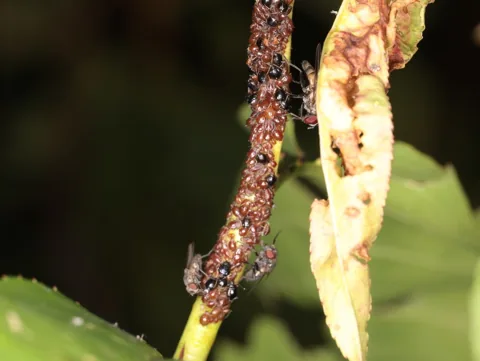 Black peach aphid
Brachycaudus persicae
The black peach aphid is a shiny black aphid of peach and nectarine that lives part of the year on the tree's roots. In spring it moves up to the new growth, where its colonies curl, yellow and drop leaves.
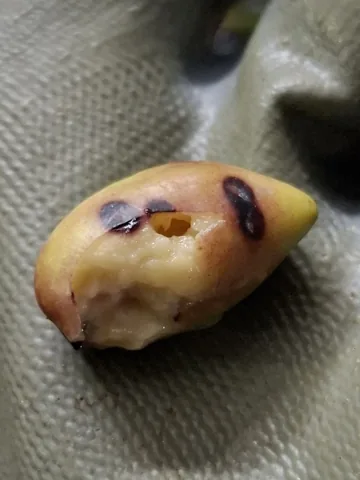 Olive scale
Parlatoria oleae
Olive scale is an armored scale insect that looks like a small gray crust on twigs, leaves and fruit. Its feeding leaves purple spots on olives and can leave red spots on fruits such as apples and peaches. It was once a very serious pest of olives and deciduous fruit in California, until introduced parasites brought it under control.
No photo yet
Gill's mealybug
Ferrisia gilli
Gill's mealybug is a pinkish gray mealybug covered in long, glassy white wax threads. A fairly new species, it has become a pest of pistachios in California's San Joaquin Valley and of wine grapes in the Sierra foothills, where it fouls fruit and spreads grapevine leafroll viruses.
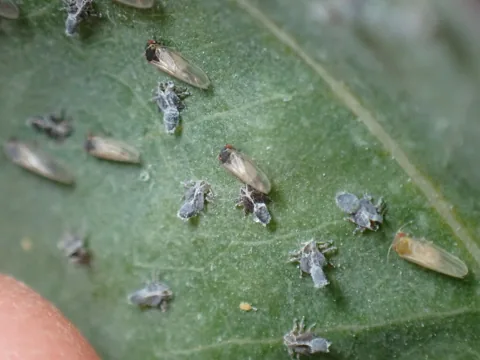 Bluegum psyllid
Ctenarytaina eucalypti
The bluegum psyllid is a tiny sap-feeding insect from Australia that lives in the growing tips of blue gum and baby blue gum eucalyptus. After it reached California in 1991 it fouled and defoliated commercial cut-foliage plantings, until a parasitic wasp released in 1993 brought it under control.
No photo yet
Green shield scale
Pulvinaria psidii
Green shield scale is a soft scale insect of tropical and subtropical plants, from hibiscus, gardenia and ficus in landscapes to guava, mango and citrus in orchards. The females surround themselves with white cottony egg sacs, and heavy infestations leave honeydew, black sooty mold and wax that lingers long after the scales die. It is a plant pest only; natural enemies, ant control and horticultural oil are the main controls.
No photo yet
Cypress sawfly
Susana cupressi
The cypress sawfly is the most common of several Susana sawflies whose larvae feed on cypress and juniper in California. The grayish green larvae chew foliage in groups from late winter to early summer, sometimes leaving a thin canopy and bare stems.
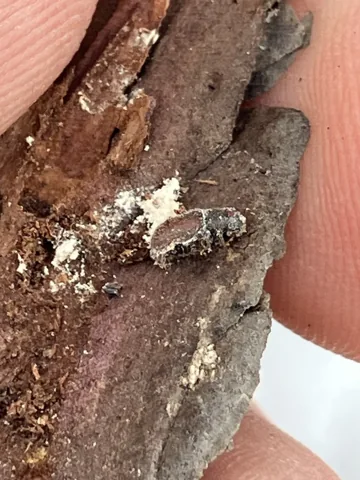 Eastern larch beetle
Dendroctonus simplex
The eastern larch beetle, Dendroctonus simplex, is a native bark beetle of tamarack (eastern larch). It used to cause small outbreaks that ended within a few years, but Minnesota has now had an outbreak every year for 25 years, with more than a million acres of tamarack affected as of 2025.
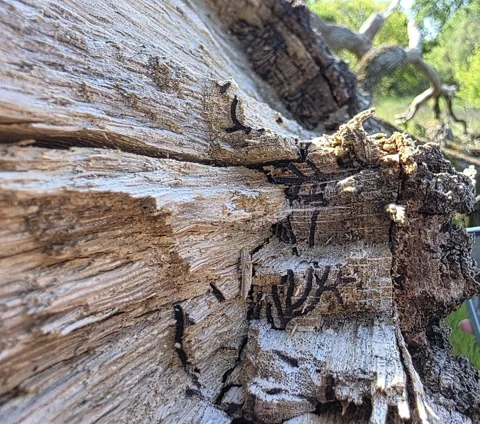 Mediterranean oak borer
Xyleborus monographus
The Mediterranean oak borer, Xyleborus monographus, is an ambrosia beetle from the Mediterranean region that is killing oaks in the western United States. It was first confirmed infesting valley oaks in Napa County, California, in 2019 and has since been found in oaks in northwest Oregon. In most infested trees, a dead branch has been followed by death of the whole tree within about three years.
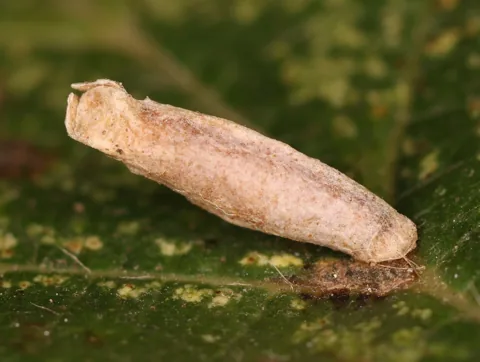 Birch Casebearer
Coleophora serratella
The birch casebearer (Coleophora serratella) is a small moth native to Europe. Its caterpillars build portable, cigar-shaped cases out of leaf pieces, carry them around on birch and alder leaves, and eat out the inside of the leaf without leaving the case. Heavy infestations can strip a birch of its spring leaves.
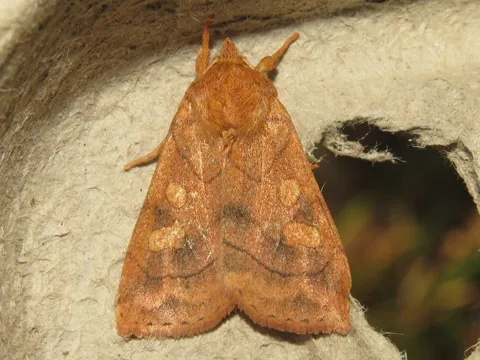 Aspen Twoleaf Tier
Enargia decolor
The aspen twoleaf tier (Enargia decolor) is a native moth whose caterpillars feed on trembling aspen and cottonwood. Their calling card is two leaves tied flat against each other with silk, with the caterpillar living between them. Outbreaks can thin or strip aspen crowns but are short-lived, and no specific control is recommended.
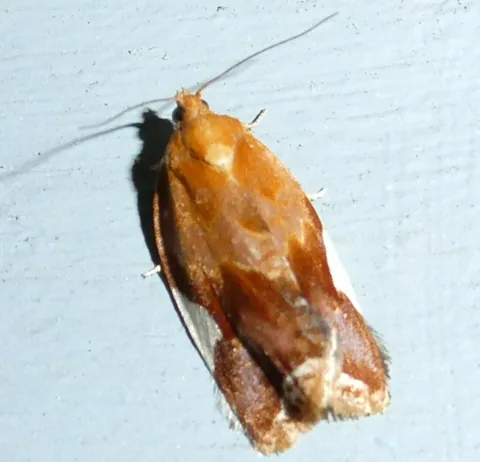 Whitetriangle Leafroller
Clepsis persicana
The whitetriangle leafroller (Clepsis persicana), also called the white triangle tortrix or green needleworm, is a small leafroller moth named for the white triangle on the front edge of each orange wing. Its slender green caterpillars feed on more than 40 kinds of trees and shrubs, conifers and broadleaf alike, but Natural Resources Canada calls it a common, innocuous defoliator.
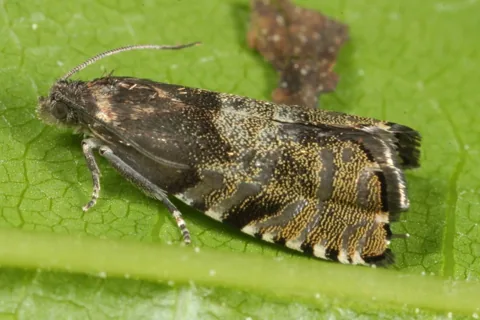 Spruce Seed Moth
Cydia strobilella
The spruce seed moth (Cydia strobilella) is a small, dark brown moth whose larvae live inside spruce cones, feeding on the scales and then the seeds. It is found in the northern United States and Canada as well as from Europe to Japan, and researchers call it a serious pest of spruce cones and a major pest in European spruce seed orchards, which grow seed for replanting forests.
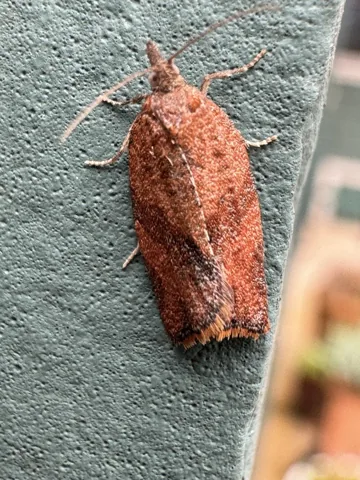 Orange Tortrix
Argyrotaenia franciscana
The orange tortrix (Argyrotaenia franciscana, long known in farm literature as Argyrotaenia citrana) is a leafroller moth of the West Coast's cooler coastal areas and river valleys. Its caterpillars roll and web leaves, feed on developing fruit and let rot into grape clusters, and they feed on more than 40 plant families.
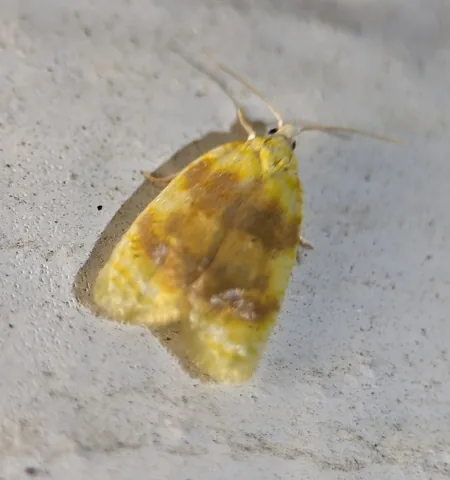 Oak Leafshredder
Acleris semipurpurana
The oak leafshredder (Acleris semipurpurana, formerly Croesia semipurpurana), also called the oak leaf tier or oak leaftier, is a native moth whose caterpillars bore into red oak buds at bud break. The leaves that open are full of small holes and are then tied and rolled together with silk. Outbreaks thin oak crowns for a couple of years, and the caterpillars dangling on silk threads are a nuisance in yards.
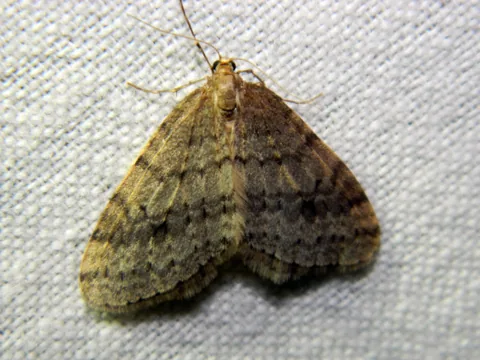 Bruce Spanworm
Operophtera bruceata
The Bruce spanworm (Operophtera bruceata) is an inchworm whose caterpillars feed in spring on the buds, flowers and young leaves of fruit trees and of native trees and shrubs such as willow, poplar, maple and alder. A USDA Forest Service guide says it is very similar in appearance to the introduced winter moth. Its moths appear late in the year, and the females have no wings.
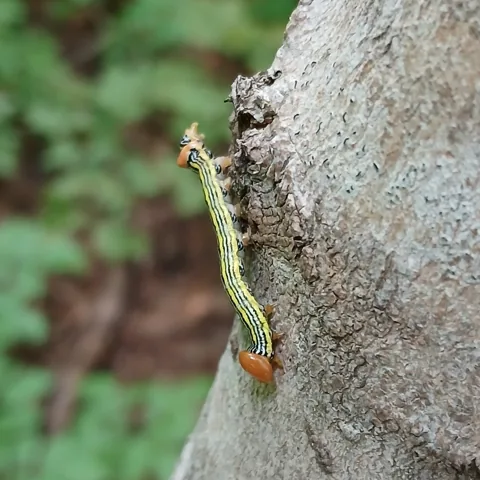 Orangehumped Mapleworm
Symmerista leucitys
The orangehumped mapleworm (Symmerista leucitys) is a prominent moth (family Notodontidae). Its striped caterpillar feeds on many forest trees but especially maples, from July to September, according to the USDA Forest Service Caterpillars of Eastern Forests guide. A USDA Forest Service guide to oak-feeding caterpillars cites studies saying it feeds mostly on sugar maple and is the only Symmerista in the eastern United States known to feed on maple.
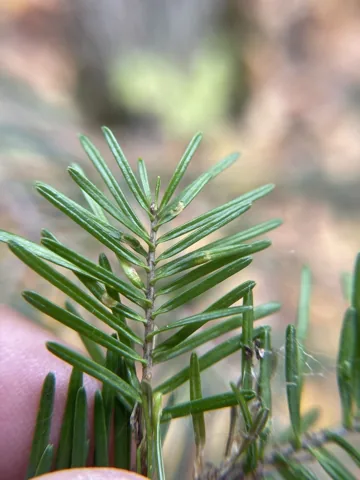 Balsam Gall Midge
Paradiplosis tumifex
The balsam gall midge (Paradiplosis tumifex), also called the balsam fir needle gallmaker, is a tiny orange fly whose larvae live inside new fir needles. Each larva makes the needle swell into a gall near its base, and the galled needles fall off in autumn. Forest trees suffer little lasting harm, but heavy infestations can make Christmas trees unsellable for years.
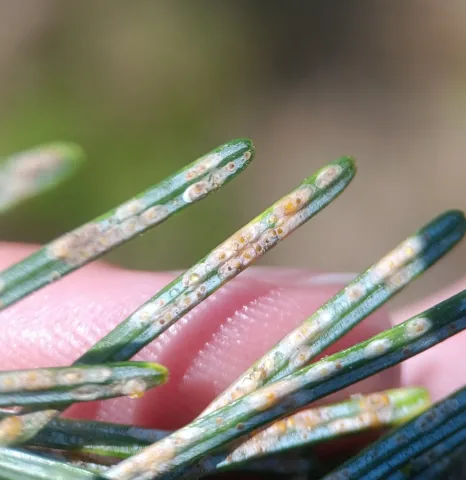 Cryptomeria scale
Aspidiotus cryptomeriae
Cryptomeria scale is an armored scale insect from Asia that has become a serious conifer pest from southern New England to the Southeast, above all on Christmas tree farms. It settles on the undersides of needles, mostly on true firs and hemlocks, and causes yellow mottling and early needle drop on the lower and inner branches. Is it harmful? Not to people or pets, but damage can start suddenly and spread quickly through a planting. To get rid of it, scout the lower inner needles, cull or prune heavily infested trees, use dormant oil before bud break, and time any insecticide to the crawlers.
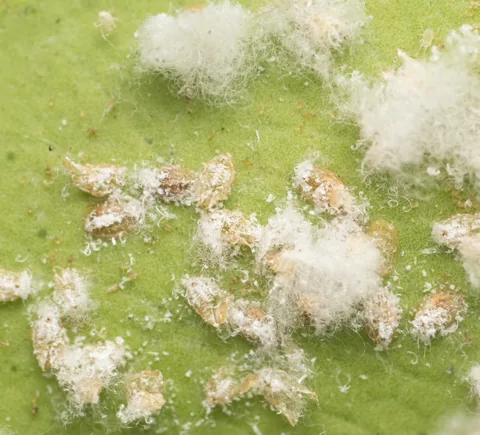 Woolly whitefly
Aleurothrixus floccosus
The woolly whitefly is a citrus whitefly whose nymphs are covered in fluffy, waxy filaments on the undersides of leaves. It came to California from Mexico in the 1960s and is one of the main whiteflies of Florida citrus, but in both states it is normally held in check by natural enemies. Outbreaks usually mean something, such as broad-spectrum sprays, ants or extreme weather, has knocked those enemies back.
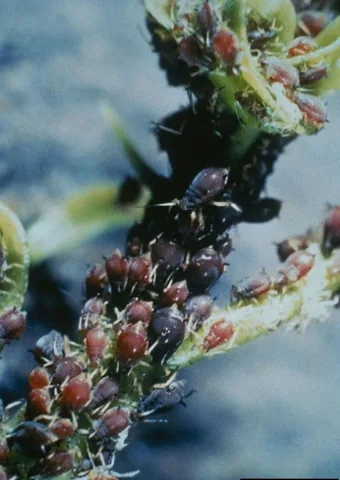 Brown citrus aphid
Aphis citricidus
The brown citrus aphid (Aphis citricidus, formerly Toxoptera citricida) is one of the most serious citrus pests. It feeds on new citrus growth, but its real threat is citrus tristeza virus, which it spreads more efficiently than any other aphid; on sour orange rootstock the virus causes quick decline. Native to Southeast Asia, it has spread to most citrus regions except California and the Mediterranean basin, and it reached Florida at the end of 1995. One of the worst citrus losses ever recorded followed its arrival in Brazil and Argentina, where tristeza killed 16 million trees on sour orange rootstock.
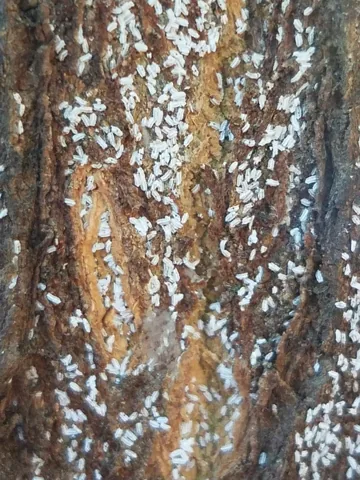 Citrus snow scale
Unaspis citri
Citrus snow scale is an armored scale insect of citrus trunks and limbs. Its name comes from the white covers of the young males, which can coat the bark like snow, while the dark females blend in. Heavy infestations stop the bark from growing so that it splits, opening the tree to fungi and borers. Clemson calls it a sporadic pest; for home trees, horticultural oil sprays and its natural enemies are the main tools.
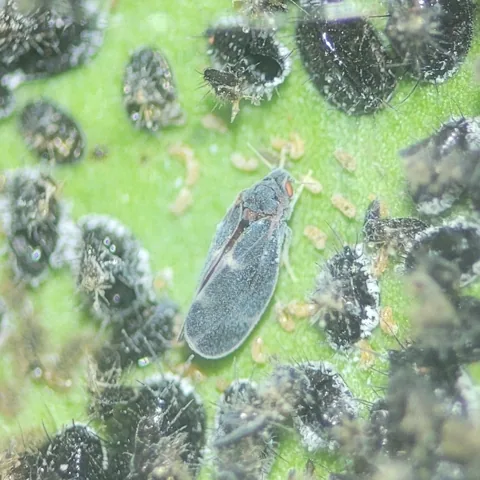 Citrus blackfly
Aleurocanthus woglumi
The citrus blackfly is a whitefly from Southeast Asia whose adults look slate blue or metallic gray-blue instead of white. Its spiny dark nymphs suck sap from citrus leaves and excrete honeydew that grows black sooty mold. In Florida it is widespread from north-central through south Florida, but parasitic wasps normally keep it at very low numbers, so it rarely needs treatment.
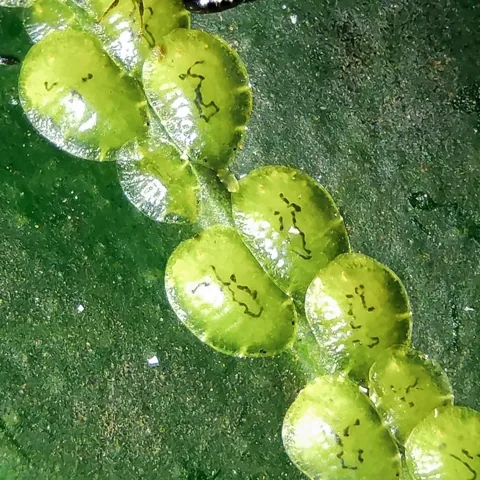 Green scale
Coccus viridis
Green scale, also called green coffee scale, is a soft scale of tropical and subtropical regions that feeds on more than 200 plant species, from coffee, guava and citrus to ornamentals such as gardenia and ixora. The scales settle along the leaf veins and on young stems, and their honeydew blackens plants with sooty mold.
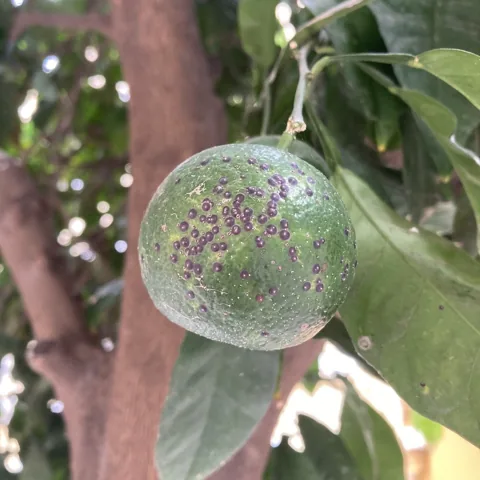 Florida red scale
Chrysomphalus aonidum
Florida red scale is an armored scale insect, apparently native to tropical Asia, and one of the most damaging scale pests of citrus. It dots leaves and fruit with small, round, dark scales, and heavy infestations yellow the leaves and can defoliate trees. It also attacks palms, orchids and many ornamentals, including plants kept in greenhouses. UF/IFAS's Florida Citrus Production Guide lists it among the most important armored scales in Florida.
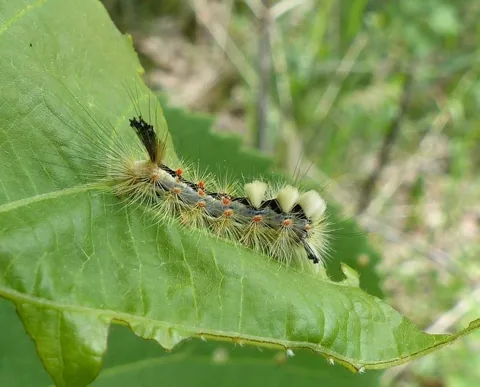 Rusty Tussock Moth
Orgyia antiqua
The rusty tussock moth (Orgyia antiqua), called the vapourer moth in Britain, came to North America from Europe and is now established across Canada and south to the mid-Atlantic states and northern California. Its showy, hairy caterpillars feed on more than 50 kinds of trees and shrubs, conifers included, but outbreaks are usually small and short and plants usually recover. The main caution is the hairs, which detach easily and can irritate skin: tussock moth hairs have caused itchy rash outbreaks. On shrubs, pick off caterpillars, cocoons and egg masses wearing gloves; sprays are rarely needed, and Bt works best on young caterpillars.
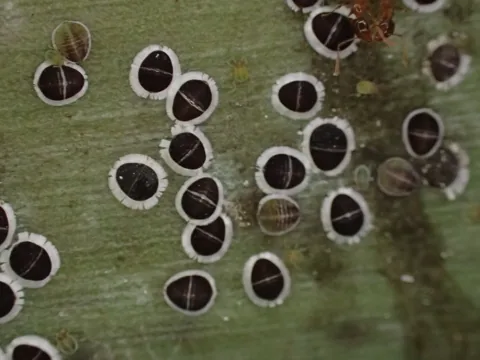 Palm aphid
Cerataphis brasiliensis
The palm aphid (Cerataphis brasiliensis) doesn't look like a typical aphid: University of Florida Extension says it resembles a whitefly or scale insect. Wingless adults are oval, glossy dark brown and edged with white wax, and every stage carries a pair of small horns that the aphids use to butt each other off feeding sites. Native to Asia, it now occurs throughout the tropics, is common in south Florida and can be a major pest of young landscape palms, especially coconut.
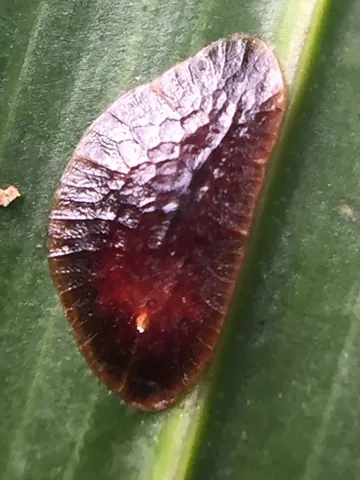 Tessellated scale
Eucalymnatus tessellatus
Tessellated scale is a soft scale insect named for the checkered, tile-like pattern on the adult female's back. It is probably South American in origin and has been carried around the world on cultivated plants. It is mainly a leaf-feeding greenhouse pest, and in south Florida it is often found outdoors on palms, crape-jasmine and mango.
No photo yet
Bondar's nesting whitefly
Paraleyrodes bondari
Bondar's nesting whitefly is a tiny Neotropical whitefly first found in southern Florida in 2011, where UF/IFAS calls it an emerging pest. Its nymphs sit in round nests of white wax on the leaves, and heavy infestations leave a polka-dot pattern of white nests on black sooty mold; in South Florida it has badly disfigured ficus hedges. It has also spread as an invasive pest of horticultural and plantation crops elsewhere in the tropics.
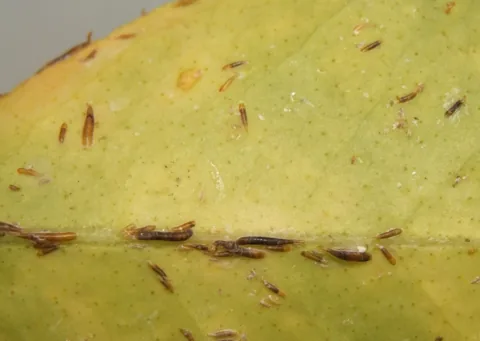 Glover's scale
Lepidosaphes gloverii
Glover's scale is a long, narrow, brown armored scale that lives on the bark, leaves and fruit of citrus wherever citrus grows in the tropics and subtropics. Parasitic wasps introduced to many countries have made it much less of a problem than it once was, but it is still occasionally serious enough to need control. Heavy infestations leave green spots on ripening fruit and can yellow and drop leaves. UF/IFAS lists it among the most important armored scales in Florida citrus.
No photo yet
Chaff scale
Parlatoria pergandii
Chaff scale is a small, flat, grayish-tan armored scale found on the bark, leaves and fruit of citrus. UF/IFAS lists it among the most important armored scales of Florida citrus, it has been reported as a citrus pest in the Gulf Coast states, and it favors older trees with plenty of shade. It also feeds on camellia, boxwood, oleander, ficus and dozens of other plants.
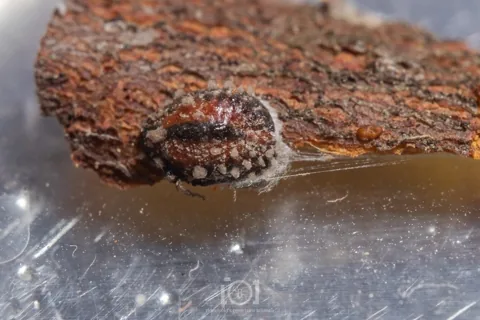 Cottony azalea scale
Pulvinaria ericicola
Cottony azalea scale is a soft scale insect of azaleas, rhododendrons, blueberries and other heath-family shrubs in the eastern United States. It is easiest to spot in late spring, when each female sits at the end of a flat, fluffy white egg sac. Is it harmful? Not to people or pets, but heavy infestations drip honeydew that turns black with sooty mold. To get rid of it, spray horticultural oil when the crawlers hatch in late May and early June, repeat two weeks later, and remember that scales on the roots are sheltered from both sprays and parasites.
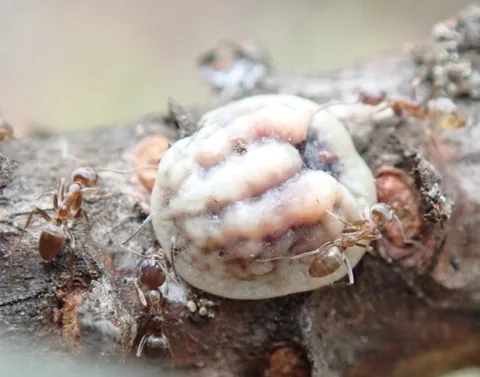 Irregular pine scale
Toumeyella pinicola
Irregular pine scale is a soft scale insect known only from California, where it is a serious pest of pines, especially Monterey pine. The females form lumpy, mottled bumps on young shoots that are often blackened by sooty mold, while the males' white cocoons line the needles like grains of rice. Heavy, prolonged infestations can stop new shoot growth and kill young pines.
No photo yet
Red date scale
Phoenicococcus marlatti
Red date scale, Phoenicococcus marlatti, is a small pink to dark red scale insect hidden in fluffy white wax on the soft, pale tissue at the base of date palm leaves and fruit stalks. It came from the Middle East and North Africa on infested date palms and also uses ornamental palms such as Canary Island and pygmy date palms. Is it harmful? Not to people or pets. ScaleNet calls it a serious pest of date palms, but UC IPM says it is uncommon in California's desert date groves, never builds large populations and needs no management, and no insecticide is recommended for it.
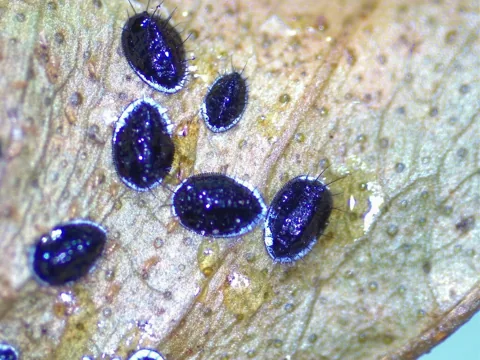 Orange spiny whitefly
Aleurocanthus spiniferus
The orange spiny whitefly is a small sap-sucking insect from Asia that infests citrus, rose and many other plants. Its nymphs are dark brown to black with a fringe of white wax and spines on the back, and the adults have blue-grey wings with white markings. It does not bite people, but heavy infestations coat leaves and fruit with sooty mold. Parasitic wasps brought it under control in Hawaii, and in field trials in Italy oils, plant extracts and organic insecticides gave no significant control of the nymphs.
No photo yet
Mexican mealybug
Phenacoccus gossypii
The Mexican mealybug is a small, grayish, wax-dusted sap-feeder found on English ivy, geraniums, chrysanthemums, lantana, poinsettias and other ornamentals. Females lay eggs in dense white sacs, and numbers can build up quite a bit before plants wilt and blacken with sooty mold. Check new plants before bringing them home; on a few plants, dab mealybugs off with rubbing alcohol on a cotton swab, then wash the plant with mild soapy water. NC State says insecticidal soaps or houseplant sprays labeled for mealybugs should be repeated weekly at least twice and probably three times, because the egg sacs shield the eggs.
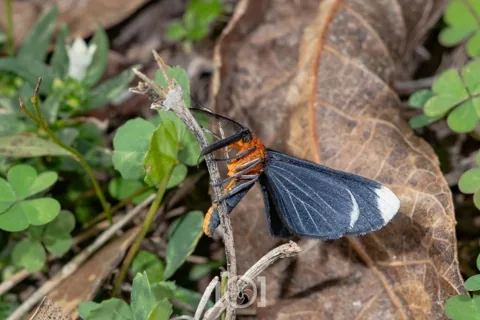 Snowbush Spanworm
Melanchroia chephise
The snowbush spanworm (Melanchroia chephise) is a banded inchworm that feeds in groups and can strip a snowbush hedge soon after the caterpillars hatch. Its adult, the white-tipped black, is a day-flying moth with dark wings tipped in white. Outbreaks look alarming, but snowbush usually grows back, and the caterpillars pose little risk to people.
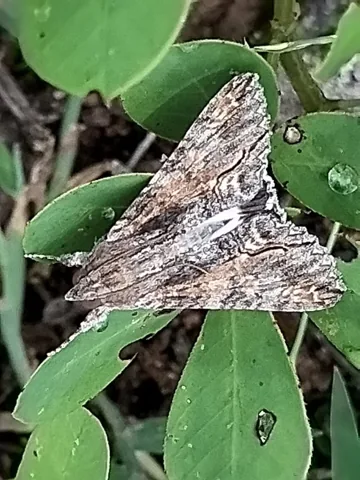 Royal Poinciana Caterpillar
Melipotis acontioides
The royal poinciana caterpillar (Melipotis acontioides) is one of the few climbing cutworms that defoliates tall trees. In southern Florida, outbreaks strip royal poinciana trees, sometimes completely. The caterpillars feed at night, swarming up the trunk after sunset, and spend the day hiding in debris at the base of the tree.
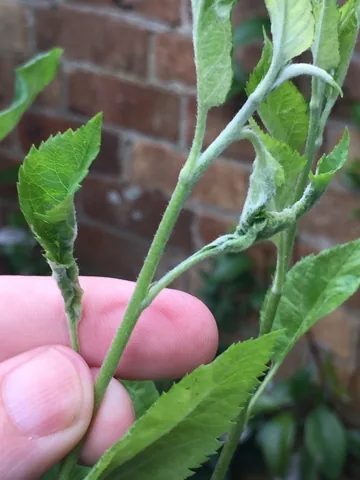 Apple Leaf Curling Midge
Dasineura mali
The apple leaf curling midge (Dasineura mali) is a tiny fly from Europe that feeds only on apple. Its pinkish orange maggots feed inside young leaves at the shoot tips and roll the leaf edges into tight tubes. It reached the northeastern United States in the 1960s and western Washington in 1994.
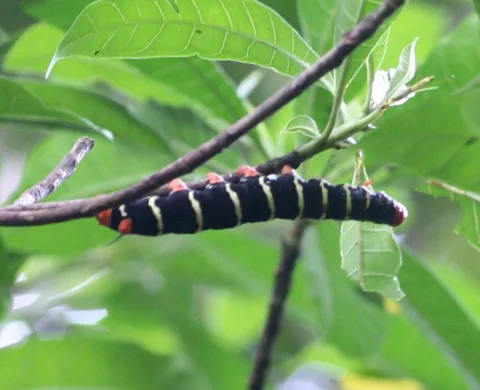 Tetrio Sphinx (Frangipani Hornworm)
Pseudosphinx tetrio
The frangipani hornworm is the caterpillar of the tetrio sphinx (Pseudosphinx tetrio), a large gray moth of the American tropics that also breeds in southern Florida. The caterpillars are hard to miss: black with yellow bands, a red-orange head, a long black horn and more than 15 cm (6 inches) long. They feed on frangipani (plumeria) and allamanda and can strip a tree in a few days, but the trees are not killed. They bite if handled and their hairs have injured a gardener's eye, so wear gloves and eye protection; hand-picking is the simplest fix. UF/IFAS Featured Creatures calls it a common moth of the American tropics and subtropics that turns up less often in southern Florida, where its large caterpillars often appear in gardens.
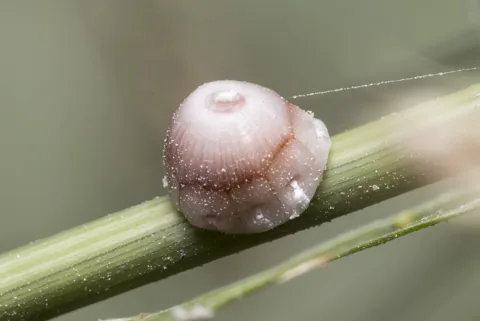 Fig wax scale
Ceroplastes rusci
Fig wax scale is a soft scale insect hidden under a thick, hard, domed cap of pinkish to white wax. A pest of figs in the Mediterranean region, it was first found in Florida at nurseries in 1994 and 1995, where it has been a pest of ixora, and since 2024 it has been found on fig trees in southern California, now in three counties.
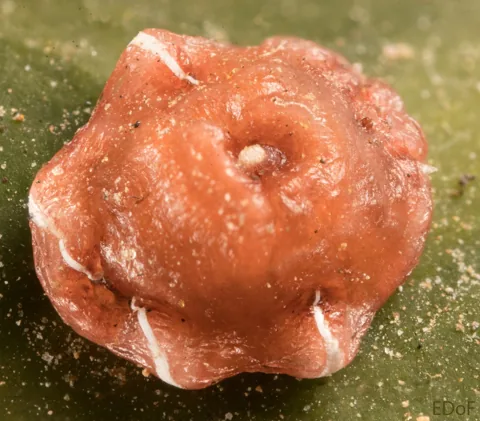 Red wax scale
Ceroplastes rubens
Red wax scale, also called pink wax scale, is a soft scale insect covered by a convex cap of pinkish-red to reddish-brown wax. It feeds on many plants, from citrus to foliage plants such as aglaonema and schefflera, and is a major citrus pest in Australia, Hawaii and Japan. In the continental United States it was first found in November 1955 at an Orange County, Florida, nursery on greenhouse-grown aglaonema, apparently brought in on imported foliage plants.
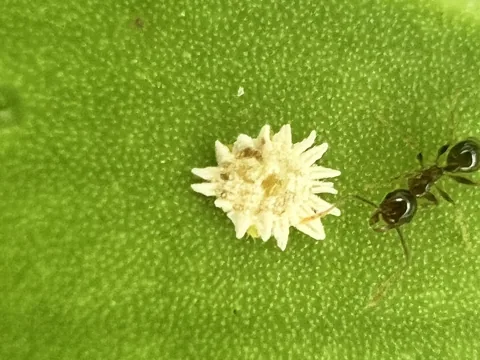 Coconut mealybug
Nipaecoccus nipae
Coconut mealybug, also called spiked mealybug, is a tiny sap-feeding insect coated in thick buff to yellowish-orange wax drawn out into rows of pyramid-shaped spikes. It feeds on palms, fruit crops and ornamentals. Pacific Pests, Pathogens and Weeds calls it a minor mealybug except where ants tend it; heavy feeding turns plants yellow and weak and its honeydew grows sooty mold. That fact sheet advises pruning off infested parts, spraying soap or horticultural oil, and controlling the ants.
No photo yet
Lebbeck mealybug
Nipaecoccus viridis
Lebbeck mealybug, also called hibiscus mealybug or spherical mealybug, is an invasive mealybug with a dark purple body under thick white wax that may turn pale yellow. In Florida it was first recorded in 2009 and was found in commercial citrus in 2019. Its feeding on citrus causes fruit drop, deformed fruit, distorted leaves and branch dieback. UF/IFAS says it had earlier been found on dodder and tallow wood in Palm Beach County and intercepted at ports of entry before it was documented damaging citrus in Highlands County in June 2019.
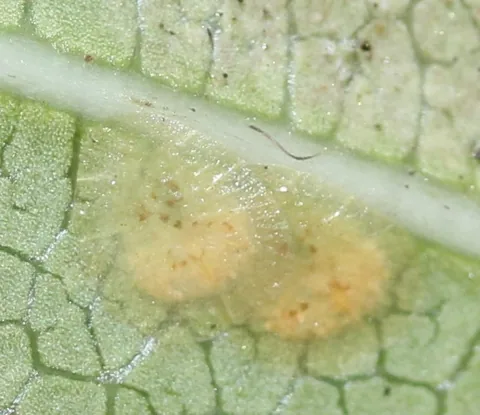 Mango shield scale
Milviscutulus mangiferae
Mango shield scale is a soft scale insect with a flat, shiny, pale-green body shaped almost like a triangle. It occurs widely in tropical and warmer subtropical regions, including Florida and Texas, and it can be a serious pest of mango. It also feeds on citrus, avocado, hibiscus and other ornamentals.
No photo yet
Obscure mealybug
Pseudococcus viburni
Obscure mealybug is a powdery, white-waxed mealybug that is nearly identical to grape mealybug and attacks grapes, pears and many other plants. In California it is one of the main mealybugs in North Coast, San Joaquin Valley and Central Coast vineyards. Elsewhere it is a pest of greenhouse crops, and it has been recorded in more than two dozen U.S. states.
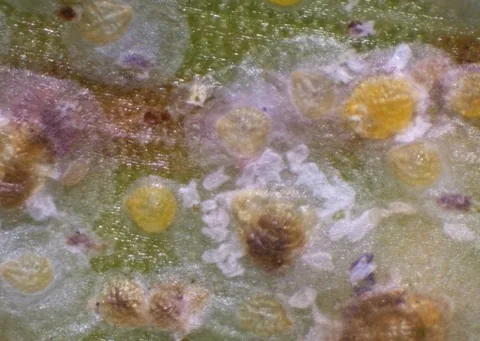 Coconut scale
Aspidiotus destructor
Coconut scale is an armored scale insect that feeds on a wide range of tropical and subtropical plants and is potentially the most destructive scale pest of coconut wherever it occurs. Its flat, translucent covers crowd the undersides of leaves, and the toxic saliva it injects turns leaves yellow. In the United States it has been recorded from Florida, Georgia, Pennsylvania and Hawaii, and from Connecticut under glass. UF/IFAS calls it a pest in over 60 plant families and a major threat to coconut palms throughout the world.
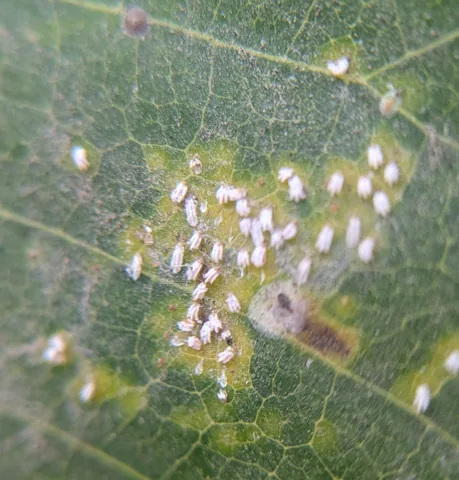 Mango scale
Aulacaspis tubercularis
Mango scale, also called white mango scale, is an invasive armored scale insect that has spread with infested plant material to many mango-growing countries; UF/IFAS lists it among the scales that infest mango in Florida. Its small white covers cluster on leaves, young stems and fruit, where feeding turns patches of leaf yellow and leaves pink blemishes on the fruit.
No photo yet
Lesser snow scale
Pinnaspis strachani
Lesser snow scale is an armored scale insect that coats twigs, branches and trunks with snow-white male covers and grayish, mussel-shaped females. It feeds on more than 170 plant genera and is an occasional pest of citrus, hibiscus, palms, mango and banana. In the United States it is widespread in Florida and Hawaii and recorded from Texas east to Georgia.
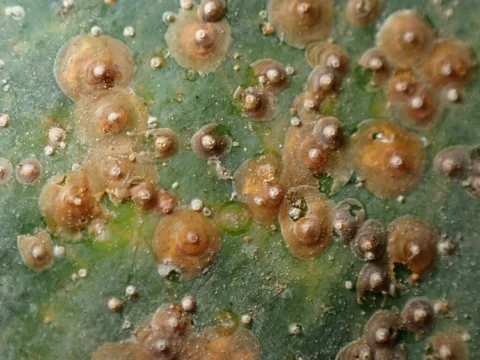 Dictyospermum scale
Chrysomphalus dictyospermi
Dictyospermum scale is an armored scale insect with a flat, round, grayish to reddish-brown cover, often with a coppery sheen. It feeds on hundreds of plants, favoring palms, dracaena and citrus, and it is a serious citrus pest in Florida and the western Mediterranean; in cooler areas it lives in greenhouses and indoors. It harms plants, not people. Prune off infested parts, let parasitic wasps work, and use horticultural oil when crawlers are active; imidacloprid does not control armored scales.
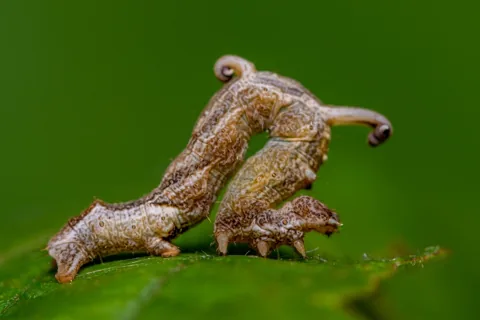 Filament Bearer (Horned Spanworm)
Nematocampa resistaria
The filament bearer, also called the horned spanworm (Nematocampa resistaria), is an inchworm you can recognize at a glance: it carries two pairs of white-tipped tentacles on its back. It eats the leaves of many conifers, hardwoods and low plants, from Douglas-fir and hemlock to willow, birch, strawberry and carrot. Natural Resources Canada calls it a common defoliator that only occasionally causes noticeable damage.
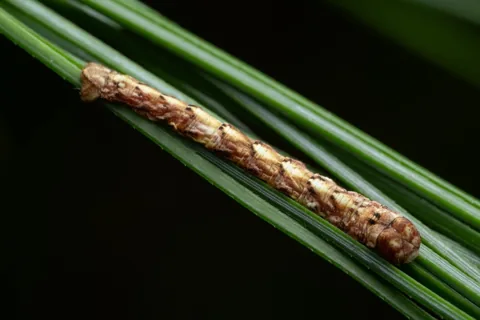 Pine Measuringworm
Hypagyrtis piniata
The pine measuringworm (Hypagyrtis piniata) is an inchworm of coniferous forests. Natural Resources Canada describes it as a common innocuous solitary defoliator found through the central and southern interior of British Columbia and east to Newfoundland. Despite its name it feeds on many conifers; the principal hosts are Douglas-fir, western hemlock, Engelmann spruce and white spruce. The USDA Forest Service's guide to geometroid caterpillars calls it transcontinental in Canada and, in the East, gives it south to Maryland, the Great Lakes region and the mountains of Georgia.
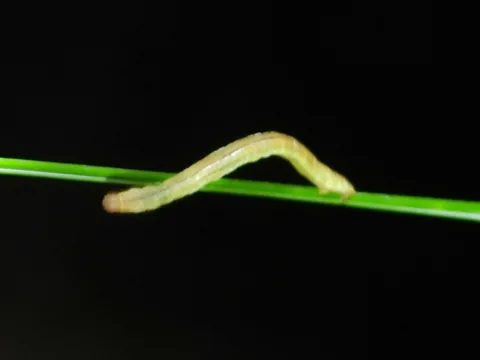 Small Pine Looper
Eupithecia palpata
The small pine looper (Eupithecia palpata) is a geometrid moth whose slender caterpillars feed on the needles of pine, Douglas-fir, spruce, fir and other conifers. In Canada the caterpillars are present from June to late September. Natural Resources Canada calls it a relatively uncommon, innocuous solitary defoliator.
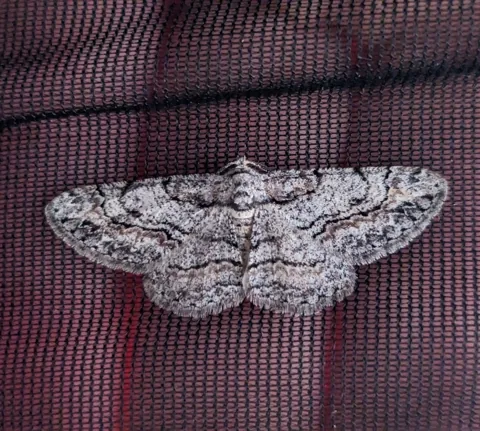 Common Gray
Anavitrinella pampinaria
The common gray (Anavitrinella pampinaria) is a geometrid moth whose tan, twig-like inchworm feeds on many deciduous trees and shrubs and even on clover, cotton and grasses. GBIF holds about 15,600 records of it, most from the United States.
No photo yet
Green Larch Looper (Six-Spotted Angle)
Macaria sexmaculata
The green larch looper (Macaria sexmaculata), whose moth BAMONA lists as the six-spotted angle and the USDA Forest Service as the lesser larch angle, is a small inchworm of tamarack and western larch. It lives mainly in northern wetlands but also wherever larches are planted, including parks and yards. Natural Resources Canada calls it a common, frequently abundant and occasionally destructive solitary defoliator.
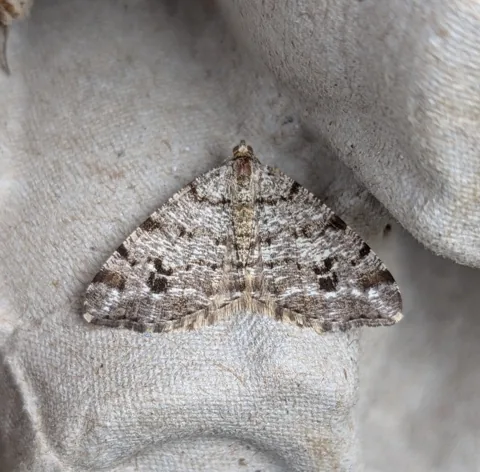 Spruce-Fir Looper (Pale-Marked Angle)
Macaria signaria
The spruce-fir looper (Macaria signaria), which BAMONA and the USDA Forest Service caterpillar guide call the pale-marked angle, is a green inchworm of conifer forests and bogs found across both North America and Eurasia. Natural Resources Canada describes M. signaria dispuncta as a common, occasionally abundant but innocuous solitary defoliator whose principal hosts in British Columbia are Douglas-fir, western hemlock and Engelmann spruce.
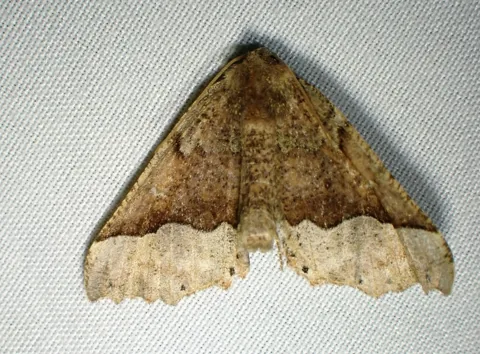 Morrison's Pero
Pero morrisonaria
Morrison's pero (Pero morrisonaria) is a geometrid moth whose caterpillar a USDA Forest Service guide calls an excellent twig mimic. It feeds mostly on conifers: balsam fir, eastern hemlock, eastern larch, pines and spruces in the Northeast, and Douglas-fir and western hemlock in British Columbia, where Natural Resources Canada rates it a relatively uncommon, innocuous solitary defoliator.
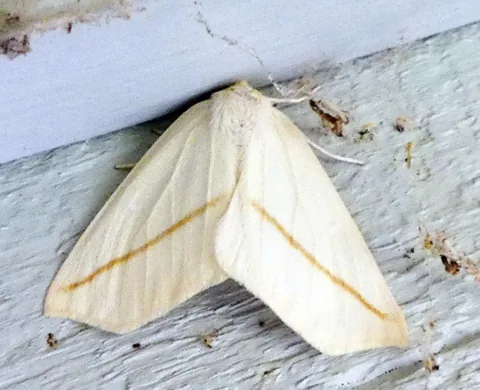 White Slant-Line
Tetracis cachexiata
The white slant-line (Tetracis cachexiata) is a geometrid moth whose large brown-to-grey caterpillar is, in the Ohio field guide's words, an extraordinary twig mimic. It feeds on many hardwoods and conifers. Ohio calls the moth one of the most abundant forest inchworm moths in the state, while Natural Resources Canada calls it a relatively uncommon, innocuous solitary defoliator.
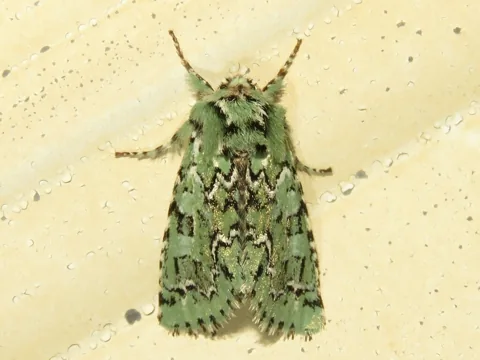 Jocose Sallow (The Joker)
Feralia jocosa
The jocose sallow (Feralia jocosa), known in Canada as the redlined conifer caterpillar, is a noctuid moth whose deep green caterpillar is, in the words of the USDA Forest Service eastern forest guide, stunningly marked with red, white and yellow. It feeds alone on the needles of fir, spruce, hemlock, Douglas-fir, larch and other conifers from late spring into summer, and Natural Resources Canada calls it common and innocuous.
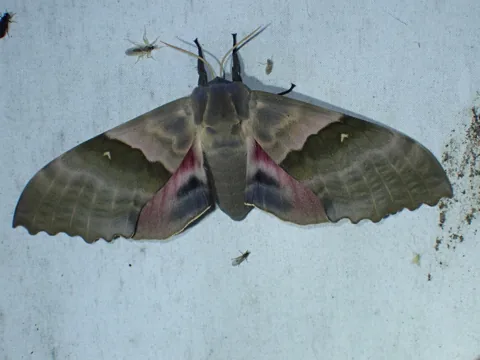 Big Poplar Sphinx (Modest Sphinx)
Pachysphinx modesta
The big poplar sphinx, or modest sphinx (Pachysphinx modesta), is a large hawk moth found through much of North America. Its large green caterpillar feeds on poplars, including aspen and cottonwood, and in Alberta it is reputed to be the heaviest insect in the province. Ohio DNR calls it a common Ohio species.
No photo yet
Vine mealybug
Planococcus ficus
Vine mealybug is an invasive mealybug that now occurs in all the major grape-growing areas of California. Unlike the other mealybugs found on grapes, it lives on roots as well as on the trunk, leaves and clusters, and it can spread grapevine leafroll viruses.
No photo yet
Passionvine mealybug
Planococcus minor
Passionvine mealybug, also called Pacific mealybug, is a mealybug of probable Asian origin that feeds on more than 250 kinds of plants, cocoa among the most common. It was found in the continental United States for the first time in southern Florida in December 2010, after state and federal officials had expected its arrival for years. In the field it cannot be told apart from citrus mealybug. The University of Florida notes that USDA APHIS had listed it as a high-priority threat before it arrived.
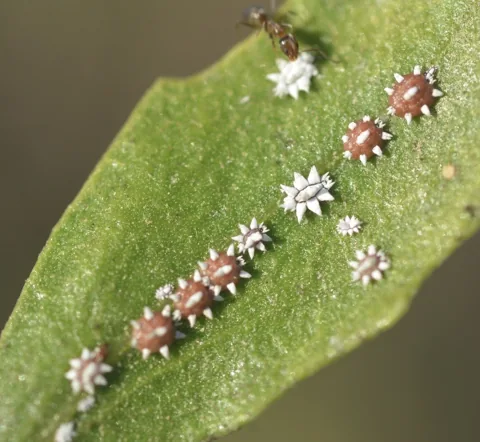 Chinese wax scale
Ceroplastes sinensis
Chinese wax scale is a soft scale insect that hides under a domed cap of white wax. Despite its name, it probably comes from Central or South America. It does not harm people or pets, but it is a citrus pest in Australia, Italy and Spain, and in California it is one of the wax scales that sometimes build up on landscape shrubs. Parasitic wasps, ant control, pruning and well-timed horticultural oil sprays keep it in check.
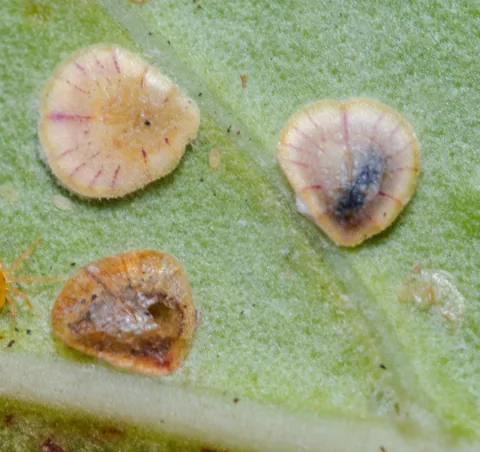 Pyriform scale
Protopulvinaria pyriformis
Pyriform scale is a flat soft scale named for its pear-like (pyriform) or heart-shaped outline. It spends its whole life on the undersides of leaves and is a serious pest of fruit trees and ornamentals in several tropical and subtropical countries. ScaleNet records it from Florida, and mango is among its hosts. UF/IFAS lists it among the many scales that infest mango in Florida.
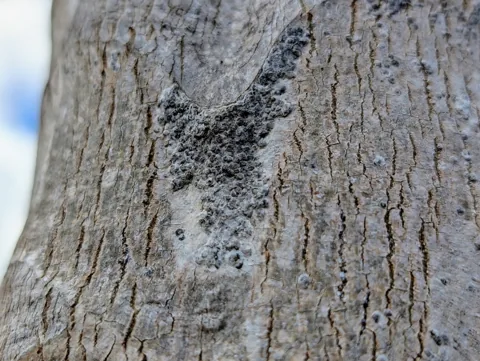 Plumose scale
Morganella longispina
Plumose scale, also called Maskell scale, is a tiny armored scale with a round, almost black cover that lives on the bark of branches. It feeds on plants in more than 80 genera, is more often a pest of ornamental plants, as in Florida, and has damaged mango and fig there. UF/IFAS lists it among the scales that infest mango in Florida.
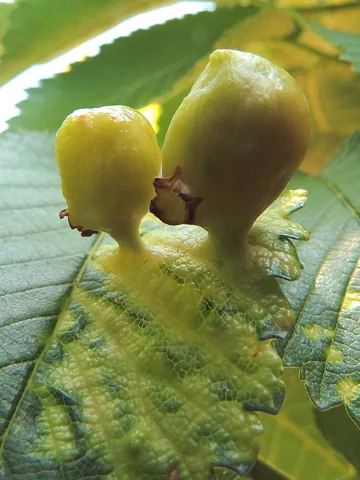 Elm-grass root aphid
Tetraneura ulmi
The elm-grass root aphid, also called the elm sack gall aphid, lives on two very different hosts. In spring it raises small stalked sack galls on elm leaves, and in early summer winged aphids leave the galls for grass roots, where ants tend them.
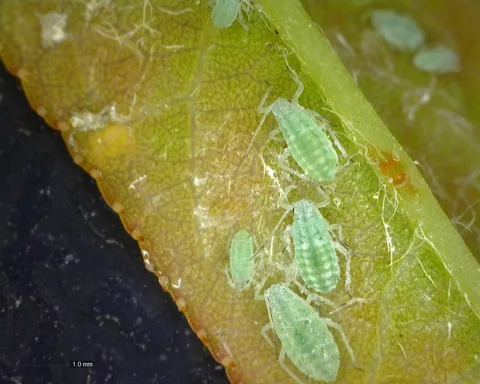 Mealy plum aphid
Hyalopterus pruni
Mealy plum aphids are pale green aphids coated in white mealy wax that build up on the undersides of plum and prune leaves in spring. They leave for cattails and reed grass in early summer and come back in fall to lay their eggs.
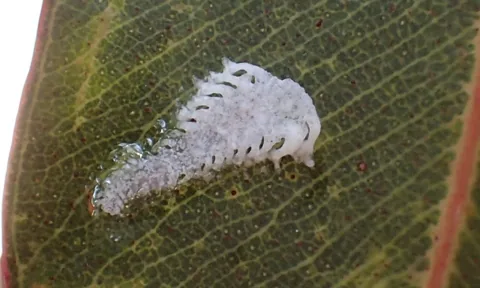 Spotted gum lerp psyllid
Eucalyptolyma maideni
The spotted gum lerp psyllid is an Australian insect first found in California in August 2000 on a lemon-scented gum in Los Angeles. It quickly spread through Los Angeles, Orange and San Diego counties and became a major pest of ornamental lemon-scented gum and spotted gum eucalyptus.
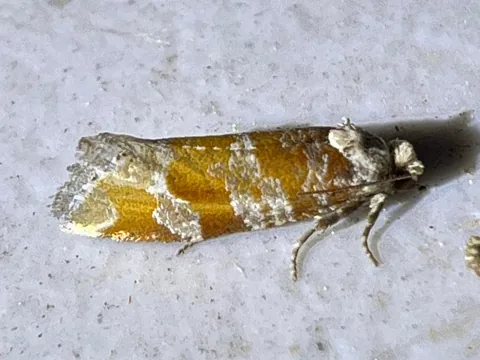 Eastern Pine Shoot Borer
Eucopina gloriola
The eastern pine shoot borer (Eucopina gloriola, formerly Eucosma gloriola), also called the white pine shoot borer, is a moth native to North America. Its caterpillar tunnels down the pith of new pine shoots, which droop, discolor and often break off. Natural Resources Canada says even severe attacks don't kill trees, but on Christmas tree plantings the damage leaves short, crooked leaders and hurts marketability in the year of attack.
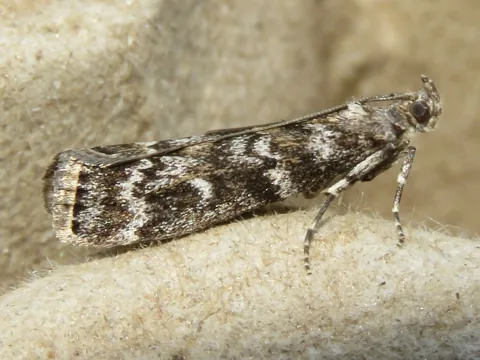 Fir Coneworm
Dioryctria abietivorella
The fir coneworm (Dioryctria abietivorella, often recorded under the older name D. abietella) is a transcontinental moth whose caterpillar bores into the cones of many conifers, and sometimes into buds, shoots and bark. It does not seriously harm the tree, but in a bad year it can destroy an entire cone and seed crop, which makes it a particular problem in seed orchards.
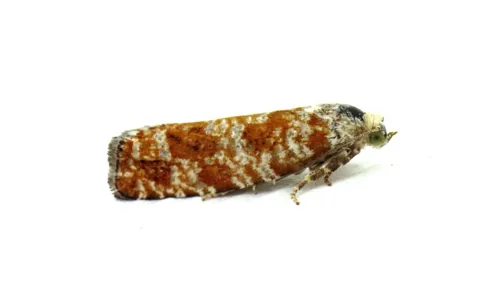 Northern Pitch Twig Moth
Retinia albicapitana
The northern pitch twig moth, also called the pitch nodule maker (Retinia albicapitana, formerly Petrova albicapitana), is a small moth whose caterpillar spends two years feeding in the bark and wood of young pines under a blister of resin, silk and frass, usually at a branch whorl. Partly girdled leaders can break in high wind and wet snow, leaving crooked or multiple stems. Jack, lodgepole and Scots pines are the main hosts, in natural stands, plantations, seed orchards, nurseries, shelterbelts and ornamental plantings.
No photo yet
Western Pine Budworm
Choristoneura lambertiana
The western pine budworm, also called the sugar pine tortrix (Choristoneura lambertiana), is a native relative of the spruce budworm and the only pine-feeding member of the budworm group west of the Rocky Mountains. Its caterpillars feed on pollen cones, buds and new needles of western pines, tying the needles into silk shelters. Local populations can damage a few trees badly, but the extensive outbreaks of related budworms have not been reported, and it is one of the least known species in the group.
No photo yet
Red Pine Needle Midge
Thecodiplosis piniresinosae
The red pine needle midge (Thecodiplosis piniresinosae) is a small gall midge, a fly, whose larvae feed inside the needle sheaths of red pine. The needles they feed on stay short, turn brown in fall and drop early. Natural Resources Canada says major damage is occasional and very local, and the midge does not threaten a tree's survival.
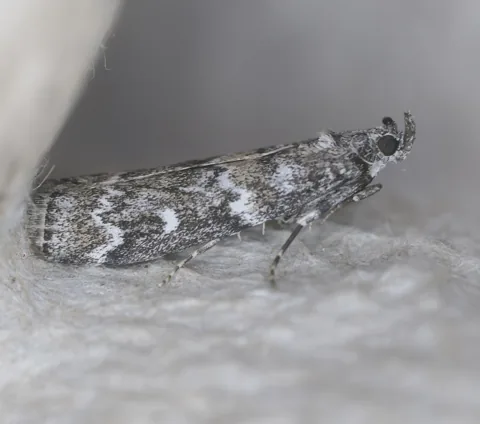 Spruce Coneworm
Dioryctria reniculelloides
The spruce coneworm (Dioryctria reniculelloides, long listed as D. reniculella) is a native moth whose caterpillar feeds mainly in the cones of spruce and balsam fir, leaving holes and webbed frass, and turns to buds and needles when cones are scarce. It is often associated with the spruce budworm, cones are sometimes completely destroyed, and in certain years it takes a heavy toll of white spruce seed.
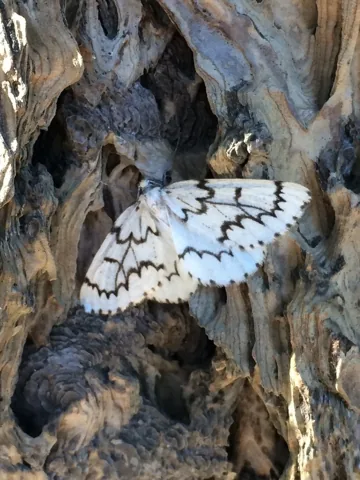 Phantom Hemlock Looper
Nepytia phantasmaria
The phantom hemlock looper (Nepytia phantasmaria) is an inchworm moth of the Pacific coast, from British Columbia to California, whose lime-green caterpillar feeds alone on Douglas-fir, western hemlock and other conifers. Natural Resources Canada calls it common and occasionally destructive; the USDA Forest Service says it is rarely noticed because outbreaks are local and sporadic, but outbreaks have killed trees, especially in city parks. GBIF's U.S. records come from Washington and Oregon.
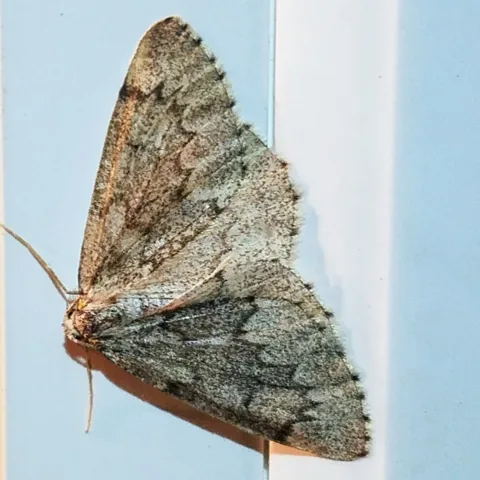 Western False Hemlock Looper
Nepytia freemani
The western false hemlock looper (Nepytia freemani) is an inchworm moth of British Columbia and the interior western United States. Natural Resources Canada calls it a common and occasionally destructive solitary defoliator of Douglas-fir, subalpine fir, Engelmann spruce, western hemlock and ponderosa pine. Its tan-and-yellow striped caterpillar is a wasteful feeder that chews needles off at the base, so a heavily infested tree looks scorched. The USDA Forest Service manual Western Forest Insects says its local outbreaks, in pole- and sapling-sized stands, have so far not caused damage warranting control.
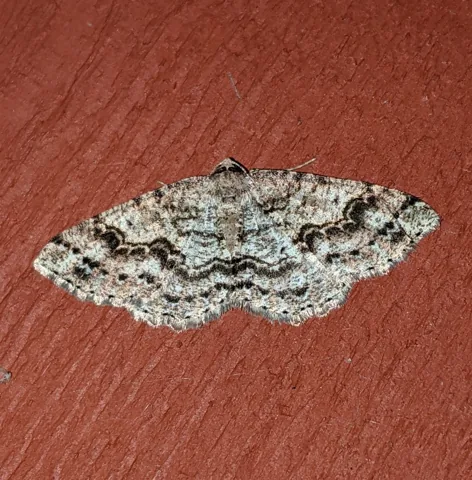 Greenstriped Forest Looper
Melanolophia imitata
The greenstriped forest looper (Melanolophia imitata) is a geometrid moth whose big green caterpillar feeds alone on Pacific coast conifers. Natural Resources Canada lists it in British Columbia as common and occasionally destructive, on hosts including western hemlock, Douglas-fir, western redcedar, true firs and spruces. A 1960 outbreak on the west coast of Vancouver Island killed an estimated 2,400,000 cubic feet of western hemlock by the fall of 1961.
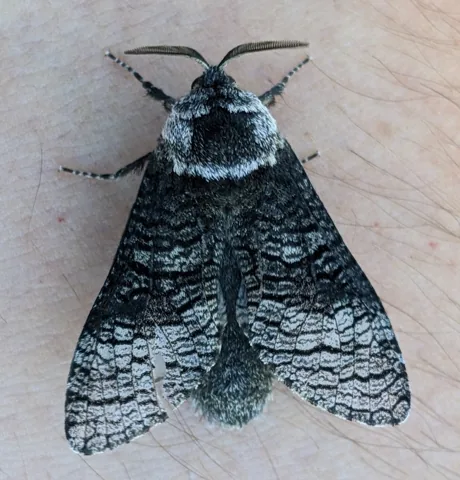 Poplar Carpenterworm
Acossus centerensis
The poplar carpenterworm (Acossus centerensis) is a northern cossid moth, similar in appearance to the carpenterworm, found from New Jersey west to Illinois and North Dakota and in Canada from Quebec and Ontario west to British Columbia. Its caterpillar bores in the wood of living poplars; quaking aspen is preferred, and balsam poplar has been casually mentioned as a host. Like other wood borers it often goes unnoticed until severe damage has resulted.
No photo yet
Hemlock sawfly
Neodiprion tsugae
The hemlock sawfly is a native defoliator of western hemlock in the Pacific coastal forests of Oregon, Washington, British Columbia and southeast Alaska, with interior populations in British Columbia, Idaho and Montana. Its green, striped, black-headed larvae look like caterpillars but are wasp relatives; they do not bite or sting people. They feed in groups on older needles and in outbreak years can strip whole hillsides of hemlock, yet outbreaks usually end on their own through weather, disease and parasites, so spraying is rarely needed.
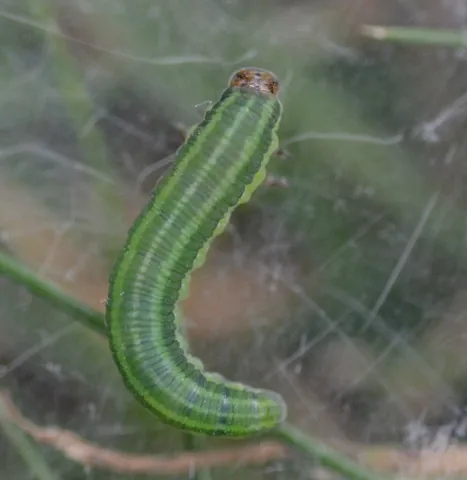 European spruce sawfly
Gilpinia hercyniae
The European spruce sawfly is an introduced defoliator of spruce, first detected in North America near Ottawa in 1922. Its outbreaks of the 1930s spread from Quebec through the Maritimes and into the adjacent United States before collapsing under an introduced virus and parasitoids, and no significant outbreak has been recorded since the late 1940s. Today it turns up as scattered, short-lived defoliation of older spruce needles.
No photo yet
Balsam fir sawfly
Neodiprion abietis
The balsam fir sawfly is a native North American defoliator of young and semi-mature balsam fir. Its larvae feed in groups and strip the needles of the previous year, turning them yellow and then red, and its outbreaks recur about every ten years and normally last three to five. Since the 1990s, outbreaks in thinned stands and plantations in eastern Canada have lasted longer and done more damage, which concerns both the forest industry and Christmas tree growers.
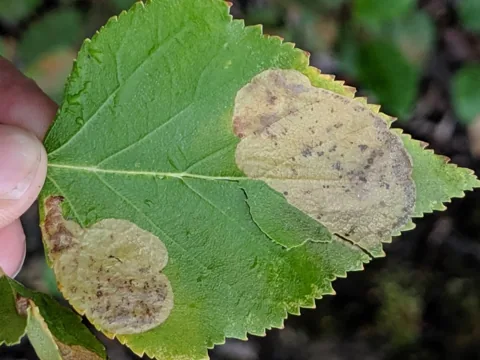 Amber-marked birch leafminer
Profenusa thomsoni
The amber-marked birch leafminer is a small, stingless sawfly whose larvae feed inside birch leaves. Long known in Europe and probably introduced, it reached Alaska in the early 1990s; it built to outbreak levels around Anchorage, peaking in 2006, and has intensified around Fairbanks since it was found there in 2002. Its mines turn leaves a sickly yellowish brown in late July and August, often mistaken for early fall color.
No photo yet
Western webspinning sawfly
Cephalcia californica
The western webspinning sawfly is a web-building sawfly of western North America, from British Columbia and Alberta south to California. Its larvae eat the older needles of pines, and in the Pacific Northwest handbook also spruce, while living in loose silk webs that fill with frass. Heavily infested trees can be covered with large, unsightly webs, and it occasionally does real damage to pines planted in towns and to lodgepole pine seed orchards.
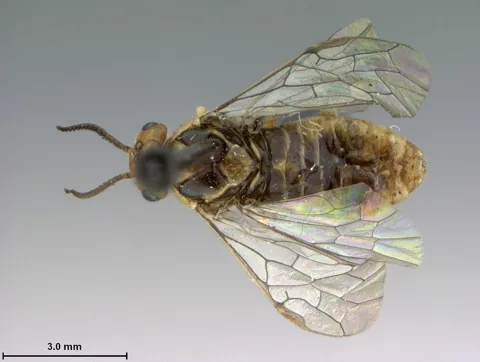 Red pine sawfly
Neodiprion nanulus
The red pine sawfly is a native sawfly of hard pines. Colonies of striped green larvae with dark heads strip the older needles in late spring and early summer and leave the current year's growth at the shoot tips. It does not bother people. Trees usually recover; on small landscape pines the colonies can be picked or pruned off, and Bt sprays made for caterpillars do not work on sawflies.
No photo yet
Swaine jack pine sawfly
Neodiprion swainei
The Swaine jack pine sawfly is a native defoliator of jack pine east of the Rocky Mountains. Its colonies of pale larvae feed at the branch tips in mid to late summer, stripping old needles while a chemical in the new foliage keeps them off the current year's growth. It caused a series of damaging outbreaks in Ontario and Quebec between 1945 and 1970, the last large one in Quebec in 1994, and has since been a localized problem.
No photo yet
Douglas-fir twig weevil
Cylindrocopturus furnissi
Reddish-brown, dying branch tips on a young Douglas-fir, especially in a Christmas tree plantation or a new planting in a dry year, are the usual first sign of the Douglas-fir twig weevil. The adult is a wingless beetle about a tenth of an inch long, and the damage comes from its larvae, which mine just under the bark of twigs and small stems. Healthy trees shrug it off; stressed seedlings can lose their tops or die.
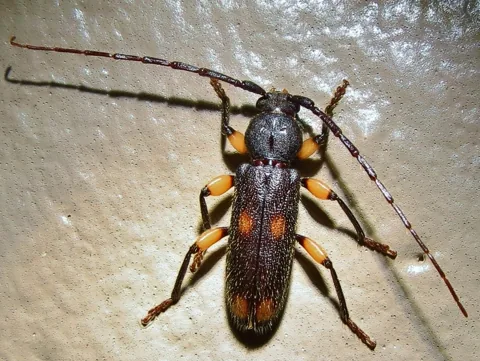 Ash and privet borer
Tylonotus bimaculatus
The ash and privet borer is a native longhorn beetle whose larvae tunnel beneath the bark of ash, privet, elm, hickory and several other hardwoods. It favors trees that are old, drought-injured or otherwise stressed, killing an ash a branch at a time from the top down, and it is the borer most likely to wreck a privet hedge, where it attacks at the base of the plants. In dry regions such as the Great Plains it has been a serious pest of windbreak ash.
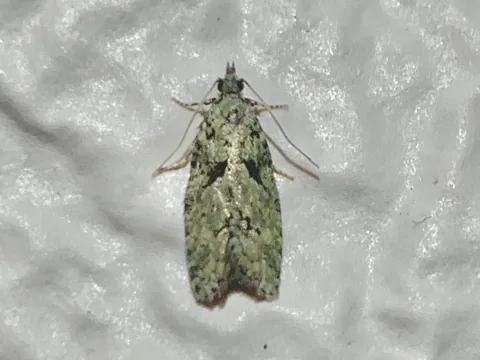 Epinotia hopkinsana
Epinotia hopkinsana is a small tortricid moth of coastal British Columbia that also occurs south to California. The caterpillar spends the winter inside a mined needle, then moves in April and May to the swelling buds, new shoots and conelets of Sitka spruce and lodgepole or shore pine. Natural Resources Canada rates the damage to newly flushed shoots as relatively minor.
No photo yet
Dioryctria pseudotsugella
Dioryctria pseudotsugella
Dioryctria pseudotsugella is a small western moth of the genus Dioryctria. Its caterpillar feeds singly on the foliage of Douglas-fir and other conifers from May to July. Natural Resources Canada describes it as a common, occasionally abundant and innocuous defoliator whose numbers rise and fall in step with the western spruce budworm.
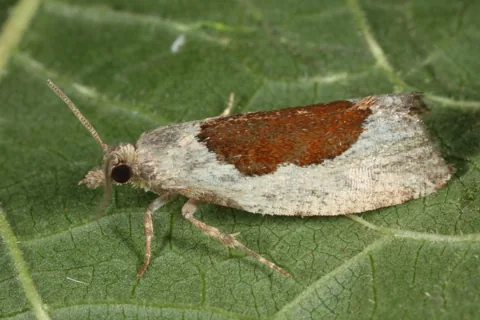 Birch-Aspen Leafroller
Epinotia solandriana
The birch-aspen leafroller (Epinotia solandriana) is a small moth of northern hardwood forests, known in Europe since 1758 and first reported in British Columbia in 1909. Its caterpillar eats into swelling buds in spring, chews the unfolding leaves, and then rolls a leaf into a small tube to feed inside. White birch is the main host, with trembling aspen, alders and yellow birch also attacked. Natural Resources Canada calls its damage usually sporadic and local, and in Alaska the Forest Service calls it the most common leafroller on birch.
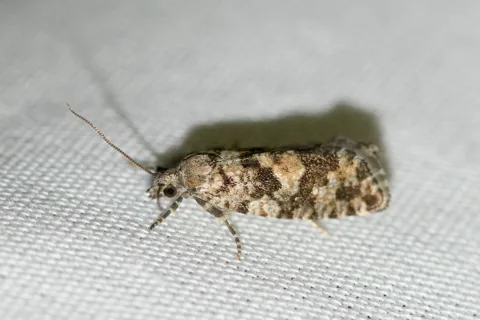 Larch Needleworm
Zeiraphera improbana
The larch needleworm, also called the larch bud moth (Zeiraphera improbana), is a small tortricid moth of tamarack and other larches. Its caterpillars web bundles of young needles into compact silk tubes in May and June. When numbers are high the trees turn red and lose growth, but the damage comes early enough for a new set of needles before winter, and Natural Resources Canada says outbreaks are usually short-lived and not very extensive. It was long confused with the European species Zeiraphera diniana.
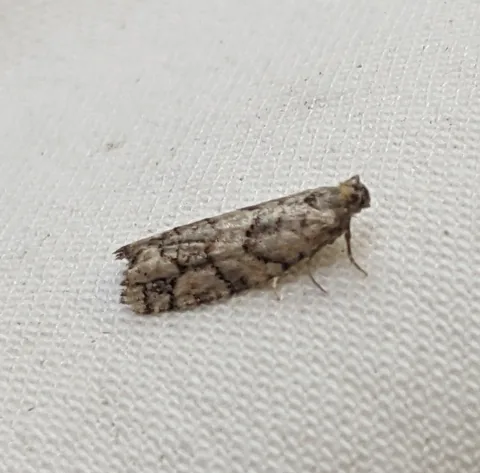 Cypress Leaftier
Epinotia subviridis
The cypress leaftier is a small moth whose caterpillar ties the shoot tips of cypress, cedar and juniper into little shelters of frass, chewed twigs and foliage, so the tips brown and die back. The sources mention no effect on people. It only occasionally causes visible dieback, and clipping off the shelters in spring is usually all a home tree needs.
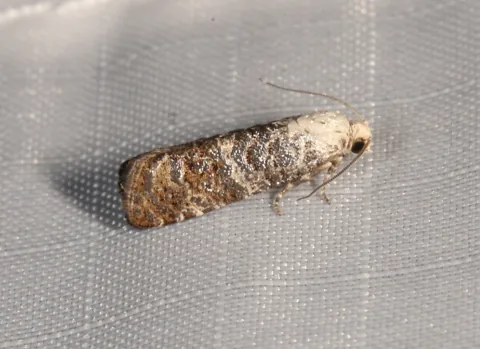 Metallic Pitch Blister Moth
Retinia metallica
The metallic pitch blister moth (Retinia metallica, long listed as Petrova metallica) is a small mottled gray moth of western North America, from California, Colorado and Minnesota north to southern Yukon. Its caterpillar mines lengthwise inside a current-year shoot of pine under a blister of resin, killing or injuring buds and some first-year cones. The result on a young tree can be a dead terminal or a crooked, forked stem; Natural Resources Canada says most reported injury is on pines 0.5 to 5 metres tall in natural stands, plantations, nurseries, seed orchards, shelterbelts and yards.
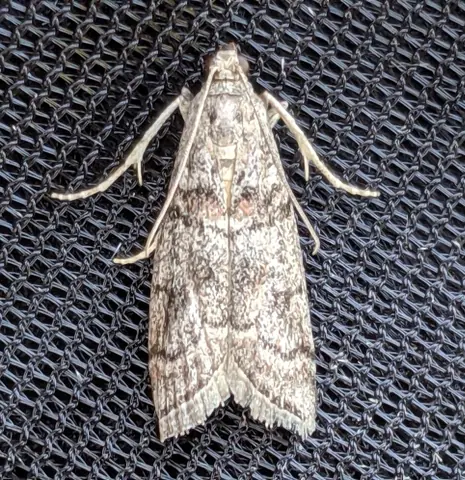 Promylea lunigerella
Promylea lunigerella is a pyralid moth of the Pacific coast conifer forest, found throughout south coastal British Columbia and south to California. Neither Natural Resources Canada nor BAMONA gives it a common name. Its green caterpillar, marked with a broad yellow stripe low on each side, feeds singly in the open on the needles of grand fir and other conifers from May to mid-June. Natural Resources Canada classes it as a common but innocuous solitary defoliator.
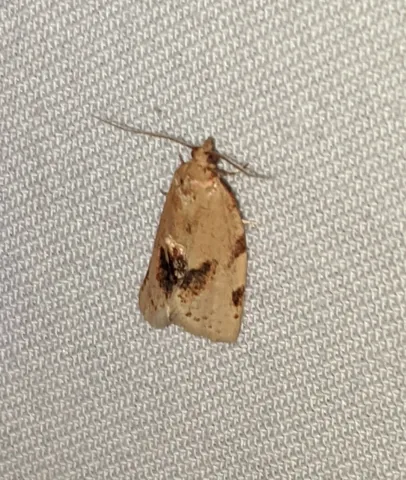 Argyrotaenia dorsalana
Argyrotaenia dorsalana is a small tortricid moth of western conifer forests with no common name. Natural Resources Canada records it on the south coast and in the southern interior of British Columbia south of 51 degrees, and in California and Utah. Its yellowish-green caterpillar feeds singly on the foliage of Douglas-fir and other conifers from early May to mid-June, and Natural Resources Canada rates it a common but innocuous defoliator.
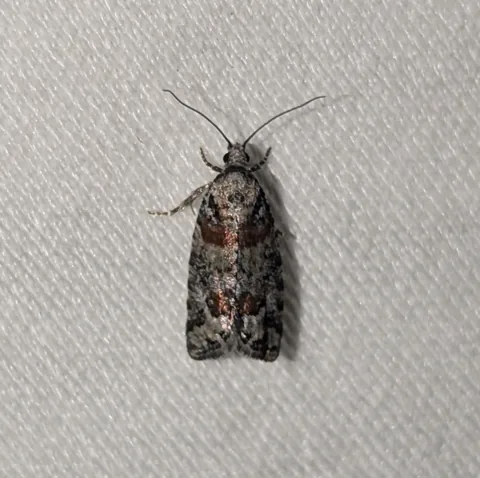 Spruce Tip Moth
Epinotia radicana
The spruce tip moth, also called the red-striped needleworm (Epinotia radicana; listed as Griselda radicana in older USDA manuals), is a small tortricid moth found throughout British Columbia and east to Newfoundland and south to California. Its caterpillar, only about 9 mm long when grown, feeds in the opening buds and on the current year's foliage of spruce, Douglas-fir and true firs from late May to early July, much as the spruce budworm does and often alongside it. No economically important outbreak has been recorded.
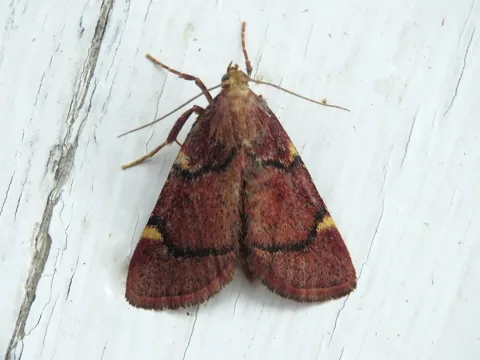 Spruce Needleworm
Hypsopygia thymetusalis
The spruce needleworm (Hypsopygia thymetusalis; Natural Resources Canada uses Dolichomia thymetusalis and a 1977 USDA Forest Service manual Herculia thymetusalis) is a pyralid moth whose tan, black-headed caterpillar feeds on spruce needles through the summer. Natural Resources Canada records it from the central interior of British Columbia east to Newfoundland and rates it a rather uncommon, innocuous solitary defoliator. The USDA manual adds that in Manitoba and Saskatchewan it is one of a complex of insects that defoliate the tops of black spruce.
No photo yet
Woolly pine scale
Pseudophilippia quaintancii
The woolly pine scale is a soft scale insect of pines in the eastern and southeastern United States. In most pine forests it stays at harmless levels, and it becomes a pest mainly where insecticides sprayed for other pests have killed off its natural enemies: seed orchards, Christmas tree plantations and ornamental plantings. Its calling card is fluffy, snow-white wax, first on the new shoots in spring and later on the older needles, which can make a whole tree look flocked.
No photo yet
Red pine scale
Matsucoccus matsumurae
The red pine scale is a tiny bast scale that feeds through the bark of red pine and a few Asian pines. It was discovered in 1946 killing 30-year-old red pine plantations at Easton, Connecticut, and became one of the most important insect pests of red pine in the Northeast, killing thousands of trees from nursery stock to mature timber. The American population was described as Matsucoccus resinosae; ScaleNet now treats that name as a synonym of the Asian species Matsucoccus matsumurae.
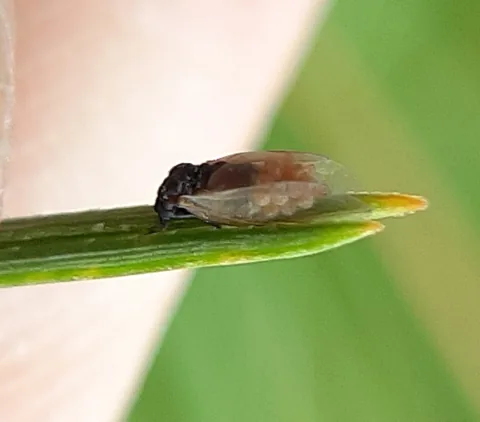 Pine leaf adelgid
Pineus pinifoliae
The pine leaf adelgid is a tiny native sap-feeding insect with a two-year double life. It makes cone-shaped galls on the new shoots of red and black spruce, then flies to eastern white pine, where its offspring feed on the current year's shoots. The spruce galls are unsightly but cause little injury; on white pine a severe infestation kills the new shoots, and it is a very important pest where white pine grows next to red and black spruce. Vigorous trees tolerate moderate numbers; on small or ornamental trees a strong water spray, horticultural oil or insecticidal soap aimed at the crawlers is the usual answer.
No photo yet
Loblolly pine sawfly
Neodiprion taedae
The loblolly pine sawfly, Neodiprion taedae linearis, is one of the most serious insect pests of loblolly and shortleaf pine stands in the South-central United States. Its larvae hatch in late winter and early spring and can strip medium and large forest pines of their old needles before the new shoots expand. Trees are not known to die from its feeding, but a heavy defoliation can cut diameter growth in half for several years, and Arkansas outbreaks have covered as much as three million acres.
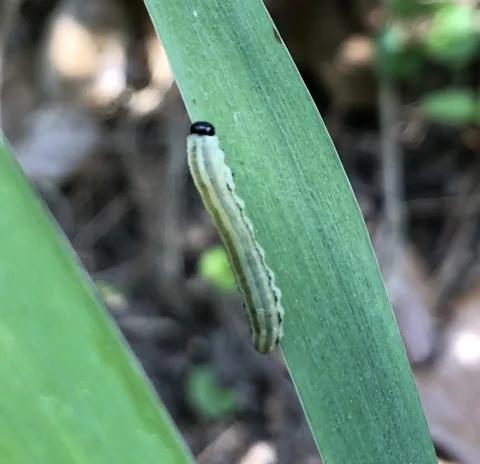 Blackheaded pine sawfly
Neodiprion excitans
The blackheaded pine sawfly is an important native defoliator of pines across the South from Virginia to Texas, with serious outbreaks recorded in Florida and Texas. Unlike the spring-feeding pine sawflies, it breeds through the whole warm season, four or five generations a year, and does most of its damage in late summer and early fall, so a heavily infested pine can stand bare through the winter.
No photo yet
Jack pine sawfly
Neodiprion pratti
Neodiprion pratti is a native pine sawfly with two faces. In the Lake States and southern Canada the subspecies banksianae, the jack pine sawfly, is a serious defoliator of jack pine that became destructive once large, even-aged stands of jack pine were planted or seeded in after fires. In the South the subspecies pratti, the Virginia pine sawfly, feeds on loblolly, sand and Virginia pine. Both strip the previous year's needles in spring and leave the new growth alone, so damaged trees keep tufts of fresh needles at the branch tips.
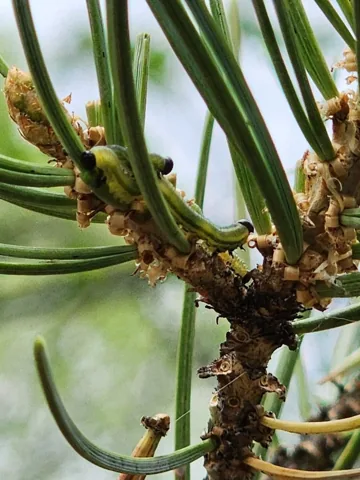 Pinyon sawfly
Neodiprion edulicolus
The pinyon sawfly is a native defoliator of pinyon pines in the Southwest and Great Basin. In eastern Nevada it has stripped more than 100,000 acres of single-leaf pinyon in a single outbreak, hitting small trees hardest and spoiling many for sale as Christmas trees. Its larvae are fussy about temperature: an Arizona population declined over twelve years as April lows swung too cold or too warm, and the insect rarely lives above about 1,900 meters even where its host trees are abundant.
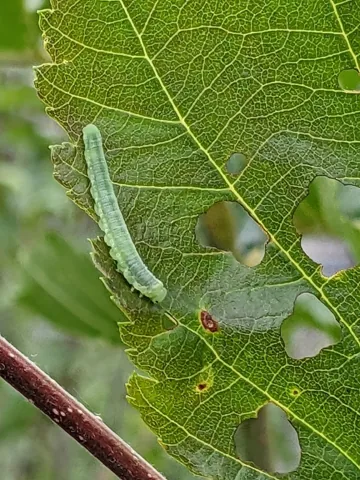 Green alder sawfly
Monsoma pulveratum
The green alder sawfly is a small, non-native wasp from Europe, North Africa and the Near East whose bluish-green, caterpillar-like larvae chew shot holes in alder leaves. It has been defoliating riparian thin-leaf alder across southcentral Alaska, is the most commonly encountered sawfly on alder in Southeast Alaska, and has been trapped in Oregon, Washington, Idaho and Montana. The sources report no harm to people, and alders usually survive the feeding. On a few yard alders, pick the larvae off or knock them off with a strong jet of water, and don't move alder firewood out of infested areas, because the larvae spend the winter inside dead wood.
No photo yet
Neodiprion autumnalis (ponderosa pine sawfly)
Neodiprion autumnalis
Neodiprion autumnalis has no settled common name, but it is the most wide-ranging of the pine sawflies that feed on ponderosa pine, known across the western United States and throughout the pine forests of Mexico. The species name refers to its fall-emerging adults, which lay eggs that overwinter in the needles; the orange-headed larvae hatch the next spring and can feed until late summer. Outbreaks in the early 1990s covered 84,000 acres in eastern Wyoming and thousands more in western South Dakota, with widely spaced trees on dry, poor soils hit hardest.
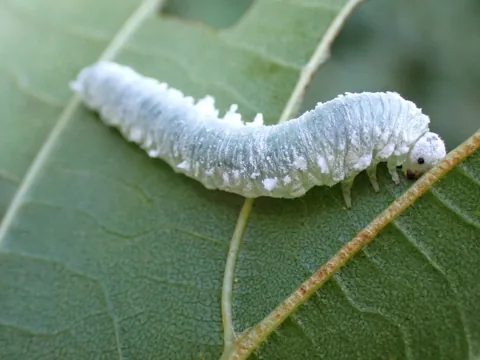 Woolly alder sawfly
Eriocampa ovata
The woolly alder sawfly is a non-native sawfly of alders whose larvae wear a white, waxy, hair-like coat that gets thicker as they grow. They chew small holes that give the leaf a shotgun look and then eat everything but the main veins. In Alaska it was the likely cause of the 2025 alder defoliation along the Matanuska and Knik Rivers and left pockets of severe damage in Southcentral Alaska; in Nova Scotia it is listed among the pests of the Acadian forest. Alders tolerate it well, and no insecticide is needed.
No photo yet
Balsam shootboring sawfly
Pleroneura brunneicornis
The balsam shootboring sawfly is a native insect of balsam fir whose larvae tunnel into the current year's shoots. By late June the attacked shoots wilt, flatten and turn reddish brown, damage easily mistaken for a late frost, and in bad weather they drop off. It prefers young firs under two meters tall in open areas and Christmas tree plantations, but even in large numbers it does not kill trees, and infestations are short-lived.
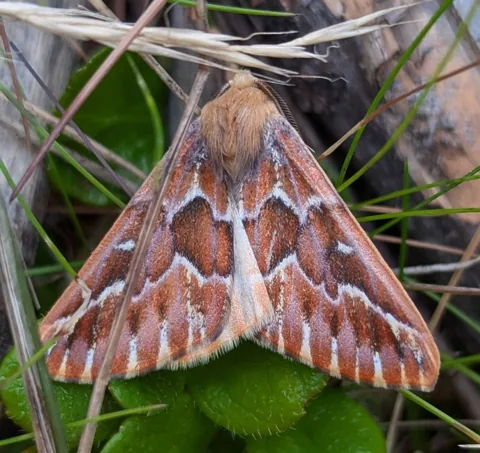 Western Conifer Looper
Caripeta aequaliaria
The western conifer looper (Caripeta aequaliaria) is a geometrid moth of the Pacific Northwest and the mountains of western Alberta. Its inchworm, up to 42 mm long, comes in two color forms and feeds in the open on Douglas-fir, lodgepole pine and ponderosa pine needles from June to September. Natural Resources Canada calls it a relatively uncommon solitary defoliator, and the USDA Forest Service manual Western Forest Insects says Caripeta larvae feed on conifer foliage but cause no significant damage.
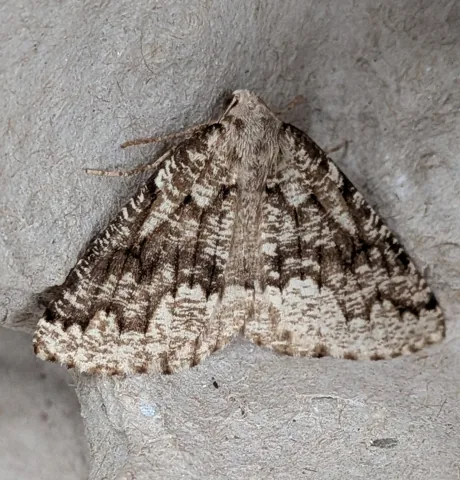 Variable Girdle Moth
Enypia venata
The variable girdle moth (Enypia venata) is a geometrid moth of western conifer forests whose rusty brown inchworm feeds on the needles of western hemlock, Douglas-fir, true firs, spruce and other conifers. The USDA Forest Service's Western Forest Insects calls it the most widely distributed of the four Enypia species, all confined to the West, and says their larvae cause no significant damage; Natural Resources Canada rates it a common but innocuous solitary defoliator.
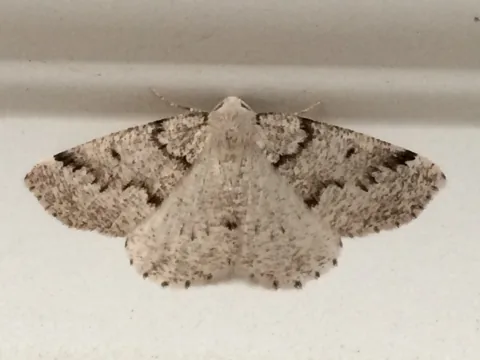 Packard's Girdle Moth
Enypia packardata
Packard's girdle moth (Enypia packardata) is a geometrid moth of the Pacific coast. Natural Resources Canada says it is generally distributed throughout coastal British Columbia and also occurs north to southern Alaska and south to California. Its bright green, white-striped inchworm feeds on Douglas-fir and western hemlock needles, and it is a common innocuous solitary defoliator. The USDA Forest Service manual Western Forest Insects calls it the redheaded looper.
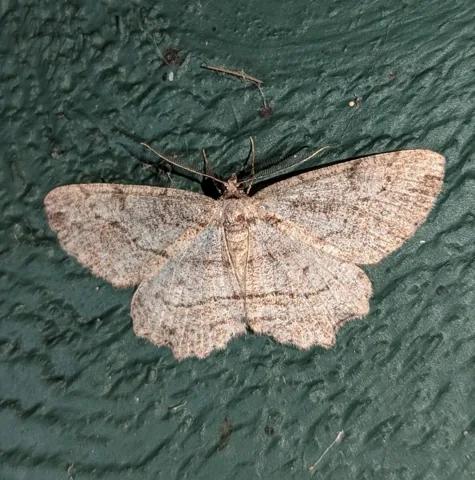 Brownlined Looper
Neoalcis californiaria
The brownlined looper (Neoalcis californiaria) is a geometrid moth of the Pacific Northwest. Its elongate, twig-mimicking inchworm feeds in the open on conifer needles. Natural Resources Canada rates it a common innocuous solitary defoliator; a USDA Forest Service guide to Pacific Northwest caterpillars calls it the most abundant moth species capable of feeding extensively on the foliage of numerous conifers and broadleaf plants.
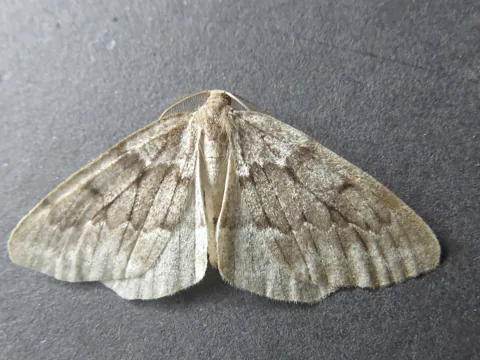 Hoary Conifer Looper
Nepytia umbrosaria
The hoary conifer looper (Nepytia umbrosaria) is a geometrid moth whose boldly striped cream, orange and rust inchworm reaches 35 mm. Natural Resources Canada describes its western subspecies, N. umbrosaria nigrovenaria, as a solitary defoliator of amabilis fir, grand fir, Douglas-fir and western hemlock in British Columbia, and rates it common and innocuous.
No photo yet
Brown Cedar Leafminer
Coleotechnites thujaella
The brown cedar leafminer (Coleotechnites thujaella) is a tiny moth whose caterpillars tunnel inside the scale-like leaves of arborvitae (eastern white cedar). It is one of the two most common of four cedar leafminers, and all four are often found together. Mined tips turn dull yellow, then brown, and repeated attacks over several years can kill twigs and sometimes stems; a single season mostly looks bad. The fixes are simple: confirm the tips are hollow, prune out infested twigs in winter, and let parasites, which often build up within a few years, do the rest.
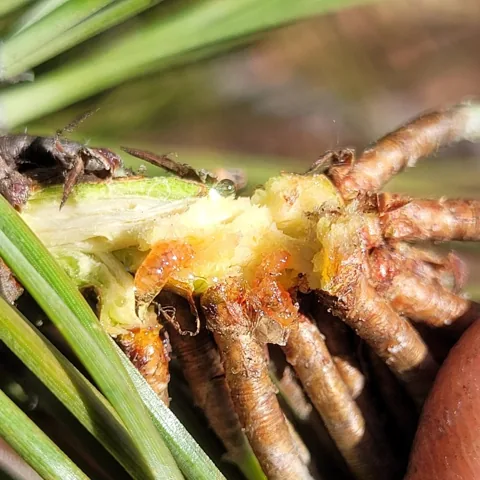 Pitch Gall Midges
Cecidomyia
Pitch gall midges, also called resin gall midges or pine pitch midges, are several species of tiny mosquito-like flies in the genus Cecidomyia. Their maggots bore into the cambium of pine twigs in spring, and the pitch that oozes out forms a white mass almost half an inch wide in which the orange maggots develop. One species, the gouty pitch midge, is transcontinental and feeds inside the current year's shoots of ponderosa, pitch, Virginia and jack pine, killing needle tufts and twig tips and, in prolonged outbreaks, stunting plantation trees.
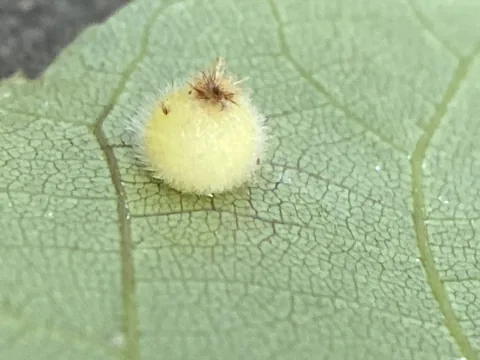 Hickory Gall Midges
Caryomyia
Hickory gall midges are gall flies of the genus Caryomyia whose maggots develop inside galls on hickory leaves. NC State describes the hickory peach gall midge (Caryomyia persicoides), which makes small, fuzzy, more or less spherical galls on the undersides of the leaves. Gall midges are tiny flies about 3 mm long, and Virginia Tech notes that most galls are harmless to trees; NC State says these galls are rarely abundant enough to injure one.
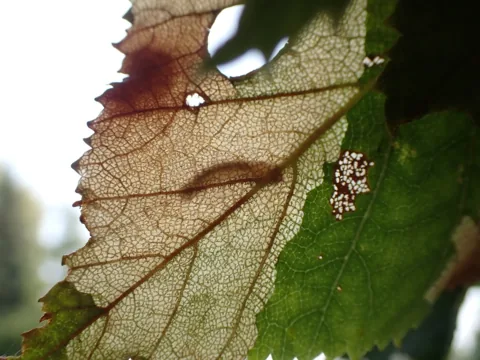 Late birch leaf edgeminer
Heterarthrus nemoratus
The late birch leaf edgeminer is one of three leaf-mining sawflies accidentally brought from Europe to North America early in the 20th century; all three are now widespread in Canada and the northern United States. It attacks mature birch leaves from July on, mining inward from the leaf edge, and its mines take on a reddish color that sets them apart from the yellow-brown blotches of the amber-marked birch leafminer. The damage is mostly cosmetic: a healthy birch tolerates years of light to moderate mining, and no birch deaths have been attributed to the insect alone.
No photo yet
Neodiprion mundus
Neodiprion mundus
Neodiprion mundus is a native sawfly of western North America that feeds only on ponderosa pine. Its larvae feed in colonies on the previous years' needles, so the fresh needles at the shoot tips stay green even on a well-chewed branch. It is common but rarely destructive and cannot fully defoliate a tree; it poses no reported risk to people, and on small landscape pines the colonies can simply be picked or pruned off.
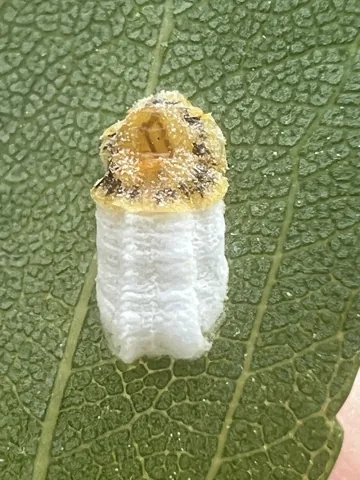 Cottony maple leaf scale
Pulvinaria acericola
The cottony maple leaf scale is a soft scale easily confused with the cottony maple scale; the two were treated as one species until 1898. The giveaway is where the white cottony egg sacs sit: this species lays on the leaves, while the cottony maple scale lays along twigs and small branches. It feeds on maples, hollies, dogwood, sourgum and several other broadleaf plants, produces one generation a year, and is usually worth treating only when populations are high and the plant is showing damage.
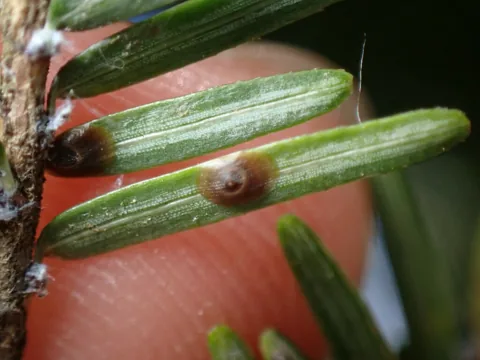 Shortneedle evergreen scale
Dynaspidiotus tsugae
The shortneedle evergreen scale, also called the shortneedle conifer scale, is a non-native armored scale first noticed in New Jersey in 1910 on Japanese hemlocks shipped from Japan. It has since been reported from Connecticut, Maryland, New York and Rhode Island, and a white spruce sample from Cape Cod confirmed it in Massachusetts in 2017. It settles on the undersides of hemlock, spruce, fir and yew needles, and in Connecticut it has historically been a serious pest of native eastern hemlock, yellowing needles, dropping them early and sometimes killing trees.
No photo yet
Hemlock scale
Hemiberlesia ithacae
The hemlock scale is a native armored scale with a round, dark cover about 2 mm across. It feeds on the undersides of needles, hemlock first of all but also spruce, fir, Douglas-fir and pine, and the first sign is often a small yellow spot on the upper side of the needle. Four to six scales on a needle are enough to yellow it and make it drop. It is easy to confuse with the elongate hemlock scale and the introduced shortneedle evergreen scale, which share its hosts.
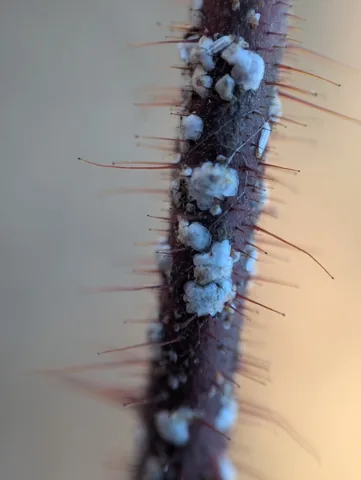 Rose scale
Aulacaspis rosae
The rose scale is an armored scale of roses and their relatives. Its flat, white, nearly circular covers coat the canes of roses, raspberries, blackberries and currants, and a heavy infestation can cause rose canes to decline and die back or kill the plant. Mississippi State calls it one of the more common armored scales on roses. Crawlers spread it along the plant and on the wind; settled scales and eggs travel on infested plants. On roses, winter pruning of the worst canes plus an oil spray usually gives sufficient control, and parasitic wasps attack it.
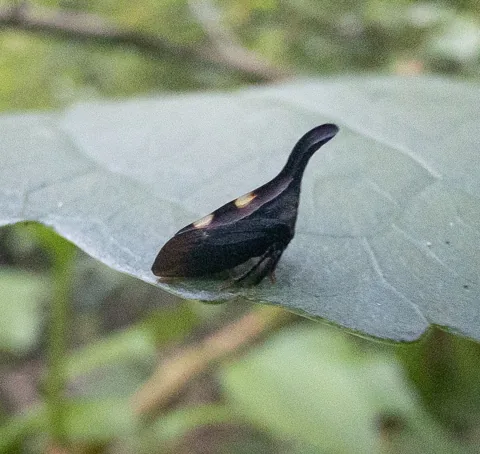 Twomarked treehopper
Enchenopa binotata
The twomarked treehopper is an 8 mm, brown-black hopper with two yellowish spots on its back. It is really a complex of closely related species, each tied to its own host plant, found mainly in eastern North America on black walnut and other nut trees, black locust, redbud, viburnum, hoptree and grapevines. Nymphs crowd the tips of new shoots to suck sap, adults line up in rows on the same shoots, and the females leave slits and frothy white egg masses in the twigs. It is abundant but rarely does enough damage to justify control.
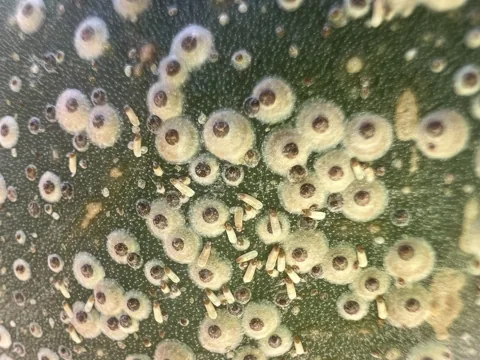 Cactus scale
Diaspis echinocacti
The cactus scale is an armored scale of cacti and succulents, probably native to the New World and now found wherever cacti are grown, under glass in cold climates. Its whitish to tan, slightly convex covers, each with a brown off-center dot, speckle the smooth surfaces of prickly pear pads, columnar cacti, orchid and holiday cacti and dozens of other genera. Feeding reduces photosynthesis and can wither entire pads or whole plants, and it is a particularly serious pest in greenhouses; in the United States it has been reported from most states and is widespread in California.
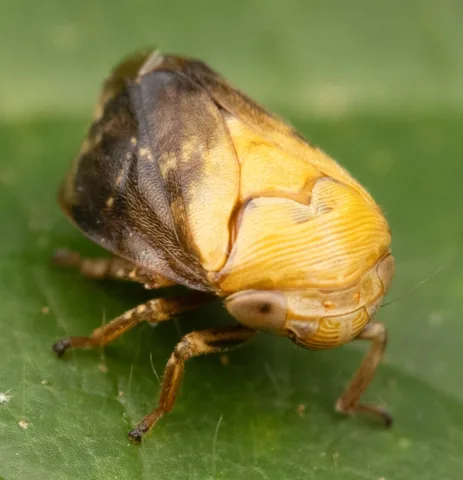 Pecan spittlebug
Clastoptera achatina
The pecan spittlebug is a small brown hopper whose nymphs hide in frothy white spittle on pecan and hickory twigs. It is common in pecan orchards of the southeastern United States and recorded from Kansas and Michigan to Florida, plus Canada and Mexico. Like other spittlebugs it overwinters as eggs in twig bark, has one generation a year and causes little direct damage, but Louisiana tests showed it can carry Xylella fastidiosa, the bacterium that causes pecan bacterial leaf scorch, from infected pecans to healthy ones.
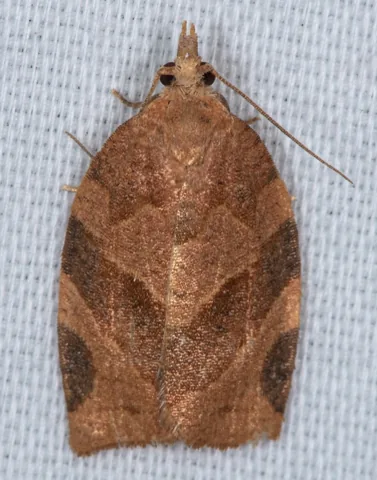 Pandemis Leafroller (Apple Pandemis)
Pandemis pyrusana
The pandemis leafroller, also called apple pandemis (Pandemis pyrusana), is one of the two-generation leafrollers of western apple orchards. Its green caterpillars with a green, straw- or gold-colored head overwinter in buds or under bark, feed on blossoms and young fruit in spring, and then windowpane leaves and tie them to fruit in summer. In California it is mainly a Central Coast orchard pest that builds up in cooler years and cooler sites.
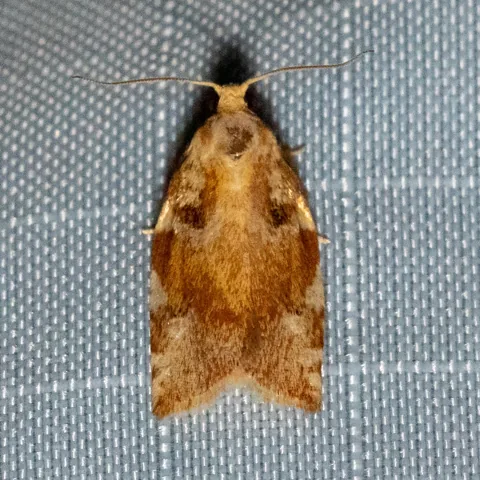 Oak Leafroller
Archips semiferanus
The oak leafroller (Archips semiferanus in GBIF, written A. semiferana by UMass and Texas A&M) is a native leafroller of oaks with one generation a year. Its eggs overwinter on twigs and hatch close to red oak budbreak, and the creamy white to greenish caterpillars web the emerging leaves together, skeletonize and shred them, roll single leaves as they grow, and hang from silk threads when dislodged. UMass says historically large outbreaks of this native insect have occurred but its natural enemies typically keep it below damaging levels; Texas A&M says that by mid-April the hundreds of dangling caterpillars can drive Hill Country residents off their patios.
No photo yet
Boxelder Leafroller
Archips negundana
The boxelder leafroller (Archips negundana) is a native caterpillar of boxelder and, to a lesser degree, raspberry, birch, elderberry, white elm and various shrubs. Its eggs overwinter in bark crevices, the larvae hatch at budbreak and feed in small groups along leaf veins before rolling single leaves, and heavy infestations can strip a tree by early to midsummer. Populations are usually low, outbreaks are occasional, boxelders put out a second set of leaves, and control is usually unnecessary.
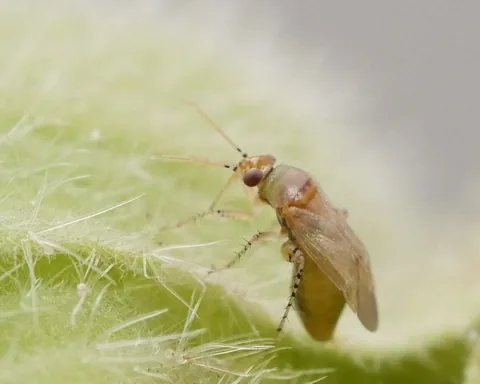 Campylomma bug (mullein plant bug)
Campylomma verbasci
The campylomma bug, or mullein plant bug (Campylomma verbasci), is a tiny insect in apple and pear trees. For a few weeks around bloom its young nymphs feed on blossoms and fruitlets, leaving corky warts and dimples that stay on the apple until harvest. After that it cannot damage the fruit, and the older nymphs and adults become helpful predators of aphids, mites, thrips and pear psylla. The PNW handbook says damaged fruit can simply be thinned off, Utah State advises against controlling the beneficial later bugs unless necessary, and Penn State suggests a petal-fall spray only where fruit damage was heavy the year before.
No photo yet
Fire bush scale
Lepidosaphes yanagicola
The fire bush scale is a small brown armored scale that lives on winged euonymus (burning bush) and a range of other deciduous trees and shrubs. On burning bush it tucks itself between the corky ridges that give the twigs their wings, where it is easy to miss until leaves turn off-color or drop early. It is a different insect from the familiar euonymus scale, is never found on evergreen euonymus, and has one generation a year. Heavy infestations have caused leaf drop and dieback in Maryland and in Ohio and northeastern nurseries, while in Pennsylvania it often builds up without doing much harm.
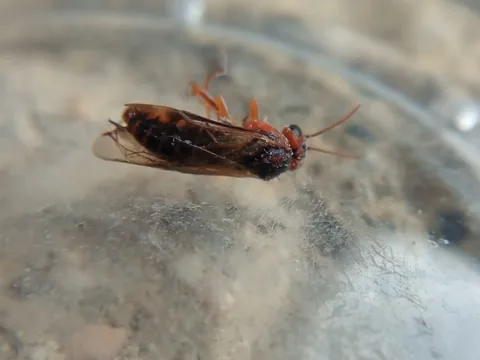 Pear fruit sawfly
Hoplocampa brevis
The pear fruit sawfly is a small reddish-yellow, fly-like wasp whose larvae feed only inside pear fruitlets for about six weeks in early to mid spring. Each larva hollows out the seeds of several young pears, leaving a round hole near the calyx that oozes wet, dark frass; the fruit swells, deforms and drops before the normal June drop. It is native to parts of Asia, was found in Pennsylvania and Maryland in the mid-1960s, is now reported from Virginia and Ontario, and was first identified in Utah in 2015. It is a different insect from the pear slug, also called pear sawfly, which eats leaves in summer.
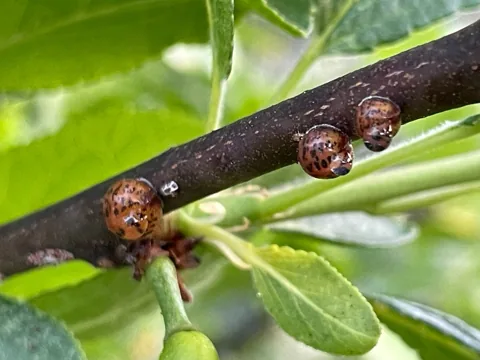 Kuno scale
Eulecanium kunoense
Kuno scale, Eulecanium kunoense, is a soft scale insect whose mature females are almost round, dark and shiny brown, about 1/6 inch (3 to 5 mm) across, and sit along twigs like beads on a string. Is it harmful? Not to people or pets, but on backyard plums it can build up quickly, drip sticky honeydew that turns black with sooty mold and draws ants, and in heavy numbers cause leaf drop and twig dieback. UC IPM says it is mostly found in the San Francisco Bay Area and Sacramento Valley and is not a pest of commercial fruit and nut crops. To get rid of it, control the ants that guard it so its natural enemies can work, and where it has been abundant use horticultural oil at delayed dormant or on the leaf undersides in early summer.
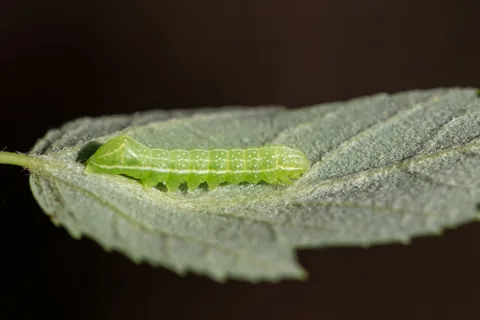 Copper Underwing
Amphipyra pyramidoides
The copper underwing (Amphipyra pyramidoides) is a large noctuid moth whose green, hump-tailed caterpillar is one of the green fruitworms. UC IPM calls it the humped green fruitworm and ranks it with the speckled green fruitworm as the most important of at least ten green fruitworm species in California; the Pacific Northwest handbook lists it as the pyramidal fruitworm on apple. The caterpillars eat flowers and leaves in spring and then bite into the young fruit, leaving large russeted cavities, but they are also general feeders on many forest trees and shrubs.
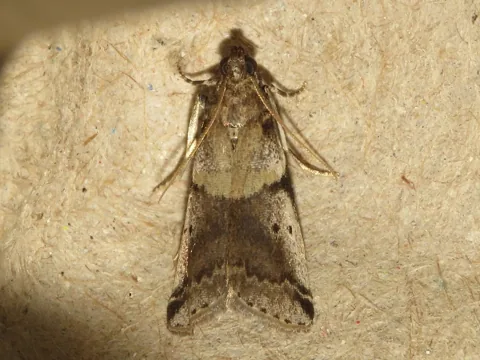 Leaf Crumpler
Acrobasis indigenella
The leaf crumpler (Acrobasis indigenella) is a small moth whose caterpillar spins a twisting silk tube on twigs of cotoneaster, crabapple, apple, hawthorn, pyracantha, quince and stone fruits, then webs nearby leaves into ugly wads of dead brown leaves that look like fire blight. It is harmless to people. The damage is mostly cosmetic: prune out the nests in late summer or winter, and if needed spray Bacillus thuringiensis, carbaryl (Sevin) or permethrin while the caterpillars are small.
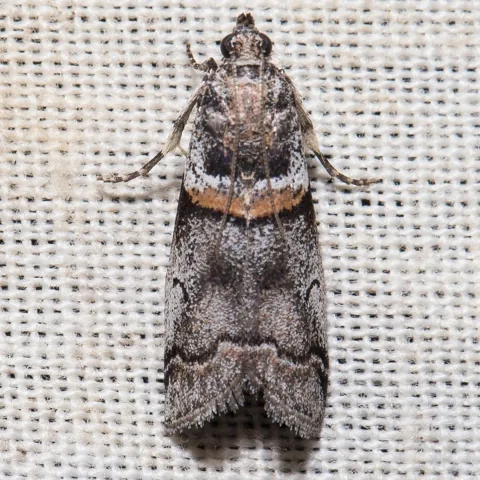 Mineola Moth
Acrobasis tricolorella
The mineola moth (Acrobasis tricolorella) is a small bluish-gray pyralid moth of the Pacific Northwest whose caterpillar, the destructive prune worm, overwinters in wart-like silk-and-bark cases on prune and cherry trees. In early spring the larvae bore into unopened buds and eat the flower parts; a summer generation then feeds inside green prunes, and a second inside ripening fruit. The Pacific Northwest handbook lists it with the leaf crumpler as a cherry pest, and a 1941 University of Idaho bulletin, written under the older name Mineola scitulella, describes its spread through prune orchards in southwestern Idaho and eastern Oregon after it was first found attacking prunes in 1925.
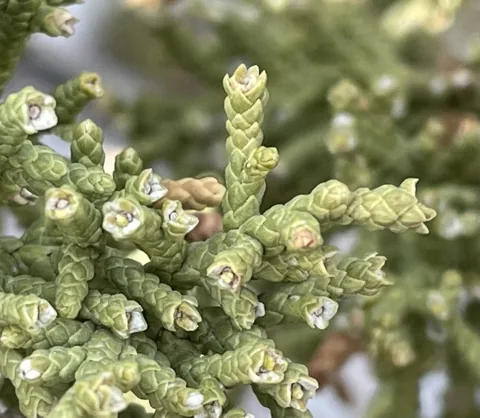 Juniper Tip Midge
Oligotrophus betheli
The juniper tip midge (Oligotrophus betheli) is a tiny yellow, mosquito-like fly whose legless maggots feed inside the tips of juniper shoots. The infested tips swell into small galls; once the larvae leave, the galls turn brown or reddish and the tips die back, which looks much like the fungal tip blight caused by Phomopsis. Colorado State describes the gall as reddish or yellow, appearing as a rosette of leaves.
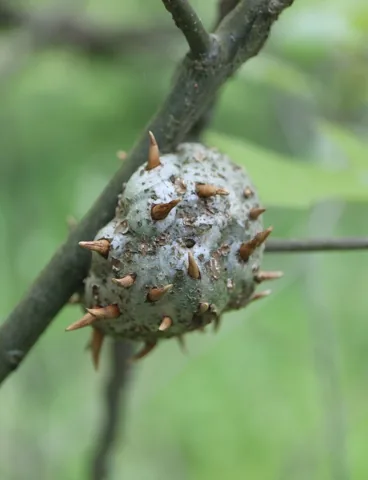 Horned oak gall wasp
Callirhytis quercuscornigera
The horned oak gall wasp is a tiny cynipid wasp whose woody twig galls on pin, black, scrub, blackjack and water oaks grow to golf-ball size and sprout short horns, one wasp emerging from the tip of each. The galls are easy to spot after leaf drop; the earlier generation, which forms small blister galls along leaf veins, is usually missed. Heavy infestations make branches droop, disfigure trees and can cause dieback. Both Penn State and Kentucky report that insecticides give little control once galls form, and pruning out young galls on lightly infested trees is the practical option.
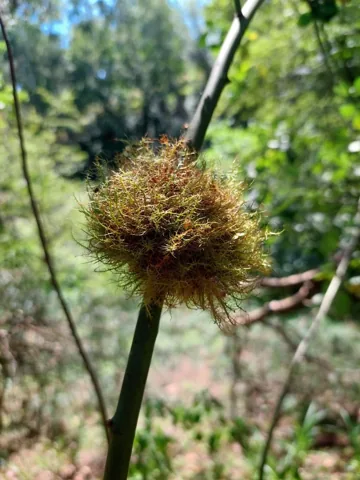 Rose gall wasps
Diplolepis (e.g., Diplolepis rosae, mossy rose gall wasp, and Diplolepis bicolor, spiny rose gall wasp)
Rose gall wasps are tiny wasps, about an eighth to a quarter of an inch long, that are almost never seen; what gardeners notice are the galls their larvae cause roses to grow. The mossy rose gall is a cluster of hard, kernel-like cells on a stem or leaf covered in moss-like filaments, sometimes bigger than a golf ball, and it occurs on cultivated roses. The spiny rose gall is a hard sphere bristling with sharp spines, usually on the leaves of wild roses. Both are harmless to healthy plants. The wasp spends the year inside the gall and emerges in spring, so pruning galls out in late summer or winter, before the exit holes appear, is the only practical control; no spray removes a gall once it has formed.
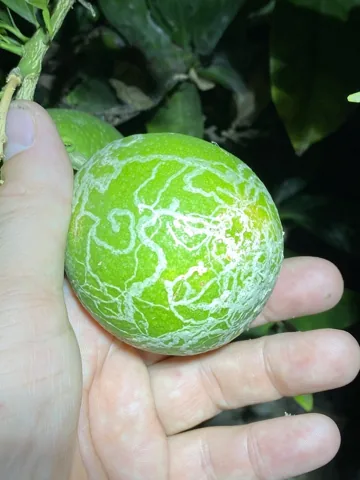 Citrus Peelminer
Marmara gulosa
The citrus peelminer (Marmara gulosa) is a small gracillariid moth of the Coachella and San Joaquin valleys of California whose larva feeds on the rind of citrus fruit, cutting a winding tunnel that grows wider as the larva grows. The damage is only skin deep, but a single mine can make a grapefruit or navel orange unsellable as fresh fruit, and the moth also breeds in the stems of walnuts, willows, oleander, cotton, beans and weeds, moving into neighboring citrus as those plants dry down. Researchers call it a sporadic pest; UC IPM says it is hard to control with sprays and expects long-term control to come from native parasitic wasps.
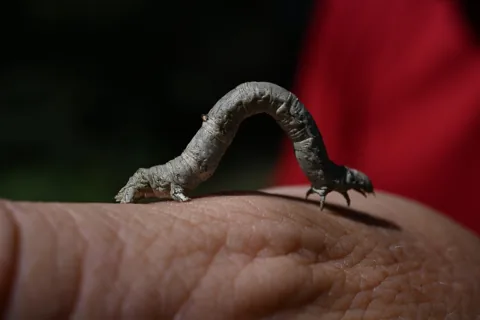 Curved-toothed Geometer Moth
Eutrapela clemataria
The curved-toothed geometer (Eutrapela clemataria), called the purplish-brown looper in a USDA Forest Service caterpillar guide and the great or big cranberry spanworm on Massachusetts cranberry bogs, is one of the larger inchworms of the eastern United States. Its smooth, twig-mimicking caterpillar grows to about 2.5 inches and feeds on many trees and shrubs, including softwoods. On cranberry it usually turns up in distinct patches and is particularly destructive only on rare occasions.
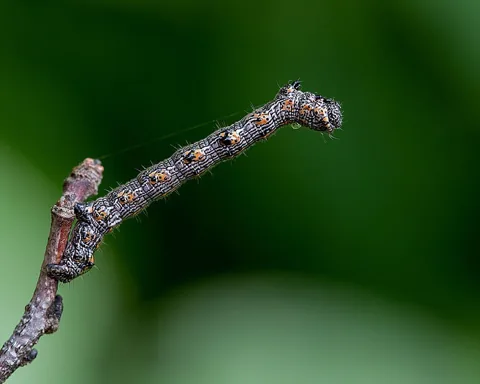 Half-wing Moth
Phigalia titea
The half-wing (Phigalia titea), which BAMONA calls the spiny looper, is an early-spring geometrid moth whose female is virtually wingless, with useless 3 mm stubs. Its caterpillar, called the spiny looper by cranberry growers, is a violet, pinkish-gray brown inchworm with many blackish lines along the body. BAMONA lists basswood, elm, blueberry, hickories, maples, oaks and poplars as hosts, and UMass has found it in dense patches on the edges of Massachusetts cranberry bogs, where the larvae nip new shoots and brown the tips.
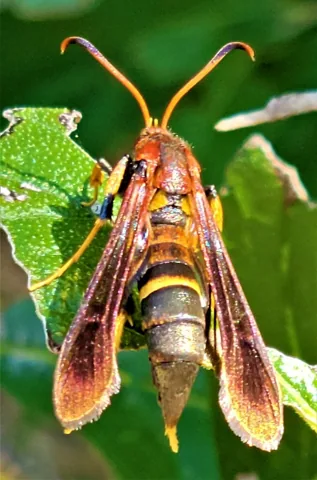 Banded Ash Borer Moth
Podosesia aureocincta
The banded ash clearwing (Podosesia aureocincta) is the late-season twin of the familiar ash/lilac borer. Both are day-flying, wasp-like clearwing moths whose larvae tunnel under the bark of ash, and the adults look so alike that older literature confused their emergence periods until pheromone trapping showed a second species flying in late August and September. Rutgers calls it the last important clearwing borer to become active in the urban landscape each year, and unlike most clearwings, which seek out bark wounds, it will also lay eggs on healthy ash trees.
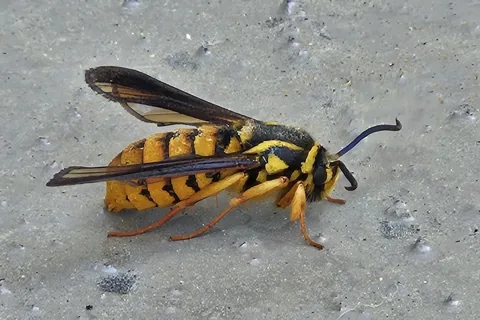 Red Oak Clearwing Moth
Paranthrene simulans
The red oak clearwing borer is a day-flying moth that looks remarkably like a yellowjacket; NC State says the moths cannot hurt people. Its caterpillars bore into the base of oak trunks, leaving frass and empty pupal cases in the bark. In forests the damage is usually minor, but in yards, parks and street trees a single borer can open a tree to decay, and heavy attacks can kill small trees. Valuable oaks can be protected with a well-timed bark spray.
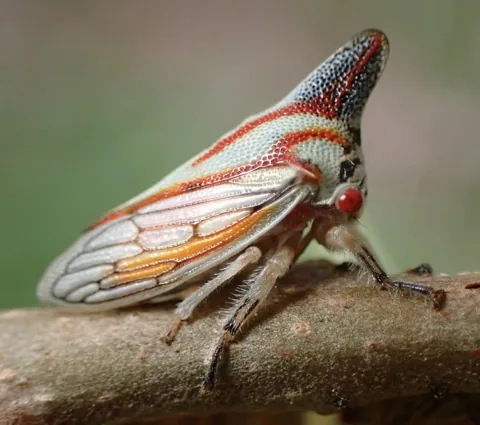 Treehoppers
Membracidae (more than 260 North American species)
Treehoppers are the odd little bugs that look like thorns or green humps sitting in the crotch of a twig. More than 260 species live in North America north of Mexico and at least 40 in California alone. What sets them apart from leafhoppers and other small hoppers is the pronotum, the plate behind the head, which is expanded into a hood or thorn that covers much of the body. They drink sap through a beak, and most species cause no real trouble; the main injury is the rows of egg slits females cut into small twigs, which can roughen bark and kill shoot tips. A few species, such as the buffalo treehopper and the threecornered alfalfa hopper, are considered pests.
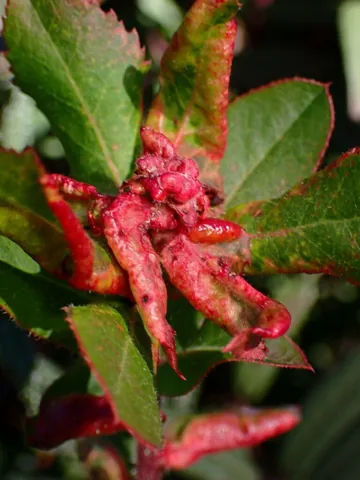 Manzanita leafgall aphid
Tamalia coweni (UC IPM treats the gall makers as Tamalia spp.)
Manzanita leafgall aphids turn manzanita leaves into green or red pods. Tiny gray or greenish aphids of the genus Tamalia hatch in late winter or spring, walk up to the leaves and feed inside them, and the galled leaves look as if their edges have swollen or rolled. UC IPM says these aphids feed only on manzanita, produce several generations a year and spend winter as eggs on the bark at the base of the plant, and that the damage does not significantly affect plant health but can be aesthetically objectionable. Its first advice is to avoid practices that stimulate succulent new growth.
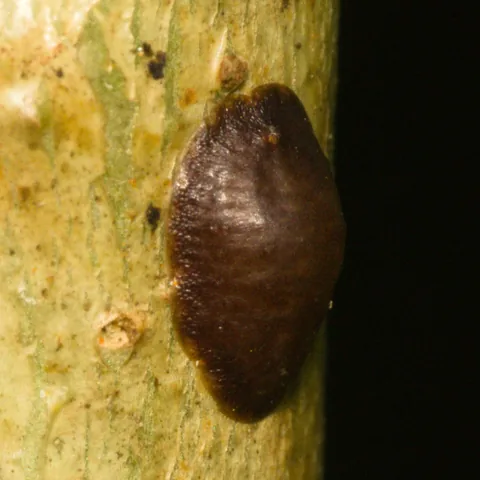 Nigra scale
Parasaissetia nigra
Nigra scale is a small, shiny, dark brown soft scale, 3 to 4 mm long, that sucks sap from leaves, stems and fruit of hibiscus, ficus, English ivy, oleander, avocado, mango and plants from more than 100 families. It is harmless to people and pets. Heavy infestations weaken plants and drip sticky honeydew that grows black sooty mold. To get rid of it: inspect new plants, prune out heavily infested branches, control the ants that guard it, let parasitic wasps work, and if needed use horticultural oil; systemic insecticides are a last resort for heavy infestations.
No photo yet
Western balsam bark beetle
Dryocoetes confusus
Most of the subalpine fir that dies in the high country dies from this beetle, but slowly. Less than five percent of a stand is usually attacked in a year, and the attacks are high on the trunk where nobody looks, so the first sign is a tree whose needles go brick red. Dryocoetes confusus also carries a canker fungus on its thorax, and Canadian work credits that fungus with roughly two-thirds of the mortality: trees that successfully pitch out the beetles can still be girdled by coalescing fungal lesions.
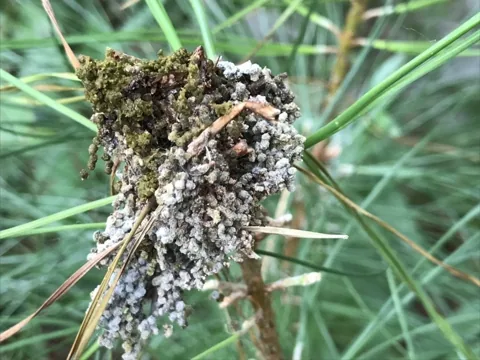 Pine Webworm Moth
Pococera robustella
The pine webworm (Pococera robustella, formerly Tetralopha robustella) is a moth of southern Canada and the eastern United States whose caterpillars build loosely webbed, messy nests of silk and brown frass on pine twigs in summer. UMass Extension calls it a pest of ornamental pines and Christmas trees, usually considered a pest on seedling pines in plantations and managed landscapes; the nests are unsightly, and the damage is usually noticed only after the caterpillars have left.
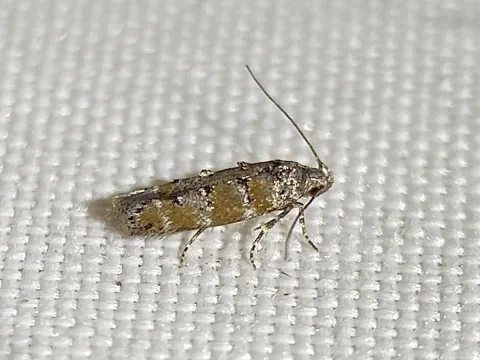 Pine Needleminer Moth
Exoteleia pinifoliella
The pine needleminer (Exoteleia pinifoliella) is a native moth of eastern North America whose 6 mm caterpillars live and feed inside pine needles, moving from one needle to the next and killing each one they mine. Pitch pine is the preferred host. UMass calls it typically a minor pest in landscapes whose native natural enemies usually keep it in check, though it can occasionally defoliate trees and the brown needles spoil the look of nursery pines and Christmas trees. Getting rid of it is rarely needed; confirm the caterpillars first, and save sprays for trees grown for sale.
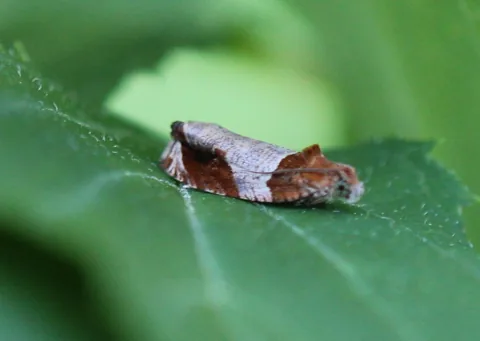 Hydrangea Leaftier Moth
Olethreutes ferriferana
The hydrangea leaftier (Olethreutes ferriferana) is a small brown-and-white moth whose caterpillar glues two to four expanding leaves at the tip of a hydrangea shoot into a cupped, bladder-like pouch and feeds on the flower bud and leaves inside. It is common in eastern North America from Maine to North Carolina and west into Illinois, has a single generation, and does no real harm to the shrub, so the usual advice is to pull the pouch open and squash the caterpillar rather than spray.
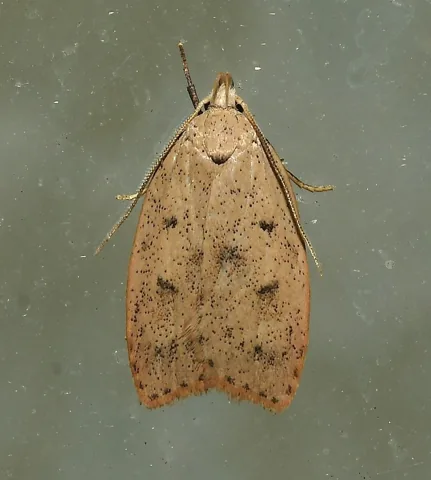 Gold-striped Leaftier Moth
Machimia tentoriferella
The gold-striped leaftier (Machimia tentoriferella) is a small moth found from Nova Scotia to Virginia and west to Iowa and Mississippi. Its pale green caterpillar spins silk shelters on either side of a leaf and feeds inside the folded leaf. BAMONA lists ash, elms, maples, oaks and many other trees as hosts, and NC State records it as one of three leaf-tying caterpillars on highbush blueberries in North Carolina, where leaf tiers are common but rarely cause severe damage. The USDA Forest Service manual Eastern Forest Insects (1972) says it occurs rather commonly in the Northeastern States and southeastern Canada.
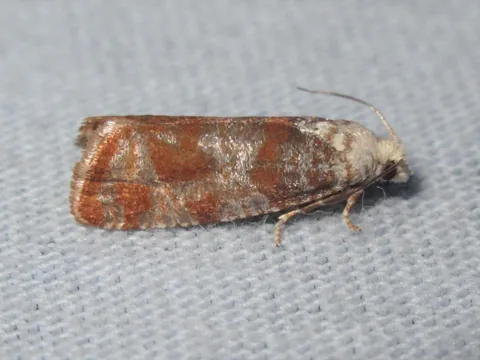 Pitch Twig Moth
Retinia comstockiana
The pitch twig moth (Retinia comstockiana, also listed as Petrova comstockiana) is a small native moth whose caterpillar bores into the current year's twigs of pitch pine and Scotch pine. The giveaway is an orange nodule of resin and frass, about 7/8 inch long, on the upper side of the shoot. It is harmless to people. Infested twigs can be girdled and snap off, deforming young and ornamental pines, but the trees are typically not killed. Prune out twigs with nodules; insecticides are often unnecessary where natural enemies are present.
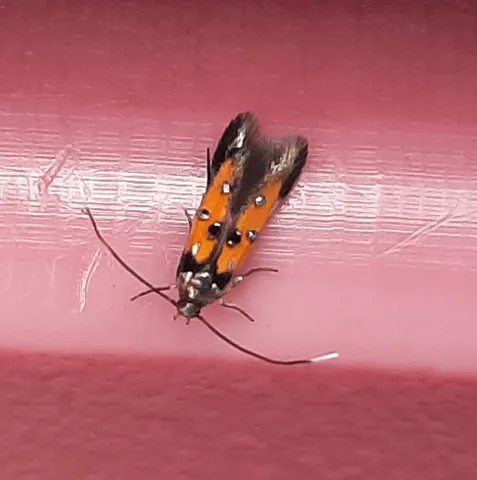 Linden Bark Borer Moth
Chrysoclista linneella
The linden bark borer (Chrysoclista linneella, formerly Glyphipterix linneella) is a small, brightly colored European moth first reported in North America from specimens collected in New York City in 1928, and since reported from New Jersey, Connecticut, Vermont, the Boston area and parts of Canada. Its larvae feed in the bark of European linden, leaving rusty frass and, in heavy infestations, honeycombing the inner bark from the ground up into the crown. UMass Extension says its impact on the trees still needs study.
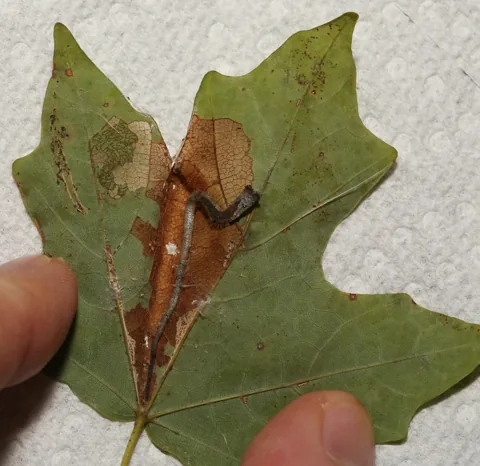 Maple Trumpet Skeletonizer Moth
Catastega aceriella
The maple trumpet skeletonizer (Catastega aceriella, long listed as Epinotia aceriella) is a small gray moth found through much of New England and parts of Canada whose caterpillar folds and crumples maple leaves in late summer. Working on the underside of a sugar or red maple leaf, it spins a trumpet-shaped tube of silk and frass about 5 cm long, folds the leaf around it and skeletonizes the webbed tissue. Minor damage shows up every year and outbreaks occur occasionally, but UMass says it rarely harms tree health because the feeding comes late in the season.
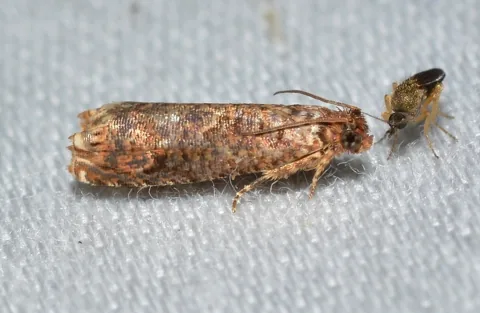 Sumac Leaftier Moth
Episimus argutana
The sumac leaftier (Episimus argutana, written Episimus argutanus by UMass Extension and the USDA Forest Service) is a common little moth with a wing expanse of about half an inch, whose caterpillars roll and tie the leaves of sumac and also feed on witch-hazel, poison ivy and spurge. Feeding shows up by June in Massachusetts, two or more generations a year may occur in parts of New England, and UMass says the damage is not typically significant to the plant's health, so management is typically not necessary.
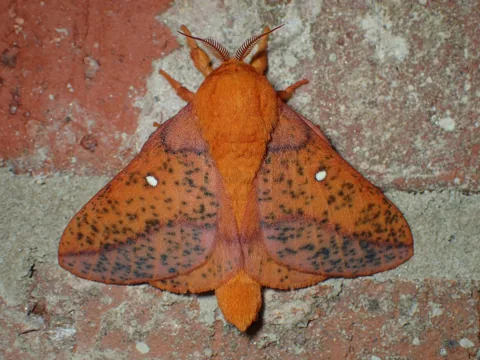 Spiny Oakworm Moth
Anisota stigma
The spiny oakworm (Anisota stigma) is the most common of Ohio's three oakworm moths. Its caterpillars, red, pink or tawny and heavily speckled with white, have longer back spines than the other oakworms in the Forest Service's caterpillar guide. Young caterpillars feed together in groups on oak leaves, sometimes in numbers large enough to defoliate young trees, but Ohio DNR says the trees normally suffer no lasting damage. Numbers rise and crash in cycles.
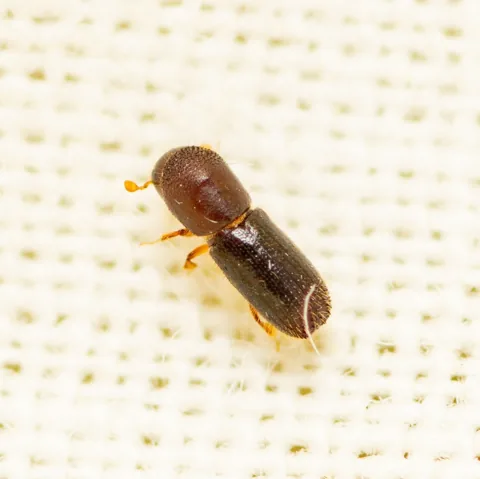 Fruit-tree pinhole borer
Xyleborinus saxesenii
This ambrosia beetle came from Europe and now turns up across much of the United States, in nearly every kind of broadleaf tree and occasionally conifers; Natural Resources Canada calls it the lesser shothole borer. It goes after trees that are dying, weakened or recently cut.
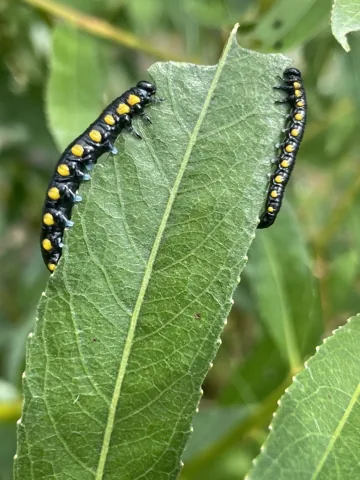 Willow Sawfly
Euura ventralis (Minnesota Extension: Nematus ventralis)
Groups of black larvae with big yellow spots chewing willow leaves may be willow sawflies. Sawfly larvae look like caterpillars, but adult sawflies are non-stinging, wasp-like insects. Willow sawfly larvae start by eating small holes and end up taking nearly whole leaves, leaving only the midrib. The USDA Forest Service's Eastern Forest Insects says it occasionally heavily defoliates willows in ornamental plantings and along streams.
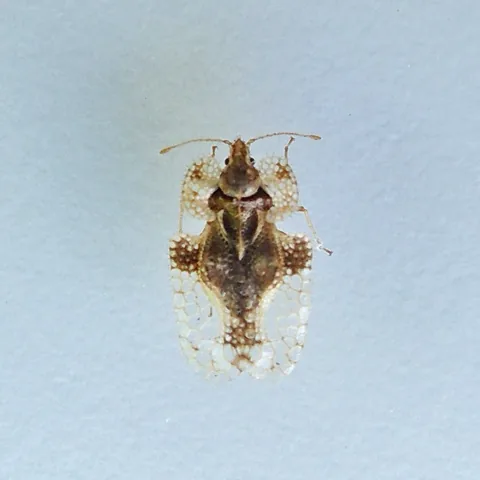 Elm Lace Bug
Corythucha ulmi
If the leaves on an elm look pale and speckled on top, turn one over. Tiny tan bugs with lacy wings, black spiny nymphs and dark specks of excrement on the underside point to the elm lace bug. NC State lists American elm as its only host and calls it rarely reported. The USDA Forest Service's Eastern Forest Insects adds Siberian elm on the Northern Great Plains as a host.
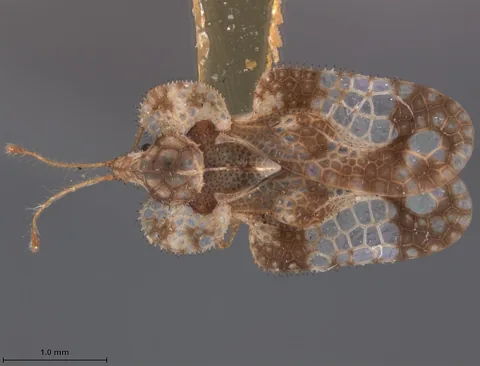 Hackberry Lace Bug
Corythucha celtidis
Hackberry leaves that turn pale, scorched-looking or brown by August or September are usually the work of lace bugs. Ohio State lists the hackberry lace bug among the most common lace bug pests in Ohio, and Iowa State names hackberry, sycamore and oak as the trees lace bugs hit most there. The damage can look alarming, but healthy, established trees are not seriously harmed, and late-summer spraying does little good.
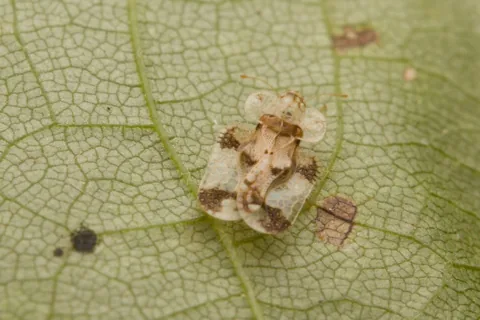 Walnut Lace Bug
Corythucha juglandis
The walnut lace bug (Corythucha juglandis) is a tiny sap-feeding lace bug that the 1972 USDA Forest Service manual records on black walnut, butternut and linden. In a northeastern Massachusetts study on butternut (Juglans cinerea), one tree carried a heavy infestation every year, with up to 48 bugs on a single leaf. Like other lace bugs, the adults have lacy wings and a hood over the head, and their feeding leaves yellow or whitish spots on the leaves with dark varnish-like excrement underneath.
Bagworms
Bagworms build spindle-shaped silk bags, 1-1/2 to 2-1/2 inches long, covered with bits of foliage. They prefer arborvitae and red cedar but attack many conifers and broadleaf trees, from New England to Nebraska and south through Texas.[9]
- Females can't fly, so populations build up quickly on favored hosts. Heavy feeding can kill buds and branches, and severe defoliation can kill arborvitae, cedar or juniper the following season.[9]
- Each overwintering bag can hold 300 to 1,000 eggs, which hatch in late May or early June; tiny larvae balloon on silk to nearby plants.[9]
- Hand-pick bags in late fall, when they turn brown and are easy to see, and cut the silk band attaching them, which can girdle the branch years later.[9]
- Bt works only against young larvae; apply it at the end of June after eggs have hatched and ballooning is over. With any spray, cover foliage thoroughly, because larvae are protected inside the bag.[9]
Emerald ash borer
Emerald ash borer is an invasive beetle that kills true ash trees (Fraxinus). Its larvae tunnel just under the bark, cutting off water and nutrients. Mountain ash isn't a true ash and isn't attacked.[10]
- Early signs: dieback in the top third of the canopy, more woodpecker activity, and sprouts on the lower trunk. Adults leave D-shaped exit holes; vertical bark splits appear as the tree declines.[10]
- Adults are metallic green, about 1/2 inch long and 1/8 inch wide.[10]
- White and green ash usually survive 7 to 10 years after infestation, but can die in 1 to 2 years when beetle numbers are high or the tree is already stressed.[10]
- Systemic insecticide treatment is currently the only way to protect a tree, and it must be repeated for the foreseeable future. Treat healthy trees you value; remove trees that are badly damaged, defective or recently planted, and replace with a mix of species.[10]
Asian longhorned beetle (report it)
- A shiny black beetle about the size of an almond, with white spots and black-and-white antennae longer than its body. It attacks and kills maples and other hardwoods.[2]
- Signs: round exit holes about the size of a dime or smaller, oval or round egg-site wounds chewed in the bark, sawdust-like frass, and limbs falling from healthy-looking trees.[2]
- USDA is working to eliminate infestations in central Long Island, NY; Worcester County, MA; Clermont County, OH; and Charleston County, SC. Report a suspect beetle or damage to the ALB hotline, 1-866-702-9938, with a photo, and freeze the beetle in a container if you can.[2]
Peachtree borer, twig girdlers and cottonwood borer
- Peachtree borer larvae tunnel in the lower trunk of peaches, cherries, plums and ornamental Prunus; the first sign is a mass of gum mixed with sawdust and frass from about 3 inches below to 12 inches above the soil. Adults are wasp-like clearwing moths.[3]
- Stressed, transplanted or mower-wounded trees are attacked more. Don't pile mulch against Prunus trunks, avoid bark wounds, and remove severely infested trees.[3]
- Twig girdlers are longhorned beetles. After the adults emerge and mate in late summer and fall, the female chews a groove around a pencil-sized twig, leaving a small column of wood in the center, and lays eggs farther out toward the tip, so the girdled twig tips drop. Mississippi State says hickory, pecan and elm are favored, but other hardwoods are attacked too.[21]
- Cottonwood borers are large beetles, about 1 1/2 inches long, with rows of black angular patches bordered by white stripes. Females lay eggs in bark at the base of the tree below the soil line, and the larvae burrow into the bases and exposed roots of cottonwoods, poplars and, less often, willows; Nebraska Extension says severely infested young trees can be badly damaged or killed.[22]
Bark beetles
- Adults are small, dark, cylindrical beetles about the size of a grain of rice; look for many tiny holes, boring dust, holes oozing sap and a declining crown, and galleries under the bark.[12]
- Native bark beetles mostly attack trees already stressed by drought, disease or injury, though some invasive species kill healthy trees. Healthy trees fight off light attacks by pushing out sap.[12]
- Water trees properly, thin dense stands, and avoid compacting soil or injuring roots and trunks. Insecticides won't save a heavily infested tree; remove it promptly and chip the wood, or solarize small piles under thick clear plastic for several months.[12]
Pine sawflies
- Sawfly larvae look like caterpillars but have more than five pairs of fleshy legs on the abdomen; they feed in groups and can strip needles quickly.[19]
- Bt, which works on moth and butterfly caterpillars, doesn't work on sawflies. Handpick, shake off or prune out small colonies; insecticidal soap works if it hits the larvae directly.[19]
Psyllids, lace bugs and woolly aphids
- Psyllids are aphidlike insects, 1/10 to 1/5 inch, that jump when disturbed and leave sticky honeydew, sooty mold, white wax or distorted leaves; most plants tolerate low to moderate numbers.[13]
- Conserve the lady beetles, pirate bugs and parasitic wasps that attack psyllids, fertilize less to avoid succulent growth, and use soaps or oils only for heavy infestations.[13]
- Lace bugs, about 1/8 inch with lacelike wings, leave pale stippling and black specks under leaves; the damage is mostly cosmetic.[14]
- Woolly aphids hide under white, waxy fluff; brush the wax away to see the insects, since adelgids, mealybugs, psyllids and woolly whiteflies look similar. Woolly apple aphid causes warty galls on apple and pyracantha bark and roots.[15]
Hemlock woolly adelgid
- The giveaway is white, cottony wax masses at the base of hemlock needles; tiny black females overwinter beneath them. Severe infestations cause needle drop, dieback and can kill eastern hemlocks.[4]
- Late September through October is the best time to treat with a labeled insecticide, targeting overwintering females; commercial applicators can soil-inject systemic insecticides around large trees, best in early spring with good soil moisture.[4]
Box tree moth
- An invasive moth whose caterpillars feed only on boxwood. First found in Toronto in 2018 and in New York in 2021, it has since been confirmed in Michigan, Ohio, Massachusetts and Pennsylvania.[5]
- Caterpillars are green and yellow with white, yellow and black stripes and black spots; young ones leave leaves looking peeled, older ones eat all but the midrib and web leaves together. Extensive feeding can kill whole plantings.[5]
- Adults are mostly white with a brown border; 5 to 10 percent are entirely brown except for white commas on the forewings.[5]
Browntail moth (Maine and New England)
- The caterpillars' microscopic toxic hairs break off and float in the air or settle on surfaces, causing a rash like poison ivy and sometimes trouble breathing that can last hours to weeks.[6]
- In Maine it occurs along the coast and up to 60 miles inland. Caterpillars leave their winter webs to feed in mid-April, so clip and destroy webs between October and March, wearing long sleeves, goggles, a dust mask and disposable coveralls.[6]
Black vine weevil
- Adults are flightless, slate-gray to black weevils about 3/8 to 1/2 inch long that notch the edges of rhododendron, yew, euonymus and Japanese holly leaves at night; the notching seldom hurts the plant.[7]
- The white, C-shaped larvae feed on roots and can girdle them, killing plants, especially ones moved from containers to landscapes. Boards or burlap laid on the mulch in early May reveal when adults appear; treat foliage three weeks after the first adult, or use beneficial nematodes against larvae in containers.[7]
Spruce spider mite
- A cool-season mite that speckles and bronzes the older inner needles of spruce, arborvitae, juniper, hemlock and pine; dwarf Alberta spruce is a favorite.[8]
- Strike a branch over white paper: ten or more dark mites at each of several spots justifies a miticide, best in early to mid-May and again in early September. Some insecticides can make mite outbreaks worse.[8]
Oak galls
- Galls are abnormal plant growths triggered by chemicals from insects such as tiny gall wasps. Most leaf galls on oak cause little or no harm, but woody twig galls such as horned oak gall and gouty oak gall can injure or even kill heavily infested trees.[1]
- The horned oak gall has small horns around it, each the exit point of one adult wasp; it attacks pin, scrub, black, blackjack and water oaks.[1]
- Once a gall starts it can't be stopped. Rake and destroy fallen infested leaves, and prune woody galls while they're small; insecticides are seldom useful.[1]
Elm leaf beetle
Adults are 1/4-inch olive-green beetles with black stripes that chew shothole patterns through elm leaves, while larvae skeletonize leaf surfaces; repeated defoliation weakens trees. European elms suffer most; most Chinese elm cultivars and zelkova are rarely fed on.[16]
Codling moth in apples and pears
- Sanitation comes first: every week or two, starting 6 to 8 weeks after bloom, remove fruit with frass-filled holes, and pick up dropped fruit promptly, especially in May and June.[11]
- Bagging is the only nonchemical method effective enough to use alone. When fruit is 1/2 to 1 inch across, thin to one per cluster, slip each fruit through a 2-inch slit in a paper lunch bag, and staple it shut. Nylon bags don't work.[11]
- Prune trees to a height where you can reach the canopy, which makes all of this easier.[11]
- Peach twig borer larvae, chocolate brown with pale bands and a black head, are a pest of almonds and stone fruits. If damage was intolerable before, Bt applied at bloom (just after first blooms open and again 7 to 10 days later) or spinosad at petal fall, late in the day after bees stop flying, works best.[18]
- Walnut husk fly mostly stains walnut shells; it generally doesn't affect the nutmeats, so most home orchardists can ignore it.[17]
How pheromone traps really work
Most pheromone traps use a lure that mimics a female moth's scent to attract males to a sticky surface. Their main use is monitoring: codling moth traps hung high in the canopy in March, checked every few days, show when moths are flying so you can time treatments.[11]
Photo credits
- Japanese Maple Scale: (c) Tyler Ekholm, some rights reserved (CC BY) — via iNaturalist, CC BY 4.0
- Redbay Ambrosia Beetle: cgmayers, public domain (CC0), via iNaturalist
- Maple Shoot Borer: (c) David George, some rights reserved (CC BY) — via iNaturalist, CC BY 4.0
- Mountain Pine Beetle: (c) Justin Paulin, some rights reserved (CC BY) — via iNaturalist, CC BY 4.0
- Red Turpentine Beetle: (c) Jake McCumber, some rights reserved (CC BY) — via iNaturalist, CC BY 4.0
- Zimmerman Pine Moth: (c) Annika Lindqvist, some rights reserved (CC BY) — via iNaturalist, CC BY 4.0
- White Pine Weevil: (c) Will Linnard, some rights reserved (CC BY) — via iNaturalist, CC BY 4.0
- Douglas-fir Tussock Moth: (c) CK2AZ, some rights reserved (CC BY) — via iNaturalist, CC BY 4.0
- Invasive Shothole Borers: (c) Jessleena Suri, some rights reserved (CC BY) — via iNaturalist, CC BY 4.0
- Oak Pit Scales: (c) Stephen Thorpe, some rights reserved (CC BY) — via iNaturalist, CC BY 4.0
- Brownheaded Ash Sawfly: (c) Jody, some rights reserved (CC BY) — via iNaturalist, CC BY 4.0
- Poplar Twiggall Fly: Jonny Tostenson, public domain (CC0), via iNaturalist
- Honeylocust Podgall Midge: (c) jamie-aa, some rights reserved (CC BY) — via iNaturalist, CC BY 4.0
- Sycamore Borer: (c) Don Loarie, some rights reserved (CC BY) — via iNaturalist, CC BY 4.0
- Western Poplar Clearwing: (c) Daniel S., some rights reserved (CC BY) — via iNaturalist, CC BY 4.0
- Lilac Root Weevil: (c) antimatterbee, some rights reserved (CC BY) — via iNaturalist, CC BY 4.0
- Asian Citrus Psyllid: (c) portioid, some rights reserved (CC BY) — via iNaturalist, CC BY 4.0
- Giant Whitefly: (c) Aiver, some rights reserved (CC BY) — via iNaturalist, CC BY 4.0
- Myoporum Thrips: (c) Cricket Raspet, some rights reserved (CC BY) — via iNaturalist, CC BY 4.0
- Indian Walking Stick: (c) Diego González Dopico, some rights reserved (CC BY) — via iNaturalist, CC BY 4.0
- Green Fruitworms: (c) Sinéad Tuttle-Lerner, some rights reserved (CC BY) — via iNaturalist, CC BY 4.0
- Redbanded Leafroller: (c) Bill Keim, some rights reserved (CC BY) — via iNaturalist, CC BY 4.0
- Grape Flea Beetle: (c) Healthy Yards, some rights reserved (CC BY) — via iNaturalist, CC BY 4.0
- Grape Cane Gallmaker: (c) daksu, some rights reserved (CC BY) — via iNaturalist, CC BY 4.0
- Raspberry Cane Borer: (c) Zachary Dankowicz, some rights reserved (CC BY) — via iNaturalist, CC BY 4.0
- Rose Curculio: (c) Alex Day, some rights reserved (CC BY) — via iNaturalist, CC BY 4.0
- Rosy Maple Moth: (c) skitterbug, some rights reserved (CC BY) — via iNaturalist, CC BY 4.0
- Elm Zigzag Sawfly: (c) carnifex, some rights reserved (CC BY) — via iNaturalist, CC BY 4.0
- California Red Scale: (c) Ben Jobson, some rights reserved (CC BY) — via iNaturalist, CC BY 4.0
- Purple Scale: (c) Katja Schulz, some rights reserved (CC BY) — via iNaturalist, CC BY 4.0
- Flatheaded Appletree Borer: (c) Katja Schulz, some rights reserved (CC BY) — via iNaturalist, CC BY 4.0
- White Peach Scale: (c) ncb1221, some rights reserved (CC BY) — via iNaturalist, CC BY 4.0
- Rhododendron Borer: (c) Bill Keim, some rights reserved (CC BY) — via iNaturalist, CC BY 4.0
- Catalpa Sphinx: (c) Matt Berger, some rights reserved (CC BY) — via iNaturalist, CC BY 4.0
- Mimosa Webworm: Dennis White, public domain (CC0), via iNaturalist
- Native Holly Leafminer: (c) W Rao, some rights reserved (CC BY) — via iNaturalist, CC BY 4.0
- Eastern Spruce Gall Adelgid: (c) Steven Lamonde, some rights reserved (CC BY) — via iNaturalist, CC BY 4.0
- Black Cherry Aphid: (c) Markus Krieger, some rights reserved (CC BY) — via iNaturalist, CC BY 4.0
- Tufted Apple Bud Moth: Samuel Paul Galick, public domain (CC0), via iNaturalist
- Lesser Appleworm: Chrissy McClarren and Andy Reago, public domain (CC0), via iNaturalist
- European Apple Sawfly: (c) ingridaltmann, some rights reserved (CC BY) — via iNaturalist, CC BY 4.0
- Magnolia Leaf-Footed Bug: (c) ncb1221, some rights reserved (CC BY) — via iNaturalist, CC BY 4.0
- Camphor Shoot Borer: Lisa Ferrel, public domain (CC0), via iNaturalist
- European Pine Shoot Moth: (c) Michael Knapp, some rights reserved (CC BY) — via iNaturalist, CC BY 4.0
- Hickory Tussock Moth: (c) Robert Roach, some rights reserved (CC BY) — via iNaturalist, CC BY 4.0
- Cherry Bark Tortrix: (c) Gabriel Casalanguida, some rights reserved (CC BY) — via iNaturalist, CC BY 4.0
- Silver-Spotted Tiger Moth: (c) Doug Macaulay, some rights reserved (CC BY) — via iNaturalist, CC BY 4.0
- Apple-and-Thorn Skeletonizer: (c) Dan MacNeal, some rights reserved (CC BY) — via iNaturalist, CC BY 4.0
- Pandora Moth: (c) Tom Kennedy, some rights reserved (CC BY) — via iNaturalist, CC BY 4.0
- Pine White Butterfly: (c) John Hibbard, some rights reserved (CC BY) — via iNaturalist, CC BY 4.0
- Spiny Elm Caterpillar (Mourning Cloak): Federico Del Barba, public domain (CC0), via iNaturalist
- European Elm Scale: (c) Daniel S., some rights reserved (CC BY) — via iNaturalist, CC BY 4.0
- Carnation Tortrix: Jean-Paul Boerekamps, public domain (CC0), via iNaturalist
- Pine Needle Sheathminer: (c) Louis Imbeau, some rights reserved (CC BY) — via iNaturalist, CC BY 4.0
- Mountain Ash Sawfly: Bruce Cook, public domain (CC0), via iNaturalist
- Douglas-Fir Needle Midges: (c) Cricket Raspet, some rights reserved (CC BY) — via iNaturalist, CC BY 4.0
- Giant Conifer Aphids: (c) Toby, some rights reserved (CC BY) — via iNaturalist, CC BY 4.0
- Western Spruce Budworm: Ellyne Geurts, public domain (CC0), via iNaturalist
- Holly Bud Moth: (c) ingridaltmann, some rights reserved (CC BY) — via iNaturalist, CC BY 4.0
- Juniper Webworm: (c) Donald Hobern, some rights reserved (CC BY) — via iNaturalist, CC BY 4.0
- Pearleaf Blister Mite: (c) Jon Mortin, some rights reserved (CC BY) — via iNaturalist, CC BY 4.0
- Oak Skeletonizer: (c) Henrik Kibak, some rights reserved (CC BY) — via iNaturalist, CC BY 4.0
- Pine Bark Adelgid: Lynn Harper, public domain (CC0), via iNaturalist
- Tuliptree Aphid: Adam Kranz, public domain (CC0), via iNaturalist
- Willow Beaked-Gall Midge: (c) giantcicada, some rights reserved (CC BY) — via iNaturalist, CC BY 4.0
- Ash Whitefly: (c) Grey Smith, some rights reserved (CC BY) — via iNaturalist, CC BY 4.0
- Rose Stem Girdler: (c) Alexis Tinker-Tsavalas, some rights reserved (CC BY) — via iNaturalist, CC BY 4.0
- Cottonwood Leaf Beetle: Chrissy McClarren and Andy Reago, public domain (CC0), via iNaturalist
- Mexican Fruit Fly: (c) Susan Blayney, some rights reserved (CC BY) — via iNaturalist, CC BY 4.0
- Mediterranean Fruit Fly (Medfly): (c) Katja Schulz, some rights reserved (CC BY) — via iNaturalist, CC BY 4.0
- Cactus Moth: (c) vinicius_s_domingues, some rights reserved (CC BY) — via iNaturalist, CC BY 4.0
- Winter Moth: (c) SteveM4560, some rights reserved (CC BY) — via iNaturalist, CC BY 4.0
- Apple Ermine Moth: (c) Jonas V., some rights reserved (CC BY) — via iNaturalist, CC BY 4.0
- Filbertworm: (c) Ken-ichi Ueda, some rights reserved (CC BY) — via iNaturalist, CC BY 4.0
- Eyespotted Bud Moth: Stephen James McWilliam, public domain (CC0), via iNaturalist
- Western Raspberry Fruitworm: (c) giantcicada, some rights reserved (CC BY) — via iNaturalist, CC BY 4.0
- Obscure Root Weevil: (c) giantcicada, some rights reserved (CC BY) — via iNaturalist, CC BY 4.0
- Snowy Tree Cricket: (c) Don Loarie, some rights reserved (CC BY) — via iNaturalist, CC BY 4.0
- Browntail Moth: (c) Drepanostoma, some rights reserved (CC BY) — via iNaturalist, CC BY 4.0
- Walnut Twig Beetle: Smithsonian National Museum of Natural History, public domain (CC0), via Smithsonian Open Access
- Birch Leafminer: (c) Alexis Tinker-Tsavalas, some rights reserved (CC BY) — via iNaturalist, CC BY 4.0
- European Red Mite: CSIRO (ScienceImage 21), via Wikimedia Commons (CC BY 3.0) — via Wikimedia Commons, CC BY 3.0
- Juniper Scale: Jacob Mullin, public domain (CC0), via iNaturalist
- Spruce Spider Mite: USDA Forest Service - Northeastern Area, Bugwood.org (public domain), via Wikimedia Commons
- Cranberry Fruitworm: (c) David Dodd, some rights reserved (CC BY) — via iNaturalist, CC BY 4.0
- Spruce Aphid: (c) Matt Bowser, some rights reserved (CC BY) — via iNaturalist, CC BY 4.0
- Azalea Bark Scale: (c) Daniel S., some rights reserved (CC BY) — via iNaturalist, CC BY 4.0
- Balsam Woolly Adelgid: (c) Archer Jones, some rights reserved (CC BY) — via iNaturalist, CC BY 4.0
- Southern Red Mite: Tracy Wootten, University of Delaware, Bugwood.org (Insect Images 5429889), CC BY 3.0 US, via Wikimedia Commons — via Wikimedia Commons-commons, CC BY 3.0
- Ash Plant Bug: Hugo Hulsberg, public domain (CC0), via iNaturalist
- Avocado Lace Bug: (c) Mark Richman, some rights reserved (CC BY) — via iNaturalist, CC BY 4.0
- Azalea Caterpillar: (c) hr_dragonfly, some rights reserved (CC BY) — via iNaturalist, CC BY 4.0
- Black Scale: (c) Mike Bowie, some rights reserved (CC BY) — via iNaturalist, CC BY 4.0
- Black Twig Borer: (c) aispinsects, some rights reserved (CC BY) — via iNaturalist, CC BY 4.0
- Boxelder Twig Borer: (c) Steven Joyner, some rights reserved (CC BY) — via iNaturalist, CC BY 4.0
- Boxwood Leafminer: (c) Katja Schulz, some rights reserved (CC BY) — via iNaturalist, CC BY 4.0
- Boxwood psyllid: (c) fuzzyspider, some rights reserved (CC BY) — via iNaturalist, CC BY 4.0
- Buffalo Treehopper: (c) Helio Lourencini, some rights reserved (CC BY) — via iNaturalist, CC BY 4.0
- Cabbage Palm Caterpillar: Vijay Barve, public domain (CC0), via iNaturalist
- Calico Scale: (c) Brendan O'Loughlin, some rights reserved (CC BY) — via iNaturalist, CC BY 4.0
- California Oakworm: Alex Heyman, public domain (CC0), via iNaturalist
- Cecropia Moth: (c) christine123, some rights reserved (CC BY) — via iNaturalist, CC BY 4.0
- Cooley Spruce Gall Adelgid: Braden J. Judson, public domain (CC0), via iNaturalist
- Cottony Maple Scale: Adam Kranz, public domain (CC0), via iNaturalist
- Crapemyrtle Aphid: (c) Katja Schulz, some rights reserved (CC BY) — via iNaturalist, CC BY 4.0
- Croton Scale: (c) Even Dankowicz, some rights reserved (CC BY) — via iNaturalist, CC BY 4.0
- Cycad Aulacaspis Scale: (c) Ken Puliafico, some rights reserved (CC BY) — via iNaturalist, CC BY 4.0
- Diaprepes Root Weevil: lightbed, public domain (CC0), via iNaturalist
- Dogwood Borer: (c) Louis Imbeau, some rights reserved (CC BY) — via iNaturalist, CC BY 4.0
- Elongate Hemlock Scale: (c) Sean Grasing, some rights reserved (CC BY) — via iNaturalist, CC BY 4.0
- Eucalyptus Longhorned Borer: (c) wendy_moore, some rights reserved (CC BY) — via iNaturalist, CC BY 4.0
- Eucalyptus Tortoise Beetle: Theo Summer, public domain (CC0), via iNaturalist
- Euonymus Scale: (c) Jon Mortin, some rights reserved (CC BY) — via iNaturalist, CC BY 4.0
- Florida Wax Scale: Agnes Trekker, public domain (CC0), via iNaturalist
- Gall and Bud Mites: (c) Katja Schulz, some rights reserved (CC BY) — via iNaturalist, CC BY 4.0
- Giant Swallowtail: David Bird, public domain (CC0), via iNaturalist
- Glassy-winged Sharpshooter: (c) cesar stastny, some rights reserved (CC BY) — via iNaturalist, CC BY 4.0
- Goldspotted Oak Borer: (c) Sue Carnahan, some rights reserved (CC BY) — via iNaturalist, CC BY 4.0
- Grape Phylloxera: andrew2285, public domain (CC0), via iNaturalist
- Grape Root Borer: Brighton Lee, public domain (CC0), via iNaturalist
- Hickory Horned Devil: (c) Adrienne van den Beemt, some rights reserved (CC BY) — via iNaturalist, CC BY 4.0
- Honeylocust Plant Bug: (c) Sascha Nunheim, some rights reserved (CC BY) — via iNaturalist, CC BY 4.0
- Lantana Lace Bug: Jesse Rorabaugh, public domain (CC0), via iNaturalist
- Lecanium Scale: Emily Langdon-Lassagne, public domain (CC0), via iNaturalist
- Lily Leaf Beetle: (c) Zachary Dankowicz, some rights reserved (CC BY) — via iNaturalist, CC BY 4.0
- Longtailed Mealybug: (c) Svavar Martin Andreasen, some rights reserved (CC BY) — via iNaturalist, CC BY 4.0
- Luna Moth: (c) Laura Gaudette, some rights reserved (CC BY) — via iNaturalist, CC BY 4.0
- Magnolia Scale: (c) Jody, some rights reserved (CC BY) — via iNaturalist, CC BY 4.0
- Obscure Scale: (c) Zihao Wang, some rights reserved (CC BY) — via iNaturalist, CC BY 4.0
- Oleander Aphid: (c) Franz Anthony, some rights reserved (CC BY) — via iNaturalist, CC BY 4.0
- Oleander Caterpillar: (c) Sandra H Statner, some rights reserved (CC BY) — via iNaturalist, CC BY 4.0
- Olive Fruit Fly: (c) Katja Schulz, some rights reserved (CC BY) — via iNaturalist, CC BY 4.0
- Omnivorous Leafroller: (c) Ken-ichi Ueda, some rights reserved (CC BY) — via iNaturalist, CC BY 4.0
- Omnivorous Looper: (c) Franco Folini, some rights reserved (CC BY) — via iNaturalist, CC BY 4.0
- Pacific Flatheaded Borer: (c) Michele Jones, some rights reserved (CC BY) — via iNaturalist, CC BY 4.0
- Palmetto Weevil: (c) johnyochum, some rights reserved (CC BY) — via iNaturalist, CC BY 4.0
- Papaya Mealybug: bob080247, public domain (CC0), via iNaturalist
- Pear Slug: (c) Alexandria 'Alex' Wenninger, some rights reserved (CC BY) — via iNaturalist, CC BY 4.0
- Pecan Weevil: (c) Annika Lindqvist, some rights reserved (CC BY) — via iNaturalist, CC BY 4.0
- Pitch Moths: (c) Doug Macaulay, some rights reserved (CC BY) — via iNaturalist, CC BY 4.0
- Poplar and Willow Borer: (c) Cosimo Costanzia di Costigliole, some rights reserved (CC BY) — via iNaturalist, CC BY 4.0
- Raspberry Crown Borer: (c) Linda Watson, some rights reserved (CC BY) — via iNaturalist, CC BY 4.0
- Redhumped Caterpillar: Red-humped Caterpillar Moth - Schizura concinna, Mason Neck, Virginia by Judy Gallagher — via Flickr, CC BY 2.0
- Rosy Apple Aphid: (c) Nikita Gerasin, some rights reserved (CC BY) — via iNaturalist, CC BY 4.0
- Rugose Spiraling Whitefly: (c) Sandra H Statner, some rights reserved (CC BY) — via iNaturalist, CC BY 4.0
- Snailcase Bagworm: (c) Roman, some rights reserved (CC BY) — via iNaturalist, CC BY 4.0
- Sri Lankan Weevil: (c) Tom Field, some rights reserved (CC BY) — via iNaturalist, CC BY 4.0
- Sycamore Scale: (c) Michele Jones, some rights reserved (CC BY) — via iNaturalist, CC BY 4.0
- Tea Scale: (c) dburger88, some rights reserved (CC BY) — via iNaturalist, CC BY 4.0
- Tuliptree Scale: (c) Celeste Ray, some rights reserved (CC BY) — via iNaturalist, CC BY 4.0
- Twig Girdler: (c) Alexis Smith, some rights reserved (CC BY) — via iNaturalist, CC BY 4.0
- Twobanded Japanese Weevil: (c) Zachary Dankowicz, some rights reserved (CC BY) — via iNaturalist, CC BY 4.0
- Twostriped walkingstick (devil rider): (c) Steven Joyner, some rights reserved (CC BY) — via iNaturalist, CC BY 4.0
- Western Grapeleaf Skeletonizer: sealgyu, public domain (CC0), via iNaturalist
- Woolly Apple Aphid: (c) Mike Bowie, some rights reserved (CC BY) — via iNaturalist, CC BY 4.0
- Woolly Hackberry Aphid: (c) Cole Shoemaker, some rights reserved (CC BY) — via iNaturalist, CC BY 4.0
- Yellow Poplar Weevil: (c) Alina Martin, some rights reserved (CC BY) — via iNaturalist, CC BY 4.0
- Beech Blight Aphid: (c) Katja Schulz, some rights reserved (CC BY) — via iNaturalist, CC BY 4.0
- Yellownecked Caterpillar: Adam Smith, public domain (CC0), via iNaturalist
- Elm Sawfly: (c) Allison Zon, some rights reserved (CC BY) — via iNaturalist, CC BY 4.0
- Brown Soft Scale: (c) Lek Khauv, some rights reserved (CC BY) — via iNaturalist, CC BY 4.0
- Gloomy Scale: (c) Zihao Wang, some rights reserved (CC BY) — via iNaturalist, CC BY 4.0
- Walnut Caterpillar: (c) Christopher Zacharias, some rights reserved (CC BY) — via iNaturalist, CC BY 4.0
- Velvet Longhorned Beetle: (c) Karol Ox, some rights reserved (CC BY) — via iNaturalist, CC BY 4.0
- Leafcurl Ash Aphid: (c) giantcicada, some rights reserved (CC BY) — via iNaturalist, CC BY 4.0
- Twig Pruner: (c) Cecil Smith, some rights reserved (CC BY) — via iNaturalist, CC BY 4.0
- Imperial Moth: (c) Susan Blayney, some rights reserved (CC BY) — via iNaturalist, CC BY 4.0
- Twolined Spittlebug: (c) Katja Schulz, some rights reserved (CC BY) — via iNaturalist, CC BY 4.0
- Orangestriped Oakworm: Evan Feusi, public domain (CC0), via iNaturalist
- Giant Bark Aphid: (c) ingret9, some rights reserved (CC BY) — via iNaturalist, CC BY 4.0
- Locust Leafminer: (c) Nash Turley, some rights reserved (CC BY) — via iNaturalist, CC BY 4.0
- Imported Willow Leaf Beetle: (c) Nash Turley, some rights reserved (CC BY) — via iNaturalist, CC BY 4.0
- Dogwood Sawfly: (c) Dan Vickers, some rights reserved (CC BY) — via iNaturalist, CC BY 4.0
- Japanese Cedar Longhorned Beetle: Kōsuke Onoda, public domain (CC0), via iNaturalist
- Rhododendron Lace Bug: (c) giantcicada, some rights reserved (CC BY) — via iNaturalist, CC BY 4.0
- Andromeda Lace Bug: (c) Daisy Cadet, some rights reserved (CC BY) — via iNaturalist, CC BY 4.0
- Redheaded Pine Sawfly: (c) Jack Forrester, some rights reserved (CC BY) — via iNaturalist, CC BY 4.0
- Locust Borer: (c) Peter Chen 2.0, some rights reserved (CC BY) — via iNaturalist, CC BY 4.0
- Pitch Mass Borer: Sigrid Jakob, public domain (CC0), via iNaturalist
- Oak Shothole Leafminer: Dawn VanDeman, public domain (CC0), via iNaturalist
- Maskell Scale: (c) Angus Campbell, some rights reserved (CC BY) — via iNaturalist, CC BY 4.0
- Balsam Twig Aphid: Dr. Alan Inman, public domain (CC0), via iNaturalist
- Kermes Scales: (c) Cricket Raspet, some rights reserved (CC BY) — via iNaturalist, CC BY 4.0
- American Dagger Moth: (c) Wendy McCrady, some rights reserved (CC BY) — via iNaturalist, CC BY 4.0
- European Elm Flea Weevil: (c) Michel Langeveld, some rights reserved (CC BY) — via iNaturalist, CC BY 4.0
- Prionus Root Borers: Robbie Hannawacker, public domain (CC0), via iNaturalist
- Boxwood Mite: wilderbombyx, public domain (CC0), via iNaturalist
- Cuban Laurel Thrips: (c) reagan peschke, some rights reserved (CC BY) — via iNaturalist, CC BY 4.0
- Rustic Sphinx: (c) Evan M. Raskin, some rights reserved (CC BY) — via iNaturalist, CC BY 4.0
- Spicebush Swallowtail: (c) M. Whitson, some rights reserved (CC BY) — via iNaturalist, CC BY 4.0
- Citrus Whitefly: (c) りなべる, some rights reserved (CC BY) — via iNaturalist, CC BY 4.0
- Oak Treehopper: (c) Cricket Raspet, some rights reserved (CC BY) — via iNaturalist, CC BY 4.0
- Citrus Flatid Planthopper: (c) Sandra H Statner, some rights reserved (CC BY) — via iNaturalist, CC BY 4.0
- Palmetto Scale: Adam Kranz, public domain (CC0), via iNaturalist
- Introduced Pine Sawfly: (c) River Ahlquist, some rights reserved (CC BY) — via iNaturalist, CC BY 4.0
- Larger Elm Leaf Beetle: Anne P, public domain (CC0), via iNaturalist
- Cypress Twig Gall Midge: (c) Chris Stahl, some rights reserved (CC BY) — via iNaturalist, CC BY 4.0
- Polyphemus Moth: (c) Peter Waycik, some rights reserved (CC BY) — via iNaturalist, CC BY 4.0
- Eastern Tiger Swallowtail: (c) Bernie Paquette, some rights reserved (CC BY) — via iNaturalist, CC BY 4.0
- Zebra Swallowtail: Andy Wilson, public domain (CC0), via iNaturalist
- Black-waved Flannel Moth: (c) Jay Pruett, some rights reserved (CC BY) — via iNaturalist, CC BY 4.0
- White Flannel Moth: (c) Antonio Lupercio, some rights reserved (CC BY) — via iNaturalist, CC BY 4.0
- Banded Tussock Moth: Christine Braaten, public domain (CC0), via iNaturalist
- Ailanthus Webworm: (c) Ken-ichi Ueda, some rights reserved (CC BY) — via iNaturalist, CC BY 4.0
- Redheaded Ash Borer: wcmorton, public domain (CC0), via iNaturalist
- False Oleander Scale: Damien Wallace, public domain (CC0), via iNaturalist
- Barklice: (c) Alejandro Alfredo Aguirre, some rights reserved (CC BY) — via iNaturalist, CC BY 4.0
- Elm Bark Beetles: (c) Sam Kieschnick, some rights reserved (CC BY) — via iNaturalist, CC BY 4.0
- Poplar Tentmaker: (c) David George, some rights reserved (CC BY) — via iNaturalist, CC BY 4.0
- Sycamore Lace Bug: (c) Stephen Thorpe, some rights reserved (CC BY) — via iNaturalist, CC BY 4.0
- Hawthorn Lace Bug: (c) Patrick Hanly, some rights reserved (CC BY) — via iNaturalist, CC BY 4.0
- Grapeleaf Skeletonizer: (c) Adrienne van den Beemt, some rights reserved (CC BY) — via iNaturalist, CC BY 4.0
- Birch Skeletonizer: (c) Jake McCumber, some rights reserved (CC BY) — via iNaturalist, CC BY 4.0
- Spring Rose Beetle: (c) Michelle Orcutt, some rights reserved (CC BY) — via iNaturalist, CC BY 4.0
- Azalea Leafminer: (c) Nick Block, some rights reserved (CC BY) — via iNaturalist, CC BY 4.0
- Indian Wax Scale: (c) Steven Joyner, some rights reserved (CC BY) — via iNaturalist, CC BY 4.0
- White Prunicola Scale: (c) Andrew Conboy, some rights reserved (CC BY) — via iNaturalist, CC BY 4.0
- Shothole Borer: (c) Борис Георги, some rights reserved (CC BY) — via iNaturalist, CC BY 4.0
- Obliquebanded Leafroller: (c) Henrique Pacheco, some rights reserved (CC BY) — via iNaturalist, CC BY 4.0
- Western Cherry Fruit Fly: Steve Wells, public domain (CC0), via iNaturalist
- Elm Borer: kcthetc1, public domain (CC0), via iNaturalist
- Woolly Oak Aphids: (c) Cricket Raspet, some rights reserved (CC BY) — via iNaturalist, CC BY 4.0
- Citrus Red Mite: (c) the natural moment, some rights reserved (CC BY) — via iNaturalist, CC BY 4.0
- Northern Two-Striped Walkingstick: (c) Megan Kossa, some rights reserved (CC BY) — via iNaturalist, CC BY 4.0
- Ninebark Calligrapha: Conway Hawn, public domain (CC0), via iNaturalist
- Honeylocust Borer: (c) Emmett Collins-Sussman, some rights reserved (CC BY) — via iNaturalist, CC BY 4.0
- Pinyon Needle Scale: Christian Pietzsch, public domain (CC0), via iNaturalist
- Palmetto Tortoise Beetle: Brighton Lee, public domain (CC0), via iNaturalist
- Genista Broom Moth: (c) Lia Keener, some rights reserved (CC BY) — via iNaturalist, CC BY 4.0
- Spirea Aphid: Lucas Rodrigues, public domain (CC0), via iNaturalist
- Spiny Witchhazel Gall Aphid: (c) Jeff Clark, some rights reserved (CC BY) — via iNaturalist, CC BY 4.0
- Acorn Weevils: (c) Victor Heng, some rights reserved (CC BY) — via iNaturalist, CC BY 4.0
- Pales Weevil: Samuel Paul Galick, public domain (CC0), via iNaturalist
- Spruce Bud Scale: Physokermes piceae by Steven Katovich, Bugwood.org — via Wikimedia Commons, CC BY 3.0
- Pine Tortoise Scale: (c) Jody, some rights reserved (CC BY) — via iNaturalist, CC BY 4.0
- Rhododendron Gall Midge: Yann Kemper, public domain (CC0), via iNaturalist
- Cottony Camellia Scale: Stephen James McWilliam, public domain (CC0), via iNaturalist
- Wool Sower Gall Wasp: (c) Elizabeth Axley, some rights reserved (CC BY) — via iNaturalist, CC BY 4.0
- Redbanded Thrips: Shiwen Yu, public domain (CC0), via iNaturalist
- Black Thread Scale: (c) Ben Jobson, some rights reserved (CC BY) — via iNaturalist, CC BY 4.0
- Striped Mealybug: (c) aubrey_moore, some rights reserved (CC BY) — via iNaturalist, CC BY 4.0
- Deodar Weevil: Gerald J. Lenhard, Louisiana State University, Bugwood.org (Insect Images 0795088), via Wikimedia Commons (CC BY 3.0 US) — via Wikimedia Commons, CC BY 3.0
- Azalea Plant Bug: cgmayers, public domain (CC0), via iNaturalist
- Persimmon Psyllid: (c) Zachary Dankowicz, some rights reserved (CC BY) — via iNaturalist, CC BY 4.0
- Hibiscus Scentless Plant Bug: (c) Derrick Wales, some rights reserved (CC BY) — via iNaturalist, CC BY 4.0
- Sycamore Plant Bug: (c) Alexis Smith, some rights reserved (CC BY) — via iNaturalist, CC BY 4.0
- Black Pineleaf Scale: (c) Hunter Hickok, some rights reserved (CC BY) — via iNaturalist, CC BY 4.0
- Elm Leafminer: (c) Eric Schmidt, some rights reserved (CC BY) — via iNaturalist, CC BY 4.0
- Minute Cypress Scale: (c) Alison Copeland, some rights reserved (CC BY) — via iNaturalist, CC BY 4.0
- Eastern Pine Looper: (c) Seth Wollney, some rights reserved (CC BY) — via iNaturalist, CC BY 4.0
- White Pine Aphid: (c) botanygirl, some rights reserved (CC BY) — via iNaturalist, CC BY 4.0
- Euonymus Caterpillar: Peter Gabler, public domain (CC0), via iNaturalist
- Redbanded Leafhopper: (c) Sam Kieschnick, some rights reserved (CC BY) — via iNaturalist, CC BY 4.0
- Eastern Spruce Budworm: Trix Niernberger, public domain (CC0), via iNaturalist
- Spruce Needleminer: (c) Louis Imbeau, some rights reserved (CC BY) — via iNaturalist, CC BY 4.0
- Beech Scale: Logan Stecker, public domain (CC0), via iNaturalist
- Woolly Beech Aphid: (c) Jenni Ly, some rights reserved (CC BY) — via iNaturalist, CC BY 4.0
- Rose Leafhopper: (c) Peter Preus, some rights reserved (CC BY) — via iNaturalist, CC BY 4.0
- Solitary Oak Leafminer: Samuel Paul Galick, public domain (CC0), via iNaturalist
- Asian Chestnut Gall Wasp: (c) Andy Deans, some rights reserved (CC BY) — via iNaturalist, CC BY 4.0
- Saratoga Spittlebug: (c) Jake McCumber, some rights reserved (CC BY) — via iNaturalist, CC BY 4.0
- Pine Spittlebug: Ari Hippensteal, public domain (CC0), via iNaturalist
- Sugar Maple Borer: (c) Marie Studer, some rights reserved (CC BY) — via iNaturalist, CC BY 4.0
- Elm Spanworm: Jack Gelinas, public domain (CC0), via iNaturalist
- Larch Casebearer: (c) Donald Hobern, some rights reserved (CC BY) — via iNaturalist, CC BY 4.0
- Saddled Prominent: (c) Adrienne van den Beemt, some rights reserved (CC BY) — via iNaturalist, CC BY 4.0
- Variable Oakleaf Caterpillar: (c) David George, some rights reserved (CC BY) — via iNaturalist, CC BY 4.0
- Hemlock Looper: Brighton Lee, public domain (CC0), via iNaturalist
- Satin Moth: J Mark Earlam, public domain (CC0), via iNaturalist
- Yellowheaded Spruce Sawfly: (c) Ramsey Sullivan, some rights reserved (CC BY) — via iNaturalist, CC BY 4.0
- Cedar Tree Borer: kcthetc1, public domain (CC0), via iNaturalist
- Polydrusus Weevils: (c) Darren Obbard, some rights reserved (CC BY) — via iNaturalist, CC BY 4.0
- Larch Sawfly: (c) Susanne Primdahl, some rights reserved (CC BY) — via iNaturalist, CC BY 4.0
- Dusky Birch Sawfly: (c) M. Whitson, some rights reserved (CC BY) — via iNaturalist, CC BY 4.0
- Roundheaded Appletree Borer: Lynn Harper, public domain (CC0), via iNaturalist
- Leopard Moth: Marino Linić, public domain (CC0), via iNaturalist
- Honeysuckle Aphid: (c) Eric Schmidt, some rights reserved (CC BY) — via iNaturalist, CC BY 4.0
- Gouty Oak Gall Wasp: (c) Jeff Clark, some rights reserved (CC BY) — via iNaturalist, CC BY 4.0
- Giant Willow Aphid: (c) Joss Carr, some rights reserved (CC BY) — via iNaturalist, CC BY 4.0
- European Holly Leafminer: (c) Kieran Roy Powell, some rights reserved (CC BY) — via iNaturalist, CC BY 4.0
- Linden Aphid: (c) Saryu Mae 前 朝琉, some rights reserved (CC BY) — via iNaturalist, CC BY 4.0
- Birch Sawfly: (c) Christian Back, some rights reserved (CC BY) — via iNaturalist, CC BY 4.0
- Woolly Elm Aphid: (c) Emily Summerbell, some rights reserved (CC BY) — via iNaturalist, CC BY 4.0
- Lilac Leafminer: (c) alicia penney, some rights reserved (CC BY) — via iNaturalist, CC BY 4.0
- Oak Vein Pocket Gall Midge: (c) Nico Carl, some rights reserved (CC BY) — via iNaturalist, CC BY 4.0
- Spruce Beetle: (c) Alexandria 'Alex' Wenninger, some rights reserved (CC BY) — via iNaturalist, CC BY 4.0
- Arborvitae Leafminer: (c) Dan MacNeal, some rights reserved (CC BY) — via iNaturalist, CC BY 4.0
- Pine False Webworm: Liubov Ilminska, public domain (CC0), via iNaturalist
- Snowball Aphid: (c) Barry Cottam, some rights reserved (CC BY) — via iNaturalist, CC BY 4.0
- Hickory Gall Phylloxera: Nonbinary-Naturalist, public domain (CC0), via iNaturalist
- Taxus Bud Mite: (c) John Lyden, some rights reserved (CC BY) — via iNaturalist, CC BY 4.0
- White Pine Sawfly: (c) Kenneth Burdick, some rights reserved (CC BY) — via iNaturalist, CC BY 4.0
- White-Banded Elm Leafhopper: Ken Kneidel, public domain (CC0), via iNaturalist
- Oak Lace Bug: (c) Patrick O'Brien, some rights reserved (CC BY) — via iNaturalist, CC BY 4.0
- Privet Thrips: (c) Alexis Tinker-Tsavalas, some rights reserved (CC BY) — via iNaturalist, CC BY 4.0
- Linden Looper: (c) Alan Macnaughton, some rights reserved (CC BY) — via iNaturalist, CC BY 4.0
- Unicorn Caterpillar: (c) christine123, some rights reserved (CC BY) — via iNaturalist, CC BY 4.0
- Black Stem Borer: (c) Katja Schulz, some rights reserved (CC BY) — via iNaturalist, CC BY 4.0
- Beech Leaf Disease Nematode: (c) Steven Lamonde, some rights reserved (CC BY) — via iNaturalist, CC BY 4.0
- Pinewood Nematode: Bursaphelenchus xylophilus by L.D. Dwinell, USDA Forest Service, Bugwood.org — via Wikimedia Commons, CC BY 3.0
- Pine Engraver: Dezene Huber, public domain (CC0), via iNaturalist
- Western Pine Beetle: USDA Forest Service photo, 1920 (public domain), via Flickr
- Douglas-fir Beetle: Megan Blackmore, public domain (CC0), via iNaturalist
- Redheaded Flea Beetle: (c) Bao Pham, some rights reserved (CC BY) — via iNaturalist, CC BY 4.0
- Sirex Woodwasp: (c) Tania Walisch, some rights reserved (CC BY) — via iNaturalist, CC BY 4.0
- Coconut Rhinoceros Beetle: Damien Wallace, public domain (CC0), via iNaturalist
- Ficus Whitefly: (c) Christine Melvin, some rights reserved (CC BY) — via iNaturalist, CC BY 4.0
- South American Palm Weevil: (c) Laura Gaudette, some rights reserved (CC BY) — via iNaturalist, CC BY 4.0
- Lobate Lac Scale: Damien Wallace, public domain (CC0), via iNaturalist
- Palo Verde Root Borer: Brian Dickerson, public domain (CC0), via iNaturalist
- Agave Snout Weevil: (c) Tom Kennedy, some rights reserved (CC BY) — via iNaturalist, CC BY 4.0
- Lychee erinose mite: (c) Tara Severns, some rights reserved (CC BY) — via iNaturalist, CC BY 4.0
- Erythrina gall wasp: (c) Kevin Faccenda, some rights reserved (CC BY) — via iNaturalist, CC BY 4.0
- Cypress and cedar bark beetles: (c) Elliott Gordon, some rights reserved (CC BY) — via iNaturalist, CC BY 4.0
- Poplar borer: (c) Louis Imbeau, some rights reserved (CC BY) — via iNaturalist, CC BY 4.0
- Pigeon tremex: (c) Daniel S., some rights reserved (CC BY) — via iNaturalist, CC BY 4.0
- Banded ash borer: (c) Isaac Ethington, some rights reserved (CC BY) — via iNaturalist, CC BY 4.0
- Pecan nut casebearer: Smithsonian National Museum of Natural History, public domain (CC0), via Smithsonian Open Access
- Hickory shuckworm: (c) Sam Kieschnick, some rights reserved (CC BY) — via iNaturalist, CC BY 4.0
- Black pecan aphid: (c) Catherine C. Galley, some rights reserved (CC BY) — via iNaturalist, CC BY 4.0
- Pecan phylloxera: lanechaffin, public domain (CC0), via iNaturalist
- Viburnum borers: (c) Jody, some rights reserved (CC BY) — via iNaturalist, CC BY 4.0
- Spotted tentiform leafminer: (c) Nigel Voaden, some rights reserved (CC BY) — via iNaturalist, CC BY 4.0
- Woolly alder aphid: (c) Shirley Zundell, some rights reserved (CC BY) — via iNaturalist, CC BY 4.0
- European cherry fruit fly: (c) Поляков Александр, some rights reserved (CC BY) — via iNaturalist, CC BY 4.0
- Yellow pecan aphids: (c) Sam Kieschnick, some rights reserved (CC BY) — via iNaturalist, CC BY 4.0
- Giant palm borer: (c) nmoorhatch, some rights reserved (CC BY) — via iNaturalist, CC BY 4.0
- Pine shoot beetle: (c) K.P., some rights reserved (CC BY) — via iNaturalist, CC BY 4.0
- Hawthorn mealybug: (c) Zihao Wang, some rights reserved (CC BY) — via iNaturalist, CC BY 4.0
- Cottonwood borer: Vince Hale, public domain (CC0), via iNaturalist
- Poplar budgall mite: (c) Alexandria 'Alex' Wenninger, some rights reserved (CC BY) — via iNaturalist, CC BY 4.0
- Poplar petiolegall aphid: (c) Rich Sommer, some rights reserved (CC BY) — via iNaturalist, CC BY 4.0
- Vagabond gall aphid: Bruce Cook, public domain (CC0), via iNaturalist
- Sumac flea beetle: Cathy Perkins, public domain (CC0), via iNaturalist
- American hornet moth: Stephen Gasson, public domain (CC0), via iNaturalist
- Clay-colored leaf beetle: (c) Kristen Diesburg, some rights reserved (CC BY) — via iNaturalist, CC BY 4.0
- Morning-glory Prominent: (c) David George, some rights reserved (CC BY) — via iNaturalist, CC BY 4.0
- Broad-headed sharpshooter: (c) Will Kuhn, some rights reserved (CC BY) — via iNaturalist, CC BY 4.0
- Red oak borer: (c) Jay Pruett, some rights reserved (CC BY) — via iNaturalist, CC BY 4.0
- Porcelain Gray: (c) Ali Campbell, some rights reserved (CC BY) — via iNaturalist, CC BY 4.0
- Sparganothis Fruitworm: (c) Adrienne van den Beemt, some rights reserved (CC BY) — via iNaturalist, CC BY 4.0
- Fir Tussock Moth: (c) Wendy McCrady, some rights reserved (CC BY) — via iNaturalist, CC BY 4.0
- Blue-green sharpshooter: Theo Summer, public domain (CC0), via iNaturalist
- Versute sharpshooter: (c) Justin Williams, some rights reserved (CC BY) — via iNaturalist, CC BY 4.0
- Green cone-headed planthopper: pmrsco, public domain (CC0), via iNaturalist
- Orange Wing: (c) Thomas Koffel, some rights reserved (CC BY) — via iNaturalist, CC BY 4.0
- Pale Beauty: (c) Bernie Paquette, some rights reserved (CC BY) — via iNaturalist, CC BY 4.0
- Tulip-tree Beauty: (c) northerly, some rights reserved (CC BY) — via iNaturalist, CC BY 4.0
- Walnut Sphinx: Adam Kranz, public domain (CC0), via iNaturalist
- Waved Sphinx: (c) Dan MacNeal, some rights reserved (CC BY) — via iNaturalist, CC BY 4.0
- Boisduval scale: Collier Sparks, public domain (CC0), via iNaturalist
- Oak timberworm: (c) Katja Schulz, some rights reserved (CC BY) — via iNaturalist, CC BY 4.0
- Red-shouldered bostrichid: (c) Victor Engel, some rights reserved (CC BY) — via iNaturalist, CC BY 4.0
- Broad-necked root borer: Samuel Paul Galick, public domain (CC0), via iNaturalist
- Tile-horned prionus: kcthetc1, public domain (CC0), via iNaturalist
- Hardwood stump borer: (c) John P Friel, some rights reserved (CC BY) — via iNaturalist, CC BY 4.0
- Pole borer: kcthetc1, public domain (CC0), via iNaturalist
- Juniper Geometer: Brighton Lee, public domain (CC0), via iNaturalist
- Grapevine Epimenis: (c) Sam Kieschnick, some rights reserved (CC BY) — via iNaturalist, CC BY 4.0
- Common Gluphisia: (c) Annika Lindqvist, some rights reserved (CC BY) — via iNaturalist, CC BY 4.0
- Pawpaw Sphinx: Craig Williamson, public domain (CC0), via iNaturalist
- Holly Looper: (c) inbetweenbays, some rights reserved (CC BY) — via iNaturalist, CC BY 4.0
- Western Tussock Moth: (c) Bob Dodge, some rights reserved (CC BY) — via iNaturalist, CC BY 4.0
- Yellow-shouldered Slug Moth: (c) Theo Rickert, some rights reserved (CC BY) — via iNaturalist, CC BY 4.0
- Muhlygrass mealybug: (c) Don Bosan-Bruno, some rights reserved (CC BY) — via iNaturalist, CC BY 4.0
- Elderberry borer: David H. Cox, public domain (CC0), via iNaturalist
- Southern blue-green citrus root weevil: (c) Tyler Bishop, some rights reserved (CC BY) — via iNaturalist, CC BY 4.0
- Lacanobia Fruitworm: Ben Keen, public domain (CC0), via iNaturalist
- Cherry Fruitworm: (c) Sam Kieschnick, some rights reserved (CC BY) — via iNaturalist, CC BY 4.0
- Filbert Leafroller: (c) Nick Block, some rights reserved (CC BY) — via iNaturalist, CC BY 4.0
- Light Brown Apple Moth: (c) Peter Crowcroft, some rights reserved (CC BY) — via iNaturalist, CC BY 4.0
- Redbay psyllid: kcthetc1, public domain (CC0), via iNaturalist
- Cactus bug: (c) Arturo Santos, some rights reserved (CC BY) — via iNaturalist, CC BY 4.0
- Fern scale: (c) Kevin Faccenda, some rights reserved (CC BY) — via iNaturalist, CC BY 4.0
- Apple curculio: (c) Christian Back, some rights reserved (CC BY) — via iNaturalist, CC BY 4.0
- Cherry Scallop Shell Moth: (c) Will Kuhn, some rights reserved (CC BY) — via iNaturalist, CC BY 4.0
- Eastern Blackheaded Budworm: (c) Dan MacNeal, some rights reserved (CC BY) — via iNaturalist, CC BY 4.0
- Pine Tube Moth: Lynn Harper, public domain (CC0), via iNaturalist
- Variegated Leafroller: (c) Rich Sommer, some rights reserved (CC BY) — via iNaturalist, CC BY 4.0
- Aspen Leaf Miner: (c) Ian Manning, some rights reserved (CC BY) — via iNaturalist, CC BY 4.0
- Greedy scale: (c) Saryu Mae 前 朝琉, some rights reserved (CC BY) — via iNaturalist, CC BY 4.0
- Oleander scale: (c) Grey Smith, some rights reserved (CC BY) — via iNaturalist, CC BY 4.0
- Dogwood twig borer: (c) Gordon C. Snelling, some rights reserved (CC BY) — via iNaturalist, CC BY 4.0
- Ligustrum weevil: Dennis White, public domain (CC0), via iNaturalist
- Strawberry rootworm: (c) Annika Lindqvist, some rights reserved (CC BY) — via iNaturalist, CC BY 4.0
- Palm Leaf Skeletonizer: (c) Alexis Smith, some rights reserved (CC BY) — via iNaturalist, CC BY 4.0
- Currant Fruit Fly: (c) Marcel_Pepin, some rights reserved (CC BY) — via iNaturalist, CC BY 4.0
- Cypress Tip Moth: Stephen James McWilliam, public domain (CC0), via iNaturalist
- Currant Borer: (c) Katherine King, some rights reserved (CC BY) — via iNaturalist, CC BY 4.0
- Western Avocado Leafroller: Ben Keen, public domain (CC0), via iNaturalist
- Walnut aphid: (c) Mihajlo Tomić, some rights reserved (CC BY) — via iNaturalist, CC BY 4.0
- Filbert aphid: (c) Alexis Tinker-Tsavalas, some rights reserved (CC BY) — via iNaturalist, CC BY 4.0
- Leafcurl plum aphid: Stephen James McWilliam, public domain (CC0), via iNaturalist
- Cottony grape scale: (c) Oleksii Vasyliuk, some rights reserved (CC BY) — via iNaturalist, CC BY 4.0
- Black Fig Fly: (c) Arvel Hernandez, some rights reserved (CC BY) — via iNaturalist, CC BY 4.0
- Banana Moth: (c) K.P., some rights reserved (CC BY) — via iNaturalist, CC BY 4.0
- Carob Moth: (c) Joey Bom, some rights reserved (CC BY) — via iNaturalist, CC BY 4.0
- Coyote Brush Bud Gall Midge: (c) Alan Rockefeller, some rights reserved (CC BY) — via iNaturalist, CC BY 4.0
- Pink Scavenger Caterpillar: (c) John Rosford, some rights reserved (CC BY) — via iNaturalist, CC BY 4.0
- Large Aspen Tortrix: Jack Gelinas, public domain (CC0), via iNaturalist
- Lesser Maple Spanworm: Samuel Paul Galick, public domain (CC0), via iNaturalist
- Cherry leafhopper: (c) Jeff Clark, some rights reserved (CC BY) — via iNaturalist, CC BY 4.0
- California pear sawfly: (c) Feo Marshmallow, some rights reserved (CC BY) — via iNaturalist, CC BY 4.0
- Black citrus aphid: (c) Sandra H Statner, some rights reserved (CC BY) — via iNaturalist, CC BY 4.0
- Oak leaf phylloxera: (c) jayjt, some rights reserved (CC BY) — via iNaturalist, CC BY 4.0
- Green apple aphid: Aphis pomi colony on crab apple in East Sussex by InfluentialPoints — via Wikimedia Commons, CC BY 3.0
- Mountain leafhopper: (c) giantcicada, some rights reserved (CC BY) — via iNaturalist, CC BY 4.0
- Olive psyllid: (c) Clément Maouche, some rights reserved (CC BY) — via iNaturalist, CC BY 4.0
- Saddleback Looper: (c) Stephan Mende, some rights reserved (CC BY) — via iNaturalist, CC BY 4.0
- Pale-winged Gray: (c) Louis Imbeau, some rights reserved (CC BY) — via iNaturalist, CC BY 4.0
- Yellowlined Forest Looper: (c) Nick Block, some rights reserved (CC BY) — via iNaturalist, CC BY 4.0
- Gray Spruce Looper: Lynn Harper, public domain (CC0), via iNaturalist
- Autumnal Moth: Ben Keen, public domain (CC0), via iNaturalist
- Jack Pine Budworm: (c) Jake McCumber, some rights reserved (CC BY) — via iNaturalist, CC BY 4.0
- Spruce Bud Moth: Mardon Erbland, public domain (CC0), via iNaturalist
- Pine False Looper: Ben Keen, public domain (CC0), via iNaturalist
- Orange Spruce Needleminer: (c) Поляков Александр, some rights reserved (CC BY) — via iNaturalist, CC BY 4.0
- Maple Leafcutter: (c) naturalist charlie, some rights reserved (CC BY) — via iNaturalist, CC BY 4.0
- Black peach aphid: (c) Rafael Carbonell Font, some rights reserved (CC BY) — via iNaturalist, CC BY 4.0
- Olive scale: Athan, public domain (CC0), via iNaturalist
- Bluegum psyllid: (c) Cricket Raspet, some rights reserved (CC BY) — via iNaturalist, CC BY 4.0
- Eastern larch beetle: (c) Rose Zappa, some rights reserved (CC BY) — via iNaturalist, CC BY 4.0
- Mediterranean oak borer: (c) Alexandria 'Alex' Wenninger, some rights reserved (CC BY) — via iNaturalist, CC BY 4.0
- Birch Casebearer: (c) Joey Bom, some rights reserved (CC BY) — via iNaturalist, CC BY 4.0
- Aspen Twoleaf Tier: (c) Dan MacNeal, some rights reserved (CC BY) — via iNaturalist, CC BY 4.0
- Whitetriangle Leafroller: Bruce Cook, public domain (CC0), via iNaturalist
- Spruce Seed Moth: (c) ingridaltmann, some rights reserved (CC BY) — via iNaturalist, CC BY 4.0
- Orange Tortrix: (c) John Hibbard, some rights reserved (CC BY) — via iNaturalist, CC BY 4.0
- Oak Leafshredder: (c) Michael, Antoni and Nihat Hinczewski, some rights reserved (CC BY) — via iNaturalist, CC BY 4.0
- Bruce Spanworm: (c) Louis Imbeau, some rights reserved (CC BY) — via iNaturalist, CC BY 4.0
- Orangehumped Mapleworm: (c) Nashwaak Watershed Association Inc., some rights reserved (CC BY) — via iNaturalist, CC BY 4.0
- Balsam Gall Midge: (c) Brandon Corder, some rights reserved (CC BY) — via iNaturalist, CC BY 4.0
- Cryptomeria scale: (c) Tyler Ekholm, some rights reserved (CC BY) — via iNaturalist, CC BY 4.0
- Woolly whitefly: Jesse Rorabaugh, public domain (CC0), via iNaturalist
- Brown citrus aphid: Brown citrus aphid colony by Florida Division of Plant Industry Archive, FDACS, Bugwood.org — via Wikimedia Commons, CC BY 3.0
- Citrus snow scale: geralg, public domain (CC0), via iNaturalist
- Citrus blackfly: (c) João Vitor Oliveira de Souza, some rights reserved (CC BY) — via iNaturalist, CC BY 4.0
- Green scale: (c) Jhonatan Matheus, some rights reserved (CC BY) — via iNaturalist, CC BY 4.0
- Florida red scale: no_goodny, public domain (CC0), via iNaturalist
- Rusty Tussock Moth: (c) christine123, some rights reserved (CC BY) — via iNaturalist, CC BY 4.0
- Palm aphid: (c) George Greiff, some rights reserved (CC BY) — via iNaturalist, CC BY 4.0
- Tessellated scale: (c) Stephen Thorpe, some rights reserved (CC BY) — via iNaturalist, CC BY 4.0
- Glover's scale: (c) Mike Bowie, some rights reserved (CC BY) — via iNaturalist, CC BY 4.0
- Cottony azalea scale: Lyn Roueche, public domain (CC0), via iNaturalist
- Irregular pine scale: (c) Henrik Kibak, some rights reserved (CC BY) — via iNaturalist, CC BY 4.0
- Orange spiny whitefly: (c) aubrey_moore, some rights reserved (CC BY) — via iNaturalist, CC BY 4.0
- Snowbush Spanworm: Lyn Roueche, public domain (CC0), via iNaturalist
- Royal Poinciana Caterpillar: Sinaloa Silvestre, public domain (CC0), via iNaturalist
- Apple Leaf Curling Midge: (c) Stephen Thorpe, some rights reserved (CC BY) — via iNaturalist, CC BY 4.0
- Tetrio Sphinx (Frangipani Hornworm): (c) hr_dragonfly, some rights reserved (CC BY) — via iNaturalist, CC BY 4.0
- Fig wax scale: (c) Eleftherios Katsillis, some rights reserved (CC BY) — via iNaturalist, CC BY 4.0
- Red wax scale: (c) portioid, some rights reserved (CC BY) — via iNaturalist, CC BY 4.0
- Coconut mealybug: (c) Mark Richman, some rights reserved (CC BY) — via iNaturalist, CC BY 4.0
- Mango shield scale: (c) Even Dankowicz, some rights reserved (CC BY) — via iNaturalist, CC BY 4.0
- Coconut scale: (c) Mike Bowie, some rights reserved (CC BY) — via iNaturalist, CC BY 4.0
- Mango scale: (c) Shikha Sreenivas, some rights reserved (CC BY) — via iNaturalist, CC BY 4.0
- Dictyospermum scale: (c) W Rao, some rights reserved (CC BY) — via iNaturalist, CC BY 4.0
- Filament Bearer (Horned Spanworm): (c) Desislav Iliev, some rights reserved (CC BY) — via iNaturalist, CC BY 4.0
- Pine Measuringworm: (c) Jack Forrester, some rights reserved (CC BY) — via iNaturalist, CC BY 4.0
- Small Pine Looper: (c) Dan MacNeal, some rights reserved (CC BY) — via iNaturalist, CC BY 4.0
- Common Gray: Ben Keen, public domain (CC0), via iNaturalist
- Spruce-Fir Looper (Pale-Marked Angle): Ben Keen, public domain (CC0), via iNaturalist
- Morrison's Pero: (c) Louis Imbeau, some rights reserved (CC BY) — via iNaturalist, CC BY 4.0
- White Slant-Line: (c) Susan Blayney, some rights reserved (CC BY) — via iNaturalist, CC BY 4.0
- Jocose Sallow (The Joker): (c) Dan MacNeal, some rights reserved (CC BY) — via iNaturalist, CC BY 4.0
- Big Poplar Sphinx (Modest Sphinx): (c) Louis Imbeau, some rights reserved (CC BY) — via iNaturalist, CC BY 4.0
- Chinese wax scale: (c) Cricket Raspet, some rights reserved (CC BY) — via iNaturalist, CC BY 4.0
- Pyriform scale: (c) portioid, some rights reserved (CC BY) — via iNaturalist, CC BY 4.0
- Plumose scale: Damien Wallace, public domain (CC0), via iNaturalist
- Elm-grass root aphid: (c) Gianni Del Bufalo bygdb, some rights reserved (CC BY) — via iNaturalist, CC BY 4.0
- Mealy plum aphid: (c) Duarte Frade, some rights reserved (CC BY) — via iNaturalist, CC BY 4.0
- Spotted gum lerp psyllid: corunastylis, public domain (CC0), via iNaturalist
- Eastern Pine Shoot Borer: Jack Gelinas, public domain (CC0), via iNaturalist
- Fir Coneworm: (c) Dan MacNeal, some rights reserved (CC BY) — via iNaturalist, CC BY 4.0
- Northern Pitch Twig Moth: Nancy Mullin, public domain (CC0), via iNaturalist
- Spruce Coneworm: (c) Alan Macnaughton, some rights reserved (CC BY) — via iNaturalist, CC BY 4.0
- Phantom Hemlock Looper: (c) westcoasthikers, some rights reserved (CC BY) — via iNaturalist, CC BY 4.0
- Western False Hemlock Looper: (c) Charles Swift, some rights reserved (CC BY) — via iNaturalist, CC BY 4.0
- Greenstriped Forest Looper: Ben Keen, public domain (CC0), via iNaturalist
- Poplar Carpenterworm: Ben Keen, public domain (CC0), via iNaturalist
- European spruce sawfly: (c) Bex Goreham, some rights reserved (CC BY) — via iNaturalist, CC BY 4.0
- Amber-marked birch leafminer: (c) Alexandria 'Alex' Wenninger, some rights reserved (CC BY) — via iNaturalist, CC BY 4.0
- Red pine sawfly: Smithsonian National Museum of Natural History, public domain (CC0), via Smithsonian Open Access
- Ash and privet borer: (c) Annika Lindqvist, some rights reserved (CC BY) — via iNaturalist, CC BY 4.0
- Epinotia hopkinsana: Dario Taraborelli, public domain (CC0), via iNaturalist
- Birch-Aspen Leafroller: (c) ingridaltmann, some rights reserved (CC BY) — via iNaturalist, CC BY 4.0
- Larch Needleworm: (c) Owen Strickland, some rights reserved (CC BY) — via iNaturalist, CC BY 4.0
- Cypress Leaftier: Ben Keen, public domain (CC0), via iNaturalist
- Metallic Pitch Blister Moth: (c) Laura Gaudette, some rights reserved (CC BY) — via iNaturalist, CC BY 4.0
- Promylea lunigerella: Ben Keen, public domain (CC0), via iNaturalist
- Argyrotaenia dorsalana: Ben Keen, public domain (CC0), via iNaturalist
- Spruce Tip Moth: Ben Keen, public domain (CC0), via iNaturalist
- Spruce Needleworm: Nancy Mullin, public domain (CC0), via iNaturalist
- Pine leaf adelgid: (c) Will Linnard, some rights reserved (CC BY) — via iNaturalist, CC BY 4.0
- Blackheaded pine sawfly: (c) ch3chia, some rights reserved (CC BY) — via iNaturalist, CC BY 4.0
- Pinyon sawfly: Dillon Alexander, public domain (CC0), via iNaturalist
- Green alder sawfly: (c) Alexandria 'Alex' Wenninger, some rights reserved (CC BY) — via iNaturalist, CC BY 4.0
- Woolly alder sawfly: (c) Maria, some rights reserved (CC BY) — via iNaturalist, CC BY 4.0
- Western Conifer Looper: Ben Keen, public domain (CC0), via iNaturalist
- Variable Girdle Moth: (c) Brodie Cass Talbott, some rights reserved (CC BY) — via iNaturalist, CC BY 4.0
- Packard's Girdle Moth: (c) B. Phalan, some rights reserved (CC BY) — via iNaturalist, CC BY 4.0
- Brownlined Looper: Ben Keen, public domain (CC0), via iNaturalist
- Hoary Conifer Looper: (c) Garth Harwood, some rights reserved (CC BY) — via iNaturalist, CC BY 4.0
- Pitch Gall Midges: (c) Konshau Duman, some rights reserved (CC BY) — via iNaturalist, CC BY 4.0
- Hickory Gall Midges: (c) Emily Summerbell, some rights reserved (CC BY) — via iNaturalist, CC BY 4.0
- Late birch leaf edgeminer: (c) Matt Bowser, some rights reserved (CC BY) — via iNaturalist, CC BY 4.0
- Cottony maple leaf scale: (c) Mark Richman, some rights reserved (CC BY) — via iNaturalist, CC BY 4.0
- Shortneedle evergreen scale: (c) W Rao, some rights reserved (CC BY) — via iNaturalist, CC BY 4.0
- Rose scale: (c) Zihao Wang, some rights reserved (CC BY) — via iNaturalist, CC BY 4.0
- Twomarked treehopper: (c) Scott Morris, some rights reserved (CC BY) — via iNaturalist, CC BY 4.0
- Cactus scale: (c) Jared Shorma, some rights reserved (CC BY) — via iNaturalist, CC BY 4.0
- Pecan spittlebug: (c) daksu, some rights reserved (CC BY) — via iNaturalist, CC BY 4.0
- Pandemis Leafroller (Apple Pandemis): (c) Don Loarie, some rights reserved (CC BY) — via iNaturalist, CC BY 4.0
- Oak Leafroller: (c) Patrick Hanly, some rights reserved (CC BY) — via iNaturalist, CC BY 4.0
- Campylomma bug (mullein plant bug): (c) Alexis Tinker-Tsavalas, some rights reserved (CC BY) — via iNaturalist, CC BY 4.0
- Pear fruit sawfly: Alexis_lsu, public domain (CC0), via iNaturalist
- Kuno scale: Emily Heaton, public domain (CC0), via iNaturalist
- Copper Underwing: (c) Bill Keim, some rights reserved (CC BY) — via iNaturalist, CC BY 4.0
- Leaf Crumpler: (c) Dan MacNeal, some rights reserved (CC BY) — via iNaturalist, CC BY 4.0
- Mineola Moth: (c) Ken-ichi Ueda, some rights reserved (CC BY) — via iNaturalist, CC BY 4.0
- Juniper Tip Midge: (c) Henrik Kibak, some rights reserved (CC BY) — via iNaturalist, CC BY 4.0
- Horned oak gall wasp: (c) Jeff Clark, some rights reserved (CC BY) — via iNaturalist, CC BY 4.0
- Rose gall wasps: (c) E. Borchert, some rights reserved (CC BY) — via iNaturalist, CC BY 4.0
- Citrus Peelminer: (c) David Rankin, some rights reserved (CC BY) — via iNaturalist, CC BY 4.0
- Curved-toothed Geometer Moth: (c) Alan Rockefeller, some rights reserved (CC BY) — via iNaturalist, CC BY 4.0
- Half-wing Moth: (c) crgillette, some rights reserved (CC BY) — via iNaturalist, CC BY 4.0
- Banded Ash Borer Moth: (c) johnyochum, some rights reserved (CC BY) — via iNaturalist, CC BY 4.0
- Red Oak Clearwing Moth: (c) azurebeetle, some rights reserved (CC BY) — via iNaturalist, CC BY 4.0
- Treehoppers: (c) Cricket Raspet, some rights reserved (CC BY) — via iNaturalist, CC BY 4.0
- Manzanita leafgall aphid: (c) Cricket Raspet, some rights reserved (CC BY) — via iNaturalist, CC BY 4.0
- Nigra scale: Fernando Sessegolo, public domain (CC0), via iNaturalist
- Pine Webworm Moth: Raven Dandridge, public domain (CC0), via iNaturalist
- Pine Needleminer Moth: Samuel Paul Galick, public domain (CC0), via iNaturalist
- Hydrangea Leaftier Moth: (c) Steven Lamonde, some rights reserved (CC BY) — via iNaturalist, CC BY 4.0
- Gold-striped Leaftier Moth: Chrissy McClarren and Andy Reago, public domain (CC0), via iNaturalist
- Pitch Twig Moth: (c) Jake McCumber, some rights reserved (CC BY) — via iNaturalist, CC BY 4.0
- Linden Bark Borer Moth: (c) Will Linnard, some rights reserved (CC BY) — via iNaturalist, CC BY 4.0
- Maple Trumpet Skeletonizer Moth: (c) David George, some rights reserved (CC BY) — via iNaturalist, CC BY 4.0
- Sumac Leaftier Moth: Chrissy McClarren and Andy Reago, public domain (CC0), via iNaturalist
- Spiny Oakworm Moth: (c) John P Friel, some rights reserved (CC BY) — via iNaturalist, CC BY 4.0
- Fruit-tree pinhole borer: (c) Justin Williams, some rights reserved (CC BY) — via iNaturalist, CC BY 4.0
- Willow Sawfly: Dustin Minialoff, public domain (CC0), via iNaturalist
- Elm Lace Bug: (c) Bill Keim, some rights reserved (CC BY) — via iNaturalist, CC BY 4.0
- Hackberry Lace Bug: Smithsonian National Museum of Natural History, public domain (CC0), via Smithsonian Open Access
- Walnut Lace Bug: (c) Alec McClay, some rights reserved (CC BY) — via iNaturalist, CC BY 4.0
Sources
- Penn State Extension, “Galls on Oak (updated June 24, 2026).” extension.psu.edu/galls-on-oak (accessed 2026-10-06)
- USDA Animal and Plant Health Inspection Service, “Asian Longhorned Beetle (last modified September 17, 2026).” www.aphis.usda.gov/plant-pests-diseases/alb (accessed 2026-10-06)
- Penn State Extension, “Peachtree Borer (updated April 10, 2026).” extension.psu.edu/peachtree-borer (accessed 2026-10-06)
- Penn State Extension, “Hemlock Woolly Adelgid (updated June 24, 2026).” extension.psu.edu/hemlock-woolly-adelgid (accessed 2026-10-06)
- Penn State Extension, “Box Tree Moth (updated January 19, 2026).” extension.psu.edu/box-tree-moth (accessed 2026-10-06)
- Maine Forest Service, “Browntail Moth, Euproctis chrysorrhoea (Forest Health & Monitoring).” www.maine.gov/dacf/mfs/forest_health/invasive_threats/browntail_moth_info.htm (accessed 2026-10-06)
- Penn State Extension, “Black Vine Weevil (updated June 24, 2026).” extension.psu.edu/black-vine-weevil (accessed 2026-10-06)
- Penn State Extension, “Spruce Spider Mite (updated June 24, 2026).” extension.psu.edu/spruce-spider-mite (accessed 2026-10-06)
- Ohio State University Extension, “HYG-2149: Bagworm and Its Control.” ohioline.osu.edu/factsheet/HYG-2149-10 (accessed 2026-10-06)
- University of Kentucky Entomology, “ENTFACT-453: Emerald Ash Borer (EAB) FAQs for Kentuckians.” entomology.mgcafe.uky.edu/ef453 (accessed 2026-10-06)
- University of California Statewide IPM Program, “Codling Moth (Pest Notes, Home and Landscape).” ipm.ucanr.edu/home-and-landscape/codling-moth/ (accessed 2026-10-06)
- University of California Statewide IPM Program, “Bark Beetles (Pest Notes, Home and Landscape).” ipm.ucanr.edu/home-and-landscape/bark-beetles/ (accessed 2026-10-06)
- University of California Statewide IPM Program, “Psyllids (Pest Notes, Home and Landscape).” ipm.ucanr.edu/home-and-landscape/psyllids/ (accessed 2026-10-06)
- University of California Statewide IPM Program, “Lace Bugs (Pest Notes, Home and Landscape).” ipm.ucanr.edu/home-and-landscape/lace-bugs/ (accessed 2026-10-06)
- University of California Statewide IPM Program, “Woolly Aphids (Pest Notes, Home and Landscape).” ipm.ucanr.edu/home-and-landscape/woolly-aphids/ (accessed 2026-10-06)
- University of California Statewide IPM Program, “Elm Leaf Beetle (Pest Notes, Home and Landscape).” ipm.ucanr.edu/home-and-landscape/elm-leaf-beetle/ (accessed 2026-10-06)
- University of California Statewide IPM Program, “Walnut Husk Fly (Pest Notes, Home and Landscape).” ipm.ucanr.edu/home-and-landscape/walnut-husk-fly/ (accessed 2026-10-06)
- University of California Statewide IPM Program, “Peach Twig Borer (Pest Notes, Home and Landscape).” ipm.ucanr.edu/home-and-landscape/peach-twig-borer/ (accessed 2026-10-06)
- University of Kentucky Entomology, “ENTFACT-410: Pine Sawflies.” entomology.mgcafe.uky.edu/ef410 (accessed 2026-10-06)
- University of Kentucky Entomology, “ENTFACT-451: Japanese Beetles in the Urban Landscape (revised March 2026).” entomology.mgcafe.uky.edu/ef451 (accessed 2026-10-06)
- Mississippi State University Extension, “Twig Girdler (Bug's Eye View, Vol. 7, No. 24).” extension.msstate.edu/newsletters/bugs-eye-view/2021/twig-girdler-vol-7-no-24 (accessed 2026-11-12)
- University of Nebraska-Lincoln Extension, “Insect Borers of Shade Trees and Woody Ornamentals (EC1580).” extensionpubs.unl.edu/publication/ec1580/2010/pdf/view/ec1580-2010.pdf (accessed 2026-11-12)