On this page
How to identify it
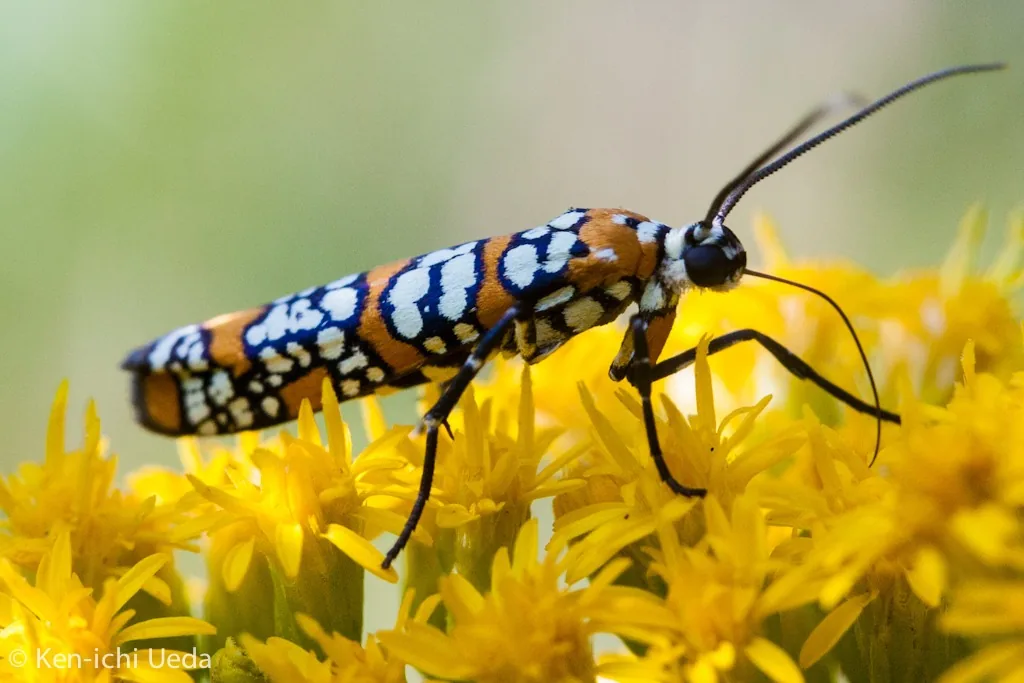
- Adults are about 1/2 inch long, yellow-orange crossed by four blue-black bands with conspicuous white spots, and hold the wings curled tightly along the body. Wingspan is given as 1/2 to 1 1/4 inches by MDC and 0.7 to 1.2 inches by Ohio DNR.[1][2][3]
- Up close, the mouthparts curve upward, some head scales form a tuft, and the threadlike antennae point forward rather than back along the wings. At rest the moth looks a lot like a beetle.[2][3]
- Caterpillars are slender, brown to nearly black, sometimes with four white dots on top of each segment, thin white and olive-green stripes along the sides, and a noticeably lighter head. MDC notes sparse, straight hairs.[1][2]
- All life stages (eggs, caterpillars, pupae and adults) can be found together in one loose web.[2][1]
Look-alikes
| Look-alike | How to tell them apart |
|---|---|
| Fall webworm | Other caterpillars also live in webs or tents, but the host (usually ailanthus) and mixed life stages in one web point to this species.[2] |
| Other wing-curling moths | Several small moths rest with their wings curled around the body, but MDC says this is Missouri's only one with orange wings marked by black-ringed white spots.[2] |
Where it lives
Its original home runs from southern Florida south to about Costa Rica, where native paradise trees grow. It followed the invasive tree-of-heaven north and now recolonizes northern states every year: MDC reports it statewide in Missouri, Ohio DNR lists it in forests, woodlands and urban and suburban areas, and a citizen-science survey recorded it in Brooklyn, New York.[2][1][3][4]
Biology and life cycle
Adults fly by day and visit many flowers, and they also come to lights at night.[1][2][3]
Moths mate in the morning, and females lay eggs in the webbing, usually in the evening. Caterpillars stay in the web by day, leave it to feed at night, and pupate in the web.[1]
An individual can go from egg to egg-laying adult within four weeks, and a web community can continue all summer.[2]
No life stage survives cold winters, so northern populations are wiped out when it freezes. In Missouri the moths arrive in early April and stay until freezing weather in November.[2]
Its host trees are tree-of-heaven and, in the tropics, paradise trees (Simarouba). It occasionally uses other trees, and MDC mentions sumacs.[1][2][3]
Damage and signs
- Caterpillars tie leaves loosely together with silk and feed inside; by midsummer the webs can be large and messy. Ohio DNR says they are rarely numerous enough to cause significant defoliation.[1][3]
- Since its main North American host is an invasive tree, MDC finds it hard to call a pest, though it may be one on other hosts such as avocado where those grow.[2]
- Adults are considered good pollinators because they visit many kinds of flowers by day.[1]
Health risk
None of the sources describe any risk to people or pets. The bright orange and black coloring likely warns predators that the moth may be distasteful, and Ohio DNR suggests it mimics foul-tasting beetles.[2][3]
Control
Prevention
Control is rarely needed. The caterpillars seldom defoliate trees, and their main host is itself an invasive weed tree.[3][2]
The lasting fix is removing tree-of-heaven, which Penn State lists as an invasive tree and noxious weed in Pennsylvania. Cutting or mowing alone backfires, because the tree answers with stump sprouts and root suckers; when a tree must come down, Penn State recommends treating it with herbicide first and cutting about 30 days later.[5]
Pesticides
If treatment is wanted, NC State says it has not been reported resistant to insecticides and most landscape-labeled insecticides should control it.[1]
Native or invasive?
It depends on how you count. MDC calls it native to North America but hard to call native to Missouri, since it probably wouldn't occur there without the introduced tree-of-heaven.[2]
A 2018 citizen-science DNA barcoding survey in Brooklyn classified it as invasive, the only invasive animal among the species it identified.[4]
Tree-of-heaven itself came from China and Taiwan and was first brought to the United States in the Philadelphia area in the late 1700s.[5]
Name changes
It was once lumped with Atteva punctella; MDC says that name now belongs to a separate rainforest species.[2]
Older references put it in the ermine moth family, Yponomeutidae, as Ohio DNR's field guide still does. A DNA-based study of the group treated the tropical ermine moths as their own family, Attevidae.[2][3][6]
Common questions
- What is the bright orange moth with white spots on my flowers?
- Likely an ailanthus webworm moth, a day-flying moth that drinks nectar from many flowers.[1][2]
- What are the webs on my tree-of-heaven?
- Ailanthus webworm caterpillars live together in flimsy webs on its leaves, often with eggs, pupae and adults in the same web.[1][2]
- Is it native?
- It is native to southern Florida and tropical America and spreads north each year on invasive tree-of-heaven, so sources describe it as either native or invasive outside that range.[2][4]
- Should I spray it?
- Usually not. It rarely defoliates trees, and its main host is an invasive tree; NC State says landscape insecticides work if treatment is really needed.[3][2][1]
Sources
- NC State Extension, “Ailanthus Webworm (PDIC Factsheet).” content.ces.ncsu.edu/ailanthus-webworm (accessed 2026-11-11)
- Missouri Department of Conservation, “Ailanthus Webworm Moth (Field Guide).” mdc.mo.gov/discover-nature/field-guide/ailanthus-webworm-moth (accessed 2026-11-11)
- Ohio Department of Natural Resources, Division of Wildlife, “Moths of Ohio Field Guide (Publication 5467).” dam.assets.ohio.gov/image/upload/ohiodnr.gov/documents/wildlife/backyard-wildlife/Moths%20of%20Ohio%20Field%20Guide%20pub5467.pdf (accessed 2026-11-11)
- PLoS One, via PubMed, “DNA barcoding Brooklyn (New York): A first assessment of biodiversity in Marine Park by citizen scientists (Marizzi et al. 2018).” pubmed.ncbi.nlm.nih.gov/30020927/ (accessed 2026-11-11)
- Penn State Extension, “Tree-of-Heaven.” extension.psu.edu/tree-of-heaven (accessed 2026-11-11)
- PLoS One, via PubMed, “A molecular phylogeny for Yponomeutoidea (Insecta, Lepidoptera, Ditrysia) and its implications for classification, biogeography and the evolution of host plant use (Sohn et al. 2013).” pubmed.ncbi.nlm.nih.gov/23383061/ (accessed 2026-11-11)
- iNaturalist, “Atteva aurea taxon page (order and family).” www.inaturalist.org/taxa/116681 (accessed 2026-10-06)