On this page
How to identify it
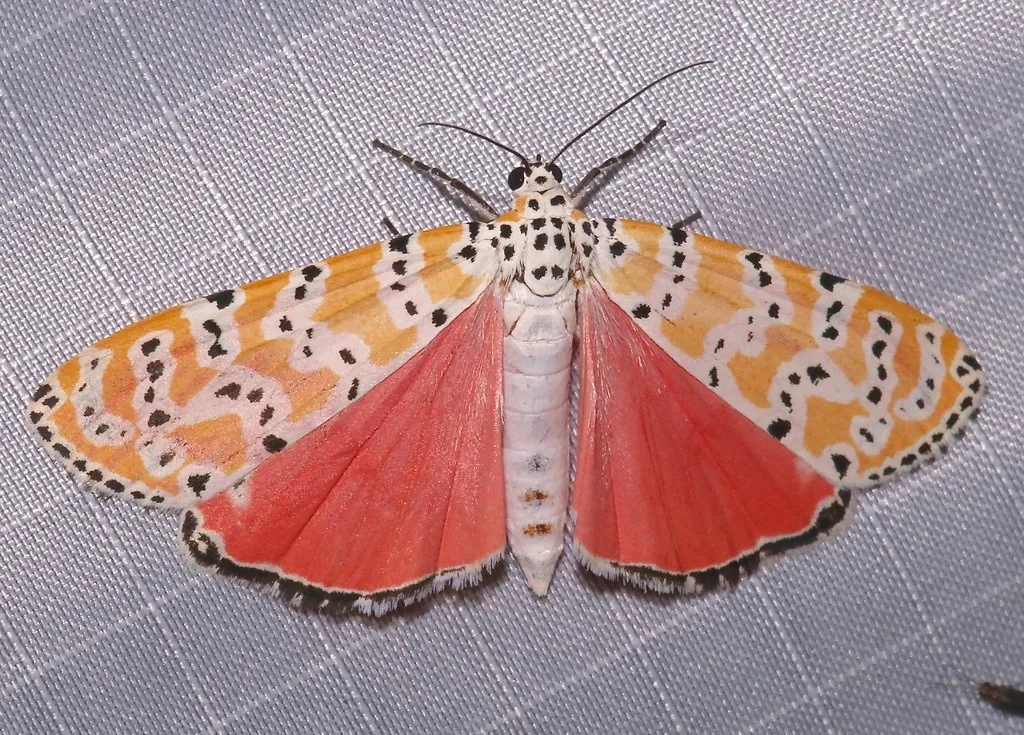
- Forewings are pink, orange, yellow or red (sometimes white) with about six irregular rows of black dots ringed in white. Hindwings are pink with an uneven black edge, so a flying moth looks like a fluttering pink spot.[1][2]
- Wingspan is about 1 1/2 inches: 3 to 4.4 cm in Butterflies and Moths of North America, 1 1/2 to 1 3/4 inches in Missouri's field guide. Color varies from moth to moth and region to region, and the sexes look alike. UF/IFAS gives a wingspan of 3.0 to 4.5 cm (1.2 to 1.8 inches). It says the common, brightly colored 'bella' form has yellow forewings with white bands, each holding a row of black dots, while a paler 'ornatrix' form is restricted to southern Florida and southern Texas.[2][1][10]
- Caterpillars are yellowish-rust with an irregular black band around the middle of each segment and white marks in the creases. Unlike woolly bears they are not furry: each black tubercle carries a single long, barbed hair. UF/IFAS says full-grown caterpillars are 30 to 35 mm (1.2 to 1.4 inches) long and orange-brown, with distinct white spots along the front and rear edges of the black bands. Unlike most tiger moth caterpillars they have no wart-like bumps, and their hairs grow singly.[1][10]
- Eggs are white to yellow and round. Pupae are black with irregular orange-brown bands, wrapped in a loose layer of silk.[10]
Look-alikes
| Look-alike | How to tell them apart |
|---|---|
| Ailanthus webworm moth | Orange forewings with white spots outlined in black, but it rolls its wings into a narrow tube, the hindwings are clear, and it is smaller, with a wingspan of 1/2 to 1 1/4 inches. In Missouri it is more commonly seen than the bella moth.[1] |
Where it lives
Butterflies and Moths of North America gives Nova Scotia to Florida, west to Minnesota, Kansas and Texas; Missouri adds that it reaches south into Central America and occurs statewide there. It is the only Utetheisa north of Mexico. UF/IFAS gives Connecticut west to southeastern Nebraska and south to New Mexico, southeastern Arizona and Florida, continuing through Mexico, Central America and South America to Argentina and through most of the Antilles. In the U.S. it is more common in the south.[2][1][10]
Biology and life cycle
Unlike most moths it flies by day, though it also comes to lights. Adults visit flowers, especially goldenrods, from mid to late summer into fall.[1][2]
It breeds year-round in Florida and other southern states. Farther north multiple broods are possible; Missouri sees adults from July until late November.[1][2]
The main caterpillar food is rattlebox (Crotalaria), a pea-family plant with toxic alkaloids. Young caterpillars eat leaves, then bore into the seed pods to eat the seeds, which carry more alkaloid. Lespedeza, lupines, elm, Prunus and sweetgale are also recorded hosts. UF/IFAS says rattlebox is the major if not the only true host; other host records may come from full-grown caterpillars wandering onto other plants before they pupate. Mature caterpillars leave the plant to pupate under loose bark on nearby trees, in thick vegetation or in debris. Immature rattlebox seeds hold about five times as much alkaloid as the leaves.[1][2][10]
The stored pyrrolizidine alkaloids protect the moth. Males pass alkaloid to the female at mating, and both parents' alkaloid goes into the eggs. In lab tests, alkaloid-laden eggs were rejected by ants and lacewing larvae and resisted a parasitic wasp, and spiders refused females that had received alkaloid at mating.[3][8][4][6][5]
Females mate with several males and favor those that smell most strongly of a courtship pheromone made from the alkaloid. Eggs are laid in clusters averaging about 20 eggs.[1][3][4]
At night the moth makes ultrasonic clicks. Bats in a lab study learned to avoid sound-producing tiger moths only when the sound came with bad-tasting chemistry, so the clicks act as a warning.[7]
UF/IFAS says adults gather in rattlebox patches. Males become active about 1 to 1½ hours after sunset and follow the female's pulsed scent. Adults live about three weeks, and females mate on average four to five times and as many as 13 times, getting nutrients and alkaloids from each male.[10]
The alkaloids don't stop every enemy. UF/IFAS reports eggs parasitized by a Telenomus wasp and six parasitoid species reared from pupae, with overall pupal parasitism of 20%. Caterpillars also eat eggs and pupae of their own kind when they get the chance, and American toads ate adults that blue jays and several spiders rejected.[10]
Damage and signs
Health risk
None of the sources reports harm to people. The alkaloids the moth stores are a defense against its predators, and few insect-eaters will eat it.[1][3]
Control
Prevention
No control is needed for this harmless moth, whose caterpillars feed on rattlebox.[1][2]
Where sources disagree
Wingspan: Butterflies and Moths of North America gives 3 to 4.4 cm (about 1 1/4 to 1 3/4 inches); Missouri gives 1 1/2 to 1 3/4 inches.[2][1]
Range: Butterflies and Moths of North America describes Nova Scotia to Florida and west to Minnesota, Kansas and Texas. Missouri describes the eastern and midwestern United States south into Central America.[2][1]
Wingspan: UF/IFAS gives 3.0 to 4.5 cm (1.2 to 1.8 inches), a little wider at the top end than the 3 to 4.4 cm in Butterflies and Moths of North America.[10][2]
Northern range: UF/IFAS gives Connecticut west to southeastern Nebraska; Butterflies and Moths of North America extends it to Nova Scotia and Minnesota.[10][2]
Common questions
- What is the bright pink and orange moth flying in the daytime?
- Likely an ornate bella moth. It is the only moth in eastern North America with pink-and-yellow forewings marked with rows of white-ringed black spots, and it flies by day.[2][1]
- Is the bella moth poisonous?
- To predators, yes. It stores alkaloids from rattlebox plants, and in lab tests spiders, ants and other predators rejected alkaloid-laden moths and eggs. None of the sources reports harm to people.[3][5][8][1]
- Where do bella moth caterpillars pupate?
- Usually off the food plant. UF/IFAS says full-grown caterpillars leave rattlebox and pupate under loose bark on nearby trees, in thick vegetation or in debris.[10]
Sources
- Missouri Department of Conservation, “Ornate Bella Moth (Field Guide).” mdc.mo.gov/discover-nature/field-guide/ornate-bella-moth (accessed 2026-11-11)
- Butterflies and Moths of North America (BAMONA), “Bella Moth, Utetheisa ornatrix (species account).” www.butterfliesandmoths.org/species/Utetheisa-ornatrix (accessed 2026-11-11)
- Proceedings of the National Academy of Sciences, via PubMed, “Biparental defensive endowment of eggs with acquired plant alkaloid in the moth Utetheisa ornatrix (Dussourd et al. 1988).” pubmed.ncbi.nlm.nih.gov/3413071/ (accessed 2026-11-11)
- Proceedings of the National Academy of Sciences, via PubMed, “Chemical defense against predation in an insect egg (Eisner et al. 2000).” pubmed.ncbi.nlm.nih.gov/10677511/ (accessed 2026-11-11)
- Proceedings of the National Academy of Sciences, via PubMed, “Sexually transmitted chemical defense in a moth (Utetheisa ornatrix) (Gonzalez et al. 1999).” pubmed.ncbi.nlm.nih.gov/10318925/ (accessed 2026-11-11)
- Proceedings of the National Academy of Sciences, via PubMed, “Plant-derived pyrrolizidine alkaloid protects eggs of a moth (Utetheisa ornatrix) against a parasitoid wasp (Bezzerides et al. 2004).” pubmed.ncbi.nlm.nih.gov/15173598/ (accessed 2026-11-11)
- Naturwissenschaften, via PubMed, “Sound strategy: acoustic aposematism in the bat-tiger moth arms race (Hristov and Conner 2005).” pubmed.ncbi.nlm.nih.gov/15772807/ (accessed 2026-11-11)
- Oecologia, via PubMed, “Pyrrolizidine alkaloid deters ant predators of Utetheisa ornatrix eggs (Hare and Eisner 1993).” pubmed.ncbi.nlm.nih.gov/28313747/ (accessed 2026-11-11)
- iNaturalist, “Utetheisa ornatrix taxon page (order and family).” www.inaturalist.org/taxa/67440 (accessed 2026-11-11)
- University of Florida IFAS Extension, EDIS (Featured Creatures), “Ornate Bella Moth, Rattlebox Moths, Utetheisa ornatrix (Linnaeus), EENY358/IN644 (Featured Creatures).” ask.ifas.ufl.edu/publication/IN644 (accessed 2026-11-14)