On this page
How to identify it
- Wingspan is about 1 to 1 1/4 inches (MDC), or 2.5 to 3.2 cm (BAMONA).[1][2]
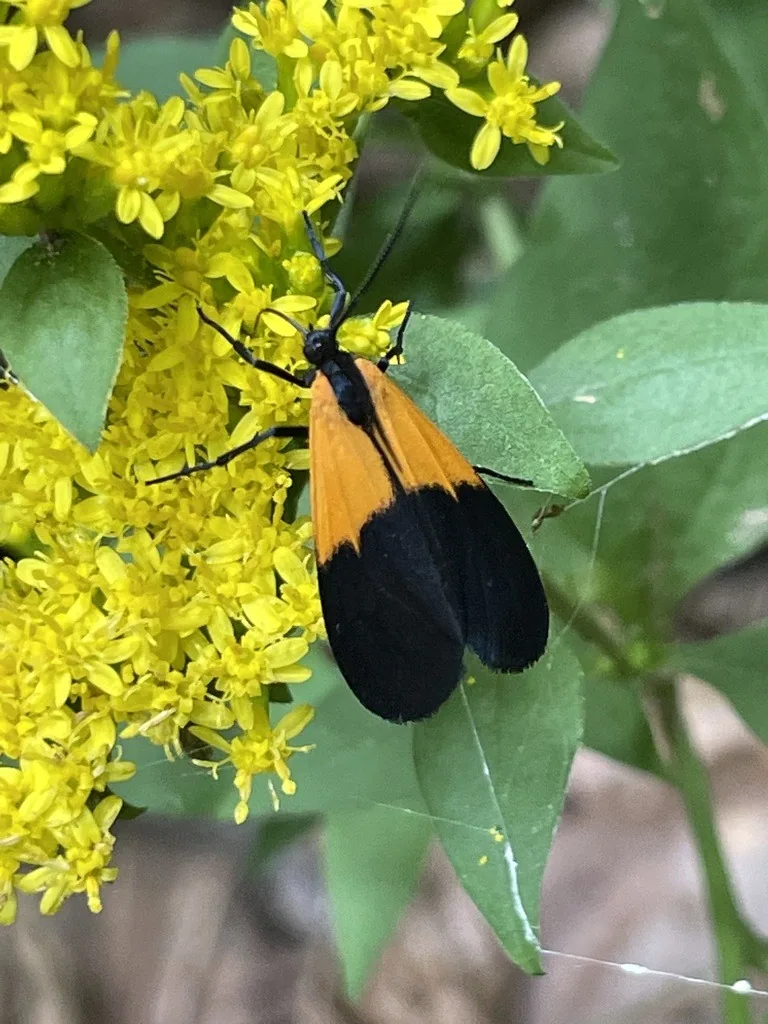
- The body and wings are black with a bluish sheen. The base of each wing is bright yellow, orange or red, and the outer part is black.[1][2]
- The caterpillars have sparse hairs and are camouflaged to look like the lichens they eat.[1]
Look-alikes
| Look-alike | How to tell them apart |
|---|---|
| Orange-patched smoky moth | Its wings are black and see-through except for an orange patch on the base of the forewing, and it is a little smaller (wingspan 1.8 to 2.8 cm). It flies earlier, from May to July, and its caterpillars have been reported on the undersides of fallen oak leaves rather than on lichens.[3][2] |
Where it lives
BAMONA gives its range as Nova Scotia to North Carolina, west to South Dakota and Texas, and MDC says it is found statewide in Missouri. GBIF has about 3,400 U.S. records since 1990, most from Texas, followed by New York, Virginia, Vermont, Maine and Colorado, with records also from New Mexico, Montana and Wyoming, west of BAMONA's stated range, plus about 750 from Canada and 2 from Mexico.[2][1][4][5]
Biology and life cycle
Adults fly from July through September, usually in more than one generation, and unlike most moths they fly during the day. They drink nectar from goldenrod, fleabane, sunflowers and other composites.[1][2]
It spends the winter as a nearly full-grown caterpillar. The hairy cocoons are attached to objects near the lichens the caterpillar fed on.[1]
MDC offers two possible reasons for the bright colors: they may mimic the warning colors of toxic beetles that birds learn to avoid, or the caterpillars may take up distasteful compounds from the lichens they eat.[1]
Damage and signs
Health risk
MDC describes it as neither a nuisance nor a beneficial insect for economic purposes, and neither MDC nor BAMONA lists any risk to people or pets.[1][2]
Control
Prevention
No control is needed. MDC calls it a strikingly attractive part of Missouri's natural wealth; leave it alone.[1]
Common questions
Sources
- Missouri Department of Conservation, “Black-and-Yellow Lichen Moth (Field Guide).” mdc.mo.gov/discover-nature/field-guide/black-yellow-lichen-moth (accessed 2026-11-11)
- Butterflies and Moths of North America (BAMONA), “Black-and-yellow Lichen Moth, Lycomorpha pholus (species page).” www.butterfliesandmoths.org/species/Lycomorpha-pholus (accessed 2026-11-11)
- Butterflies and Moths of North America (BAMONA), “Orange-patched Smoky Moth, Pyromorpha dimidiata (species page).” www.butterfliesandmoths.org/species/Pyromorpha-dimidiata (accessed 2026-11-11)
- Global Biodiversity Information Facility (GBIF), “Lycomorpha pholus: U.S. occurrence records since 1990 by state (GBIF occurrence search).” api.gbif.org/v1/occurrence/search?taxonKey=1804512&country=US&hasGeospatialIssue=false&occurrenceStatus=PRESENT&year=1990%2C2026&facet=stateProvince&facetLimit=400&limit=0 (accessed 2026-11-11). Exact count at access: 3,379 U.S. records since 1990 (Texas 895; New York 259; Virginia 201; Vermont 187; Maine 183; Colorado 175; Pennsylvania 130).
- Global Biodiversity Information Facility (GBIF), “Lycomorpha pholus: occurrence records since 1990 by country (GBIF occurrence search).” api.gbif.org/v1/occurrence/search?taxonKey=1804512&hasGeospatialIssue=false&occurrenceStatus=PRESENT&year=1990%2C2026&facet=country&limit=0 (accessed 2026-11-11). Exact counts at access: 4,133 records since 1990; United States 3,379, Canada 747, Mexico 2.
- iNaturalist, “Lycomorpha pholus taxon page (order and family).” www.inaturalist.org/taxa/128950 (accessed 2026-10-06)