On this page
How to identify it
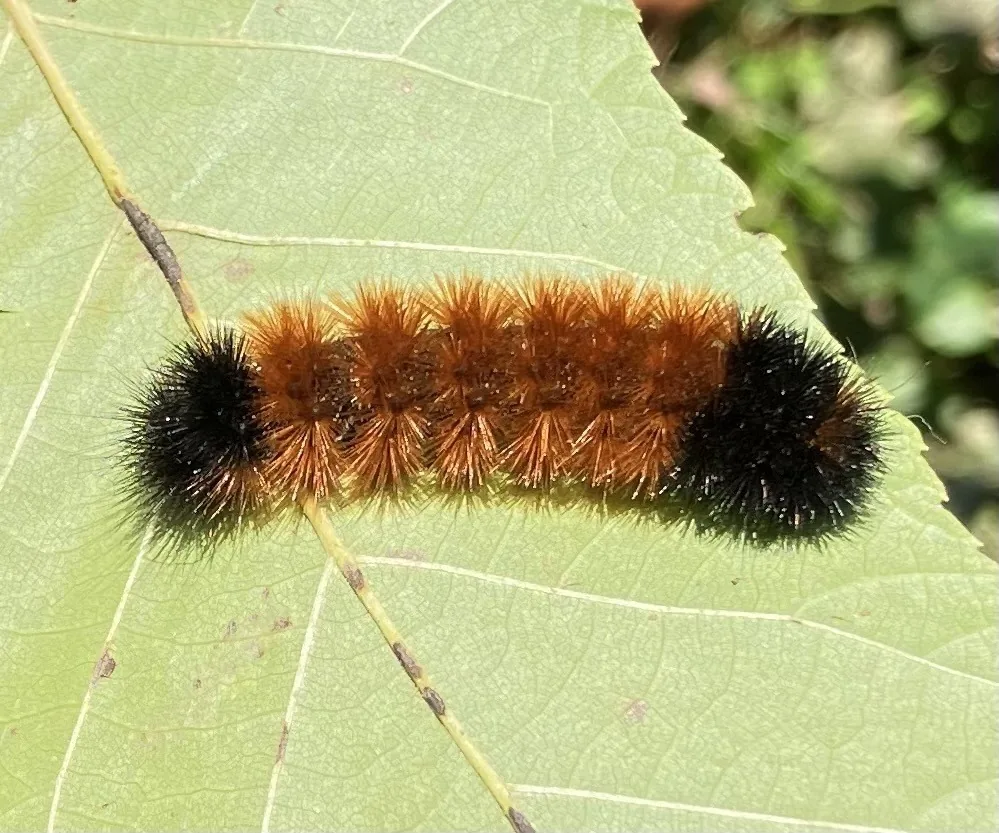
- Mature caterpillars are a little over an inch long and covered with dense, stiff hairs: rusty red in the middle and black at both ends. Disturbed caterpillars often roll into a ball.[1][2]
- As caterpillars grow, black hairs are replaced with orange ones, so the rusty band tends to be widest in older woolly bears.[1][2]
- Isabella tiger moths have yellowish tan, pointed forewings with small dark spots and a wingspan of 1-3/4 to 2-1/4 inches. Female hind wings are colored: pink according to NC State, orange according to Missouri.[1][2]
Look-alikes
| Look-alike | How to tell them apart |
|---|---|
| Giant woolly bear | The giant woolly bear, the larva of the giant leopard moth (Hypercompe scribonia), is black with red bands between the segments and tufts of stiff black bristles, and grows to about 3 inches, far bigger than the banded woolly bear. UF/IFAS gives about 75 mm (about 3 inches) for full-grown giant woolly bears, black with red spiracles and red bands between the segments under shiny black bristles. When threatened they curl up tightly, showing the bright red bands as a warning. The adult giant leopard moth is white with hollow or solid black spots and a wingspan of about 2.25 to 3.6 inches.[3][1][4] |
Where it lives
NC State Extension covers it in North Carolina, and the Missouri Department of Conservation lists it statewide in Missouri, where its caterpillars eat so many kinds of plants that the moth could turn up almost anywhere plants grow.[1][2]
Biology and life cycle
In fall, caterpillars look for shelter under bark, leaf litter or logs. They overwinter as caterpillars, or in some cases as pupae in flimsy cocoons; in spring overwintered caterpillars feed again, then pupate in cocoons made from their hairs.[1][2]
They are freeze tolerant. In a lab study, caterpillars frozen at -3°C to -10°C were moving within minutes of thawing, glycerol in their blood limited ice formation, and many went on to become moths.[5]
After 18 weeks of cold acclimation, caterpillars survived a week of continuous freezing at -20°C or seven freeze-thaw cycles, but none survived freezing at -80°C.[6]
Caterpillars overwintering above the snow stayed colder than those under it and burned less of their fat reserve, mainly because freezing slows their metabolism.[7]
Moths lay eggs, often in batches of 100 or more, on weeds, trees and grasses. There are one or two generations a year in North Carolina and two broods in Missouri, where adults fly from early April through September.[1][2]
UF/IFAS notes that tiger moth caterpillars, the group woolly bears belong to, lack stinging spines and do not bite; their stiff hairs are their defense.[4]
UF/IFAS says many tiger moth caterpillars feed briefly on one plant and then move to another, often of a different species, which makes it likely they eat plants with toxic chemicals that they may store for their own defense.[4]
Damage and signs
Health risk
NC State Extension calls woolly bears virtually harmless to people, though caterpillar hairs in general can irritate skin. Swallowing one is different: in two published cases, infants who put a banded woolly bear in their mouth had hairs embedded in the mouth and throat. An 8-month-old developed airway swelling that needed urgent treatment in the operating room and intensive care; a 19-month-old was observed in hospital with steroids and recovered without the hairs being removed.[1][8][9]
Control
Prevention
No control is needed: they're virtually harmless, feed on weeds and are mostly seen in fall after they've finished feeding, so spraying makes no sense.[1]
Traps and physical control
If one wanders indoors, move it outside. Some people react to caterpillar hairs, so Missouri advises not touching fuzzy caterpillars with bare skin if you're unsure of the species or your own sensitivity.[1][3][2]
What the bands really mean
Folklore says a wide rusty band means a mild winter and wide black bands a harsh one. Band widths actually depend on several factors: wetter-than-average weather tends to produce longer black bands, older caterpillars have longer rusty bands, and genetics plays a part.[1][2]
Woolly bears star in fall festivals, including the Woollybear Festival in Vermilion, Ohio, and the Woolly Worm Festival in Banner Elk, North Carolina.[1][2]
Where sources disagree
Cold limits: NC State says woolly bears can survive temperatures as low as -90°F. In a lab study, caterpillars acclimated to cold survived freezing at -20°C, but none survived -80°C.[1][6]
Overwintering stage: NC State says they overwinter as caterpillars or as pupae; Missouri says they overwinter as full-grown caterpillars.[1][2]
Common questions
- Can a woolly bear predict the winter?
- That's folklore. Band width reflects the caterpillar's age, recent wet weather and genetics, not the coming winter.[2][1]
- Are woolly bear caterpillars poisonous or harmful?
- Not to touch for most people, though some get a rash from caterpillar hairs. Swallowing is the real risk: in two reported cases, infants who put one in their mouth needed hospital care for hairs stuck in the mouth and throat.[1][2][8][9]
- Is the big black woolly bear with red bands the same caterpillar?
- No. That's the giant woolly bear, the larva of the giant leopard moth (Hypercompe scribonia). UF/IFAS says full-grown ones reach about 75 mm (about 3 inches), are black with red bands between the segments, and range from southern Ontario south to Florida and west to Minnesota and Texas.[4]
Sources
- NC State Extension, “Banded Woollybear / Isabella Moth (PDIC Factsheet, reviewed October 3, 2026).” content.ces.ncsu.edu/banded-woollybear (accessed 2026-11-14)
- Missouri Department of Conservation, “Isabella Tiger Moth (Woolly Bear; Woolly Worm), Field Guide.” mdc.mo.gov/discover-nature/field-guide/isabella-tiger-moth-woolly-bear-woolly-worm (accessed 2026-11-14)
- Missouri Department of Conservation, “Giant Leopard Moth, Field Guide.” mdc.mo.gov/discover-nature/field-guide/giant-leopard-moth (accessed 2026-11-14)
- University of Florida/IFAS Extension (Featured Creatures), “Giant Woolly Bear (larva), Giant or Great Leopard Moth (adult), Hypercompe scribonia (Stoll 1790), EENY599/IN1043 (Featured Creatures).” ask.ifas.ufl.edu/publication/IN1043 (accessed 2026-11-14)
- Journal of Insect Physiology, via PubMed, “Effect of freeze temperature on ice formation and long-term survival of the woolly bear caterpillar (Layne and Blakeley 2002).” pubmed.ncbi.nlm.nih.gov/12770036/ (accessed 2026-11-14)
- Journal of Experimental Biology, via PubMed, “Cold-hardening during long-term acclimation in a freeze-tolerant woolly bear caterpillar, Pyrrharctia isabella (Yi and Lee 2016).” pubmed.ncbi.nlm.nih.gov/26643089/ (accessed 2026-11-14)
- Naturwissenschaften, via PubMed, “Threshold temperatures mediate the impact of reduced snow cover on overwintering freeze-tolerant caterpillars (Marshall and Sinclair 2012).” pubmed.ncbi.nlm.nih.gov/22139093/ (accessed 2026-11-14)
- Wilderness and Environmental Medicine, via PubMed, “A Nonsurgical Approach to Management of Lepidopterism due to Woolly Bear Caterpillar Ingestion (Halmo et al. 2023).” pubmed.ncbi.nlm.nih.gov/36868886/ (accessed 2026-11-14)
- Journal of Emergency Medicine, via PubMed, “Oropharyngeal Edema in an 8-Month-Old Girl after Woolly Bear Caterpillar Exposure (MacKinnon et al. 2015).” pubmed.ncbi.nlm.nih.gov/26281804/ (accessed 2026-11-14)
- iNaturalist, “Pyrrharctia isabella taxon page (order and family).” www.inaturalist.org/taxa/59675 (accessed 2026-11-14)