On this page
How to identify it
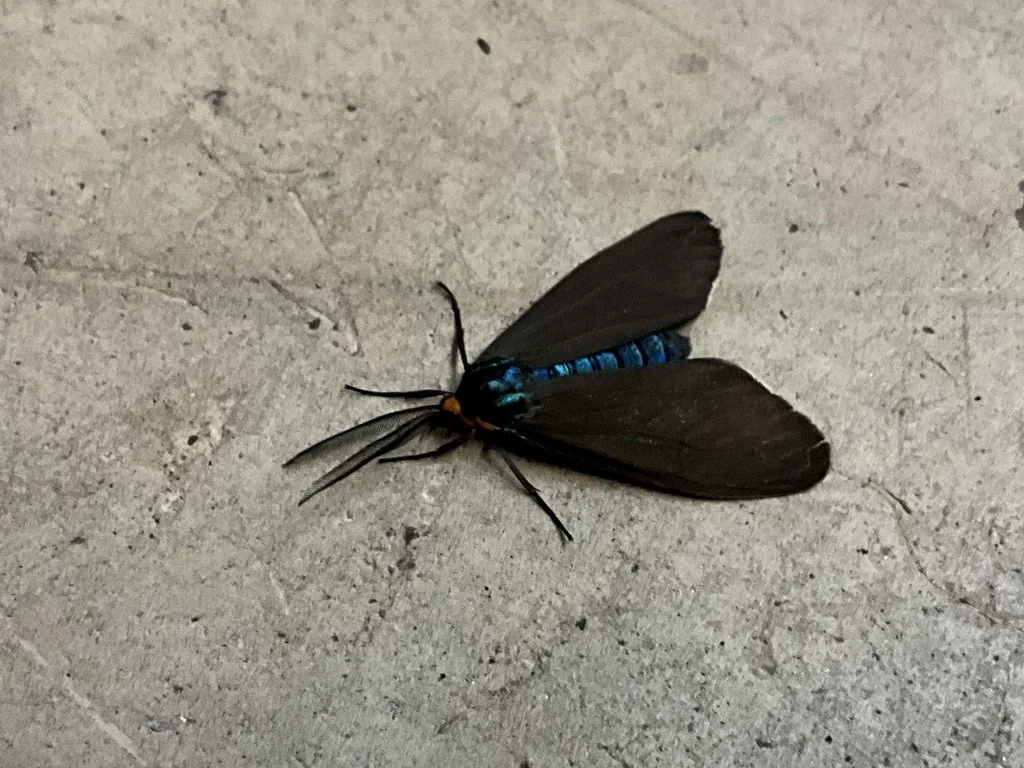
- A large wasp moth, the biggest in Ohio, with a wingspan of about 1.6 to 2 inches. The overall look is metallic blue-black, almost tropical.[1]
- The bluish metallic thorax stays visible even when the wings are folded, which separates it from similar wasp-mimic moths.[1]
- In flight it flutters like a butterfly, then ducks under a leaf and folds its wings when alarmed.[5][6]
- BAMONA calls it the largest and most broad-winged wasp moth in North America. The body is metallic blue and the head and sides of the collar are orange; the forewing is deep grayish brown with metallic blue at the base, the hindwing black, and the wing fringes are partly white.[3]
Look-alikes
| Look-alike | How to tell them apart |
|---|---|
| Yellow-collared scape moth (Cisseps fulvicollis) | A smaller wasp moth that the Ohio guide lists right after the ctenucha. The University of Alberta museum says it is the only other species with an orange collar and metallic blue abdomen, but it has much narrower wings and is smaller; the ctenucha also shows a metallic blue thorax at rest.[1][2] |
Where it lives
A northern species. BAMONA gives its range as Labrador to Pennsylvania, west to Manitoba and Kansas, and most GBIF records come from Canada (above all Ontario and Quebec) and the northern United States, such as Vermont, Michigan, Wisconsin and New York; despite the name, Virginia has few records. The University of Alberta museum says it has apparently spread westward in the last fifty years, since a 1951 survey of Alberta did not record it. It lives in weedy fields, wet meadows and other grassland where adults visit flowers.[3][4][5][1][2]
Biology and life cycle
Adults fly by day in the first half of summer and feed at flowers, particularly goldenrods.[1][5]
Caterpillars feed mainly on grasses, and also on sedges and iris.[1][5][2]
The species overwinters as a caterpillar. Larvae are active early in the year and are seen walking on warm roads in late winter and early spring.[5][6]
Some Ctenucha species mimic wasps or distasteful beetles, which may help them go unbothered on flowers.[5]
BAMONA gives the adult flight period as May to July.[3]
Fun fact: the adults follow their noses to certain plants. A New York State Agricultural Experiment Station study found Virginia ctenuchas are drawn to plants containing defensive chemicals called pyrrolizidine alkaloids, such as spotted Joe-Pye weed, locating them by smell and feeding on the leaves, flowers and roots with their tongue; traps baited with chemicals made from those alkaloids caught them.[7]
Damage and signs
Health risk
None of the sources (Ohio DNR, the University of Wisconsin-Milwaukee, BAMONA, the University of Alberta museum) describes stings, bites or other effects on people; its wasp look is mimicry.[1][5][3][2]
Control
Prevention
No control is needed. The sources describe it as a showy native moth of weedy fields and wet meadows, not a pest.[1][5]
Where sources disagree
Lights: the Ohio DNR says adults rarely come to lights, while the University of Wisconsin-Milwaukee field station says they will also come to porch lights at night.[1][5]
Common questions
- What is the black moth with a shiny blue body on my goldenrod?
- Very likely a Virginia ctenucha. It flies by day and keeps its metallic blue thorax visible even with the wings folded.[1]
- Why are caterpillars crawling around in winter?
- Virginia ctenucha caterpillars overwinter and are often seen walking on warm days in late winter and early spring.[5][6]
- Is it a wasp? Can it sting?
- No. It is a moth that mimics wasps; the Ohio DNR calls it the largest wasp moth in Ohio, and none of the sources reports stings or bites.[1][5]
- What does the Virginia ctenucha look for on plants?
- Besides nectar flowers such as goldenrod, adults seek out plants with pyrrolizidine alkaloids, like spotted Joe-Pye weed, finding them by smell.[1][7]
Sources
- Ohio Department of Natural Resources, Division of Wildlife, “Moths of Ohio Field Guide (Publication 5467).” dam.assets.ohio.gov/image/upload/ohiodnr.gov/documents/wildlife/backyard-wildlife/Moths%20of%20Ohio%20Field%20Guide%20pub5467.pdf (accessed 2026-11-12)
- University of Alberta, E.H. Strickland Entomological Museum, “Species Details: Ctenucha virginica.” search.museums.ualberta.ca/g/2-259 (accessed 2026-11-12)
- Butterflies and Moths of North America (BAMONA), “Virginia Ctenucha Ctenucha virginica (Esper, [1794]).” www.butterfliesandmoths.org/species/Ctenucha-virginica (accessed 2026-11-12)
- Global Biodiversity Information Facility (GBIF), “Ctenucha virginica (Esper, 1794): occurrence records.” www.gbif.org/species/1814843 (accessed 2026-11-12)
- University of Wisconsin-Milwaukee Field Station, “It's National Moth Week (soon), Bug of the Week (K. Redmond, 'the BugLady').” uwm.edu/field-station/bug-of-the-week/its-national-moth-week-soon/ (accessed 2026-11-12). University field station's natural-history column
- University of Wisconsin-Milwaukee Field Station, “Summer Sights - and Sounds, Bug of the Week (K. Redmond, 'the BugLady').” uwm.edu/field-station/bug-of-the-week/summer-sights-and-sounds/ (accessed 2026-11-12). University field station's natural-history column
- J Chem Ecol 1989;15(1), via PubMed, “Dihydropyrrolizine attractants for arctiid moths that visit plants containing pyrrolizidine alkaloids.” pubmed.ncbi.nlm.nih.gov/24271426/ (accessed 2026-11-12)
- iNaturalist, “Ctenucha virginica taxon page (order and family).” www.inaturalist.org/taxa/119013 (accessed 2026-11-12)