On this page
How to identify it
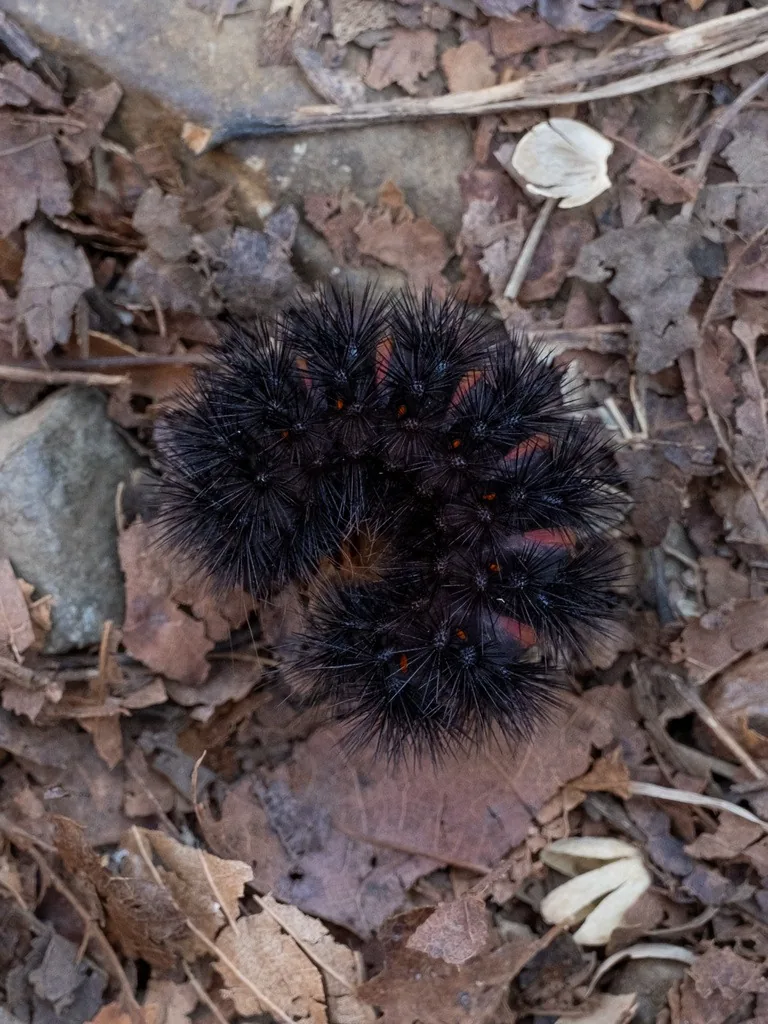
- Full-grown caterpillars reach 3 inches long. They are black, with tufts of stiff black bristles growing from brownish bumps on each segment. UF/IFAS gives about 75 mm (about 3 inches) for full-grown caterpillars, with red spiracles and red between the segments, covered with shiny black bristles.[1][2]
- Red sections show between the segments, and the small breathing holes along the sides are orange or red.[1]
- The moth is white, with many black spots on the forewings, most with hollow white centers; some markings look iridescent blue in the light. The wingspan is 2 1/4 to 3 1/2 inches, and females are larger than males. UF/IFAS says the spots vary: in some moths they are solid instead of hollow, and rarely they are missing entirely.[1][3][2]
- The moth's abdomen, usually hidden under the wings, has lines of iridescent blue, orange and black. Worn moths lose scales and the outer wings turn see-through.[1][3]
- Young caterpillars look different: the head, thorax and abdominal segments 4, 5, 9 and 10 are orange, segments 1–3 and 6–8 are dark brown, and orange lines run along the back and sides. Their spiracles are yellow.[2]
- Eggs are nearly round, 0.8 mm across and pearly gray. Pupae are black with reddish brown spiracles, inside thin yellow net-like cocoons with small amber beads where the threads meet.[2]
Look-alikes
| Look-alike | How to tell them apart |
|---|---|
| Banded woolly bear | The familiar banded woolly bear, the Isabella tiger moth caterpillar, is black on the ends with a rusty red or brownish middle. The giant woolly bear is black all over apart from red between the segments, and at 3 inches it is the largest woolly bear in Missouri.[4][1] |
Where it lives
Massachusetts and southern Ontario south to Florida and west to Michigan, Missouri and Texas, according to Butterflies and Moths of North America; Missouri reports it statewide. GBIF's US records since 1990 come mostly from the East and South, with the most from Texas, Pennsylvania and Florida.[3][1][5]
Biology and life cycle
It spends the winter as a full-grown caterpillar. In early spring people sometimes find hibernating caterpillars by peeling bark off dead trees and logs.[1][6]
Caterpillars feed on a wide variety of plants, including maples, dandelions, sunflowers, cabbage, cherries, willows and violets, and in southern states orange and banana leaves. UF/IFAS's list of recorded hosts also includes cabbage, lemon, sweet orange, avocado, magnolia, plantain, American pokeweed, black locust and Tatarian honeysuckle, and it expects the caterpillars feed on many more. Like other tiger moth caterpillars they probably feed briefly on one plant, then move to another.[1][3][2]
Missouri reports adults from early May through September, with several broods a year; Butterflies and Moths of North America gives a flight period of April to September.[1][3]
Most giant leopard moths people see are males drawn to lights at night. UF/IFAS says dozens of males sometimes come to bright lights in good habitat, while females are less common at lights.[1][2]
UF/IFAS says there is a single brood in the North and two or more in the South. Nearly full-grown caterpillars overwinter and finish developing in spring, and in northern latitudes they build up glycerol that helps them tolerate freezing.[2]
Caterpillars feed mainly at night. People often see them crossing roads in fall as they look for places to spend the winter, or find them under leaves and in woodpiles during spring and fall yard work.[2]
Damage and signs
Health risk
MedlinePlus says most caterpillars are harmless, but the hairs of some cause allergic reactions in the skin, eyes or lungs, and as a general rule brightly colored caterpillars with spines, bristles or a fuzzy look may be venomous and shouldn't be touched. If hairs get into the eyes, flush them with plenty of water and get medical help. UF/IFAS notes that tiger moth caterpillars like this one lack stinging spines and do not bite; their stiff bristles are a defense against predators.[7][2]
Control
Prevention
Don't pick it up with bare hands. MedlinePlus advises against touching caterpillars with spines, bristles or a fuzzy look, and some people react to caterpillar hairs.[7]
UF/IFAS says control measures are neither recommended nor required.[2]
Traps and physical control
If bristles get on your skin, press sticky tape over the spot and pull it off, repeating until the hairs are gone, then wash with soap and water and apply ice wrapped in a cloth.[7]
More from the research literature
A 2008 Environmental Entomology study of caterpillars collected in western Pennsylvania, where they overwinter, found that all of them survived being frozen at -3°C (about 27°F), with roughly 45% of their body water turned to ice.[6]
In the same study, freezing at -10°C (14°F) always killed the caterpillars, and only about one third of those frozen at -3°C went on to become moths. The authors say its freeze tolerance suits western Pennsylvania winters but is limited compared with tiger moth caterpillars that range farther north.[6]
Where sources disagree
Range: Butterflies and Moths of North America puts its western limit at Michigan, Missouri and Texas, but GBIF has US records since 1990 from farther west and north, including Minnesota, Nebraska, Kansas and Maine.[3][5]
Flight season: Missouri says early May through September, while Butterflies and Moths of North America says April to September.[1][3]
Range: UF/IFAS gives southern Ontario south to Florida and west to Minnesota and Texas.[2]
Defenses
When threatened, the caterpillar curls up tightly to protect its underside, and its bright red bands between segments show as a warning. Its stiff, smooth bristles bend back when it is picked up and push it out of the grip, so it is almost impossible to uncurl.[2]
Threatened moths play dead, curl the abdomen to show its bright colors and release a droplet of yellow, acrid fluid from glands on the thorax. UF/IFAS says both moths and caterpillars are probably protected by chemicals taken up from their food plants.[2]
The moths have ears just behind the bases of the hind wings, probably to detect the sonar of hunting bats.[2]
Despite these defenses, the caterpillars are frequently parasitized, particularly by tachinid flies.[2]
Common questions
- What's the big black fuzzy caterpillar?
- If it's up to 3 inches long, black with stiff black bristles and red between the segments, it's likely a giant woolly bear, the caterpillar of the giant leopard moth.[1]
- What does it become?
- A large white moth with black spots, many of them hollow, called the giant leopard moth. Its wingspan is 2 1/4 to 3 1/2 inches.[1][3]
- Is it safe to touch?
- It's best not to. MedlinePlus says most caterpillars are harmless but some cause allergic reactions, and advises against touching bristly or fuzzy ones; remove any hairs from your skin with sticky tape and wash the area.[7]
- Does the giant woolly bear sting or bite?
- UF/IFAS says tiger moth caterpillars lack stinging spines and do not bite. MedlinePlus still advises against handling bristly or fuzzy caterpillars, since some people react to the hairs.[2][7]
Sources
- Missouri Department of Conservation, “Giant Leopard Moth (Field Guide).” mdc.mo.gov/discover-nature/field-guide/giant-leopard-moth (accessed 2026-11-14)
- University of Florida/IFAS Extension (Featured Creatures), “Giant Woolly Bear (larva), Giant or Great Leopard Moth (adult), Hypercompe scribonia (Stoll 1790), EENY599/IN1043.” ask.ifas.ufl.edu/publication/IN1043 (accessed 2026-11-14)
- Butterflies and Moths of North America, “Great Leopard Moth, Hypercompe scribonia.” www.butterfliesandmoths.org/species/Hypercompe-scribonia (accessed 2026-11-14)
- Missouri Department of Conservation, “Isabella Tiger Moth (Woolly Bear; Woolly Worm) (Field Guide).” mdc.mo.gov/discover-nature/field-guide/isabella-tiger-moth-woolly-bear-woolly-worm (accessed 2026-11-14)
- Global Biodiversity Information Facility (GBIF), “Hypercompe scribonia: US occurrence records since 1990 by state (GBIF occurrence search API).” api.gbif.org/v1/occurrence/search?taxonKey=1811079&country=US&hasGeospatialIssue=false&occurrenceStatus=PRESENT&year=1990%2C2026&facet=stateProvince&facetLimit=400&limit=0 (accessed 2026-11-14)
- Peer-reviewed literature (PubMed), “Cold hardiness and postfreeze metabolism in caterpillars of Hypercompe scribonia (Arctiidae: Lepidoptera) (Layne JR et al., Environmental entomology, 2008).” pubmed.ncbi.nlm.nih.gov/19036183/ (accessed 2026-11-14)
- MedlinePlus, U.S. National Library of Medicine, “Caterpillars (Medical Encyclopedia).” medlineplus.gov/ency/article/002860.htm (accessed 2026-11-14)
- iNaturalist, “Hypercompe scribonia taxon page (order and family).” www.inaturalist.org/taxa/63028 (accessed 2026-11-14)