On this page
How to identify it
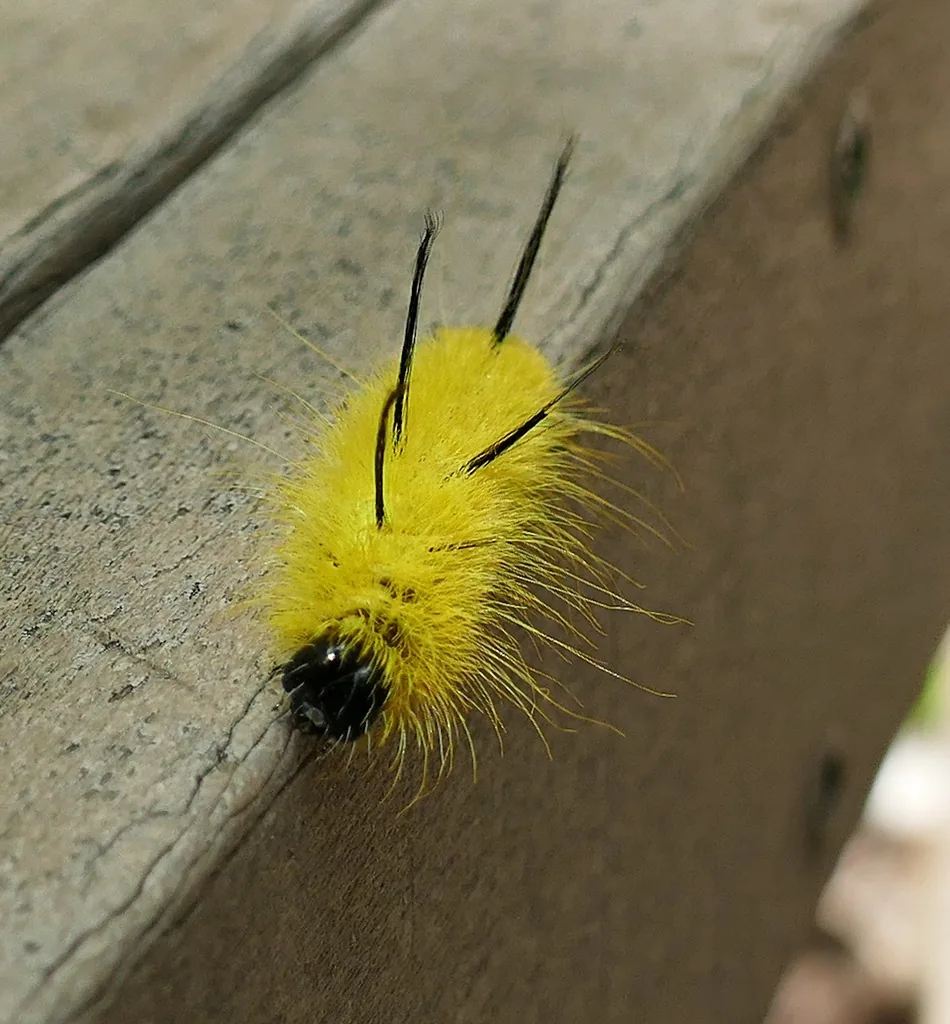
- Caterpillars are covered in long yellow, yellow-green or even white hairs. NC State describes four slender black 'pencils' of hair rising from the first and third abdominal segments and a fifth near the rear; Colorado State describes two pairs of black tufts toward the front.[1][2]
- NC State says the caterpillars can grow as long as 2 inches.[1]
- The adult is a medium-sized moth with faint black zigzag markings that comes to lights at night; Colorado State describes it as grayish brown with black markings, and BAMONA gives a wingspan of 5 to 6.5 cm.[1][2][3]
- Ohio DNR says it is the largest of Ohio's roughly 40 dagger moth species. Like its relatives it is mottled gray and blends in with the tree bark it rests on by day.[4]
Look-alikes
| Look-alike | How to tell them apart |
|---|---|
| Poplar dagger moth | In Colorado the related poplar dagger moth feeds on poplar, willow and birch; its caterpillars look and behave much the same.[2] |
Where it lives
BAMONA gives its range as throughout eastern North America. In Colorado, CSU says it is probably found wherever boxelder grows and in towns where silver maple is common. GBIF holds about 21,900 U.S. records since 1990, most from Ohio, Pennsylvania, New York, Michigan and North Carolina.[3][2][5]
Biology and life cycle
Winter is spent as a pupa in a cocoon; the moths emerge and lay eggs on maples in late spring.[2]
Caterpillars feed through summer and, once full grown, crawl down the trunk looking for a place to spin a cocoon, sometimes dozens of yards from the tree.[2]
CSU reports one generation a year in Colorado and NC State probably two in North Carolina, where caterpillars are found from July through late October. BAMONA gives two or more broods, with moths flying from April to September.[2][1][3]
NC State says adults are most active from spring to early autumn.[1]
Damage and signs
- Caterpillars eat the leaves of many hardwoods. NC State lists alder, ash, elm, maple, oak and willow, and BAMONA adds birch, hickory, poplar and walnut; in Colorado, boxelder and silver maple are common hosts.[1][3][2]
- After finishing a leaf, the caterpillar often clips its stem so it drops, which CSU says may help hide feeding from birds.[2]
- Usually they are not pests: NC State says most are noticed one or two at a time.[1]
Health risk
Don't handle it with bare hands. Poison Control and MedlinePlus advise not touching brightly colored caterpillars with spines, bristles or a fuzzy look, because they might be venomous, though most caterpillars are harmless.[6][7]
Control
Prevention
Control is rarely needed; wandering caterpillars that are ready to pupate can simply be stepped on or left alone.[1]
Pesticides
If noticeable defoliation does occur, most insecticides labeled for residential landscapes give adequate control; full-grown wandering caterpillars may appear resistant.[1]
If caterpillar hairs get on your skin
MedlinePlus lists itching, rash, redness, hives and blisters among the skin symptoms of contact with caterpillar hairs; severe allergic reactions are rare.[7]
Move a caterpillar off skin with a stick or tool rather than your fingers. To remove hairs, press sticky tape on the spot and pull it off, repeating until they are gone, then wash with soap and water and apply ice wrapped in a cloth, 10 minutes on and 10 minutes off.[6][7]
If hairs get in the eyes, flush with plenty of water and get medical help; also get medical care if hairs are breathed in. For advice, call Poison Help at 1-800-222-1222.[7][6]
Where the sources disagree
Generations: Colorado State reports one a year in Colorado, NC State says there are probably two in North Carolina, and BAMONA gives two or more broods.[2][1][3]
Hosts: Colorado State ties it to boxelder and silver maple in Colorado; NC State and BAMONA list a wide range of hardwoods, from alder and ash to oak, walnut and willow.[2][1][3]
Common questions
- Is the fuzzy yellow caterpillar with black spikes poisonous?
- Treat it with care. Poison Control and MedlinePlus say fuzzy or bristly caterpillars might be venomous and should not be touched with bare hands.[6][7]
- Will it hurt my tree?
- Rarely. Most are seen singly, and defoliation is uncommon.[1]
- Why is it crawling across my driveway?
- Full-grown caterpillars leave the tree in late summer and fall to find a sheltered spot to spin a cocoon.[2]
Sources
- NC State Extension, “American Dagger Moth (PDIC Factsheet).” content.ces.ncsu.edu/american-dagger-moth (accessed 2026-11-13)
- Colorado State University Extension (Colorado Insects of Interest, W. Cranshaw), “American Dagger Moth (Colorado Insect of Interest).” webdoc.agsci.colostate.edu/bspm/arthropodsofcolorado/American-Dagger-Moth.pdf (accessed 2026-11-13)
- Butterflies and Moths of North America (BAMONA), “American Dagger Moth, Acronicta americana (species account).” www.butterfliesandmoths.org/species/Acronicta-americana (accessed 2026-11-13)
- Ohio Department of Natural Resources, Division of Wildlife, “Moths of Ohio Field Guide (Publication 5467).” dam.assets.ohio.gov/image/upload/ohiodnr.gov/documents/wildlife/backyard-wildlife/Moths%20of%20Ohio%20Field%20Guide%20pub5467.pdf (accessed 2026-11-13)
- Global Biodiversity Information Facility (GBIF), “Acronicta americana: U.S. occurrence records since 1990 by state (GBIF occurrence search).” api.gbif.org/v1/occurrence/search?taxonKey=1783008&country=US&hasGeospatialIssue=false&occurrenceStatus=PRESENT&year=1990%2C2026&facet=stateProvince&facetLimit=400&limit=0 (accessed 2026-11-13)
- Poison Control, National Capital Poison Center, “Are caterpillars poisonous?.” www.poison.org/articles/caterpillar-stings (accessed 2026-11-13)
- MedlinePlus, U.S. National Library of Medicine, “Caterpillars (Medical Encyclopedia).” medlineplus.gov/ency/article/002860.htm (accessed 2026-11-13)
- Global Biodiversity Information Facility (GBIF), “Acronicta americana Harris, 1841 (GBIF Backbone Taxonomy).” api.gbif.org/v1/species/1783008 (accessed 2026-11-13)
- iNaturalist, “Acronicta americana taxon page (order and family).” www.inaturalist.org/taxa/1293501 (accessed 2026-10-06)