On this page
How to identify it
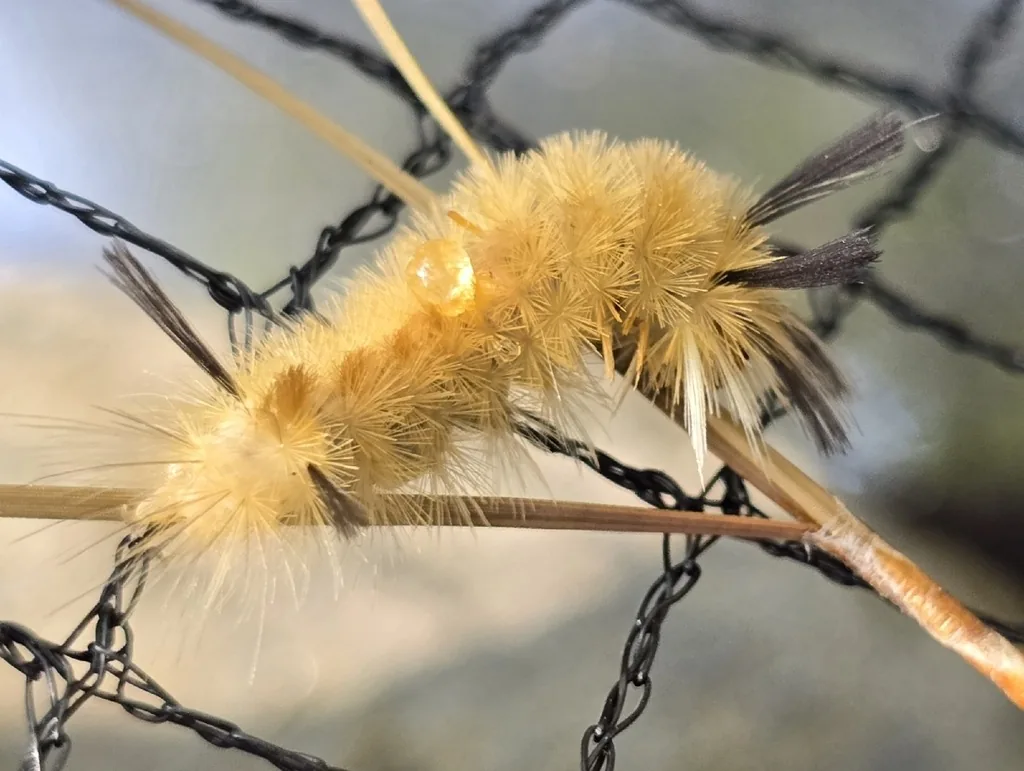
- Full-grown caterpillars are about 1 1/2 inches long and densely covered in tufts of white, silver-gray or black hairs. Long black and shorter white pencils point forward from behind the head, a pair sticks out sideways, and two black pencils point backward.[1][2]
- A row of dark gray to blackish tufts runs down the back. MDC describes the rest of the hair as gray to pale yellowish green, darker on the thorax.[1][2]
- The adult is a pale yellow-tan or cream moth whose forewings carry four wavy crossbands made of small squarish blocks, like a mosaic. The top of the thorax has a pale orange stripe with thinner turquoise stripes beside it.[2]
Look-alikes
| Look-alike | How to tell them apart |
|---|---|
| Sycamore (Harris') tussock moth | The adults are basically identical and are separated only by dissection. Its caterpillars feed on American sycamore and have pale whitish or yellowish hairs with white and orangish tufts.[2] |
| Hickory tussock moth | A white-and-black caterpillar up to about 1.7 inches, with black tufts along the back and black pencils at the front and rear. It has one generation a year, with caterpillars from July to September.[3] |
Where it lives
Found statewide in Missouri, mostly near wooded areas where its host trees grow. GBIF holds about 35,000 U.S. records since 1990, most from Pennsylvania, North Carolina, Ohio and Virginia, with only a handful from Colorado and Arizona.[2][4]
Biology and life cycle
There are two generations a year. MDC has adults flying from early May through August, often coming to lights at night.[1][2]
Caterpillars are around from early summer to fall according to MU Extension; MDC says they are most noticeable from midsummer until the October frosts.[1][2]
It overwinters in a gray, felt-like cocoon spun from the caterpillar's own hairs.[2]
The hairs defend against birds, salamanders and toads, which is why the caterpillars often rest in the open on top of a leaf. The adults are protected too: they store toxic alkaloids from the plants eaten as caterpillars.[2]
Damage and signs
Health risk
Contact with caterpillar hairs can cause skin reactions. A dermatology review says most reactions to caterpillars and moths are mild and clear up on their own, though sensitive people can react more strongly. In one case report, an adult with allergic asthma developed hives and breathing difficulty after contact with larvae of the closely related sycamore tussock moth.[5][6]
Control
Prevention
Don't handle fuzzy caterpillars with bare skin, especially if you aren't sure of the species or of your own sensitivity. Young children are the most likely to pick them up.[2]
If someone touches or swallows one
For skin contact, the dermatology review says reactions can usually be treated by promptly removing the hairs and treating the symptoms. Anti-itch or numbing creams, steroid creams and oral antihistamines are often used.[5]
Swallowing a hairy caterpillar is more serious, because hairs can lodge in the mouth and throat. In a reported case, a 19-month-old who ate half of a woolly bear caterpillar had hairs embedded in the lips, mouth and throat; he was watched in the hospital and recovered without the hairs being removed.[7]
The same report lists drooling, trouble swallowing, swelling and possible airway blockage as the risks of swallowed hairs, so a child who has eaten a hairy caterpillar needs medical care.[7]
Common questions
- Can the fuzzy tan caterpillar give you a rash?
- It can. Caterpillar hairs commonly cause mild skin reactions, and a related Halysidota species caused hives and breathing trouble in one allergic adult.[5][6]
- What does it eat?
- Leaves of oak, hickory, willow, poplar, grape, hackberry and many other hardwoods.[1][2]
- Is it the same as a white-marked tussock moth?
- No. MDC notes 'tussock moth' is used both for tiger moths like this one and for the separate 'true' tussock moths, now in the same family.[2]
Sources
- University of Missouri Extension (Caterpillars in Your Yard and Garden, IPM1019), “Caterpillars in Your Yard and Garden, page 31: Pale tussock moth.” extension.missouri.edu/publications/ipm1019-31 (accessed 2026-11-11)
- Missouri Department of Conservation, “Banded Tussock Moth (Field Guide).” mdc.mo.gov/discover-nature/field-guide/banded-tussock-moth (accessed 2026-11-11)
- Penn State Extension, “Hickory Tussock Moth Caterpillar.” extension.psu.edu/hickory-tussock-moth-caterpillar (accessed 2026-11-11)
- Global Biodiversity Information Facility (GBIF), “Halysidota tessellaris: U.S. occurrence records since 1990 by state (GBIF occurrence search).” api.gbif.org/v1/occurrence/search?taxonKey=1814338&country=US&hasGeospatialIssue=false&occurrenceStatus=PRESENT&year=1990%2C2026&facet=stateProvince&facetLimit=400&limit=0 (accessed 2026-11-11)
- Dermatologic Therapy, via PubMed, “Caterpillars and moths (Hossler 2009).” pubmed.ncbi.nlm.nih.gov/19580579/ (accessed 2026-11-11)
- Journal of Inflammation Research, via PubMed, “Immune response profiles after caterpillar exposure: a case report (Smith-Norowitz et al. 2010; sycamore tussock moth, Halysidota harrisii).” pubmed.ncbi.nlm.nih.gov/22096356/ (accessed 2026-11-11)
- Wilderness and Environmental Medicine, via PubMed, “A nonsurgical approach to management of lepidopterism due to woolly bear caterpillar ingestion (Halmo et al. 2023).” pubmed.ncbi.nlm.nih.gov/36868886/ (accessed 2026-11-11)
- iNaturalist, “Halysidota tessellaris taxon page (order and family).” www.inaturalist.org/taxa/120217 (accessed 2026-10-06)