On this page
How to identify it
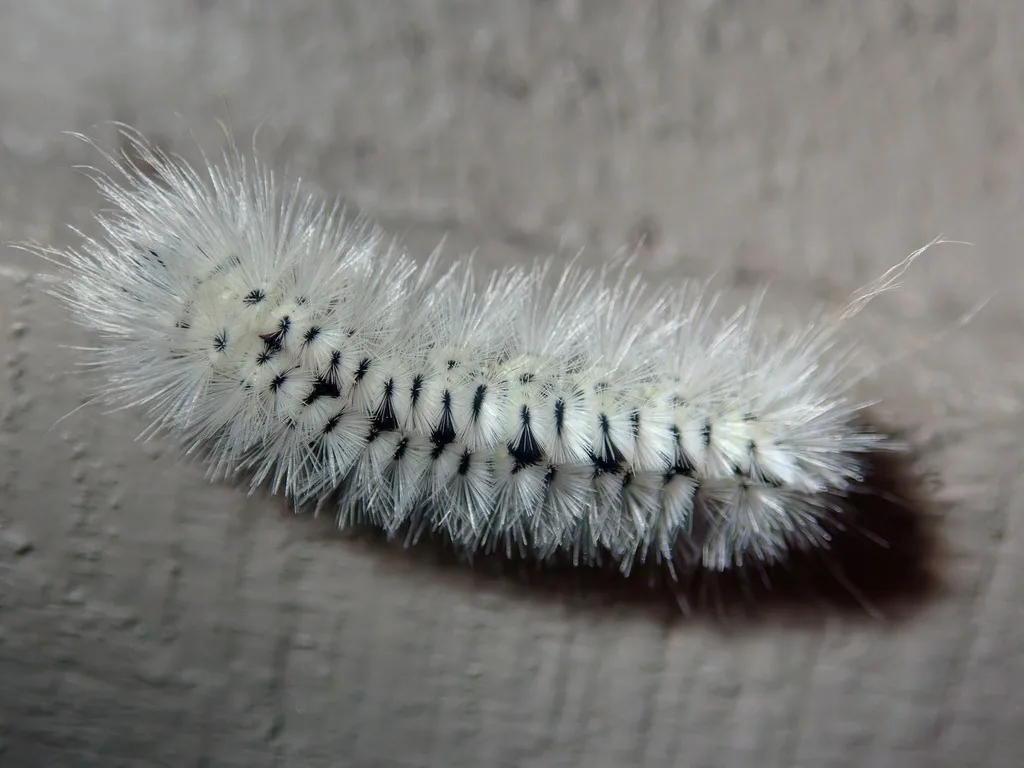
- Young caterpillars are white with black spots; older ones reach 1.7 inches (4.5 cm) and are covered in white and black hairs.[1]
- Tufts of black hairs run along the back, and black hair 'pencils' often stick out at the front and back.[1]
- Descriptions of the adult moth differ: Penn State calls it tan to light brown with rows of cream-colored spots and cream underwings; BAMONA describes a yellow forewing with brown shading and bands of translucent white spots, very pale yellow hindwings, and a wingspan of 3.7 to 5.5 cm.[1][3]
- Cocoons are spun from silk with the caterpillar's hairs worked in, so they irritate skin too.[1][5]
Where it lives
Penn State places it mainly in northeastern North America, from Maine and New Brunswick to North Carolina and west to Wisconsin and Illinois, less commonly southwest into Texas and Mexico; BAMONA gives Nova Scotia to the North Carolina mountains, west to Ontario, Wisconsin and Texas. GBIF's 1990-2026 U.S. records (about 28,000, from 18 states on the map) come mostly from New York, Pennsylvania and Vermont.[1][3][8]
Biology and life cycle
There's one generation a year: moths fly in May and June, and caterpillars feed from July to September.[1][3]
Eggs are laid in clusters of up to 100 or more under leaves; young caterpillars feed in groups, older ones alone or a few together.[1][3]
Mature caterpillars wander in search of sheltered places to spin cocoons, which can be found year-round, so people can touch them when moving firewood or reaching into hidden spots.[1]
Hickory, walnut, pecan and American hornbeam are preferred, but they likely feed on most deciduous hardwoods, including ash, elm, oak, willow and maple.[1][3]
Damage and signs
- Outbreaks occasionally defoliate trees locally, but most feeding comes a few weeks before leaf drop, so trees generally aren't harmed long term.[1]
Health risk
A Pittsburgh Poison Center review of 365 exposures found 80% involved children and 92.1% were skin contact; skin cases with minimal symptoms were managed at home and cleared within 24 hours. Swallowed hairs are more serious: a 14-month-old who ate a cocoon had barbed hairs embedded in her tongue and mouth and recovered with supportive care within 48 hours. A 5-year-old had presumed anaphylaxis after contact with a related species, the spotted tussock moth.[4][5][6]
Control
Traps and physical control
Prune out egg masses or clusters of young caterpillars, or drop them into a bucket of soapy water; wear gloves to hand-pick older caterpillars.[1]
Biological control
As a native moth it is usually kept in check by natural enemies, and control is rarely warranted once caterpillars are large.[1]
Pesticides
For many young caterpillars on trees under about 15 feet tall, Penn State lists Bt or spinosad; spinosad is toxic to many pollinators, and both work less well as caterpillars grow.[1]
After contact: what medical studies say
Removing the hairs is the main treatment. In the poison-center series, skin exposures were handled with hair removal, rinsing, antihistamines or topical steroids, and patients with swallowed hairs visible in the mouth were sent to an emergency department to have them removed.[4]
Reviews of caterpillar reactions say most are mild and self-limited and are treated by promptly removing the hairs, with anti-itch or numbing creams, topical steroids and oral antihistamines.[7]
Swallowed hairs need medical care: in the poison-center series, oral exposures with visible hairs went to an emergency department. Allergic reactions are rare, but a case report describes presumed anaphylaxis (hives and worsening breathing trouble) in a 5-year-old after contact with the closely related spotted tussock moth, treated promptly with antihistamines and a bronchodilator.[4][6]
Common questions
- What should I do if a hickory tussock caterpillar touched my skin?
- Remove the hairs promptly. In poison-center cases, hair removal, rinsing, antihistamines or a topical steroid eased skin symptoms, which cleared within 24 hours.[4][7]
- Are hickory tussock moth caterpillars poisonous?
- Their hairs cause local rash and itching. Most poison-center cases were mild, but swallowed hairs need medical attention.[4][5]
- Do I need to spray for them?
- Rarely. Most feeding comes just weeks before leaf drop, so trees aren't harmed long term.[1]
Sources
- Penn State Extension, “Hickory Tussock Moth Caterpillar.” extension.psu.edu/hickory-tussock-moth-caterpillar (accessed 2026-11-11)
- iNaturalist, “Lophocampa caryae taxon page (order and family).” www.inaturalist.org/taxa/82225 (accessed 2026-11-11)
- Butterflies and Moths of North America (BAMONA), “Hickory Tussock Moth or Hickory Tiger Moth, Lophocampa caryae Harris, 1841.” www.butterfliesandmoths.org/species/Lophocampa-caryae (accessed 2026-11-11)
- American Journal of Emergency Medicine, via PubMed, “Kuspis DA, Rawlins JE, Krenzelok EP (2001), Human exposures to stinging caterpillar: Lophocampa caryae exposures, American Journal of Emergency Medicine 19(5):396-398 (Pittsburgh Poison Center).” pubmed.ncbi.nlm.nih.gov/11555796/ (accessed 2026-11-11). Cited from the PubMed abstract.
- American Journal of Otolaryngology, via PubMed, “Tripi PA, Lee R, Keiper JB, Jones AW, Arnold JE (2010), An unusual case of ingestion of a moth cocoon in a 14-month-old girl, American Journal of Otolaryngology 31(2):123-126.” pubmed.ncbi.nlm.nih.gov/20015715/ (accessed 2026-11-11). Cited from the PubMed abstract.
- Allergy and Rhinology, via PubMed, “DuGar B, Sterbank J, Tcheurekdjian H, Hostoffer R (2014), Beware of the caterpillar: anaphylaxis to the spotted tussock moth caterpillar, Lophocampa maculata, Allergy and Rhinology 5(2):e113-e115.” pubmed.ncbi.nlm.nih.gov/24988176/ (accessed 2026-11-11). Cited from the PubMed abstract.
- Dermatologic Therapy, via PubMed, “Hossler EW (2009), Caterpillars and moths, Dermatologic Therapy 22(4):353-366.” pubmed.ncbi.nlm.nih.gov/19580579/ (accessed 2026-11-11). Cited from the PubMed abstract.
- Global Biodiversity Information Facility (GBIF), “Lophocampa caryae (hickory tussock moth): occurrence records in the U.S., 1990-2026 (GBIF occurrence search).” api.gbif.org/v1/occurrence/search?taxonKey=1817732&country=US&hasGeospatialIssue=false&occurrenceStatus=PRESENT&year=1990%2C2026&facet=stateProvince&facetLimit=400&limit=0 (accessed 2026-11-11). State counts are records reported (iNaturalist research-grade, museum specimens, surveys), not abundance.