On this page
How to identify it
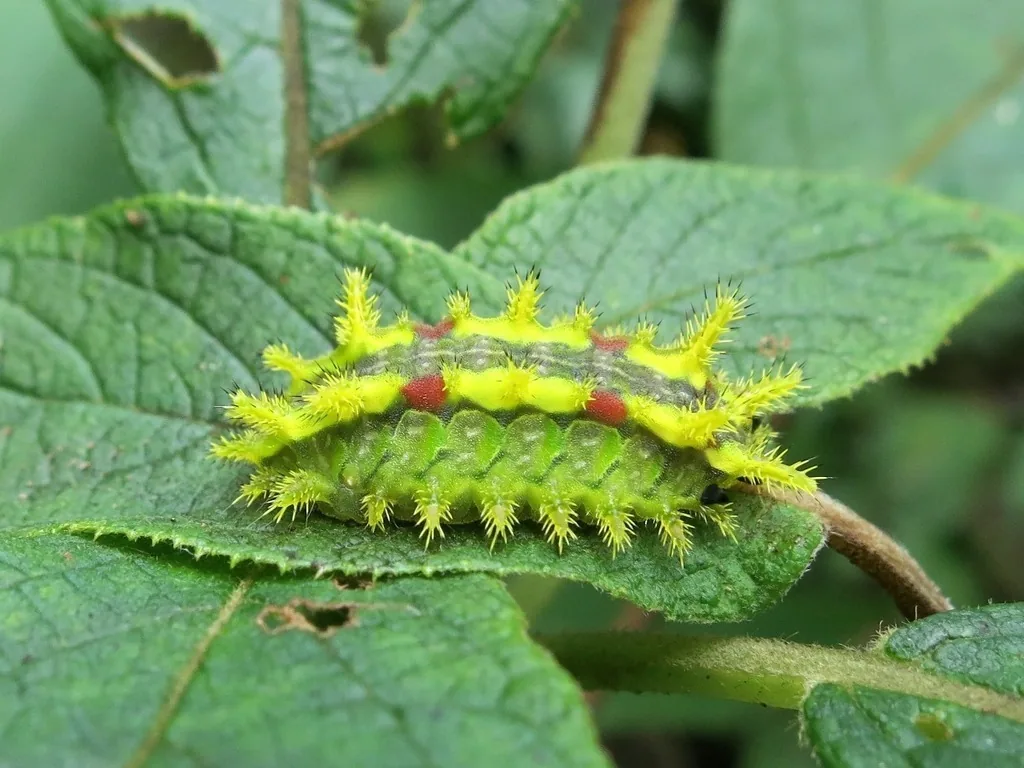
- UK describes a pale yellow-green caterpillar with four dark patches of spines toward the rear and many spiny yellow or red fleshy lobes. NC State adds a dark, mottled stripe down the back, two rows of spiny lobes on each side with two to four pairs of red spots, and says grown caterpillars are about an inch long.[1][2]
- Grown caterpillars have a brown area on the back. They are called slug caterpillars because their abdominal legs are very short and lack the tiny hooks most caterpillars have, so they look a bit like slugs.[1][2]
- The moths are brown with a large green spot, and sometimes a smaller one, on each forewing.[2]
Look-alikes
| Look-alike | How to tell them apart |
|---|---|
| Saddleback caterpillar | The spiny oak-slug is less venomous than the saddleback.[1] |
Where it lives
UK lists it among Kentucky's commonly encountered stinging caterpillars and NC State covers it in North Carolina. GBIF holds US records since 1990 from 39 states, most from Massachusetts, Ohio, Florida and New York.[1][2][7]
Biology and life cycle
NC State says the moths emerge in May and fly all summer, scattering flat, oval eggs on leaves. The caterpillars hatch about a week later, molt eight or nine times and have been collected as late as September; there is probably one generation a year.[2]
UK says young slug caterpillars may feed in groups, but older larvae feed alone. Spiny oak-slugs usually rest on the undersides of leaves, often on lower, shaded branches, so they are easy to overlook.[1][2]
In one field study, caterpillars in the shade moved and fed more often than those in the sun, and how much they moved depended on the host tree.[3]
They spend the winter in tough silk cocoons under their host plants. In a field study, 22% of spiny oak-slug cocoons were eaten by predators over winter (29% for the saddleback), and larger cocoons were less likely to be eaten.[2][4]
Damage and signs
Health risk
Touching the spines can sting. Poison Control lists stinging or burning pain, redness, itching, swelling, welts and blisters, and says allergic reactions with shortness of breath or trouble swallowing can develop in some people. MedlinePlus says caterpillar hairs can cause allergic reactions, especially on the eyes, skin or lungs.[5][6]
Control
Prevention
Most stings come from brushing against leaves where caterpillars feed; their bright warning colors help you spot them. Poison Control advises teaching children to leave caterpillars alone.[1][5]
Biological control
Parasitic wasps and tachinid flies attack spiny oak-slugs, which NC State says may explain why they are usually not abundant even though the moths lay many eggs.[2]
Pesticides
UK suggests products containing Bacillus thuringiensis or carbaryl. NC State says the caterpillar is susceptible to most insecticides labeled for home landscapes, especially pyrethroids, which are not particularly hazardous to people and pets when used as directed but are toxic to fish, so keep them away from pools, ponds and streams. Follow the label.[1][2]
More from NC State Extension
The caterpillars usually rest on the undersides of leaves, so they are easy to overlook; the moths are brown with a large green spot on each forewing.[2]
Common questions
- What should I do if a caterpillar stings me?
- MedlinePlus says to put sticky tape on the spot and pull it off to remove hairs, wash with soap and water, then apply ice wrapped in a cloth (10 minutes on, 10 minutes off), and later a baking soda paste. For any exposure, call 911 or Poison Help at 1-800-222-1222.[6][5]
- Is the spiny oak-slug as bad as a saddleback?
- It's less venomous than the saddleback caterpillar.[1]
- When will I see spiny oak-slugs?
- NC State says the moths fly from May through summer and the caterpillars have been found as late as September; UK says grown slug caterpillars are usually found in late summer.[2][1]
Sources
- University of Kentucky Entomology (ENTFACT), “Stinging Caterpillars (ENTFACT-003).” entomology.mgcafe.uky.edu/ef003 (accessed 2026-11-12)
- NC State Extension, “Spiny Oakslug.” content.ces.ncsu.edu/spiny-oak-slug (accessed 2026-11-12)
- Environ Entomol 2014, via PubMed, “Intraplant movement of generalist slug caterpillars (Limacodidae: Lepidoptera): effects of host plant and light environment.” pubmed.ncbi.nlm.nih.gov/25290903/ (accessed 2026-11-12)
- Environ Entomol 2010, via PubMed, “Winter predation of diapausing cocoons of slug caterpillars (Lepidoptera: Limacodidae).” pubmed.ncbi.nlm.nih.gov/22182555/ (accessed 2026-11-12)
- National Capital Poison Center (Poison Control), “Are caterpillars poisonous?.” www.poison.org/articles/caterpillar-stings (accessed 2026-11-12)
- NIH National Library of Medicine, MedlinePlus, “Caterpillars (Medical Encyclopedia).” medlineplus.gov/ency/article/002860.htm (accessed 2026-11-12)
- Global Biodiversity Information Facility (GBIF), “Euclea delphinii: U.S. occurrence records since 1990 by state (GBIF occurrence search).” api.gbif.org/v1/occurrence/search?taxonKey=5105365&country=US&hasGeospatialIssue=false&occurrenceStatus=PRESENT&year=1990%2C2026&facet=stateProvince&facetLimit=400&limit=0 (accessed 2026-11-12)
- iNaturalist, “Euclea delphinii taxon page (order and family).” www.inaturalist.org/taxa/136548 (accessed 2026-10-06)