On this page
How to identify it
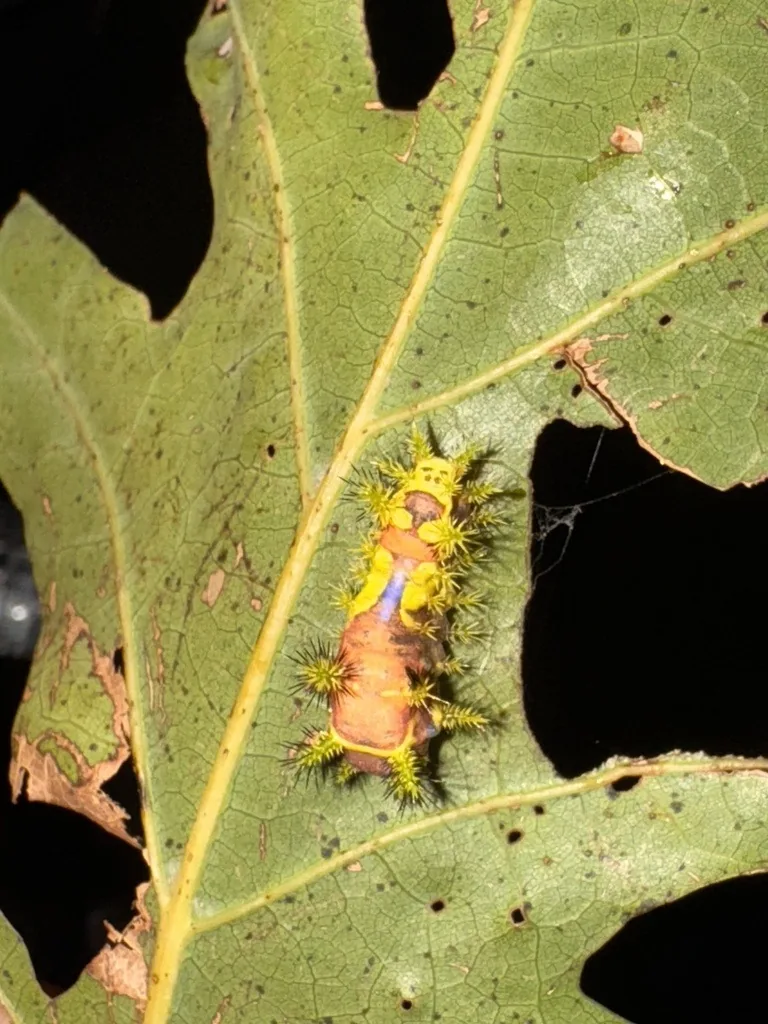
- Caterpillars are green and yellow with blue, green and purple markings and fleshy horns bearing stinging spines; grown larvae are 18 to 24 mm long.[1][2]
- Mature caterpillars spin hard, white and gray-brown cocoons in the forks of small twigs or sometimes on the trunk, where they can pass for buds. A fun fact: the cocoon is mineralized with calcium oxalate and is likely the hardest cocoon built by any insect.[1][2][5][6]
- Adults are brownish moths about 30 mm long.[2]
Where it lives
Native to East Asia, from China, Korea and Japan to Taiwan, Nepal, Bhutan and the Russian Far East. In the US it is known only from Massachusetts, where cocoons likely arrived in a Boston suburb around 1906, and it is now rarely seen within about 30 miles of Boston. GBIF holds 190 U.S. records since 1990, 189 of them from Massachusetts.[1][2][5][8]
Biology and life cycle
It spends the winter in its cocoon: UMass calls the pupa the overwintering stage, while the European Food Safety Authority says it overwinters as a fully grown larva or prepupa inside the cocoon. In Massachusetts adults emerge from late June to early August. UMass says females lay flat, transparent eggs singly under leaves; EFSA says the eggs are laid in groups on leaf undersides. EPPO says females normally produce 500-1000 eggs.[1][5][2]
Caterpillars feed from late July into October, first on leaf undersides, later eating whole leaves down to the midrib, through six to eight larval stages.[1][2]
In Asia there are one or two generations a year, depending on climate.[2]
Females attract males with a scent (sex pheromone) that researchers in Japan identified, and lures baited with it caught males in the field.[7][1]
Damage and signs
- In Massachusetts it feeds on many hardwoods, mostly Norway maple, sycamore maple, apple and hawthorn; UMass also lists beech, black birch, buckthorn, cherry, elm, pear, plum, poplar and rose. Worldwide it has been reported on 51 plant species in 24 families.[1][5][2]
- In Asia it is a growing pest of fruit, nut and urban trees, but Massachusetts populations are so low that they cause no measurable damage.[1][2]
Health risk
The caterpillars' spines are known human irritants: the European Food Safety Authority notes urticating spines affecting human health, and a Japanese study says the spines contain a poison that causes serious irritation and inflammation in people. Poison Control says venomous caterpillar spines can cause pain, itching, burning, swelling and blistering, and MedlinePlus advises not touching brightly colored caterpillars with spines and calling Poison Help (1-800-222-1222) after an exposure, or 911 for an emergency.[5][7][4][3]
Control
Traps and physical control
Don't handle the caterpillars, even to collect and destroy them. If one lands on your skin, Poison Control says to remove it with a stick or tool, not bare hands, and to teach children to leave caterpillars alone.[1][4]
Biological control
Parasitoids released near Boston from China and Japan between 1917 and 1930 attacked it, though it is unclear whether they persist; in its native range natural enemies keep it from being a major pest.[1][5]
Pesticides
Chemical treatment is almost certainly unnecessary because populations are too low to cause measurable damage. UMass lists active ingredients registered in Massachusetts for this insect, such as spinosad, neem oil, azadirachtin, chlorantraniliprole, indoxacarb and bifenthrin, and says any application should come after bloom to protect pollinators.[1]
When to call a professional
In Massachusetts, photograph any caterpillar you find, collect one only if it can be done safely, and report it to the Department of Agricultural Resources (MDAR); MDAR or UMass Extension can help send a sample to USDA APHIS for confirmation.[1]
Common questions
- Is the stinging nettle caterpillar dangerous?
- Its spines sting like nettles and cause pain, itching, burning, swelling or blisters, so don't touch it. It is rarely seen.[1][4]
- What should I do if one stings me?
- MedlinePlus says to put sticky tape on the spot and pull it off to remove the hairs (repeat with fresh tape as needed), then wash with soap and water and use ice wrapped in a cloth. Call Poison Help at 1-800-222-1222 for advice, and call 911 for trouble breathing or swelling of the face, lips or tongue.[3][4]
- Where are oriental moths found in the US?
- Only in eastern Massachusetts, mostly around Boston. GBIF's U.S. records since 1990 are almost all from Massachusetts (189 of 190).[1][2][5][8]
- How do you find the cocoons?
- Look in winter for hard, bud-like cocoons in the forks of twigs. Researchers have even spotted them from a drone flown over tree canopies, and aerial surveys found unopened cocoons more accurately than ground surveys.[1][9]
Sources
- UMass Extension Landscape, Nursery and Urban Forestry Program (Landscape Insect & Mite Guide), “Monema (Cnidocampa) flavescens (Oriental Moth, Stinging Nettle Caterpillar).” www.umass.edu/agriculture-food-environment/landscape/publications-resources/insect-mite-guide/monema-cnidocampa-flavescens (accessed 2026-11-12)
- European and Mediterranean Plant Protection Organization (EPPO), “EPPO Alert List: Monema flavescens (Lepidoptera: Limacodidae).” www.eppo.int/ACTIVITIES/plant_quarantine/alert_list_insects/monema_flavescens (accessed 2026-11-12)
- NIH National Library of Medicine, MedlinePlus, “Caterpillars (Medical Encyclopedia).” medlineplus.gov/ency/article/002860.htm (accessed 2026-11-12)
- National Capital Poison Center (Poison Control), “Are caterpillars poisonous?.” www.poison.org/articles/caterpillar-stings (accessed 2026-11-12)
- EFSA J 2024;22(7):e8831, via PubMed, “Pest categorisation of Monema flavescens (EFSA Panel on Plant Health).” pubmed.ncbi.nlm.nih.gov/38988805/ (accessed 2026-11-12)
- Insect Biochem Mol Biol 2022;151:103878, via PubMed, “Insights into the structure and composition of mineralized hard cocoons constructed by the oriental moth, Monema (Cnidocampa) flavescens Walker.” pubmed.ncbi.nlm.nih.gov/36410578/ (accessed 2026-11-12)
- J Chem Ecol 2013;39(3):350-7, via PubMed, “Identification of the sex pheromone secreted by a nettle moth, Monema flavescens, using gas chromatography/fourier transform infrared spectroscopy.” pubmed.ncbi.nlm.nih.gov/23400496/ (accessed 2026-11-12)
- Global Biodiversity Information Facility (GBIF), “Monema flavescens: U.S. occurrence records since 1990 by state (GBIF occurrence search).” api.gbif.org/v1/occurrence/search?taxonKey=5105588&country=US&hasGeospatialIssue=false&occurrenceStatus=PRESENT&year=1990%2C2026&facet=stateProvince&facetLimit=400&limit=0 (accessed 2026-11-12)
- J Econ Entomol 2021;114(5):1927-1933, via PubMed, “Detection of Monema flavescens (Lepidoptera: Limacodidae) Cocoons Using Small Unmanned Aircraft System.” pubmed.ncbi.nlm.nih.gov/34180529/ (accessed 2026-11-12)
- iNaturalist, “Monema flavescens taxon page (order and family).” www.inaturalist.org/taxa/484293 (accessed 2026-10-06)