On this page
How to identify it
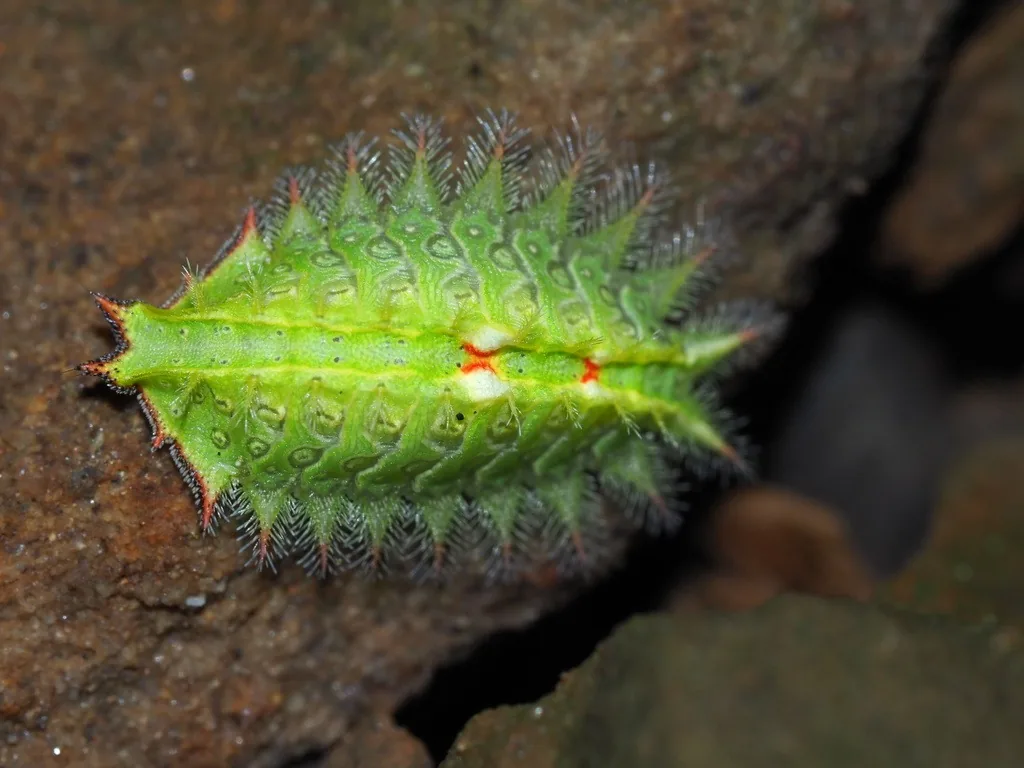
- Caterpillars are flattened, oval and pastel green, with plumes of stinging hairs around the edge and shorter stinging hairs on top.[1]
- Two pale lines run down the back, ending in a pair of “horns” at the front and a pair of stinging plumes at the rear; some have small red dots.[1]
- Adults are small brown moths about 3/4 inch long with a one-inch wingspan.[1]
Look-alikes
| Look-alike | How to tell them apart |
|---|---|
| Saddleback caterpillar | The most common slug caterpillar: charcoal gray with a lime-green saddle across the middle.[2] |
Where it lives
It is an eastern species. GBIF's U.S. records since 1990 come mostly from North Carolina, Massachusetts, Virginia, Ohio and Pennsylvania, with records west to Texas and south to Florida. NC State profiles it as a North Carolina hardwood caterpillar.[5][1]
Biology and life cycle
Caterpillars feed in summer and fall, even as leaves begin to change color, then spin dense, slightly oval cocoons, usually on the host plant.[1]
Moths fly from May to August, and there is probably one generation a year.[1]
Hosts include cherry, elm, hickory, linden, maple, oak, Norway maple and other trees and shrubs.[1]
Damage and signs
Health risk
Its hollow stinging hairs are connected to venom glands; when they touch skin they can cause stinging or burning pain, redness, itching, swelling, welts and blisters, and headache and nausea can also occur. Severe allergic reactions are rare. Sources differ on how long it lasts: Poison Control says pain usually improves within a few hours, while NC State says the symptoms can last several days.[3][4][2][1]
Control
Prevention
Most stings come from brushing against trees and shrubs during yard work or from careless handling; admire them from afar without touching.[2]
Traps and physical control
Be careful if removing one by hand, since the stings are uncomfortable and the symptoms can last for several days.[1]
Pesticides
No preventive spray is needed: NC State says it is surely susceptible to landscape pesticides but so rarely encountered that treatment is unnecessary, and Clemson says no chemical control is needed for stinging caterpillars that occur in low numbers.[1][2]
Common questions
- What should I do if a crowned slug stings me?
- Put sticky tape over the spot and pull it off to remove the hairs, repeating with fresh tape as needed, then wash with soap and water and apply ice wrapped in a cloth. If the hairs got in your eyes, flush them right away with plenty of water and get medical help. For questions, call the Poison Help line at 1-800-222-1222.[4][3]
- When should a sting send me to a doctor?
- Poison Control says to call 911 for trouble breathing, fainting, or swelling of the lips, face or tongue, and to see a health care provider if the sting area blisters, eye irritation persists, or you suspect a localized allergic reaction.[3]
- Is the crowned slug dangerous?
- It stings painfully and the symptoms may last several days, but it is rarely encountered.[1]
- Do I need to spray my tree?
- No. It is so rarely encountered that preventive treatment isn't necessary.[1][2]
Sources
- NC State Extension, “Crowned Slug Caterpillar (PDIC Factsheet).” content.ces.ncsu.edu/crowned-slug-caterpillar (accessed 2026-11-12)
- Clemson Cooperative Extension, Home & Garden Information Center, “Stinging Caterpillars (HGIC 2482).” hgic.clemson.edu/factsheet/stinging-caterpillars/ (accessed 2026-11-12)
- Poison Control, National Capital Poison Center, “Are caterpillars poisonous?.” www.poison.org/articles/caterpillar-stings (accessed 2026-11-12)
- MedlinePlus, U.S. National Library of Medicine, “Caterpillars (Medical Encyclopedia).” medlineplus.gov/ency/article/002860.htm (accessed 2026-11-12)
- Global Biodiversity Information Facility (GBIF), “Isa textula: U.S. occurrence records since 1990 by state (GBIF occurrence search).” api.gbif.org/v1/occurrence/search?taxonKey=10413588&country=US&hasGeospatialIssue=false&occurrenceStatus=PRESENT&year=1990%2C2026&facet=stateProvince&facetLimit=400&limit=0 (accessed 2026-11-12)
- iNaturalist, “Isa textula taxon page (order and family).” www.inaturalist.org/taxa/154469 (accessed 2026-10-06)