On this page
How to identify it
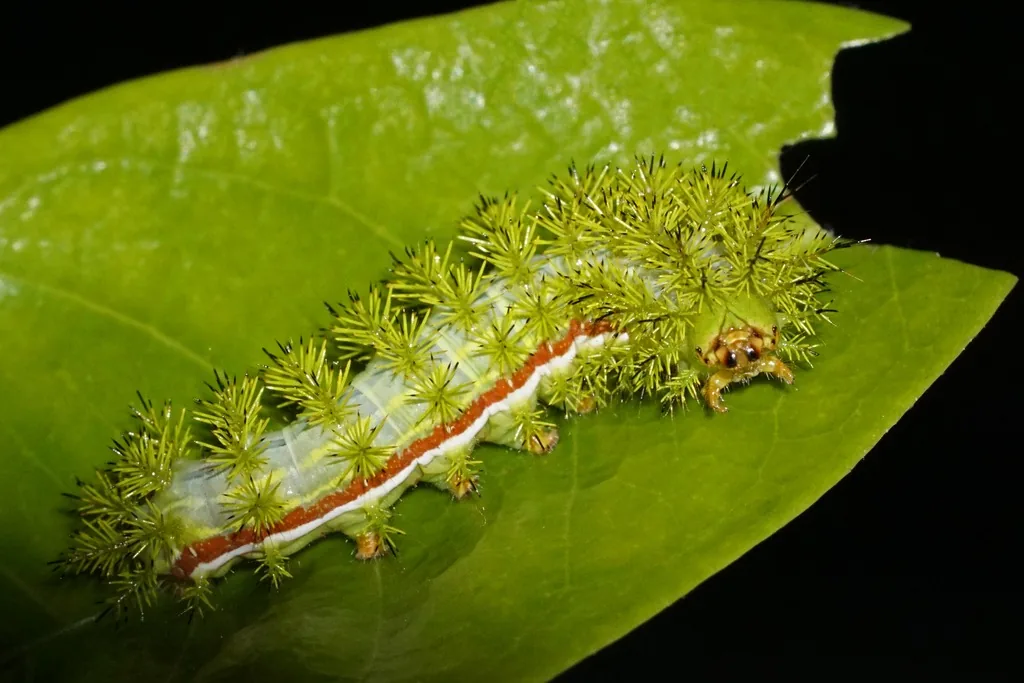
- Mature caterpillars are light green to yellowish or bluish green, with a red stripe along each side bordered below by white. UF/IFAS describes the full-grown caterpillar, usually the fifth instar, as about 60 mm (about 2 1/3 in.) long and green with a white stripe along the side edged above and below with red; the true legs and prolegs are reddish, and there are reddish patches low on the sides.[1][3][4]
- Clusters of branched, black-pointed yellow spines cover the body. These are the stinging spines. UF/IFAS says the spines, yellow or green with black tips, sit on clusters that almost surround the body.[1][3][2][4][5]
- Young caterpillars are orange and stay in groups, becoming more solitary as they grow. UF/IFAS says first instars are reddish brown with six light lines, growing more yellowish brown through the next three instars; its stinging-caterpillar guide says early instars are dark brown and molt to a dull orange.[3][4][5]
- The adult rests with its wings flattened; when prodded it parts its forewings to show a large blue-and-black eyespot on each hind wing. Males have yellowish forewings; females are larger, with brown, rusty red or purplish forewings. UF/IFAS gives a wingspan of 50 to 80 mm (approx. 2 to 3 in.), females larger than males; female forewings vary from red to brown, and male forewings from yellow to tawny or orange-brown, with yellow males commoner in the north.[3][4]
Look-alikes
| Look-alike | How to tell them apart |
|---|---|
| Buck moth caterpillar | Brown to purplish black with many yellow spots and branched black spines; it is common on oak or willow from spring to midsummer. UF/IFAS describes a common dark form, black with many tiny white dots, and a light form, white with a reddish head, reaching 6.5 cm.[1][5] |
| Saddleback caterpillar | Short and slug-like, brown at both ends with a green middle 'saddle' and spiny horns front and rear.[1] |
| Puss caterpillar | Looks like a tuft of soft brown hair; its stinging spines are hidden under long silky hairs.[1] |
Where it lives
Missouri reports it statewide, with larger populations in the east and south, in many habitats but especially forests and parklike areas. Kentucky and Clemson describe it in their states, and CDC lists it among stinging caterpillars common in Florida. UF/IFAS gives the whole range as southern Canada through the eastern U.S. to eastern Mexico. It says the moth is now rare in New England, apart from Cape Cod and some Massachusetts islands, and has declined in the Gulf States, except Louisiana, since the 1970s.[3][1][2][6][4]
Biology and life cycle
Females lay clusters of eggs on host plants. UF/IFAS says the eggs, about 1.7 × 1.3 × 1.1 mm and white with yellow markings, go in clusters on leaves or stems, usually on leaf undersides, over several nights; they usually hatch within 8 to 11 days, and the new caterpillars eat their eggshells before starting on the plant.[3][4]
Young caterpillars live in groups and sometimes march in single file. UF/IFAS says they follow silk trails to new feeding spots, gather in rosettes with heads facing out when ready to molt, and eat their shed skins except the head capsules.[3][4]
They feed on a great variety of plants; Missouri has records on more than 30 species, and in the Ozarks they are common on sassafras. Kentucky lists corn, roses, willow, linden, elm, oak, locust, apple, beech, ash, currant and clover. UF/IFAS lists the commonest host genera as maples, birches, hickories, hackberries, redbud, wax myrtles, poplars, cherries, pear, currants, blackberries, sassafras, willows, basswoods, elms and wisteria; mesquite is a preferred host on the Texas Gulf Coast, and hibiscus, royal poinciana and red mangrove are common hosts in South Florida.[3][1][4][5]
Grown caterpillars spin papery silk cocoons on the ground in leaf litter or on plants, sometimes working in leaves. UF/IFAS says full-grown caterpillars crawl down from the plant and spin in leaf litter or protected spots such as crevices in logs or rocks.[3][4]
Missouri has two broods a year, with adults flying from early May into September. UF/IFAS says northern populations have one generation a year; coastal South Carolina, the Gulf States and north Florida probably two; and Florida from Orlando south probably four, or four or five farther south.[3][4]
Adults have reduced mouthparts and don't eat. They fly at night and come to lights, and when disturbed they flash the hind-wing eyespots, which are thought to startle or deter predators. UF/IFAS says adults are strictly nocturnal and short-lived, and by day they sit still and pass for dead leaves.[3][7][4]
Saturniid caterpillars normally have five instars, but more molts can happen on poor hosts: UF/IFAS cites seven instars for io caterpillars reared on coral bean.[4]
Damage and signs
- Stinging caterpillars like the io are generally not encountered in large numbers, and Kentucky says they are infrequently encountered; Clemson says no chemical control is needed. UF/IFAS says they have been reported from cotton and corn but are never abundant enough to need control on those crops; control is only worth considering when they are a stinging hazard on landscape plants, and then Bt or insecticides recommended for other caterpillars should work.[2][1][4]
Health risk
Contact causes stinging or burning pain, redness, itching and swelling or welts. The io was one of four caterpillar species confirmed in stings in a year-long Louisiana poison center study, and a small experiment found reactions to its spines varied a lot from person to person. Severe allergic reactions are rare.[8][9][10][11][6]
Control
Prevention
Most stings come from brushing against leaves where caterpillars are feeding, often while mowing or doing yard work. Their bright warning colors make them easy to spot if you look first.[1][2]
Traps and physical control
Don't brush one off bare-handed; use a stick or tool. A single caterpillar can be moved by clipping the leaf or stem it is on.[1][9]
Pesticides
Preventive sprays aren't recommended. Where stinging caterpillars are numerous around homes, schools or play areas, Kentucky suggests Bacillus thuringiensis or carbaryl, following the label; Clemson says no chemical control is needed because they occur in low numbers.[1][2]
First aid for an io caterpillar sting
Remove the caterpillar without bare hands, then lay tape sticky side down over the area and pull it up to strip out broken spines. Repeat with fresh tape as needed.[9][8]
Wash with soap and water and ice the area, wrapped in a cloth, 10 minutes on and 10 minutes off; a baking soda paste can follow.[8]
Oral pain relievers can help, and pain usually improves within a few hours. If removing the spines doesn't help, Poison Control suggests an oral or topical antihistamine.[9]
Flush the eyes with plenty of water if hairs get in them and get medical help. Call 911 for trouble breathing, fainting or swelling of the face, lips or tongue; Poison Help is 1-800-222-1222.[8][9]
Where sources disagree
Size: Kentucky says mature caterpillars are two inches long; Clemson says they can reach 2.5 inches.[1][2]
Antihistamines: Poison Control suggests trying one if tape removal doesn't help, and a dermatology review says they are often used; Poison Control also describes a stung patient for whom antihistamines gave no relief until the hairs were removed.[9][12]
Size (continued): UF/IFAS gives about 60 mm (about 2 1/3 in.) for full-grown caterpillars, and its stinging-caterpillar guide says they can reach 6.5 cm.[4][5]
Side stripe: Kentucky and Missouri describe a red stripe bordered below by white; UF/IFAS describes a white stripe edged with red above and below.[1][3][4]
Generations: Missouri reports two broods; UF/IFAS says one a year in the North and up to four or five in South Florida.[3][4]
Natural enemies
UF/IFAS says hornets commonly attack io caterpillars, and birds, mammals, spiders and other insects probably take them too.[4]
At least seven tachinid fly species, two ichneumonid wasps and two braconid wasps have been reported as parasitoids.[4]
Common questions
- Can the io moth itself sting?
- No. Only the caterpillar stage has stinging hairs; the adult moths don't sting.[1][3]
- How common are io caterpillar stings?
- Not very. A one-year Louisiana poison center study logged 112 caterpillar stings and confirmed four species, the io among them; most effects were mild to moderate and local, though 61% still had effects 24 hours later.[10]
- Why are tiny caterpillars marching in a line?
- Young io caterpillars live in groups and sometimes travel in single file. They already carry spines, so don't touch them.[3][1]
- Why is it called the io moth?
- UF/IFAS says the species name comes from Io, a figure in Greek mythology who was a priestess of Hera. Older common names include corn emperor moth and peacock moth.[4]
Sources
- University of Kentucky Entomology, “ENTFACT-003: Stinging Caterpillars.” entomology.mgcafe.uky.edu/ef003 (accessed 2026-11-14)
- Clemson Cooperative Extension, Home & Garden Information Center, “Stinging Caterpillars (HGIC 2482).” hgic.clemson.edu/factsheet/stinging-caterpillars/ (accessed 2026-11-14)
- Missouri Department of Conservation, “Io Moth (Field Guide).” mdc.mo.gov/discover-nature/field-guide/io-moth (accessed 2026-11-14)
- University of Florida/IFAS Extension (Featured Creatures), “Io Moth, Automeris io (Fabricius), EENY-608/IN1065 (D. W. Hall).” ask.ifas.ufl.edu/publication/IN1065 (accessed 2026-11-14). Used for identification, range, biology, hosts, natural enemies and control; its medical section is not used on its own.
- University of Florida/IFAS Extension (EDIS), “Stinging and Venomous Caterpillars of the Southeast, SP107/IN014.” ask.ifas.ufl.edu/publication/IN014 (accessed 2026-11-14). Used for caterpillar identification, hosts and generations only.
- Centers for Disease Control and Prevention, “Caterpillar-Associated Rashes in Children, Hillsborough County, Florida, 2011 (MMWR 61(12)).” www.cdc.gov/mmwr/preview/mmwrhtml/mm6112a3.htm (accessed 2026-11-14)
- G3: Genes, Genomes, Genetics, via PubMed, “Long read genome assembly of Automeris io, an emerging model for the evolution of deimatic displays (Skojec et al. 2024).” pubmed.ncbi.nlm.nih.gov/38324397/ (accessed 2026-11-14)
- MedlinePlus, U.S. National Library of Medicine, “Caterpillars (Medical Encyclopedia).” medlineplus.gov/ency/article/002860.htm (accessed 2026-11-14)
- Poison Control, National Capital Poison Center, “Are caterpillars poisonous?.” www.poison.org/articles/caterpillar-stings (accessed 2026-11-14)
- Veterinary and Human Toxicology, via PubMed, “Caterpillar envenomations: a prospective study of 112 cases (Everson et al. 1990).” pubmed.ncbi.nlm.nih.gov/2327053/ (accessed 2026-11-14)
- Cutis, via PubMed, “Automeris io (caterpillar) dermatitis (Hughes and Rosen 1980).” pubmed.ncbi.nlm.nih.gov/7389400/ (accessed 2026-11-14)
- Dermatologic Therapy, via PubMed, “Caterpillars and moths (Hossler 2009).” pubmed.ncbi.nlm.nih.gov/19580579/ (accessed 2026-11-14)
- iNaturalist, “Automeris io taxon page (order and family).” www.inaturalist.org/taxa/82279 (accessed 2026-11-14)