On this page
How to identify it
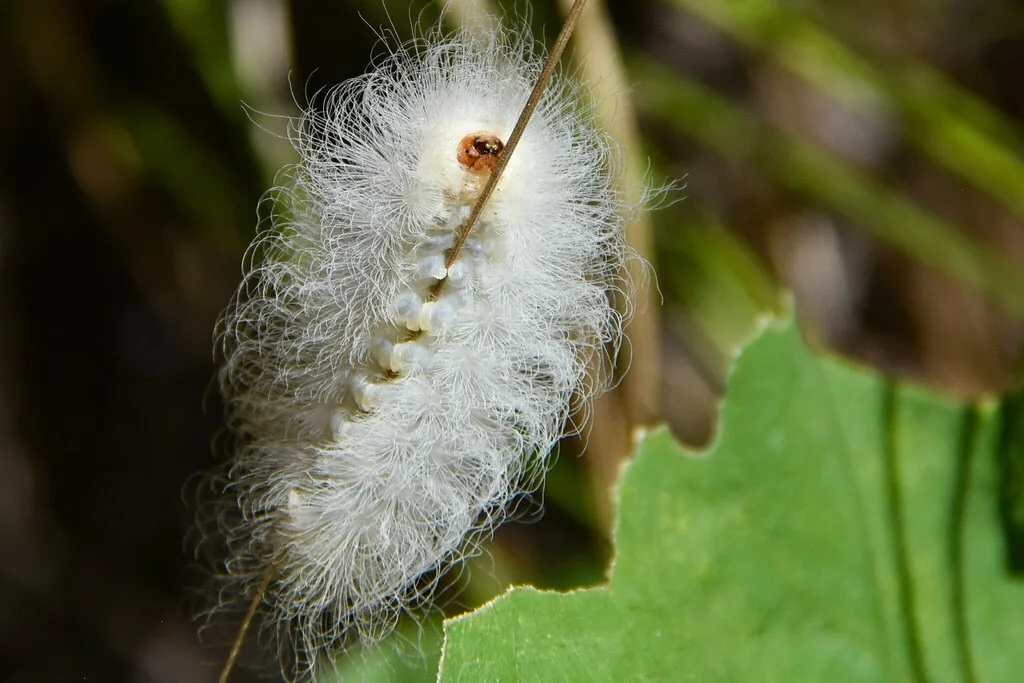
- Mature caterpillars are covered in dense tufts of long hair in gray, orange or tan, with lighter hairs forming a crest along the back. Colors vary widely, from white to cream, caramel or red, and the hairs can be long and wispy or short and crinkly. Young caterpillars carry long white wispy hairs.[2][3][1]
- Under the coat are small tubercles bearing the stinging hairs.[2][1]
- It has no long tail of hairs at the rear, which the puss caterpillar has.[3][1]
- Flannel moth caterpillars have seven pairs of prolegs, the fleshy legs along the abdomen; all other butterfly and moth caterpillars have five pairs or fewer.[3]
- The adult moth is pale yellowish cream with several sharp, wavy black lines along the front edge of the forewing and black leg tips; males are more strongly colored than females. Missouri's field guide gives flannel moths a wingspan of 1 to 1½ inches.[3][4]
Look-alikes
| Look-alike | How to tell them apart |
|---|---|
| Puss caterpillar | Mature larvae look very much like the puss caterpillar but lack its tail of hairs extending from the rear.[1][3] |
| White flannel moth caterpillar | A yellow caterpillar up to 1¼ inches long with a wide black stripe down the back, red at each end, and 11 pairs of raised yellow tufts. It feeds on redbud, honey locust, hackberry, mimosa and beech.[1] |
Where it lives
Butterflies and Moths of North America gives its range as New Hampshire to Florida, west to Missouri and Louisiana, and calls it common in most of that range. The Missouri Department of Conservation lists it among the three flannel moths likely in Missouri, Kentucky Extension includes it among the state's stinging caterpillars, and a 2000 study reported an unusual population in western Oklahoma.[4][3][1][5]
Biology and life cycle
In Missouri caterpillars are present in summer and fall, with two generations a year, and Kentucky Extension says they can be common in late summer. Adults fly from May to October.[2][1][4]
A study of the Oklahoma population found six caterpillar instars.[5]
Fully grown flannel moth caterpillars spend the winter in a tough cocoon molded to the trunk or a branch of the host plant and pupate in spring. Females cover their eggs with hairs from the abdomen.[3]
Damage and signs
- Caterpillars feed on a wide range of trees and shrubs, including oaks, sassafras, plums and other Prunus, willows, alder, apple, birches, blackberry, poplars and bayberry. In western Oklahoma their main food is shin oak.[2][3][4][5]
- Flannel moths are usually only locally common and generally turn up in small numbers.[3]
Health risk
Its hairs and spines connect to venom glands and can break off in the skin. A caterpillar sting can cause stinging or burning pain, redness, itching, swelling, welts and blisters, and sometimes headache and nausea; a severe allergic reaction (anaphylaxis) is possible but rare.[6][7]
Control
Prevention
Don't touch fuzzy, spiny or brightly colored caterpillars, and wear a hat and gloves when gardening or pruning shrubs.[7][6][3]
Traps and physical control
If one lands on you, brush it off with a stick or tool, not a bare hand. A lone caterpillar on a plant can be moved by clipping the leaf or stem it is on.[6][1]
Pesticides
Preventive sprays aren't recommended, because stinging caterpillars are encountered infrequently. Where many are present around homes, schools or recreation areas, Kentucky Extension says infested shrubs and trees can be sprayed with Bacillus thuringiensis or carbaryl, following the label.[1]
If you are stung
Lay sticky tape over the spot and pull it away to lift out broken hairs and spines, repeating with fresh tape until no more come out. Then wash the area with soap and water.[7][6]
MedlinePlus advises ice wrapped in a clean cloth, 10 minutes on and 10 minutes off, followed after several rounds by a paste of baking soda and water. Poison Control says ice and oral pain relievers such as ibuprofen or acetaminophen can help, and an oral or topical antihistamine may help if tape alone doesn't.[7][6]
Call 911 for trouble breathing, fainting, or swelling of the lips, face or tongue. If hairs get into the eyes, flush them with plenty of water and get medical help. See a health care provider if the sting blisters, and ask about a tetanus booster if your shots aren't current.[6][7]
Poison Help is free and open 24 hours a day at 1-800-222-1222.[7][6]
What research says about these stings
A one-year study at a Louisiana poison center followed 112 caterpillar stings; puss and crinkled flannel moth caterpillars, counted together, were among the species implicated. Local pain (96 percent of patients), redness (89 percent) and swelling (72 percent) were most common, 26 percent had muscle spasms, tingling or pain spreading up a limb, and 61 percent still had mild to moderate effects a day later.[8]
More than 50 caterpillar species in the United States are venomous, and a medical review names this flannel moth among the notable ones.[9]
A 2023 study of this species and the puss caterpillar found the venom is made in cells beneath the skin and reaches the spines through canals. It consists mostly of large pore-forming proteins that switch on pain-sensing nerve cells, and in mice it caused lasting pain and swelling.[10]
Where sources disagree
Ice and baking soda: MedlinePlus recommends both after the hairs are removed, while Poison Control describes a saddleback caterpillar sting in which ice, baking soda paste, creams and antihistamines gave no relief until tape pulled the hairs out.[7][6]
Range: Butterflies and Moths of North America puts its western limit at Missouri and Louisiana, while a 2000 study described a population in western Oklahoma.[4][5]
Common questions
- Can a fuzzy caterpillar sting?
- Yes. This one's soft hairs hide short venomous spines, and MedlinePlus advises against touching fuzzy, spiny or brightly colored caterpillars.[1][2][7]
- What should I do if I'm stung?
- Pull out broken spines with sticky tape, wash with soap and water, then use ice. Call 911 for trouble breathing or facial swelling, and get medical help if hairs reach the eyes.[7][6]
- How is it different from a puss caterpillar?
- It has no tail of hairs at the rear. Otherwise mature caterpillars of the two look very much alike, so treat both as stinging.[1][3]
Sources
- University of Kentucky Entomology (ENTFACT), “Stinging Caterpillars (ENTFACT-003).” entomology.mgcafe.uky.edu/ef003 (accessed 2026-11-11)
- University of Missouri Extension (Caterpillars in Your Yard and Garden, IPM1019), “Caterpillars in Your Yard and Garden, page 11: Crinkled flannel moth.” extension.missouri.edu/publications/ipm1019-11 (accessed 2026-11-11)
- Missouri Department of Conservation, “Flannel Moths (Field Guide).” mdc.mo.gov/discover-nature/field-guide/flannel-moths (accessed 2026-11-11)
- Butterflies and Moths of North America (BAMONA), “Black-waved Flannel Moth, Megalopyge crispata (species page).” www.butterfliesandmoths.org/species/Lagoa-crispata (accessed 2026-11-11)
- Toxicon, via PubMed, “Lamdin and others (2000), The venomous hair structure, venom and life cycle of Lagoa crispata, a puss caterpillar of Oklahoma.” pubmed.ncbi.nlm.nih.gov/10736472/ (accessed 2026-11-11)
- Poison Control, National Capital Poison Center, “Are caterpillars poisonous?.” www.poison.org/articles/caterpillar-stings (accessed 2026-11-11)
- MedlinePlus, U.S. National Library of Medicine, “Caterpillars (Medical Encyclopedia).” medlineplus.gov/ency/article/002860.htm (accessed 2026-11-11)
- Veterinary and Human Toxicology, via PubMed, “Everson, Chapin and Normann (1990), Caterpillar envenomations: a prospective study of 112 cases.” pubmed.ncbi.nlm.nih.gov/2327053/ (accessed 2026-11-11)
- StatPearls (NCBI Bookshelf), via PubMed, “Goldman, Lee and Bragg (2024), Butterfly, moth, and caterpillar envenomation.” pubmed.ncbi.nlm.nih.gov/30969673/ (accessed 2026-11-11)
- Proceedings of the National Academy of Sciences, via PubMed, “Walker and others (2023), Horizontal gene transfer underlies the painful stings of asp caterpillars (Lepidoptera: Megalopygidae).” pubmed.ncbi.nlm.nih.gov/37428925/ (accessed 2026-11-11)
- iNaturalist, “Megalopyge crispata taxon page (order and family).” www.inaturalist.org/taxa/703873 (accessed 2026-10-06)