On this page
How to identify it
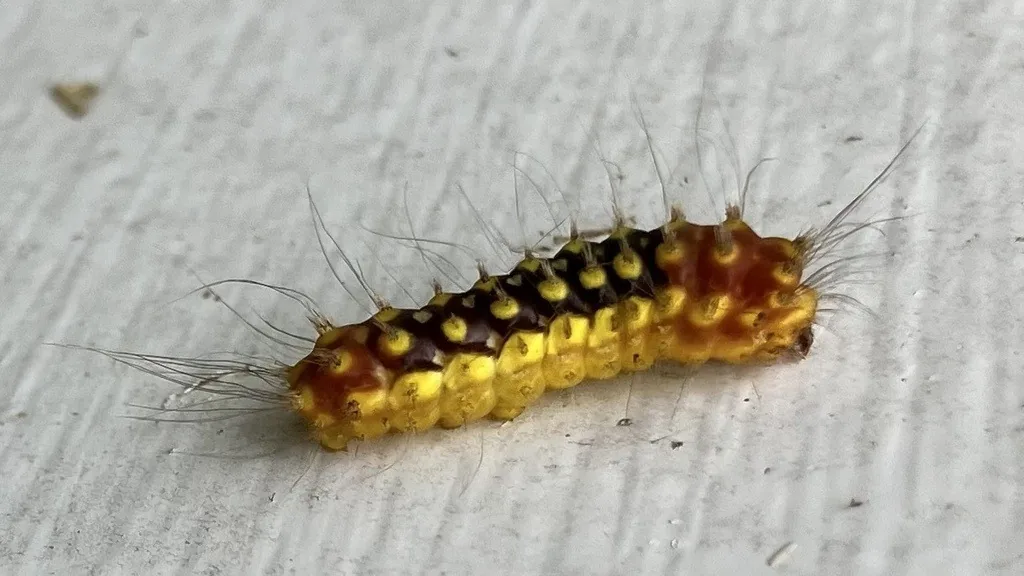
- Full-grown caterpillars are about 1 to 1 1/4 inches long and yellow, with a wide dark stripe down the back that is rusty red at each end.[1][2][3]
- Rows of raised yellow spots or tufts run along the dark stripe, with smaller tufts along the sides; the sources count the spots differently (below).[1][2][3]
- The long silky hairs don't sting; short, needle-like hairs at the base of the tufts do. NC State also notes a short, heavy spine beside each breathing pore along the side.[1][2][3]
- Like other flannel moth caterpillars it has 7 pairs of prolegs, the fleshy legs on the abdomen; other caterpillars have 5 or fewer pairs.[3]
- The adult is a pure white, fluffy moth, very hairy around the head and thorax; males have yellowish, feathery antennae.[2][3]
Look-alikes
| Look-alike | How to tell them apart |
|---|---|
| Puss caterpillar (southern flannel moth) | Puss caterpillars are teardrop-shaped and densely covered with fine gray or tan hair that tapers into a tail; Missouri warns their stings can be intense enough to need medical attention.[3] |
| Black-waved flannel moth caterpillar | Black-waved flannel moth caterpillars look like puss caterpillars without the tail, with long wispy or short crinkly hair from white to red. Kentucky says their sting is usually not as severe as the puss caterpillar's.[3][1] |
Where it lives
NC State and Kentucky Extension both describe it among the stinging caterpillars of their states. The Missouri Department of Conservation lists it among three flannel moths likely found in Missouri, where flannel moths occur statewide but seem most numerous in the south and east; it adds that most U.S. flannel moths are limited to the desert Southwest or the far Southeast.[2][1][3]
Biology and life cycle
The moths lay eggs in lines on hackberry, redbud, beech or mimosa leaves. NC State says there are two generations a year in North Carolina, and Kentucky says the larvae show up later in summer.[2][1]
Young caterpillars have a few long, feathery hairs and feed in groups, then spread out on their own as they grow.[2]
Adult flannel moths have reduced mouthparts and apparently don't eat.[3]
Numbers swing from year to year; NC State says parasites and diseases can keep them from appearing at all the next year.[2]
Damage and signs
Health risk
The sting comes from venom in short hairs that break off in the skin. NC State compares it to a wasp or bee sting, with pain lasting a few hours and sometimes blisters; Kentucky says flannel moth stings can bring pain and swelling that last for days. Poison Control lists flannel moth caterpillars among the venomous caterpillars in the U.S. and says symptoms can include burning pain, redness, itching, swelling, welts and blisters, sometimes headache and nausea; anaphylaxis is possible but rare.[2][1][5]
Control
Prevention
Don't handle brightly colored caterpillars with spines, bristles or a fuzzy look, since they might be venomous; Poison Control suggests a hat and gloves while gardening.[5][4][3]
Traps and physical control
Preventive sprays aren't recommended. For a single caterpillar, clip off the leaf or stem it is on and move it away.[1]
Pesticides
Where they are numerous near homes, play areas or schools, infested plants can be sprayed with Bacillus thuringiensis, carbaryl or another contact insecticide labeled for landscape use; follow the label.[1][2]
Sting first aid
Remove the caterpillar without using bare hands. Put tape on the skin, sticky side down, and pull it off to lift out the hairs, repeating with fresh tape as needed.[5][4]
Wash the area with soap and water, then apply ice wrapped in a cloth for 10 minutes on and 10 minutes off. Poison Control says pain usually improves within a few hours and suggests an oral or topical antihistamine if tape removal doesn't help.[4][5]
If hairs got in the eyes, flush them right away with plenty of water and get medical help; also get medical care if hairs were breathed in.[4]
Call 911 for trouble breathing, fainting, or swelling of the lips, face or tongue. For other questions, Poison Help (1-800-222-1222) is free and confidential, and Poison Control advises seeing a provider for a local allergic reaction, blistering or eye irritation that persists.[5][4]
Where sources disagree
Spots on the back: Kentucky counts 11 pairs of raised yellow tufts; NC State counts 7 pairs of yellow to white spots with small white spots between them; Missouri describes two rows of raised yellow circles.[1][2][3]
Where it pupates: NC State says grown caterpillars crawl to the ground and pupate in a tough brown cocoon just below the soil surface; Missouri, writing about flannel moths in general, says grown caterpillars overwinter in a cocoon molded to the trunk or branches of the host.[2][3]
How long a sting lasts: NC State says pain lasts a few hours; Kentucky says flannel moth stings can cause pain and swelling for days.[2][1]
Common questions
- What is the yellow and black tufted caterpillar on my redbud?
- Possibly a white flannel moth caterpillar (hackberry leafslug), which stings. Look for a yellow body with a dark stripe that is rusty red at the ends, and don't touch it.[1][2][3]
- How bad is the sting?
- NC State compares it to a bee or wasp sting lasting a few hours, sometimes with blisters; Kentucky says swelling from flannel moth stings can last days.[2][1]
- Will they be back next year?
- Maybe not; parasites and diseases make numbers swing from year to year.[2]
- What should I do if one stings me?
- Lift the hairs out with tape, wash with soap and water and use wrapped ice. Call 911 for trouble breathing or facial swelling, and call Poison Help at 1-800-222-1222 with questions.[5][4]
Sources
- University of Kentucky Entomology (ENTFACT), “Stinging Caterpillars (ENTFACT-003).” entomology.mgcafe.uky.edu/ef003 (accessed 2026-11-11)
- NC State Extension, “Hackberry Leafslug or White Flannel Moth (PDIC Factsheet).” content.ces.ncsu.edu/hackberry-leafslug-or-the-white-flannel-moth (accessed 2026-11-11)
- Missouri Department of Conservation, “Flannel Moths (Field Guide).” mdc.mo.gov/discover-nature/field-guide/flannel-moths (accessed 2026-11-11)
- MedlinePlus, U.S. National Library of Medicine, “Caterpillars (Medical Encyclopedia).” medlineplus.gov/ency/article/002860.htm (accessed 2026-11-11)
- Poison Control, National Capital Poison Center, “Are caterpillars poisonous?.” www.poison.org/articles/caterpillar-stings (accessed 2026-11-11)
- iNaturalist, “Norape ovina taxon page (order and family).” www.inaturalist.org/taxa/1368495 (accessed 2026-11-11)