On this page
How to identify it
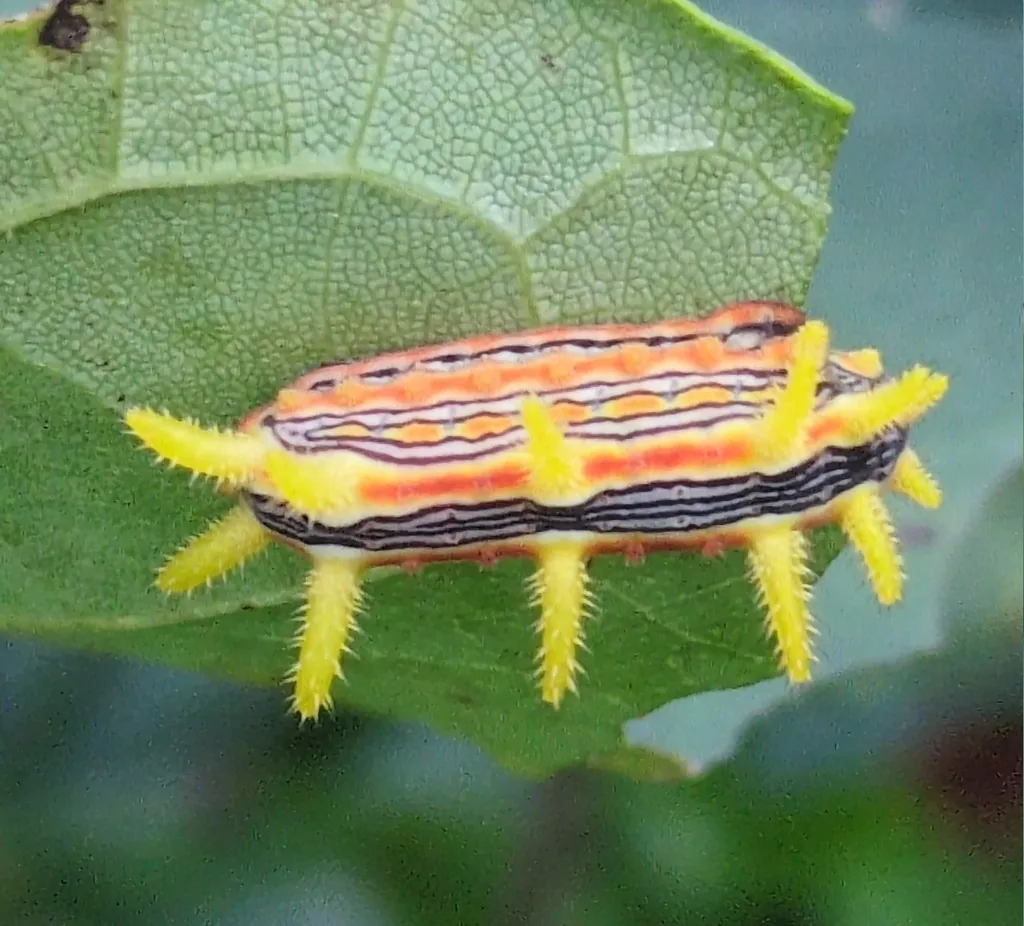
- It is yellow to red with black and blue stripes down the back and fainter red, blue and black stripes along the sides. MU Extension describes alternating yellow and orange stripes with a blue-purple stripe outlined in black along the top.[1][3]
- Prominent spiny yellow horns stick out at the front, rear and middle of the body, and the spines on these lobes are poisonous.[1][3][2]
- Grown caterpillars are about 1 inch long or a little less. Some have a fiery red ground color; many lack the red and are yellow throughout.[3][2]
- Like other slug caterpillars, it has tiny thoracic legs and no fleshy prolegs, creeps along like a slug and keeps its head tucked out of sight.[3][2][1]
- The adult is a green and pale brown moth with a wingspan of about an inch. Only the caterpillar stage stings.[2][1]
Look-alikes
| Look-alike | How to tell them apart |
|---|---|
| Saddleback caterpillar | Another slug caterpillar, brown at both ends and green in the middle, with a purple spot in the center of the green saddle and two prominent horns at each end. Clemson calls it the most common slug caterpillar.[1][4] |
| Spiny oak-slug | Pale yellow-green, with four dark patches of spines toward the rear and many spiny yellow or red fleshy lobes; grown caterpillars have a brown area on the back.[1] |
| Parasa chloris | A close relative living in the same areas. Its adult moths look much like the stinging rose caterpillar's, and a 2025 study is still sorting out which old names belong to which species.[5] |
Where it lives
Widespread in the forests of the eastern United States but not particularly common; New York State considers it a species of conservation concern. Kentucky and Missouri Extension list it among their states' stinging caterpillars.[2][1][3]
Biology and life cycle
The moths fly in early summer, females lay eggs in July, and the eggs hatch in about nine days. Caterpillars tend to hide on the undersides of leaves and mature around mid-September, and the species spends the winter as a pupa inside a cocoon.[2]
Caterpillars are present in summer and fall. MU Extension gives one to two generations a year; the University of Kentucky says slug caterpillars typically have one, with grown larvae in late summer.[3][1]
Small slug caterpillars may feed in groups, but older ones feed alone.[1]
Damage and signs
- It feeds on bushes and low tree branches. Hosts include redbud, oak, hickory, bayberry, wild cherry and sycamore, and also rose, dogwood, apple, maple and poplar.[1][2][3]
- Most stings happen when people brush against leaves the caterpillars are feeding on, often while mowing or doing other yard work.[1][4][6]
Health risk
Its spines connect to venom glands and can break off in the skin. A caterpillar sting can cause stinging or burning pain, redness, itching, swelling, welts and blisters, and sometimes headache and nausea; anaphylaxis is possible but rare.[6][7]
Control
Prevention
Don't touch brightly colored, spiny caterpillars, and wear a hat and gloves when gardening or pruning shrubs.[7][6]
Traps and physical control
If one gets on you, remove it with a stick or tool, never a bare hand.[6][1]
Clip and move the leaf or stem holding a lone caterpillar.[1]
Pesticides
Preventive sprays aren't recommended, because stinging caterpillars are seldom numerous. Where many are present around homes, schools or recreation areas, Kentucky Extension says infested shrubs can be treated with Bacillus thuringiensis or carbaryl, following the label.[1][4]
If you are stung
Put sticky tape over the area and pull it off to remove broken spines and hairs, repeating with fresh tape as needed. Then wash with soap and water.[7][6]
MedlinePlus advises ice wrapped in a clean cloth, 10 minutes on and 10 minutes off, then a paste of baking soda and water after several ice treatments. Poison Control adds that ice and oral pain relievers such as ibuprofen or acetaminophen can help, and an oral or topical antihistamine may help if tape alone doesn't.[7][6]
Pain usually improves within a few hours. Call 911 for trouble breathing, fainting or swelling of the lips, face or tongue. If a caterpillar touches the eyes, flush them with plenty of water and get medical help. See a health care provider if the sting blisters, and check that your tetanus shots are up to date.[6][7]
A poison center can be reached 24 hours a day at 1-800-222-1222.[7][6]
What studies of caterpillar stings show
In a prospective study of 112 caterpillar stings, the most common effects were local pain (96 percent of patients), redness (89 percent) and swelling (72 percent). Muscle spasms, tingling or pain spreading up a limb showed up in 26 percent, and 61 percent still had mild to moderate effects 24 hours later.[8]
More than 50 caterpillar species in the U.S. are venomous, and reports of skin, lung and whole-body reactions after caterpillar encounters have increased across the South since the 1970s.[9][10]
Where sources disagree
Generations: one to two a year (MU Extension) against one, with eggs in July and the winter spent as a pupa (University of Arkansas Arthropod Museum; Kentucky gives one for slug caterpillars in general).[3][2][1]
Ice and baking soda: MedlinePlus recommends both after the hairs are removed with tape, while a Poison Control case describes a saddleback sting in which ice, baking soda paste, creams and antihistamines gave no relief until tape pulled the hairs out.[7][6]
Size: about 1 inch (MU Extension) or less than an inch (University of Arkansas Arthropod Museum).[3][2]
Common questions
- What should I do if a caterpillar stings me?
- Pull out broken spines with sticky tape, wash with soap and water, then use ice. Get medical help for eye contact, trouble breathing or a severe reaction.[7][6]
- Should I spray for stinging caterpillars?
- Usually not. They're seldom numerous, so clip off the leaf holding a lone caterpillar and treat shrubs only where many are present near homes, schools or play areas.[1][4]
- Does the moth sting too?
- No. Only the caterpillar stage has stinging spines; the adult is a green and pale brown moth.[1][2]
Sources
- University of Kentucky Entomology (ENTFACT), “Stinging Caterpillars (ENTFACT-003).” entomology.mgcafe.uky.edu/ef003 (accessed 2026-11-11)
- University of Arkansas Arthropod Museum, “Stinging rose caterpillar (Parasa indetermina).” arthropod.uark.edu/?p=27664 (accessed 2026-11-11)
- University of Missouri Extension, “Caterpillars in Your Yard and Garden (IPM1019), page 43: Stinging rose caterpillar.” extension.missouri.edu/publications/ipm1019-43 (accessed 2026-11-11)
- Clemson Cooperative Extension, Home & Garden Information Center, “Stinging Caterpillars (HGIC factsheet).” hgic.clemson.edu/factsheet/stinging-caterpillars/ (accessed 2026-11-11)
- Annals of the Entomological Society of America, via PubMed, “Taberer (2025), On the identity of the type species of Parasa (Lepidoptera: Limacodidae): investigations into the Nearctic Parasa chloris and related taxa.” pubmed.ncbi.nlm.nih.gov/40708897/ (accessed 2026-11-11)
- Poison Control, National Capital Poison Center, “Are caterpillars poisonous?.” www.poison.org/articles/caterpillar-stings (accessed 2026-11-11)
- MedlinePlus, U.S. National Library of Medicine, “Caterpillars (Medical Encyclopedia).” medlineplus.gov/ency/article/002860.htm (accessed 2026-11-11)
- Veterinary and Human Toxicology, via PubMed, “Everson, Chapin and Normann (1990), Caterpillar envenomations: a prospective study of 112 cases.” pubmed.ncbi.nlm.nih.gov/2327053/ (accessed 2026-11-11)
- StatPearls (NCBI Bookshelf), via PubMed, “Goldman, Lee and Bragg (2024), Butterfly, moth, and caterpillar envenomation.” pubmed.ncbi.nlm.nih.gov/30969673/ (accessed 2026-11-11)
- Journal of the Louisiana State Medical Society, via PubMed, “Diaz (2005), The epidemiology, diagnosis, and management of caterpillar envenoming in the southern US.” pubmed.ncbi.nlm.nih.gov/16173315/ (accessed 2026-11-11)
- iNaturalist, “Parasa indetermina taxon page (order and family).” www.inaturalist.org/taxa/153078 (accessed 2026-10-06)