On this page
How to identify it
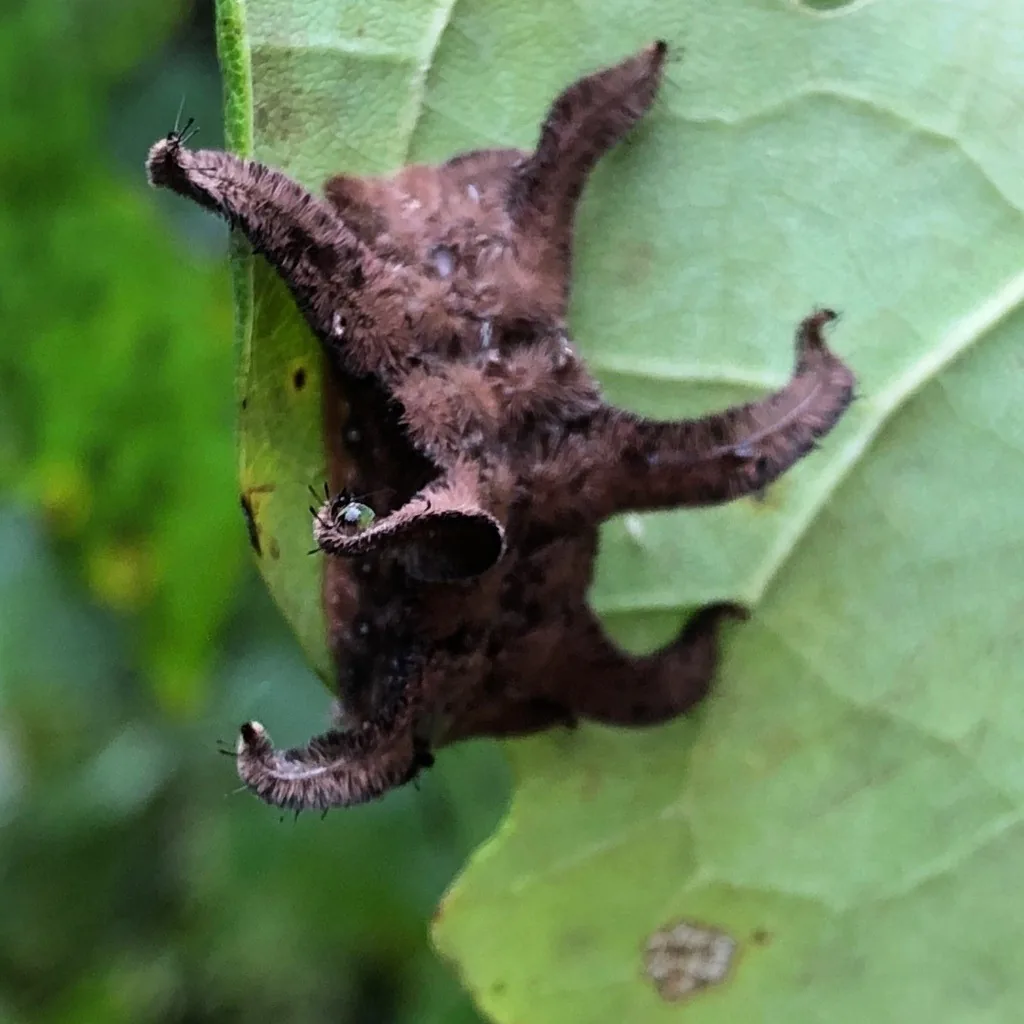
- The caterpillar is brown with nine pairs of fleshy lobes, all with stinging hairs. Mississippi State calls the long, wavy, hair-covered arms unique among slug caterpillars and says three pairs are usually longer than the others, especially in older caterpillars.[1][2]
- A resting caterpillar looks more like a dried leaf or a bit of dead brown plant material than something a bird would eat. It is also known as the monkeyslug or monkey slug caterpillar.[1][2]
- The adult is a small, unusually hairy moth with a stout body and a wingspan of 2-2.8 cm. The male's wings are mostly see-through with black veins and edges; the female's forewings are mixed yellow and brown.[2][3]
Look-alikes
| Look-alike | How to tell them apart |
|---|---|
| Saddleback caterpillar | Another slug caterpillar, but with a charcoal gray body and a lime green saddle across its middle (Clemson) and stinging hairs on four prominent knobs at the front and rear (NC State). The hag moth caterpillar is brown and hairy, with long wavy arms instead of horns; Kentucky says it is less venomous than the saddleback.[6][7][1] |
Where it lives
BAMONA gives the range as Maine and Quebec to Florida, west to Nebraska, Arkansas and Mississippi. GBIF records reach farther west: it holds 2,255 U.S. records since 1990 from 37 states and territories, led by Texas (335), Virginia (168), Florida (144), North Carolina (138) and Maryland (135). Kentucky and Mississippi State both cover it.[3][8][1][2]
Biology and life cycle
Slug caterpillars are short and stocky and creep over leaves like slugs; the head and legs cannot be seen from above.[1]
It is usually seen feeding on the undersides of leaves on lower branches. BAMONA gives the adult flight season as May to September.[1][3]
Damage and signs
Health risk
Kentucky says stinging caterpillars have hollow, quill-like hairs connected to poison sacs. Reports on this species differ: Kentucky says it is less venomous than the saddleback, and Mississippi State says its stings are reported to be milder than some other slug caterpillars', with some people saying it cannot sting and others that it can. Poison Control lists the symptoms of a caterpillar sting as stinging or burning pain, skin redness, itching, swelling, welts and blisters, and says to call 911 at once for difficulty breathing, fainting, or swelling of the lips, face or tongue. MedlinePlus adds that some caterpillars cause allergic reactions, especially if the hairs touch the eyes, skin or lungs.[1][2][4][5]
Control
Prevention
Kentucky says most encounters with stinging caterpillars come from accidentally brushing against leaves they are feeding on. If you find one on yourself, don't brush it off or slap it with a bare hand; remove it carefully with a stick or other object.[1]
Kentucky warns that the hollow spines may break off in clothing or gloves, where they can still cause a sting.[1]
Traps and physical control
Stinging caterpillars are not met often, and Kentucky does not recommend preventive sprays. For a single caterpillar, clip the leaf or stem it is on and move it away from where people work or play.[1]
More from Virginia Cooperative Extension
Virginia Cooperative Extension notes that the long, twisted side appendages are not legs and can break off without harming the caterpillar, probably to escape predators; the stinging spines sit in tufts underneath them, and the caterpillar glides rather than walks on a smooth, hairless yellowish underside.[9]
Common questions
- What should I do if a caterpillar stings me?
- MedlinePlus and Poison Control both say to put sticky tape on the spot and pull it off to remove the hairs (repeat with fresh tape as needed), then wash the area with soap and water. MedlinePlus adds ice wrapped in a cloth, 10 minutes on and 10 minutes off, then a baking soda paste; Poison Control says ice and pain relievers such as ibuprofen or acetaminophen can help and that pain usually improves within a few hours. Call the Poison Help line at 1-800-222-1222 for advice, see a health care provider if blisters or eye irritation persist, and call 911 for trouble breathing or swelling of the face, lips or tongue.[5][4]
- Does the adult hag moth sting?
- No. Only the caterpillar stage has stinging hairs; Kentucky says the adults of these species do not.[1]
- What is a monkey slug?
- It is the caterpillar of the hag moth. Mississippi State says monkey slugs belong to the slug caterpillar family, known for their odd look, slug-like way of moving and ability to sting if mishandled, and that their long, wavy, hair-covered arms are unique in that family.[2]
Sources
- University of Kentucky Entomology (ENTFACT), “Stinging Caterpillars (ENTFACT-003).” entomology.mgcafe.uky.edu/ef003 (accessed 2026-11-12)
- Mississippi State University Extension Service, “Monkey Slug (Bug's Eye View, Vol. 10, No. 13).” extension.msstate.edu/newsletters/bugs-eye-view/2024/monkey-slug-vol-10-no-13 (accessed 2026-11-12)
- Butterflies and Moths of North America (BAMONA), “Hag Moth, Phobetron pithecium (species page).” www.butterfliesandmoths.org/species/Phobetron-pithecium (accessed 2026-11-12)
- National Capital Poison Center (Poison Control), “Are caterpillars poisonous?.” www.poison.org/articles/caterpillar-stings (accessed 2026-11-12)
- NIH National Library of Medicine, MedlinePlus, “Caterpillars (Medical Encyclopedia).” medlineplus.gov/ency/article/002860.htm (accessed 2026-11-12)
- Clemson Cooperative Extension, Home & Garden Information Center, “Stinging Caterpillars (HGIC).” hgic.clemson.edu/factsheet/stinging-caterpillars/ (accessed 2026-11-12)
- NC State Extension, North Carolina State University, “Saddleback Caterpillar.” content.ces.ncsu.edu/saddleback-caterpillar (accessed 2026-11-12)
- Global Biodiversity Information Facility (GBIF), “Phobetron pithecium: U.S. occurrence records since 1990 by state (GBIF occurrence search).” api.gbif.org/v1/occurrence/search?taxonKey=1752111&country=US&hasGeospatialIssue=false&occurrenceStatus=PRESENT&year=1990%2C2026&facet=stateProvince&facetLimit=400&limit=0 (accessed 2026-11-12)
- Virginia Cooperative Extension, “Hag Moth Caterpillar.” www.pubs.ext.vt.edu/ENTO/ENTO-19/ENTO-19.html (accessed 2026-11-12)
- iNaturalist, “Phobetron pithecium taxon page (order and family).” www.inaturalist.org/taxa/122254 (accessed 2026-10-06)