On this page
How to identify it
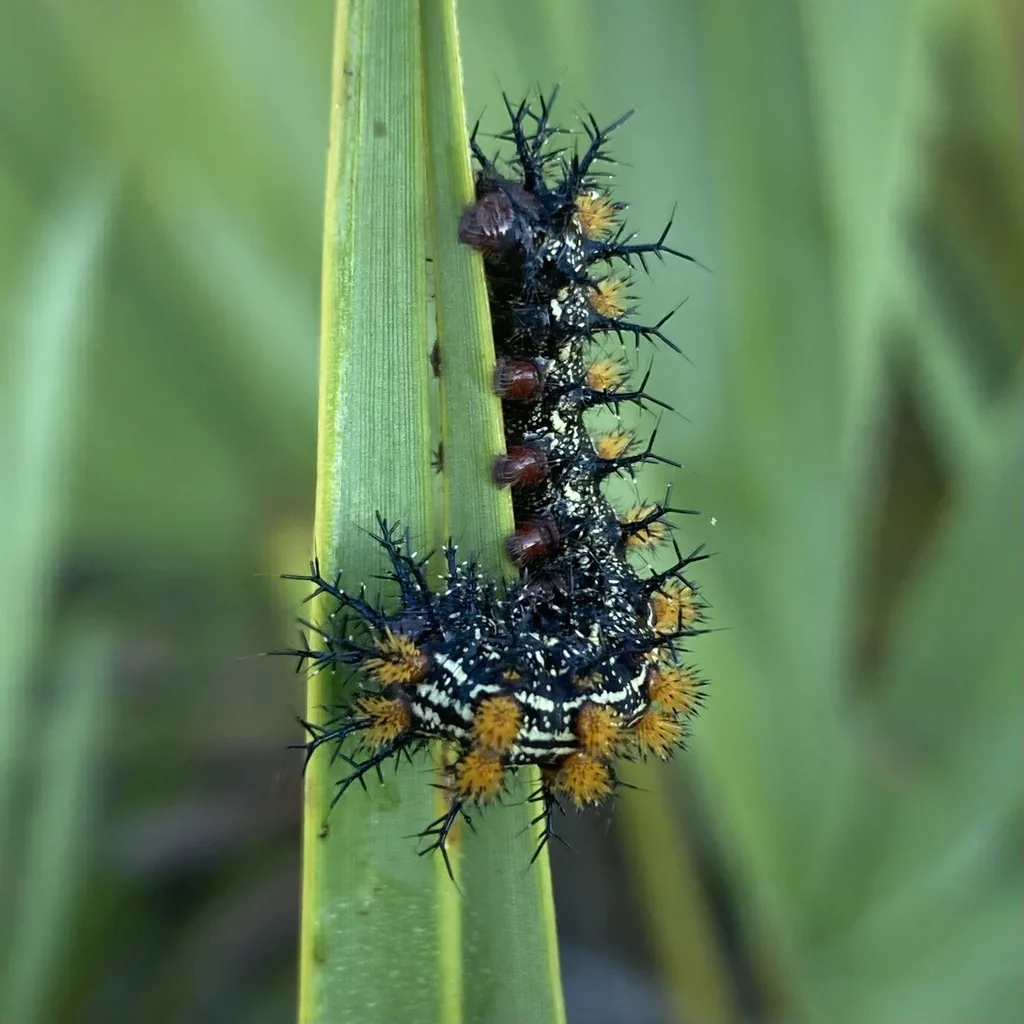
- Older caterpillars are black and spiny, often covered with tiny white spots, sometimes so many that they look almost white. Kentucky describes the mature caterpillar as brown to purplish black with numerous yellow spots, so coloring varies. UF/IFAS describes a more common dark form, black with many tiny white dots, and a light form that is white with a reddish head; grown caterpillars reach 6.5 cm (2.5 inches), and the breathing pores along the sides are pale brown edged with black.[1][4][5][6]
- The spines are branched and grouped on bumps in several rows along the body; the ones on top are longer and more branched, and they may have red or black tips. UF/IFAS says the spines sit on raised, hardened bumps called tubercles and scoli and are connected to venom glands inside the caterpillar's body.[1][4][5]
- Young caterpillars feed in groups; older ones tend to be solitary. UF/IFAS says they stay together for their first three larval stages, then split up and wander onto other plants to finish feeding.[1][2][5]
- The adult is a dark gray to black moth with a white band and an eyespot on each wing and a wingspan of 2 to 3 inches. Females are larger; the male's abdomen has a red tip. UF/IFAS gives the wingspan as 5 to 7.5 cm, notes a black-bordered, kidney-shaped spot on the forewing, and says Florida specimens more often have a reduced white band on the forewing.[1][2][5]
Look-alikes
| Look-alike | How to tell them apart |
|---|---|
| Io moth caterpillar | Light green to yellow, with a narrow red line bordered below by white along each side, and covered with black-pointed yellow spines. UF/IFAS describes io caterpillars as pale green with a yellow-white and a red stripe, up to 6.5 cm long, with yellow or green, black-tipped spines clustered on fleshy bumps.[4][6] |
| Saddleback caterpillar | Brown at the front and rear and green in the middle, with a purple spot in the center of the green 'saddle' and two prominent horns at each end. UF/IFAS adds that the brown oval saddle is usually bordered with white and that grown caterpillars reach about 2 cm.[4][6] |
| Nevada and New England buck moth caterpillars | UF/IFAS says light-colored buck moth caterpillars can be confused with these relatives. Host plants are the best way to separate them: Nevada buck moth caterpillars feed mainly on willow and New England buck moth caterpillars on meadowsweet (Spiraea), while the buck moth feeds on oaks. The buck moth's spines are also longer.[5] |
Where it lives
Maine west to eastern Kansas and south to northern Florida, the Gulf states and eastern Texas. It lives in scrub oak-pine sand barrens, oak woods and oak trees in cities. UF/IFAS puts it in the eastern U.S. from Maine to Florida, with records as far west as Wisconsin, Kansas and Texas.[2][5]
Biology and life cycle
Unlike most giant silkworm moths, females lay eggs in fall, in a tight ring around an oak twig. The eggs spend the winter there and hatch the next spring.[1][2]
Hosts are mainly oaks, including scrub oak, live oak, blackjack oak and dwarf chestnut oak. Kentucky also finds them on willow. UF/IFAS says larvae prefer scrub oak where it grows and have been reared successfully on willow.[1][2][4][5][6]
Grown caterpillars crawl down and pupate in leaf litter or a few inches into soft soil. UF/IFAS says they pupate in debris on or near the ground, and any cocoon they spin is not very large.[1][2][5]
Moths emerge from September through December, though some wait a year or two. There is one generation a year. UF/IFAS gives the main flight period as October to November, with records as early as September in northern states and as late as December in Florida, and says some may not leave the pupa for up to two years.[1][2][4][5]
Adults do not feed. They emerge in the morning, mate in early afternoon, and females lay eggs in late afternoon. UF/IFAS says adults have no functional mouthparts, are very quick fliers, and are seen most often between noon and 2:00 pm in oak forests in sunny weather; females lay their eggs in a ring around a host branch after mating.[1][2][5]
Damage and signs
- Caterpillars can be common on oak or willow from spring to midsummer, and people most often meet them when mature caterpillars leave the trees looking for a place to pupate.[4]
- Outbreaks can bring a run of stings: in a rural West Virginia community in 1991, 19 people came to a health center over five weeks starting in May with painful rashes from buck moth caterpillars.[7]
Health risk
A sting can cause burning pain, redness, itching, swelling, welts and blisters, and sometimes headache and nausea. In a Louisiana poison center study of caterpillar stings that included buck moth caterpillars, 96% of patients had local pain, 89% redness and 72% swelling, and 61% still had mild to moderate effects 24 hours later. Severe allergic reactions (anaphylaxis) are rare.[3][8][9]
Control
Prevention
Not handling spiny caterpillars is one of the best ways to avoid stings. Teach children to leave caterpillars alone, wear a hat and gloves when gardening, and watch under oaks and willows from spring to midsummer. UF/IFAS gives the same advice.[1][3][4][5]
Traps and physical control
If one lands on you, don't brush it off or slap it with a bare hand; remove it with a stick or other tool. A single caterpillar can be moved by clipping the leaf or twig it is on.[4][3]
Pesticides
Buck moth caterpillars aren't especially resistant to insecticides. Bacillus thuringiensis works on young caterpillars, and carbaryl or another labeled insecticide can be used where they are numerous around homes, schools or recreation areas. Preventive sprays aren't recommended. Read and follow the label.[1][4]
First aid for a buck moth sting
Remove the caterpillar without using your hands. Put tape, such as duct or masking tape, sticky side down over the area and pull it off; repeat with fresh pieces until the hairs and spines are out.[3][9]
Wash the area with soap and water. Then apply ice wrapped in a clean cloth, 10 minutes on and 10 minutes off; MedlinePlus suggests a paste of baking soda and water after several ice treatments.[9][3]
Pain usually improves within a few hours; ice and ibuprofen or acetaminophen can help. For itching, Poison Control suggests hydrocortisone cream, then an oral or topical antihistamine if that doesn't help.[3]
If hairs get in the eyes, rinse right away with plenty of water and get medical help. Get medical care if hairs are breathed in. Call 911 for trouble breathing, fainting or swelling of the lips, face or tongue.[9][3]
For advice, call Poison Help at 1-800-222-1222, any time, from anywhere in the U.S.[9][3]
Removing the hairs comes first: in one Poison Control case, ice, baking soda, creams and oral antihistamines gave no relief from a caterpillar sting until the hairs were pulled out with tape, while in another case an antihistamine was part of a quick recovery.[3]
The buck moth's family
The buck moth is a giant silkworm moth (family Saturniidae), a mainly tropical family that also includes the luna, imperial, polyphemus, regal and io moths, all found in Florida. Adults in this family have reduced or no mouthparts and live on reserves built up by the caterpillars.[5]
It belongs to the subfamily Hemileucinae, the buck and day moths, found only in the Western Hemisphere and mostly in the tropics; caterpillars in this group carry many multi-branched spines used for defense.[5]
A western relative, the range caterpillar (Hemileuca olivae), feeds on grasses in Mexico and parts of Colorado, Kansas, New Mexico, Oklahoma and Texas and can be a problem for livestock in infested pastures.[5]
Common questions
- Why is it called a buck moth?
- The adult moths fly during the day in fall, during deer season, when other moths usually don't fly by day.[1]
- Do the adult moths sting?
- No. Only the caterpillar stage has stinging spines, and the adults don't even feed.[4][1][2]
- When are buck moth caterpillars around?
- Eggs hatch in spring, and caterpillars can be found from spring into midsummer before they pupate.[4][1][2]
- Are light-colored spiny caterpillars on willow buck moths?
- Not necessarily. UF/IFAS says light buck moth caterpillars resemble the Nevada buck moth, which feeds mainly on willow; host plant is the best clue, and buck moth spines are longer.[5]
Sources
- NC State Extension, “Buck Moth (PDIC Factsheet, reviewed October 3, 2026).” content.ces.ncsu.edu/buck-moth (accessed 2026-11-14)
- Butterflies and Moths of North America, “Eastern buckmoth, Hemileuca maia (species account).” www.butterfliesandmoths.org/species/Hemileuca-maia (accessed 2026-11-14)
- Poison Control, National Capital Poison Center, “Are caterpillars poisonous?.” www.poison.org/articles/caterpillar-stings (accessed 2026-11-14)
- University of Kentucky Entomology, “ENTFACT-003: Stinging Caterpillars.” entomology.mgcafe.uky.edu/ef003 (accessed 2026-11-14)
- University of Florida/IFAS Extension (Featured Creatures), “Buck Moth, Hemileuca maia (Drury), IN834.” ask.ifas.ufl.edu/publication/IN834 (accessed 2026-11-14). Used for identification, range, biology and relatives; its sting-symptom and first-aid lines are not used (medical-source rule).
- University of Florida/IFAS Extension, “Stinging Caterpillars, IN014.” ask.ifas.ufl.edu/publication/IN014 (accessed 2026-11-14). Used for caterpillar descriptions and host plants only; symptom lines are not used (medical-source rule).
- West Virginia Medical Journal, via PubMed, “An epidemic of caterpillar sting dermatitis in a rural West Virginia community (Walker et al. 1993).” pubmed.ncbi.nlm.nih.gov/8442349/ (accessed 2026-11-14)
- Veterinary and Human Toxicology, via PubMed, “Caterpillar envenomations: a prospective study of 112 cases (Everson, Chapin and Normann 1990).” pubmed.ncbi.nlm.nih.gov/2327053/ (accessed 2026-11-14)
- MedlinePlus, U.S. National Library of Medicine, “Caterpillars (Medical Encyclopedia).” medlineplus.gov/ency/article/002860.htm (accessed 2026-11-14)
- iNaturalist, “Hemileuca maia taxon page (order and family).” www.inaturalist.org/taxa/1587238 (accessed 2026-11-14)