On this page
How to identify it
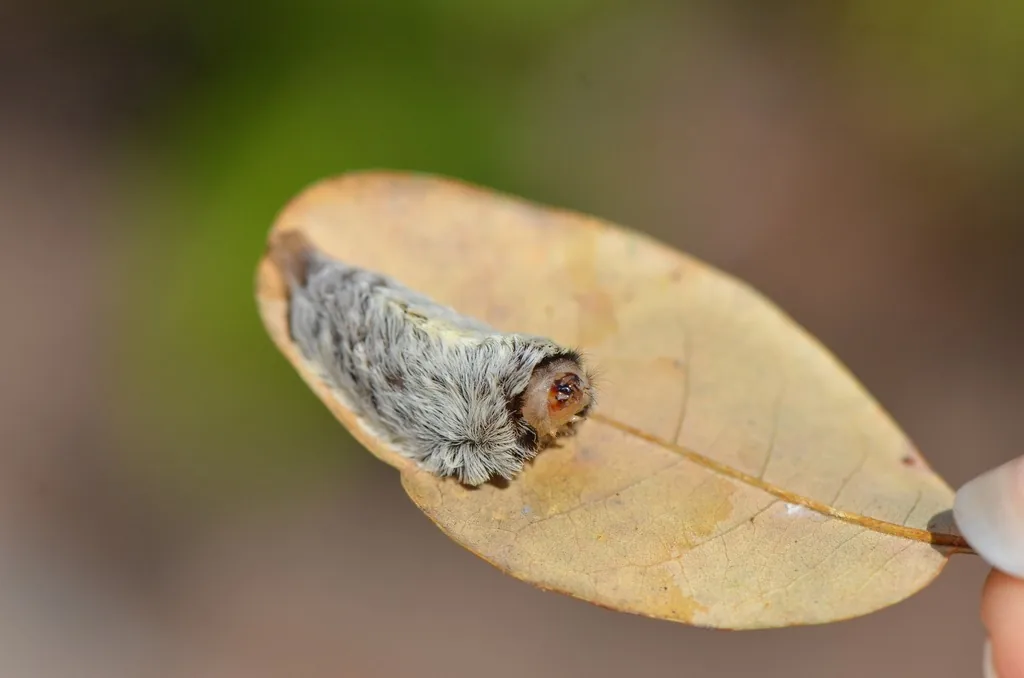
- A plump, teardrop-shaped caterpillar covered in a dense coat of soft hair that tapers into a tail-like tuft at the rear.[6][2][7][4]
- The hair is usually tan to brown or gray, sometimes with a crest of rusty hairs along the back and whitish tufts along the sides.[6][2][4]
- The head is carried beneath the body, so it is hard to spot. UF/IFAS says the head and the segment behind it may show when the caterpillar is moving about or now and then while feeding.[7][5]
- Short, hollow venomous spines, each with a venom gland at the base, are hidden under the long silky hairs; the long hairs themselves are harmless.[6][7][4]
- Flannel moth caterpillars have seven pairs of fleshy prolegs; other caterpillars have five pairs or fewer. UF/IFAS says the extra prolegs sit on the second and seventh abdominal segments and lack the hooks found on the others.[2][5]
- The adult southern flannel moth is golden yellow, grading to paler beige at the rear, with black hairy legs; the moths are even hairier than the caterpillars.[2][7]
- Young caterpillars look different: UF/IFAS says first and second instars have a yellow skin that turns pale greenish white to white later, and the caterpillars get hairier with each molt, so early instars carry far fewer hairs. Only late instars have the hairy tail.[5][8]
- Full-grown caterpillars that UF/IFAS reared on winged elm measured about 3.5 cm (1.4 inches) in body length and 4.0 cm (1.6 inches) including the tail.[5]
- UF/IFAS gives the adult moth a wingspan of 2.4 to 3.6 cm (about 1 to 1.5 inches), with females larger than males. The front wings are yellow with some black along the front edge and wavy white hair-like scales, the hind wings creamy yellow, and the thick body fur mostly orange on the thorax. Males have comb-like antennae; a female's look almost thread-like.[5]
Look-alikes
| Look-alike | How to tell them apart |
|---|---|
| Black-wave flannel moth caterpillar | Very similar when mature but lacks the long tail of hairs; younger larvae bear long, white wispy hairs. Kentucky says its sting is usually not as severe as the puss caterpillar's.[6][2] |
| White flannel moth caterpillar | Yellow with a wide black stripe down the back carrying two rows of raised yellow tufts, so it looks polka-dotted; it feeds especially on redbud, honey locust, hackberry and mimosa.[6][2] |
| Other caterpillars | Many hairy or spiny caterpillars are harmless, and saltmarsh caterpillars are often mistaken for stinging ones. If you aren't sure what a hairy caterpillar is, don't touch it.[7][9][2] |
Where it lives
Found in the southeastern and south-central United States, particularly Texas, Louisiana and Florida; Texas A&M calls it perhaps the most common stinging caterpillar in Texas. Missouri lists it among the flannel moths likely found there, and it lives in trees and shrubbery around homes, schools and parks. UF/IFAS gives the range as New Jersey to Florida and west to Arkansas and Texas; it is common in Florida and most abundant in Texas from Dallas southward.[10][4][9][2][5]
Biology and life cycle
Two generations occur each year, with caterpillars most abundant in July and October. UF/IFAS adds that a partial third brood is possible in the Deep South.[1][5]
Young caterpillars feed in groups on the leaf surface; older ones eat whole leaves.[1][6]
Hosts include elm, hackberry, maple, oak, sycamore, apple, fruit trees and many shrubs; Mississippi reports outbreaks on azalea and yaupon holly. UF/IFAS says hosts in 41 plant genera have been recorded, though some records may be wrong; in north central Florida it is most common on oaks and also common on elms, including the exotic Chinese elm. UF/IFAS's stinging-caterpillar guide names oaks and citrus as the usual hosts.[1][6][7][5][8]
Second-generation caterpillars spin a tough cocoon on the host plant, often on the trunk or branches, and spend the winter in it. The cocoon has a bump on the back and a round hatch lid the moth pushes open in spring; it is brown and weathers to gray. UF/IFAS says cocoons are about 1/2 to 3/4 inch long and sit on twigs and branches, in deep bark furrows or under loose bark; mature caterpillars sometimes wander off the host first and spin on nearby plants or buildings. The caterpillar packs its own hair into the hump. First-generation larvae pupate about 16 days after finishing the cocoon and the moths emerge about two weeks later, while the fall generation overwinters as prepupae and pupates in late spring.[1][2][5]
Females cover their eggs with hairs from the abdomen. The adult moths don't eat and don't sting.[2][7][6]
Sting severity increases with the size of the caterpillar and how much of it touches the skin.[6][7]
Females usually mate the night they emerge and lay eggs over the next two nights, in single or double curved rows (sometimes patches) on leaves or small twigs, covered with hair from the female's abdomen. The light yellow eggs hatch in six to eight days.[5]
Young caterpillars skeletonize leaves and later chew small holes; late instars feed from the leaf edge, curling the front of the body over the leaf. UF/IFAS reports larval development of about six weeks at 25°C (77°F) on yaupon holly, and 63 to 97 and 53 to 87 days for two sets reared on an artificial diet.[5]
Empty cocoons are extremely tough and stay on trees long after the moth has left, some long enough to grow lichens. UF/IFAS reports ants raising brood and spiders living in old cocoons.[5]
Damage and signs
Health risk
Stings cause burning pain, sometimes intense and radiating, with redness, swelling and itching; nausea, headache, abdominal upset and chest pain are also reported. Of 3484 stings reported to Texas poison centers in 2000 to 2016, 89% were managed outside a health care facility and 93% had no more than minor effects. A 2024 emergency medicine case report describes the sting's characteristic grid-like, hemorrhagic rash.[10][11][12][13][14]
Control
Prevention
Learn to recognize puss caterpillars, look before you grab railings or branches, don't sit under trees where caterpillars can drop on you, and wear long sleeves and pants in wooded areas. Teach children not to pet fuzzy caterpillars.[6][9][15]
Traps and physical control
Don't touch one with a bare hand; move it with a stick or tool, or clip and relocate the leaf or stem it is on.[6][15]
Pesticides
Preventive sprays aren't recommended. Where they are numerous around homes or schools, Kentucky and NC State name carbaryl or Bacillus thuringiensis, though Bt works poorly on older caterpillars; Mississippi State names pyrethroids such as bifenthrin or permethrin. Dead caterpillars can still sting. UF/IFAS says natural enemies keep puss caterpillars under control in most years, and where control is needed, Bt or insecticides recommended for other caterpillars should work.[6][1][7][5]
First aid for a puss caterpillar sting
Shake the caterpillar off without using your hands, then press tape onto the skin sticky side down and pull it up to remove the spines. Repeat with fresh tape until they are out.[15][13][9]
Wash the area with soap and water, then ice it, wrapped in a cloth, 10 minutes on and 10 off.[13]
Poison Control describes a teenager stung on a stair rail who used tape, washing, hydrocortisone cream and an oral antihistamine; his pain and redness went away quickly. A review of Lepidoptera reactions says topical steroids and oral antihistamines are often used after the hairs are removed.[15][16]
Pain relief can be hard: in a study of 96 Central Texas stings from 1996, no treatment promptly relieved the pain.[11]
Call 911 for trouble breathing, fainting, or swelling of the lips, face or tongue. See a health care provider for blistering, eye irritation that won't go away or a suspected allergic reaction; Poison Help is 1-800-222-1222.[15][13]
When stings peak
Texas poison center reports were highest in July (12%) and October to November (59%), and 91% of stings happened at the patient's own home.[12]
A study of 188 case reports put the peak months at July through November, with few cases at other times of year.[10]
Where sources disagree
Size: Kentucky and Mississippi State say mature caterpillars are about one inch long; Missouri says about 1 1/2 inches.[6][7][2]
Where it lives: a case study and a medical review describe it as confined to or found in the southeastern and south-central U.S., largely Texas, Louisiana and Florida; Missouri's conservation department says it is likely found in Missouri too.[10][4][2]
Spraying heavy infestations: Kentucky and NC State suggest carbaryl or Bt; Mississippi State suggests pyrethroids.[6][1][7]
Mature size: UF/IFAS measured caterpillars reared on winged elm at about 3.5 cm (1.4 inches) without the tail, and its stinging-caterpillar guide says almost 1 inch, alongside the figures above.[5][8]
Range: UF/IFAS gives New Jersey to Florida and west to Arkansas and Texas, a wider range than the medical sources above.[5]
Generations: NC State puts the two broods' peaks in July and October; UF/IFAS's stinging-caterpillar guide says one generation in spring and one in fall in Florida.[1][8]
Natural enemies
UF/IFAS reports green lacewing larvae (Chrysopa) feeding on eggs and young caterpillars; older caterpillars are probably well protected from vertebrate predators by their spines.[5]
At least four tachinid fly species parasitize it, laying eggs on the caterpillar; the flies usually finish developing inside the cocoon. A Galveston, Texas population had 20% parasitism, with similar rates in Central Florida.[5]
Two ichneumonid wasps also attack it. One, Lanugo retentor, lays its eggs through the cocoon wall and chews an exit hole of 2 to 3 mm, often through the lid; it parasitized 50% of one New Orleans population.[5]
Common questions
- Why is it called a puss caterpillar?
- Its thick, fluffy hair looks like a cat's fur. It is also called an asp, and other common names include tree asp and woolly slug. UF/IFAS says the name probably comes from its likeness to a cat, with soft fur and a tail; older names include Italian asp, possum bug and perrito (Spanish for puppy). The species name opercularis refers to the lid on the cocoon.[1][4][5]
- Can a dead puss caterpillar still sting?
- Yes. Mississippi State warns that dead caterpillars can still sting, so don't pick them up after spraying.[7]
- Does the flannel moth sting?
- No. Only the caterpillar has stinging spines; the hairy adult moths don't sting.[6][7]
- Should I go to the hospital after a puss caterpillar sting?
- Most people don't need to: in Texas poison center data, 89% of stung patients were managed outside a health care facility. Get emergency care for trouble breathing or face and throat swelling, and call Poison Control for advice.[12][15]
- What are the small humped cocoons with a lid on my tree?
- Probably old southern flannel moth cocoons. UF/IFAS says they are about 1/2 to 3/4 inch long, with a hump on the back and a flat front lid the moth pushes open, and they are so tough they stay on trees long after the moth has gone.[5]
Sources
- NC State Extension, “Puss Caterpillar (PDIC Factsheet, reviewed May 8, 2023).” content.ces.ncsu.edu/puss-caterpillar (accessed 2026-11-14)
- Missouri Department of Conservation, “Flannel Moths (Field Guide).” mdc.mo.gov/discover-nature/field-guide/flannel-moths (accessed 2026-11-14)
- Annals of Emergency Medicine, via PubMed, “Envenomation by the puss caterpillar (Megalopyge opercularis) (Pinson and Morgan 1991).” pubmed.ncbi.nlm.nih.gov/2024798/ (accessed 2026-11-14)
- StatPearls (NCBI Bookshelf), via PubMed, “Butterfly, Moth, and Caterpillar Envenomation (Goldman et al., StatPearls 2024).” pubmed.ncbi.nlm.nih.gov/30969673/ (accessed 2026-11-14)
- University of Florida/IFAS Extension (Featured Creatures), “Puss Caterpillar (Larva), Southern Flannel Moth (Adult), Megalopyge opercularis, EENY-545/IN976 (D. W. Hall).” ask.ifas.ufl.edu/publication/IN976 (accessed 2026-11-14). Used for identification, range, biology, natural enemies and control; its sting symptoms and treatment notes are not used on their own.
- University of Kentucky Entomology, “ENTFACT-003: Stinging Caterpillars.” entomology.mgcafe.uky.edu/ef003 (accessed 2026-11-14)
- Mississippi State University Extension Service, “Puss Caterpillar, Bug's Eye View Vol. 7, No. 19 (B. Layton).” extension.msstate.edu/newsletters/bugs-eye-view/2021/puss-caterpillar-vol-7-no-19 (accessed 2026-11-14)
- University of Florida/IFAS Extension (EDIS), “Stinging and Venomous Caterpillars of the Southeast, SP107/IN014.” ask.ifas.ufl.edu/publication/IN014 (accessed 2026-11-14). Used for caterpillar identification, hosts and generations only.
- Texas A&M AgriLife, “Watch out for fuzzy, stinging caterpillars (AgriLife Today).” agrilifetoday.tamu.edu/2022/04/14/start-looking-out-for-stinging-caterpillar (accessed 2026-11-14)
- Clinical Toxicology, via PubMed, “Envenomation by the asp caterpillar (Megalopyge opercularis) (Eagleman 2008).” pubmed.ncbi.nlm.nih.gov/18344102/ (accessed 2026-11-14)
- Journal of Toxicology: Clinical Toxicology, via PubMed, “A retrospective analysis of 96 "asp" (Megalopyge opercularis) envenomations in Central Texas during 1996 (Stipetic et al. 1999).” pubmed.ncbi.nlm.nih.gov/10465242/ (accessed 2026-11-14)
- Wilderness and Environmental Medicine, via PubMed, “Megalopyge opercularis Caterpillar Stings Reported to Texas Poison Centers (Forrester 2018).” pubmed.ncbi.nlm.nih.gov/29625901/ (accessed 2026-11-14)
- MedlinePlus, U.S. National Library of Medicine, “Caterpillars (Medical Encyclopedia).” medlineplus.gov/ency/article/002860.htm (accessed 2026-11-14)
- Clinical Practice and Cases in Emergency Medicine, via PubMed Central, “Severely Painful and Pruritic Forearm Rash: A Case of Caterpillar Envenomation in South Florida (Autrey et al., 2024).” pmc.ncbi.nlm.nih.gov/articles/PMC11166065/ (accessed 2026-11-14). PMID 38869339
- Poison Control, National Capital Poison Center, “Are caterpillars poisonous?.” www.poison.org/articles/caterpillar-stings (accessed 2026-11-14)
- Dermatologic Therapy, via PubMed, “Caterpillars and moths (Hossler 2009).” pubmed.ncbi.nlm.nih.gov/19580579/ (accessed 2026-11-14)
- iNaturalist, “Megalopyge opercularis taxon page (order and family).” www.inaturalist.org/taxa/84185 (accessed 2026-11-14)