On this page
How to identify it
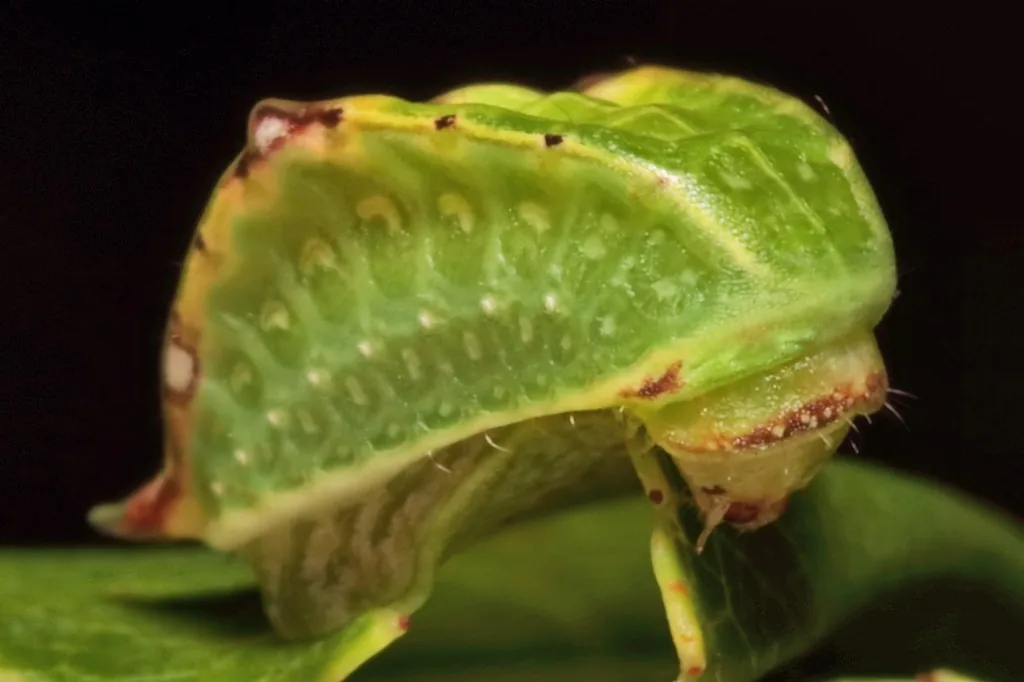
- The caterpillar is humped, with two ridges running front to back that end in a short but pronounced tail; each ridge has a small pointed bump at the crest. The head is pulled back into the thorax and the legs cannot be seen, so it looks a little like a small overturned boat. The Forest Service's Caterpillars of Eastern Forests adds that the hump is highest at the fourth abdominal segment and the rear end is drawn out to a point.[1][8]
- Color varies: some skiff caterpillars are gray, others green, and others green with small to large brown blotches. Although some other slug caterpillars carry clusters of spine-like stinging hairs, the skiff caterpillar does not. That guide describes the sides as green, sometimes with white spots that resemble damaged or dead leaf tissue, and the back as varying from brown to green; the body is smooth, without stinging spines.[1][8]
- The adult is a gray to beige moth with dark brown markings on the outer edge of the wings and a noticeable tuft of setae (hair-like scales) on the thorax. It is about an inch or a little more long with its wings folded at rest.[1]
- Like other slug caterpillars, it has no paired prolegs on the abdomen: the Forest Service guide says slug caterpillars have sucker-like pads down the middle of the first 7 abdominal segments instead, and their heads are often retracted well into the thorax.[8]
Look-alikes
| Look-alike | How to tell them apart |
|---|---|
| Saddleback caterpillar | Clemson describes the saddleback as a charcoal gray caterpillar with a lime green saddle across its middle, and NC State says it carries stinging (urticating) hairs on four prominent knobs at the front and rear plus smaller knobs along the sides; the skiff caterpillar has no stinging spines at all. The Forest Service guide describes the saddleback as charcoal black or brown with a lime green saddle that has a white-ringed brown center, and fingerlike lobes on the first and eighth abdominal segments bearing numerous stinging spines.[3][4][1][8] |
| Crowned slug caterpillar | NC State describes the crowned slug as flattened, oval and pastel green, with plumes of stinging hairs around its edge and shorter stinging hairs on top, and some have small red dots; the skiff caterpillar is humped, not flat, and has no stinging hairs. The Forest Service guide adds that the crowned slug is usually marked with red, strongly flattened, and edged in orange and red at the front.[5][1][8] |
| Yellow-shouldered slug | Green with yellow markings and a back that is flattened and then angles downward, with a corrugated surface whose setae do not sting, according to the Forest Service guide; the skiff caterpillar is instead strongly humped with a pointed tail.[8] |
Where it lives
An eastern North American moth. GBIF holds 6,052 U.S. records since 1990 from 37 states and territories, led by North Carolina (515), Virginia (453), Massachusetts (438), Maryland (431) and Ohio (430); Ohio State lists it as common in Ohio, and NC State covers it in North Carolina. It is included in the Forest Service's guide to the caterpillars of eastern forests.[6][2][1][8]
Biology and life cycle
Food plants are listed two ways: NC State names American hophornbeam, beech, black cherry, bog-myrtle, maple, oak, sycamore and other trees and shrubs, while Ohio State's moth survey lists birch, blueberry, chestnut, hornbeam, oak, poplar and willow. The Forest Service guide lists cherries, oaks and many other woody plants.[1][2][8]
Each caterpillar spins a tough, brown, oval silk cocoon and spends the winter inside it. The moth comes out the following growing season, mates and lays flat eggs singly or in small groups. In Ohio, Ohio State's survey says the moths fly in June and July and rates the species as common. The Forest Service guide puts the caterpillars out from July to October, with one generation a year in the North.[1][2][8]
Tiny braconid wasps often parasitize slug caterpillars, and together with bacterial and viral diseases they usually keep skiff caterpillar numbers sparse.[1]
Damage and signs
- The caterpillars chew leaves of their host trees and shrubs, but NC State says the skiff caterpillar is hardly ever abundant and is more of a curiosity than a true plant pest.[1]
Health risk
NC State says that although some other slug caterpillars have clusters of spine-like hairs that cause a painful sting, the skiff caterpillar has none and therefore probably cannot sting. Clemson lists slug caterpillars as one of the three main groups of stinging caterpillars, so a smooth, humped, spineless body is the feature that separates the skiff from its stinging relatives.[1][3]
Control
Prevention
No control seems necessary, NC State says, because the skiff caterpillar is hardly ever abundant, so it can simply be left alone.[1]
Biological control
Braconid wasp parasites and bacterial and viral diseases usually keep the population down without any help.[1]
Pesticides
Only in the rare event of an outbreak, NC State says Sevin (a carbaryl insecticide) or another insecticide labeled for landscape use should give more than adequate control.[1]
Common questions
- Does the skiff caterpillar sting?
- Probably not. Unlike the saddleback and some other slug caterpillars, it has no clusters of spine-like stinging hairs, so NC State says it probably cannot sting.[1]
- Why does it look like a boat?
- The body is humped, with two ridges running front to back that end in a short pointed tail, and the head and legs are tucked out of sight, so NC State says it vaguely resembles a small overturned boat, a skiff. The Forest Service guide adds that the hump is highest at the fourth abdominal segment.[1][8]
- Should I treat my tree for skiff caterpillars?
- No. They are hardly ever abundant and are kept sparse by parasitic wasps and disease; NC State considers them a curiosity rather than a pest.[1]
- When are skiff moths out?
- In Ohio, Ohio State's moth survey says the adults fly in June and July. The caterpillar stage then feeds on leaves and spins a cocoon to spend the winter in. The Forest Service guide gives July to October for the caterpillars, with one generation a year in the North.[2][1][8]
Sources
- NC State Extension, North Carolina State University, “Skiff Caterpillar, PDIC Factsheet (James Baker; published April 12, 2016, reviewed Nov. 9, 2026).” content.ces.ncsu.edu/skiff-caterpillar (accessed 2026-11-12)
- The Ohio State University, Ohio Agricultural Research and Development Center (OARDC), “Prolimacodes badia, skiff caterpillar (Moth and Butterfly Search, Research Bulletin 1192).” oardc.cfaes.osu.edu/rb1192/single.asp?ID=159 (accessed 2026-11-12)
- Clemson Cooperative Extension, Home & Garden Information Center, “Stinging Caterpillars (HGIC).” hgic.clemson.edu/factsheet/stinging-caterpillars/ (accessed 2026-11-12)
- NC State Extension, North Carolina State University, “Saddleback Caterpillar.” content.ces.ncsu.edu/saddleback-caterpillar (accessed 2026-11-12)
- NC State Extension, North Carolina State University, “Crowned Slug Caterpillar.” content.ces.ncsu.edu/crowned-slug-caterpillar (accessed 2026-11-12)
- Global Biodiversity Information Facility (GBIF), “Prolimacodes badia: U.S. occurrence records since 1990 by state (GBIF occurrence search).” api.gbif.org/v1/occurrence/search?taxonKey=1752825&country=US&hasGeospatialIssue=false&occurrenceStatus=PRESENT&year=1990%2C2026&facet=stateProvince&facetLimit=400&limit=0 (accessed 2026-11-12)
- iNaturalist, “Prolimacodes badia taxon page (order and family).” www.inaturalist.org/taxa/207603 (accessed 2026-11-10)
- USDA Forest Service, Forest Health Technology Enterprise Team, “Caterpillars of Eastern Forests, FHTET-96-34 (D. L. Wagner, V. Giles, R. C. Reardon and M. L. McManus, November 1997; scanned copy).” archive.org/details/caterpillarsofea001997 (accessed 2026-11-14). Read from the Internet Archive's full-text (djvu.txt) of this scan.