On this page
How to identify it
- It is a slug caterpillar: Ohio's field guide says slug moths are named for their sluglike caterpillars, which are slightly less than an inch long and often vividly colored, and that twenty slug moth species are known from Ohio.[4]
- Slug caterpillars are morphologically diverse. Most carry rows of spines, but some species lack spines.[5]
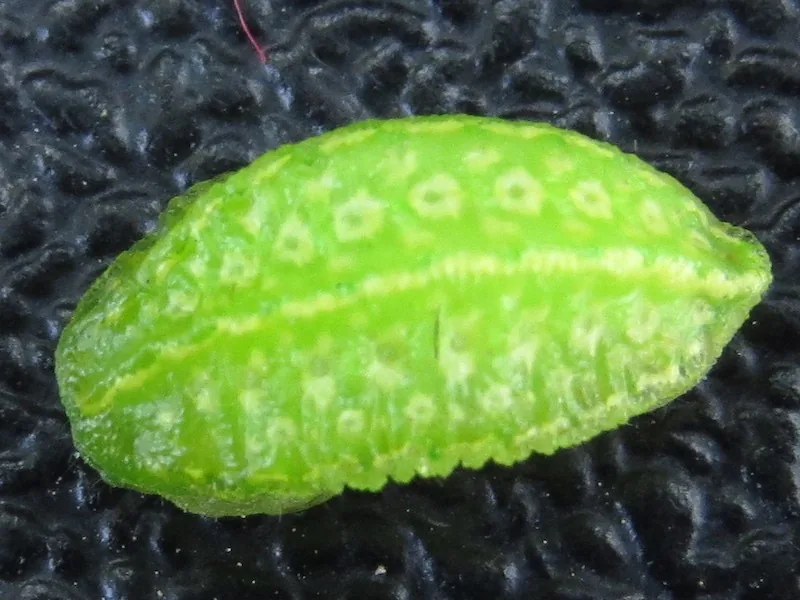
- Green with yellow markings. The skin is corrugated, with short, nonstinging hairs recessed into small depressions, and the back is flattened, then angles down to the sides.[2]
- An indistinct yellow stripe runs along each side of the back, strongest over the thorax and toward the rear, and yellow spots run down the back, around the breathing pores and in two lines below them.[2]
- Like other slug caterpillars, it has no paired fleshy legs (prolegs) on the abdomen. Instead there are suckers down the middle of the underside of the first seven abdominal segments, and the head is often retracted out of sight into the thorax.[2]
Look-alikes
| Look-alike | How to tell them apart |
|---|---|
| Apoda slug caterpillars | The USDA Forest Service guide says Apoda caterpillars are similar but have a dark shade above the yellow stripe along each side of the back.[2] |
| Saddleback and other stinging slug caterpillars | Many slug caterpillars have urticating spines, and a few can deliver a very painful sting. Clemson Extension calls the saddleback, with its charcoal grey body and lime green saddle, the most common slug caterpillar. The yellow-shouldered slug's short hairs are nonstinging and sit in small pits.[2][6] |
Where it lives
A caterpillar of eastern forests, with one generation a year in the North according to the USDA Forest Service guide. The study caterpillars came from forests of the greater Washington, D.C., area. GBIF holds about 6,500 U.S. records since 1990 from 39 state-level areas, the most from Alabama (585), North Carolina (577), Pennsylvania (508) and Texas (434).[2][3][7]
Biology and life cycle
The USDA Forest Service guide says it feeds on many forest trees and shrubs, with caterpillars from July to September and one generation a year in the North; slug caterpillars as a group prefer smooth-leaved trees and shrubs. The immune study describes Lithacodes and the spiny oak slug as highly polyphagous caterpillars of smooth-leaved trees, found in temperate eastern North American forests in late summer (June to October).[2][3]
Larval development is very drawn out, commonly 60 to 80 days or more from egg hatch to cocoon.[3]
Parasitic wasps and flies are major enemies of slug caterpillars; researchers commonly find 30 to 50% (up to 80%) of field-collected slug caterpillars parasitized.[3]
Researchers studying insect immunity reared yellow-shouldered slugs from moths and caterpillars collected in parks in Maryland and Washington, D.C., and showed that enough blood (hemolymph) can be drawn from a single caterpillar to count its blood cells.[8][3]
When injected with non-pathogenic E. coli bacteria, late-instar yellow-shouldered slugs produced more than twice the density of blood cells (hemocytes) of early-instar ones, although unchallenged small and large caterpillars had similar counts. The authors suggest this may help explain why parasitism and infection vary with a caterpillar's stage.[3]
Damage and signs
Health risk
The USDA Forest Service guide describes this caterpillar's short hairs as nonstinging, unlike the urticating spines of many other slug caterpillars, a few of which can deliver a very painful sting. A peer-reviewed study of the family likewise says most slug caterpillars carry spines with urticating properties, but some species lack spines and are nonstinging. Clemson Extension lists slug caterpillars among the three main groups of stinging caterpillars, so the nonstinging hairs are a feature of this species, not of the family.[2][5][6]
Control
Prevention
Neither the USDA Forest Service guide nor the studies recommend control. The immune study notes that parasitism of 30 to 50 percent, and up to 80 percent, is common in slug caterpillars collected in the field.[2][3]
Where it has been studied
The immune-response study used caterpillars from colonies started from moths and caterpillars collected at Little Bennett Regional Park and Patuxent National Wildlife Refuge in Maryland and Rock Creek Park in Washington, D.C.[3]
GBIF U.S. records since 1990 come from 39 state-level areas, the most from Alabama, North Carolina, Pennsylvania and Texas.[7]
Where the sources disagree
Name: BAMONA calls the moth the yellow-shouldered slug moth; GBIF lists that name too but gives ochre-winged hag moth as its default English name.[1][9]
Season: the USDA Forest Service guide gives July to September for the caterpillar; the immune study says June to October.[2][3]
Common questions
- Does the yellow-shouldered slug caterpillar sting?
- The USDA Forest Service guide describes its hairs as nonstinging and recessed in small pits in its skin. Many other slug caterpillars, including the saddleback, have urticating spines, and a few can sting very painfully.[2][6]
- When will I see yellow-shouldered slugs?
- The USDA Forest Service guide gives July to September, on the leaves of many forest trees and shrubs; the immune study describes it as a late-summer caterpillar (June to October) of smooth-leaved trees in eastern North American forests.[2][3]
- How can I tell a slug caterpillar from other caterpillars?
- Slug caterpillars lack the paired fleshy legs on the abdomen that other caterpillars have. Instead they have suckers along the middle of the underside, and their heads are often hidden under the thorax.[2]
Sources
- Butterflies and Moths of North America (BAMONA), “Yellow-shouldered Slug Moth, Lithacodes fasciola.” www.butterfliesandmoths.org/species/Lithacodes-fasciola (accessed 2026-11-14). Species page gives the name only; its description fields are empty.
- USDA Forest Service, Forest Health Technology Enterprise Team, “Caterpillars of Eastern Forests, FHTET-96-34 (D. L. Wagner, V. Giles, R. C. Reardon and M. L. McManus, November 1997; scanned copy).” archive.org/details/caterpillarsofea001997 (accessed 2026-11-14). Scanned USDA publication on the Internet Archive; full text read through archive.org's own djvu.txt download.
- PLoS ONE (via NCBI PubMed), “Hemocyte density increases with developmental stage in an immune-challenged forest caterpillar (T. M. Stoepler, J. C. Castillo, J. T. Lill and I. Eleftherianos; PLoS ONE 8(8): e70978, 2013; abstract).” pubmed.ncbi.nlm.nih.gov/23940679/ (accessed 2026-11-14). Cited from the abstract and the open-access full text (PMC3735507), read through NCBI E-utilities.
- Ohio Department of Natural Resources, Division of Wildlife, “Moths of Ohio Field Guide (Publication 5467).” dam.assets.ohio.gov/image/upload/ohiodnr.gov/documents/wildlife/backyard-wildlife/Moths%20of%20Ohio%20Field%20Guide%20pub5467.pdf (accessed 2026-11-14)
- Ecology and Evolution (via PubMed), “Lin, Lin, Braby and Hsu 2019, Evolution and losses of spines in slug caterpillars (Lepidoptera: Limacodidae) (Ecol. Evol. 9:9827-40).” pubmed.ncbi.nlm.nih.gov/31534697/ (accessed 2026-11-14). Cited from the abstract, read through NCBI E-utilities.
- Clemson Cooperative Extension, Home & Garden Information Center, “Stinging Caterpillars (HGIC 2482, revised April 22, 2020).” hgic.clemson.edu/factsheet/stinging-caterpillars/ (accessed 2026-11-14)
- Global Biodiversity Information Facility (GBIF), “Lithacodes fasciola: US occurrence records since 1990 by state (GBIF occurrence search API).” api.gbif.org/v1/occurrence/search?taxonKey=5105603&country=US&hasGeospatialIssue=false&year=1990%2C2026&facet=stateProvince&facetLimit=400&limit=0 (accessed 2026-11-14). 6,456 records from 39 state-level areas (Alabama 585, North Carolina 579, Pennsylvania 508, Texas 434); fetched 2026-11-13 at this URL.
- Journal of Visualized Experiments (via NCBI PubMed), “A simple protocol for extracting hemocytes from wild caterpillars (T. M. Stoepler, J. C. Castillo, J. T. Lill and I. Eleftherianos; Journal of Visualized Experiments (69): e4173, 2012; abstract).” pubmed.ncbi.nlm.nih.gov/23183567/ (accessed 2026-11-14). Cited from the abstract, read through NCBI E-utilities.
- Global Biodiversity Information Facility (GBIF), “Lithacodes fasciola (Herrich-Schäffer, 1854) (GBIF Backbone Taxonomy).” api.gbif.org/v1/species/5105603 (accessed 2026-11-14). ACCEPTED; order Lepidoptera, family Limacodidae; vernacular names Ochre-winged Hag Moth (default) and Yellow-shouldered Slug Moth