On this page
How to identify it
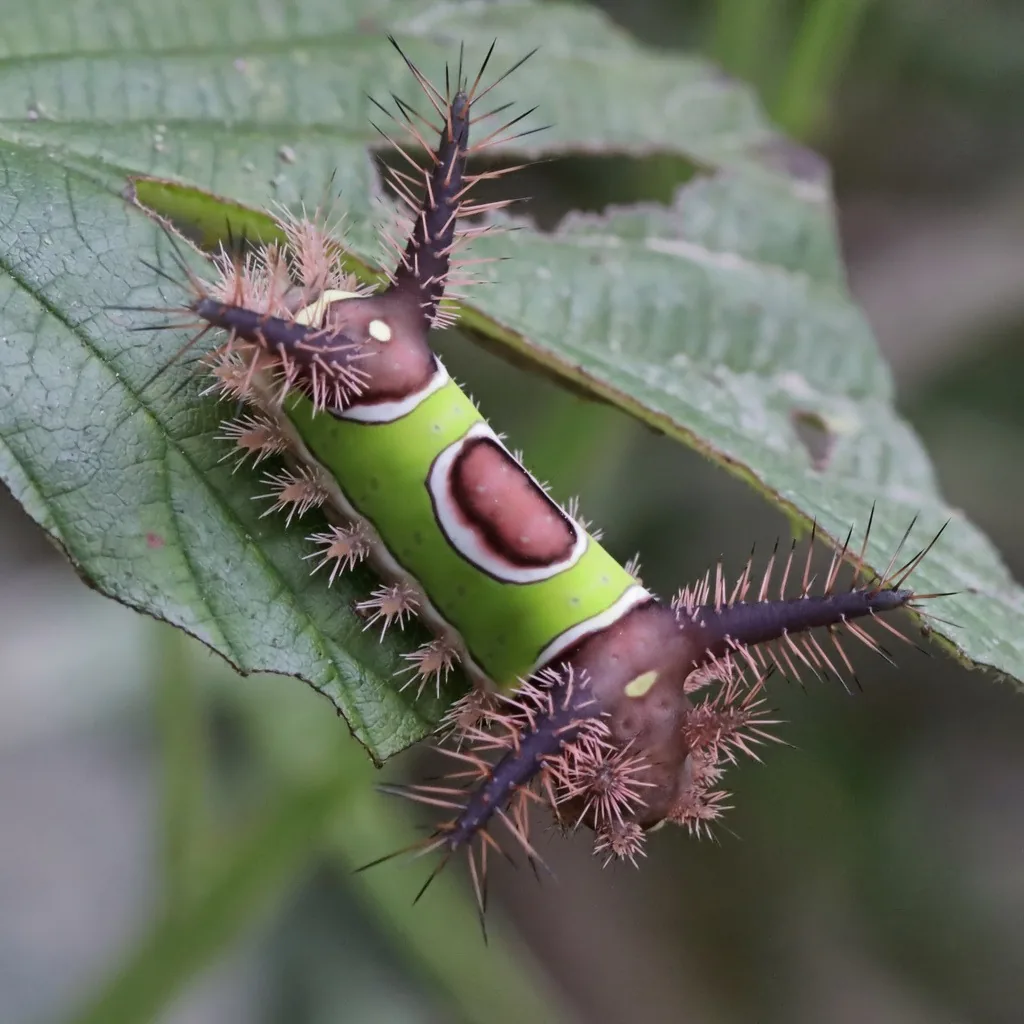
- A short, stocky body, brown at the front and rear with a green middle; a purplish-brown oval spot sits in the center of the green saddle. UF/IFAS notes cream-colored spots at the rear end that look like a face.[1][4][2][14]
- Two prominent horns at the front and two at the rear carry stinging hairs, and smaller spiny knobs run along the sides. UF/IFAS counts four large horns in all, each with long hairs and clusters of spines.[1][2][4][14]
- Slug caterpillars have very short legs, and the head and legs can't be seen from above, so they creep over leaves like slugs. UF/IFAS says the prolegs have suckers instead of hooks and the caterpillar leaves a semi-fluid silk that helps it cling, even to smooth palm leaves.[2][1][14]
- Very young caterpillars are almost transparent but already show yellow, spine-covered knobs. UF/IFAS says hatchlings can be as small as 1.2 mm and lack the warning colors, which appear in middle instars.[2][14]
- The stinging hairs are hollow, with a pore near the tip and a weak ring where the tip snaps off in the skin.[1]
- UF/IFAS says the last instar reaches about 20 mm (0.8 in) long and 7 mm wide.[14]
- The adult is glossy dark brown with a furry look, a wingspan of 26–43 mm (1.0–1.7 in), one white dot near the forewing base and one to three more near the tip.[14]
Look-alikes
| Look-alike | How to tell them apart |
|---|---|
| Spiny oak slug | Pale yellow-green with four dark patches of spines toward the rear and many spiny yellow or red lobes. Kentucky says it is less venomous than the saddleback.[1] |
| Stinging rose caterpillar | Yellow to red, with black and blue stripes down the middle of the back and prominent spiny yellow horns at the front, middle and rear.[1] |
| Other caterpillars | Most caterpillars' spines and barbs are harmless; stinging species have hollow, quill-like hairs connected to poison sacs. MedlinePlus advises not touching brightly colored caterpillars with spines, bristles or a fuzzy look.[1][6] |
Where it lives
Extension sources here describe it from Kentucky, North Carolina and South Carolina, and CDC lists it among the stinging caterpillars common in Florida. It lives on deciduous trees and shrubs and sometimes garden crops such as corn. UF/IFAS says it occurs across the eastern United States, south to Florida, north to New York and Massachusetts and west to Texas, Indiana and Kansas.[1][2][3][12][14]
Biology and life cycle
The moths come out of their cocoons in spring and summer and lay 30 to 50 tiny, flat eggs that overlap like fish scales on the upper surface of leaves. UF/IFAS describes the eggs as yellow and transparent, 1.5–2.0 mm long, and says larvae chew free after ten days.[2][14]
Young slug caterpillars may feed in groups, while older ones feed alone. In a forest study, saddlebacks reared in groups on white oak grew faster than ones reared alone, but not on American beech. UF/IFAS says larvae feed for about four to five months. Hatchlings feed together on one leaf, middle instars eat between the veins and leave see-through windows, and the last instars eat the whole leaf.[1][9][14]
It feeds on a wide range of trees, shrubs and crops; NC State says it has been reported on more than 40 plant families. Kentucky lists basswood, chestnut, cherry, oak and plum, and it can occasionally be numerous on corn. UF/IFAS lists hosts from maple, oak, pecan and citrus to many palms, orchids, dracaenas, hibiscus and crape myrtle, and says it is found on more palm species than any other slug caterpillar.[2][1][3][4][14]
Grown caterpillars are usually found in late summer. They spin tough silk cocoons and spend the winter inside them; slug caterpillars typically have one generation a year. UF/IFAS says the cocoon has a weakened circular cap that pops open when the adult emerges, and that in temperate areas the insect overwinters as a pupa.[1][4][2][14]
The moth is fuzzy and dark brown with cinnamon spots and tiny white spots. Only the caterpillar stings; the adults have no stinging hairs.[2][1]
Tiny parasitic wasps, diseases and predators usually keep numbers low. In one study, predators took 29% of saddleback cocoons set out over winter. UF/IFAS says predation on pupae accounts for a significant share of deaths.[2][10][14]
Adults have a single brood. UF/IFAS says mating flights come in June and July in the far Northeast and closer to February and March in Texas and Florida; males fly first at twilight and females later at night, and eggs are laid at night.[14]
Damage and signs
- It does little harm to the plants it feeds on; its importance is the sting to people who brush against it. UF/IFAS agrees it is not a significant defoliator of any one plant.[2][3][14]
- Stinging caterpillars are generally not found in large numbers, and in landscapes saddlebacks normally occur in very low numbers.[3][2]
Health risk
Touching the spines causes stinging or burning pain, redness, swelling and sometimes blisters; in a Louisiana poison center study, pain, redness and swelling were the most common effects, and about a quarter of patients had muscle spasms, tingling or pain radiating along an arm or leg. Severe allergic reactions are rare.[6][7][8]
Control
Prevention
Most stings happen when people brush against leaves the caterpillar is feeding on, often during yard work or mowing. Its bright warning colors make it easy to spot if you look first, and gloves and a hat help when gardening.[1][3][7]
Broken spines can stay in clothing and gloves, so handle work clothes with care after brushing against infested plants.[1]
Traps and physical control
Never brush or slap one off with a bare hand; use a stick or other tool. A single caterpillar can be moved by clipping the leaf or stem it is on, or dislodged and stepped on. UF/IFAS says removing eggs, larvae or cocoons by hand with proper protective gear and tools is effective if numbers rise.[1][7][2][14]
Pesticides
Preventive sprays aren't recommended, and Clemson says no chemical control is needed because they occur in low numbers. Where stinging caterpillars are numerous around homes, schools or play areas, Kentucky suggests Bacillus thuringiensis or carbaryl, following the label. UF/IFAS notes Bacillus thuringiensis and diflubenzuron have been used successfully against massive infestations of stinging caterpillars.[1][3][2][14]
First aid for a saddleback sting
Get the hairs out first. Press sticky tape, such as duct or masking tape, onto the spot and pull it off, and repeat with fresh pieces until the hairs are gone.[6][7]
Then wash the area with soap and water and apply ice wrapped in a clean cloth, 10 minutes on and 10 minutes off. After several rounds of ice, MedlinePlus suggests a paste of baking soda and water.[6]
Removing the hairs matters most. Poison Control describes a woman stung on the finger by a saddleback whose burning pain spread into her forearm; ice, baking soda paste, hydrocortisone and antihistamines gave no relief until tape pulled the hairs out hours later.[7]
Pain usually improves within a few hours; ice and oral pain relievers such as ibuprofen or acetaminophen can help. If tape removal doesn't help, Poison Control suggests trying an oral or topical antihistamine.[7]
If hairs get in the eyes, flush them right away with plenty of water and get medical help. Get medical care if hairs are breathed in, and call 911 for trouble breathing, fainting, or swelling of the lips, face or tongue.[6][7]
For questions, Poison Help is free and open 24 hours a day at 1-800-222-1222.[6][7]
Where sources disagree
Size: NC State says grown caterpillars are about 3/4 inch long; USGS says about an inch.[2][4]
Body color: Kentucky describes it as brown in front and rear; USGS calls the body purplish brown; Clemson describes a charcoal gray body with a lime green saddle.[1][4][3]
Treating numerous caterpillars: Kentucky names Bacillus thuringiensis or carbaryl; NC State says products labeled for landscape use should work; Clemson says no chemical control is needed.[1][2][3]
Size: NC State says grown caterpillars are about 3/4 inch long, USGS about an inch, and UF/IFAS about 20 mm (0.8 in).[2][4][14]
Moth color: NC State describes a dark brown moth with cinnamon spots; UF/IFAS describes glossy dark brown with black shading and a few white dots.[2][14]
Common questions
- Can I wear insect repellent to avoid saddleback stings?
- None of the sources here recommends repellent for stinging caterpillars. Their advice is to look before reaching into foliage, wear gloves, a hat, long sleeves and pants, and never touch spiny or brightly colored caterpillars.[7][5][6]
- Is the saddleback the worst stinging caterpillar?
- No. Kentucky says puss caterpillar stings are often more severe than those of other caterpillars, and Clemson says most caterpillar stings in the South are blamed on puss caterpillars. Among slug caterpillars, Kentucky rates the spiny oak slug as less venomous than the saddleback.[1][3]
- Why does the saddleback sting hurt so much?
- Its venom is a mix of 65 different polypeptides, and lab tests found one family of its peptide toxins acts on a human nerve receptor. More than half of the over 1500 slug caterpillar species produce pain-causing venom.[11]
- When are saddleback caterpillars around?
- Larvae feed for four to five months, and the moths fly in June and July in the far Northeast but closer to February and March in Texas and Florida, according to UF/IFAS.[14]
Sources
- University of Kentucky Entomology, “ENTFACT-003: Stinging Caterpillars.” entomology.mgcafe.uky.edu/ef003 (accessed 2026-11-11)
- NC State Extension, “Saddleback Caterpillar.” content.ces.ncsu.edu/saddleback-caterpillar (accessed 2026-11-11)
- Clemson Cooperative Extension, Home & Garden Information Center, “Stinging Caterpillars (HGIC 2482).” hgic.clemson.edu/factsheet/stinging-caterpillars/ (accessed 2026-11-11)
- U.S. Geological Survey, “Saddleback Caterpillar (Acharia stimulea), image description.” www.usgs.gov/media/images/saddleback-caterpillar-acharia-stimulea (accessed 2026-11-11)
- Texas A&M AgriLife, “Watch out for fuzzy, stinging caterpillars (AgriLife Today).” agrilifetoday.tamu.edu/2022/04/14/start-looking-out-for-stinging-caterpillar (accessed 2026-11-11)
- MedlinePlus, U.S. National Library of Medicine, “Caterpillars (Medical Encyclopedia).” medlineplus.gov/ency/article/002860.htm (accessed 2026-11-11)
- Poison Control, National Capital Poison Center, “Are caterpillars poisonous?.” www.poison.org/articles/caterpillar-stings (accessed 2026-11-11)
- Veterinary and Human Toxicology, via PubMed, “Caterpillar envenomations: a prospective study of 112 cases (Everson et al. 1990).” pubmed.ncbi.nlm.nih.gov/2327053/ (accessed 2026-11-11)
- Environmental Entomology, via PubMed, “Facilitative effects of group feeding on performance of the saddleback caterpillar (Fiorentino et al. 2014).” pubmed.ncbi.nlm.nih.gov/24472205/ (accessed 2026-11-11)
- Environmental Entomology, via PubMed, “Winter predation of diapausing cocoons of slug caterpillars (Murphy and Lill 2010).” pubmed.ncbi.nlm.nih.gov/22182555/ (accessed 2026-11-11)
- Biochemical Pharmacology, via PubMed, “Venom composition and bioactive RF-amide peptide toxins of the saddleback caterpillar, Acharia stimulea (Goudarzi et al. 2023).” pubmed.ncbi.nlm.nih.gov/37201876/ (accessed 2026-11-11)
- Centers for Disease Control and Prevention, “Caterpillar-Associated Rashes in Children, Hillsborough County, Florida, 2011 (MMWR 61(12)).” www.cdc.gov/mmwr/preview/mmwrhtml/mm6112a3.htm (accessed 2026-11-11)
- iNaturalist, “Acharia stimulea taxon page (order and family).” www.inaturalist.org/taxa/122228 (accessed 2026-11-11)
- University of Florida IFAS Extension, EDIS, “Saddleback Caterpillar, Acharia stimulea (Clemens), EENY-522/IN923 (Featured Creatures).” ask.ifas.ufl.edu/publication/IN923 (accessed 2026-11-14)