On this page
How to identify it
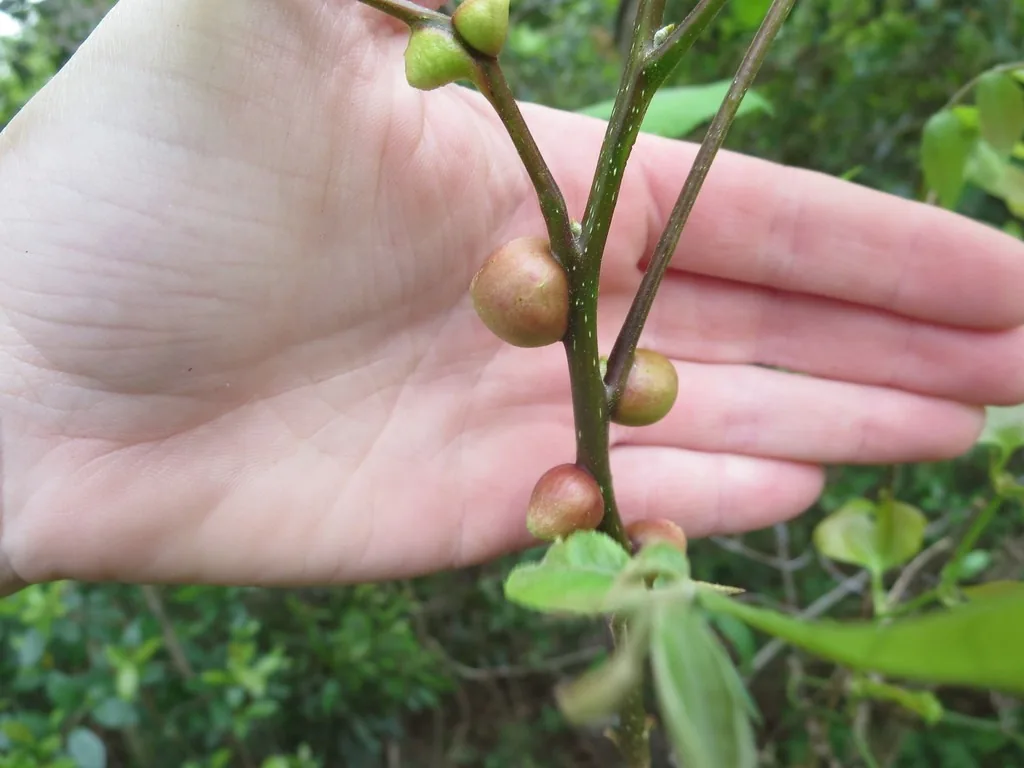
- Galls are round, up to almost an inch across, on the leaf stems (petioles), on shoots and sometimes on the midribs of the leaflets.[1][3][2]
- They start pale yellowish green, often turn red before they open, then dry to leathery or hard, woody black galls that can stay on the tree for years.[2][1]
- Sources describe the opening differently: UMass says the winged insects leave through a hole in the center of the gall on the side facing away from the plant, while Missouri says the bottom portion of the gall splits open.[1][2]
Look-alikes
Where it lives
Reported on hickories by extension services in Massachusetts, Missouri and Minnesota; it attacks many native hickories and also pecan.[1][2][3]
Biology and life cycle
The life cycle takes about a year. In spring a wingless female, the stem mother, hatches from an overwintering egg and feeds on the new leaves and leaf stems, and the plant tissue grows around her into a closed gall by early May.[1][2]
Inside the gall she lays many eggs (UMass says 1,000 or more). Missouri says they hatch in about six days and the young pass through three stages in about 15 days to become winged adults; the galls open around late May to release them.[1][2]
The winged adults lay eggs on the undersides of nearby leaflets (yellow eggs per UMass, amber per Missouri); these hatch into males and females that mate, and each female lays a single overwintering egg in or on an old gall or in a bark crevice.[1][2]
Damage and signs
- Galls are mostly unsightly and don't kill the tree, but many galls can deform leaves; Minnesota says leaves may drop early and canopies can look thin.[1][3]
- Severe infestations several years in a row can defoliate limbs and kill whole branches; dead branch tips with clustered galls at their base are an easy sign.[2]
- Hosts include shagbark, shellbark, pignut, bitternut and mockernut hickory and pecan; galls are smooth on most hosts but have been reported as spiny on mockernut and bitternut.[2][1]
Health risk
It feeds on hickories and pecan, and no cited source describes any risk to people or pets.[1][2]
Control
Prevention
Check shoots, leaf stems and leaflet midribs for new galls in May; old, woody galls from earlier years can be spotted any time.[1]
Traps and physical control
Prune off twigs with new galls before the galls open and the winged insects leave.[1][2]
Pesticides
Usually not necessary; UMass notes dormant oil can be applied to the stems before the overwintering eggs hatch in April, when the weather allows.[1]
Common questions
- What are the round balls on my hickory's leaf stems?
- Round green to red galls on the leaf stems and shoots in May are most likely made by the hickory gall phylloxera, a tiny aphid relative.[1][2][3]
- Will hickory galls hurt my tree?
- Usually not; they are unsightly and can thin the canopy, but serious branch dieback takes severe infestations several years in a row.[1][2][3]
Sources
- UMass Extension Landscape, Nursery and Urban Forestry Program (Landscape Insect & Mite Guide), “Phylloxera caryaecaulis (Hickory Leafstem Gall Phylloxera).” www.umass.edu/agriculture-food-environment/landscape/publications-resources/insect-mite-guide/phylloxera-caryaecaulis (accessed 2026-11-13)
- University of Missouri Extension (Integrated Pest Management), “Hickory Galls Induced by Phylloxera (Missouri Environment and Garden, May 2012).” ipm.missouri.edu/MEG/2012/5/Hickory-Galls-Induced-by-Phylloxera (accessed 2026-11-13)
- University of Minnesota Extension (What's wrong with my plant?), “Hickory: distorted or deformed leaves or petioles.” apps.extension.umn.edu/garden/diagnose/plant/deciduous/hickory/leavesdistorted.html (accessed 2026-11-13)
- Global Biodiversity Information Facility (GBIF), “Phylloxera caryaecaulis (Fitch, 1855) (GBIF Backbone Taxonomy).” api.gbif.org/v1/species/5155982 (accessed 2026-11-13)