On this page
How to identify it
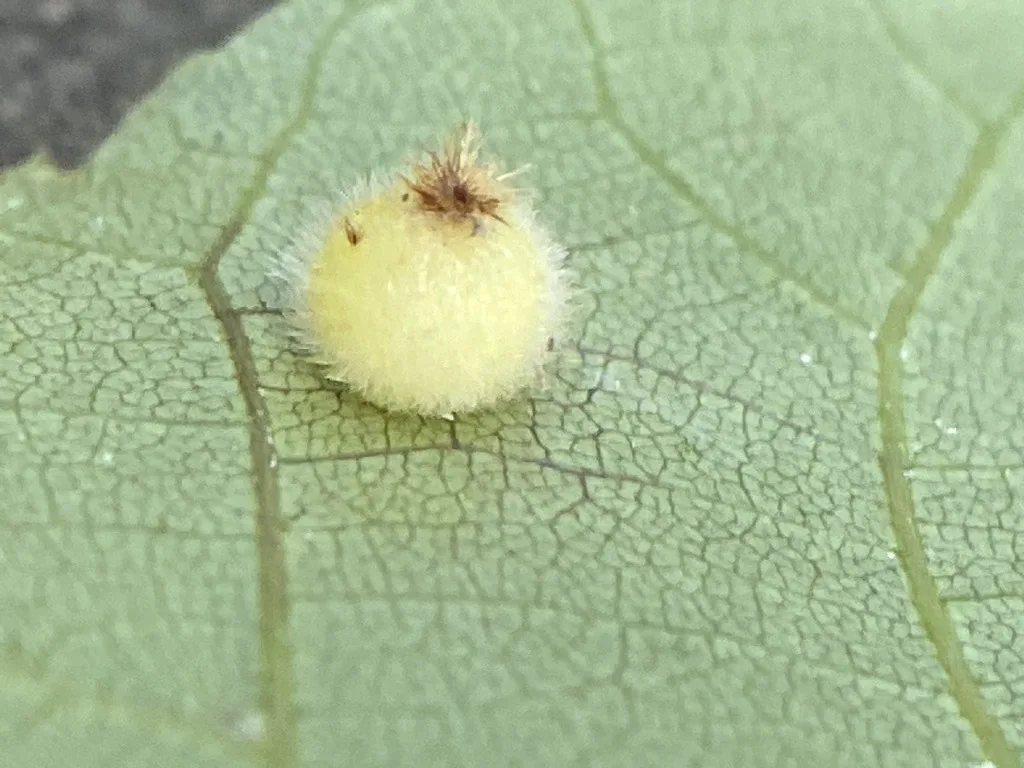
- Hickory peach galls are small, fuzzy, more or less spherical and hollow, and sit on the undersides of hickory leaves.[1]
- Opened, each gall holds a single maggot. Unlike many gall midge maggots, which are orange or yellow, hickory peach gall maggots are more or less colorless; the 'breast bone' structure typical of cecidomyiid larvae shows through the skin.[1]
- The adults are tiny, mosquito-like gnats that emerge from the soil in early spring.[1]
Look-alikes
| Look-alike | How to tell them apart |
|---|---|
| Gall wasp and psyllid galls | The galls look much like some hickory leaf galls made by cynipid gall wasps and psyllids; opening one settles it, because a midge gall holds a maggot with a visible breast-bone structure rather than a wasp or psyllid immature.[1] |
| Hickory gall phylloxera | Phylloxerans are aphid relatives, not flies. Virginia Tech says the hickory leaf stem gall phylloxera (Phylloxera caryaecaulis) makes irregular, globular growths on leaves, petioles and twigs and that other hickory phylloxerans usually make disk-, button- or bead-shaped leaf galls; Wisconsin describes pouch-like growths on twigs and leaves. A hickory peach gall is small, fuzzy, spherical and hollow, with one colorless maggot inside.[2][3][1] |
Where it lives
NC State describes the hickory peach gall midge in North Carolina, where hickory is the only reported host. GBIF holds about 6,100 U.S. records of the genus Caryomyia since 1990 from 36 states, most from Ohio, Virginia, Maryland and Massachusetts.[1][4]
Biology and life cycle
Hickory is the only host reported for the hickory peach gall midge. The maggots drop from the galls to pupate in the soil in thin silken cocoons, and the following early spring the adults emerge to lay eggs on the developing hickory buds. The egg-laying triggers a growth response in the leaf that forms the gall.[1]
Hickories carry other leaf galls too: Virginia Tech says Phylloxera species produce a variety of galls on hickory and pecan, and Missouri reports at least 29 Phylloxera species that gall hickories.[2][5]
Populations fluctuate drastically from year to year and place to place: the galls may not show up at all next year, or may be worse.[1]
Damage and signs
- The galls are rarely abundant enough to injure the tree, though some people find them an aesthetic problem.[1]
Health risk
NC State and Virginia Tech treat these midges only as gall makers on plants and mention no effect on people or pets.[1][2]
Control
Prevention
No treatment is needed for the tree's sake; the galls are rarely abundant enough to cause injury, and by the time they are noticed it is usually too late for an insecticide to reach the maggots inside.[1]
Pesticides
If control is wanted for the following year on an ornamental hickory, NC State suggests a contact or systemic insecticide such as acephate or imidacloprid applied just as the buds break in early spring, when the adults are laying eggs.[1]
Where the sources disagree
How much hickory galls matter: NC State says hickory peach galls are rarely abundant enough to injure the tree and Virginia Tech says most galls are harmless to trees, while Wisconsin says heavily infested leaves, petioles and twigs of phylloxera-galled hickories may drop.[1][2][3]
Common questions
- What are the fuzzy balls on the underside of my hickory leaves?
- Small, fuzzy, spherical, hollow galls under hickory leaves, each with a colorless maggot inside, are hickory peach galls made by the gall midge Caryomyia persicoides.[1]
- Will the galls hurt my hickory?
- Rarely. NC State says the galls are seldom abundant enough to injure the tree, and their numbers swing widely from year to year.[1]
- Can I spray the galls?
- By the time the galls are noticed it is usually too late for an insecticide to kill the maggots inside them. If you want to prevent them next year, NC State suggests treating just as the buds break in early spring, when the midges emerge and lay eggs.[1]
Sources
- NC State Extension, “Hickory Peach Gall Midge, PDIC factsheet (J. R. Baker).” content.ces.ncsu.edu/hickory-peach-gall-midge (accessed 2026-11-13)
- Virginia Cooperative Extension, Virginia Tech, “Galls on Trees and Shrubs (ENTO-146).” pubs.ext.vt.edu/ENTO/ENTO-146/ENTO-146.html (accessed 2026-11-13)
- University of Wisconsin-Madison Extension, “Deciduous Tree Galls.” hort.extension.wisc.edu/articles/deciduous-tree-galls/ (accessed 2026-11-13)
- Global Biodiversity Information Facility (GBIF), “Caryomyia: U.S. occurrence records since 1990 by state (GBIF occurrence search).” api.gbif.org/v1/occurrence/search?taxonKey=1596626&country=US&hasGeospatialIssue=false&occurrenceStatus=PRESENT&year=1990%2C2026&facet=stateProvince&facetLimit=400&limit=0 (accessed 2026-11-13)
- University of Missouri Integrated Pest Management, “Hickory Galls Induced by Phylloxera (Missouri Environment and Garden, May 2012).” ipm.missouri.edu/MEG/2012/5/Hickory-Galls-Induced-by-Phylloxera (accessed 2026-11-13)
- Global Biodiversity Information Facility (GBIF), “Caryomyia Felt, 1909 (GBIF Backbone Taxonomy).” api.gbif.org/v1/species/1596626 (accessed 2026-11-13)
- iNaturalist, “Caryomyia taxon page (order and family).” www.inaturalist.org/taxa/179370 (accessed 2026-11-10)