On this page
How to identify it
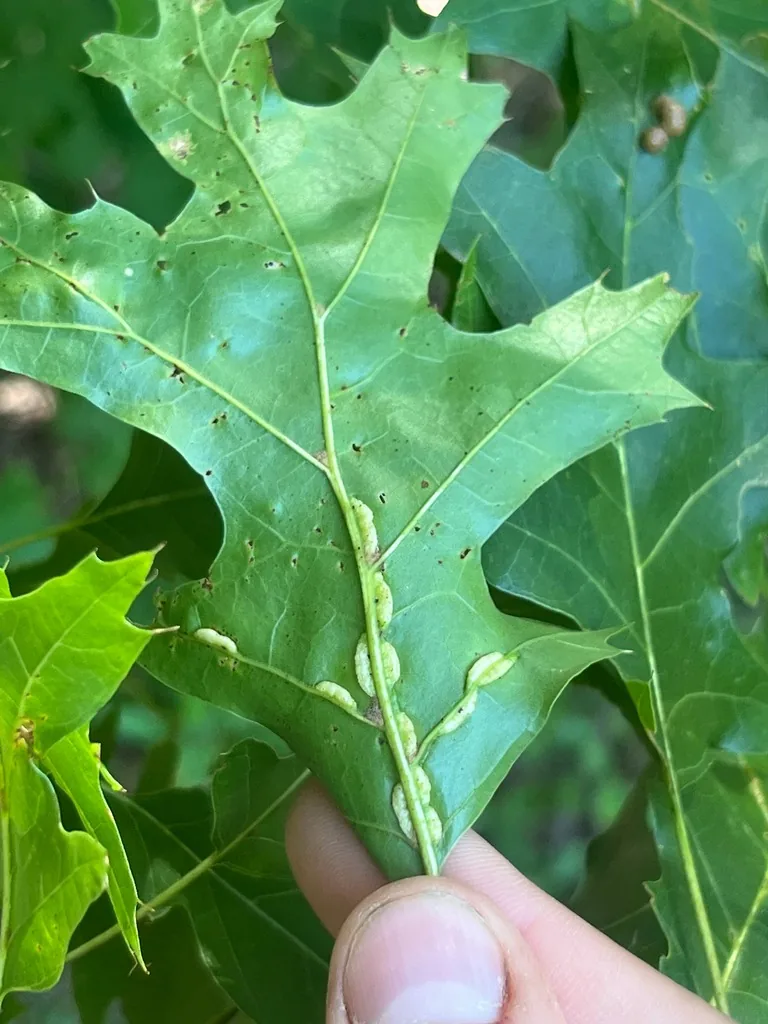
- Look for elongated, pocket-like swellings along the midrib and side veins on the underside of the leaves; heavily infested leaves twist and distort.[1][2]
- Adults are tiny mosquito-like flies about 1/8 inch (3 mm) long and are easily overlooked.[1][2]
- Each pocket holds a white maggot, about 2 mm long when grown according to Kansas State, or about 3/32 inch according to NC State.[2][1]
Where it lives
NC State reports it on red oaks in North Carolina, and Kansas State on pin oaks in Kansas, where some trees have galls on nearly all their leaves.[1][2]
Biology and life cycle
Females lay eggs in newly unfolding spring leaves; the maggots move to the veins, and gall tissue grows around each one within a few days.[1][2]
By mid-spring to early summer the grown maggots leave the galls and drop to the ground, where they stay until the next spring; there is one generation a year.[1][2]
Damage and signs
- NC State lists red oak, southern red oak, pin oak and water oak as hosts; Kansas State's reports come from pin oak.[1][2]
- Heavy infestations leave noticeably twisted, distorted leaves. Numbers vary a lot from year to year, and NC State says the galls are likely to be much less noticeable the next year because of parasites, predators and diseases.[1]
Health risk
It lives inside oak leaves. NC State and Kansas State describe only leaf galls and don't mention any risk to people or pets.[1][2]
Control
Biological control
NC State says parasites, predators and diseases usually make the galls much less noticeable by the following year.[1]
Pesticides
Kansas State says there is no control for this gall. NC State says sprays early in spring could in theory kill the midges before galls form, but little research has been done and most entomologists discourage trying.[2][1]
Common questions
- What are the lumpy, swollen veins under my pin oak leaves?
- Most likely oak vein pocket galls, made by the maggots of a tiny gall midge.[1][2]
- Should I spray for oak vein pocket gall?
- Kansas State says there is no control, and NC State says most entomologists discourage spraying; the galls are usually much less noticeable the following year.[2][1]
Sources
- NC State Extension, “Oak Vein Pocket Gall Midge (PDIC Factsheet).” content.ces.ncsu.edu/oak-vein-pocket-gall-midge (accessed 2026-11-13)
- Kansas State University Research and Extension (Entomology), “Vein Pocket Gall (Kansas Bugs, May 2015, R. Cloyd).” www.k-state.edu/news/kansasbugs/articles/2015/05/vein-pocket-gall.html (accessed 2026-11-13)
- Global Biodiversity Information Facility (GBIF), “Macrodiplosis q-orucum (Felt, 1925) (GBIF Backbone Taxonomy).” api.gbif.org/v1/species/4297937 (accessed 2026-11-13)
- iNaturalist, “Macrodiplosis qoruca taxon page (order and family).” www.inaturalist.org/taxa/714129 (accessed 2026-10-06)