On this page
How to identify it
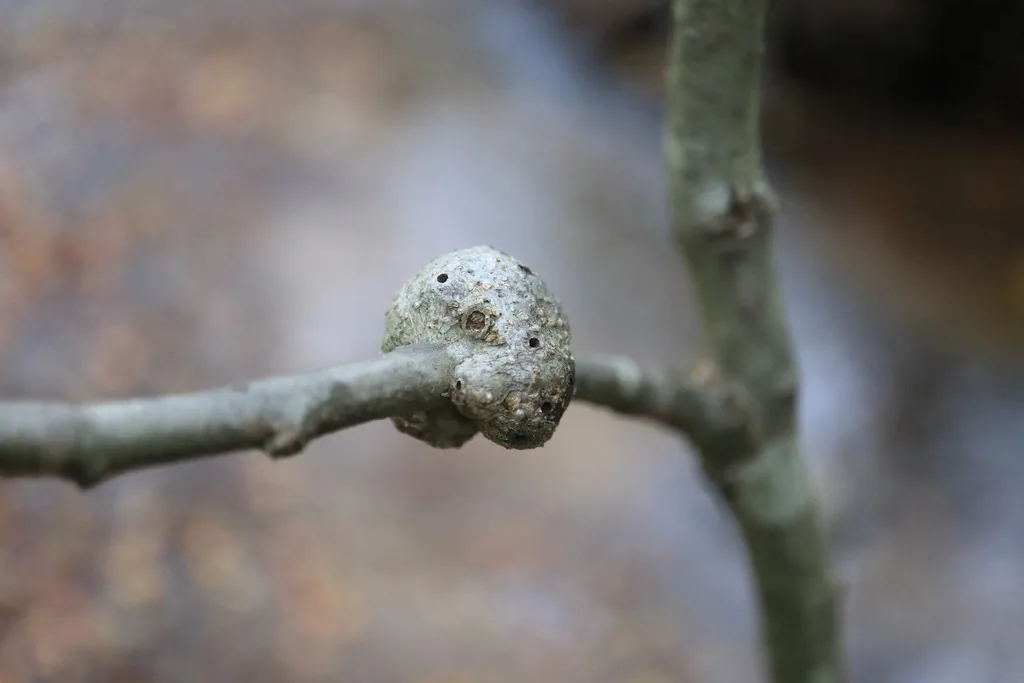
- Galls are solid, woody swellings on twigs up to about 2 inches across, sometimes merging into masses along more than 1.5 feet of branch.[1]
- Unlike horned oak galls, gouty oak galls stay smooth, without the small horns where wasps exit.[1][2]
- The adult wasps are tiny and rarely noticed; the galls are the sign.[1][2]
Look-alikes
| Look-alike | How to tell them apart |
|---|---|
| Horned oak gall | Horned oak gall is a twig gall of the related wasp Callirhytis cornigera; UMass says it develops small horns in its second or third year, one per exiting wasp, while gouty oak galls stay smooth.[1][2] |
Where it lives
Occurs from southern Canada to Georgia; UMass notes woody oak stem galls have historically been a serious problem in Plymouth County, Massachusetts, and on Long Island, New York.[1][2]
Biology and life cycle
The life cycle is complex and not fully understood; woody twig galls take two or more years to mature.[1][2]
Larvae develop in cells at the center of the gall and feed only on gall tissue.[1][2]
UMass reports that researchers have reared inquiline wasps (Synergus) from gouty oak galls, found psyllids associated with galls in St. Louis, and detected Wolbachia bacteria in about half of galls sampled in Indiana and Illinois; what these associations mean for the gall wasp isn't yet known.[1]
Damage and signs
- It develops in twigs of pin, scarlet, red and black oaks; Ohio State's BYGL also names shingle oak as susceptible to horned or gouty oak galls.[1][2][4]
- Galls can kill the branch beyond them, and UMass says heavily infested oaks may have galls on 80 percent or more of their branches, causing disfigurement and crown dieback. Sources differ on how far it goes: Clemson says severe twig gall infestations may kill an entire oak, while Ohio State's BYGL says these stem galls lead to stem dieback that pruning can correct.[1][2][3][4]
Health risk
The larvae live inside woody twig galls, and no cited source describes any risk to people or pets.[1][2]
Control
Traps and physical control
On small trees, prune out and destroy galls while they are small and green, before the adult wasps leave; UMass says this may not be practical on large trees or many trees.[1][2][3]
Pesticides
Sources differ on insecticides. UMass lists carbaryl as labeled for landscape use against cynipid gall wasps; Penn State says once a gall starts it can't be reversed and insecticides give little or no control unless applied while the wasps are flying; Clemson says chemical control is usually impractical or ineffective, especially on large trees; and Ohio State's BYGL says no chemical control is recommended for galls. Follow the label.[1][2][3][4]
Common questions
- What are the round woody lumps on my pin oak's twigs?
- Smooth ones are likely gouty oak galls; galls with small horns are horned oak galls.[1][2]
- Can gouty oak galls kill my oak?
- They can kill branches and cause crown dieback on heavily infested trees (UMass, Penn State); Clemson says severe twig gall infestations may kill a whole oak.[1][2][3]
Sources
- UMass Extension Landscape, Nursery and Urban Forestry Program (Landscape Insect & Mite Guide), “Callirhytis quercuspunctata (Gouty Oak Gall Wasp).” www.umass.edu/agriculture-food-environment/landscape/publications-resources/insect-mite-guide/callirhytis-quercuspunctata (accessed 2026-11-13)
- Penn State Extension, “Galls on Oak (updated June 24, 2026).” extension.psu.edu/galls-on-oak (accessed 2026-11-13)
- Clemson Cooperative Extension, Home & Garden Information Center, “Oak Diseases and Insect Pests in South Carolina (HGIC fact sheet).” hgic.clemson.edu/factsheet/oak-diseases-insect-pests/ (accessed 2026-11-13)
- Ohio State University Extension (Buckeye Yard & Garden onLine), “A Quirky Quercus: Shingle Oak (BYGL, A. Kulhanek, June 6, 2024).” bygl.osu.edu/node/2231 (accessed 2026-11-13)
- Global Biodiversity Information Facility (GBIF), “Callirhytis Förster, 1869 (genus) (GBIF Backbone Taxonomy).” api.gbif.org/v1/species/1309629 (accessed 2026-11-13)