On this page
How to identify it
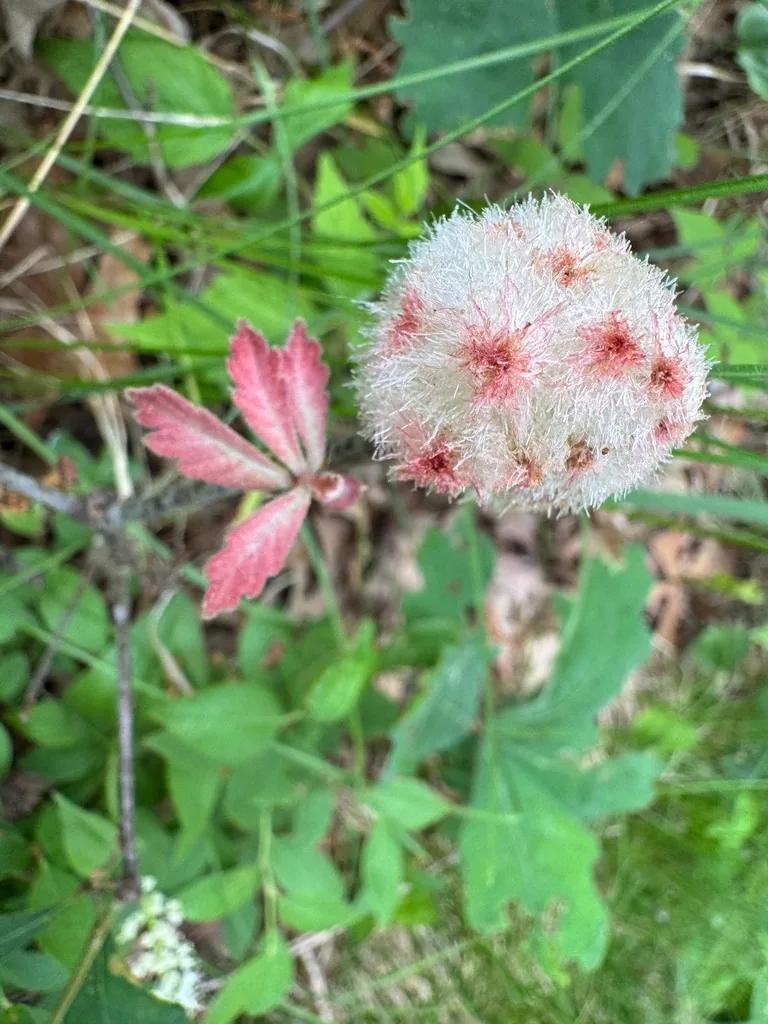
- Galls are fluffy and white at first, then white with pink spots, then brownish. Illinois Extension says that as they age they turn tan to light brown, harden and develop slightly raised darker points.[1][2][3]
- Inside are small, hard, tan seed-like capsules, each holding a single larva; the gall is also called the oak seed gall.[1][2][3]
- The larvae are plump, legless and translucent to white.[1][2]
- Adults are about 1/8 inch long and dark brown, with an abdomen flattened from side to side.[1][2][3]
- Old galls show small holes where the adult wasps tunneled out.[3]
Look-alikes
| Look-alike | How to tell them apart |
|---|---|
| Oak gall wasps | Many other gall wasps make galls on oaks; the Pacific Northwest handbook says over 400 oak galls have been identified. The wool sower gall is specific to white oaks and occurs only in spring.[4][1] |
Where it lives
Found on its white oak hosts; NC State, Clemson and Illinois Extension all describe it from their states.[1][2][3]
Biology and life cycle
Like other gall wasps, it alternates between two generations that make different galls, but the sources describe the cycle differently. Illinois Extension says wasps from wool sower galls lay eggs in stems, causing inconspicuous stem galls, and wasps from those galls lay eggs in leaf buds in spring, producing wool sower galls. Clemson describes a leaf-gall generation followed by a stem-tissue generation such as the wool sower gall, and NC State says the alternate generation's gall isn't known.[3][2][1]
The female lays eggs in young bud, leaf or stem tissue. Her fluids start the gall, and the larvae's secretions keep it growing.[3][2]
Adults tunnel out, usually in June or July. NC State says a fresh gall kept in a plastic bag out of the sun often yields tiny wasps within one to three weeks, usually from mid-June to early July.[1][2][3]
Parasitoid wasps lay eggs in the galls and their larvae eat the gall wasp larvae, which likely helps explain why numbers rise and fall from year to year.[3]
Damage and signs
- White oak is the main host. NC State also lists chestnut oak and swamp white oak, and Illinois Extension adds swamp chestnut oak.[1][3]
- The galls rarely hurt the tree: NC State says they are hardly ever abundant enough to cause real harm, Clemson says they don't typically harm the tree's growth, and Illinois Extension says they cause no damage significant enough to need management.[1][2][3]
Health risk
It is a tiny gall wasp that develops inside oak galls (NC State, Illinois Extension). No health-agency or peer-reviewed source on it was found, so this page makes no health claim.[1][3]
Control
Prevention
No treatment is usually needed. By the time galls are noticed the larvae are well protected inside, and pesticides are unlikely to reach them.[1][3]
Traps and physical control
If you find them unsightly, the galls can simply be removed.[3]
Pesticides
Only if a tree has so many galls that its health seems threatened, NC State says a pyrethroid spray in mid-June, and Clemson a pyrethroid in June, may lower gall numbers the next year. NC State says pyrethroids are very toxic to fish, so keep them away from pools, ponds and streams.[1][2]
Where the sources disagree
Life cycle: Illinois Extension says wool sower wasps lay eggs in stems and the next generation lays in leaf buds; Clemson describes a leaf-gall generation followed by a stem-tissue generation; NC State says the alternate generation's gall isn't known.[3][2][1]
Hosts: NC State lists white, chestnut and swamp white oak; Illinois Extension adds swamp chestnut oak.[1][3]
Spraying: NC State and Clemson say a June pyrethroid may help heavily galled trees; Illinois Extension says pesticides are unlikely to reach the larvae.[1][2][3]
Name: the extension sources call it Callirhytis seminator; a gall wasp checklist from The Ohio State University, published through GBIF, lists that name as a synonym of Andricus seminator.[1][2][5][6]
Common questions
- What is the cotton ball with pink spots on my oak?
- A wool sower gall, made by a tiny wasp whose larvae develop in seed-like capsules inside.[1][2][3]
- Will it hurt my tree?
- Almost never. The galls typically don't harm the tree, and they are rarely abundant enough to cause real harm.[2][1][3]
- Should I spray the galls?
- No. The larvae are protected inside the gall and sprays are unlikely to reach them; you can pick the galls off if they bother you.[1][3]
Sources
- NC State Extension, “Wool Sower Gall Wasp (PDIC Factsheet).” content.ces.ncsu.edu/wool-sower-gall-wasp (accessed 2026-11-13)
- Clemson Cooperative Extension Home & Garden Information Center, “Wool Sower Gall (Callirhytis seminator): Causes, Life Cycle and Control.” hgic.clemson.edu/wool-sower-gall-callirhytis-seminator-causes-life-cycle-control/ (accessed 2026-11-13)
- University of Illinois Extension, “Fuzzy growth on oak trees: Wool sower galls (K. Johnson, Good Growing, June 20, 2025).” extension.illinois.edu/blogs/good-growing/2025-06-20-fuzzy-growth-oak-trees-wool-sower-galls (accessed 2026-11-13)
- Pacific Northwest Pest Management Handbooks (Oregon State, Washington State and University of Idaho Extension), “Oak (Quercus)-Oak gall wasp, Pacific Northwest Insect Management Handbook.” pnwhandbooks.org/insect/hort/landscape/hosts-pests-landscape-plants/oak-quercus-oak-gall-wasp (accessed 2026-11-13)
- Global Biodiversity Information Facility (GBIF), “Callirhytis seminator (Harris) in Cynipoidea (gall wasps), xBio:D Cyberinfrastructure, The Ohio State University (GBIF checklist).” api.gbif.org/v1/species/113945659 (accessed 2026-11-13). HOMOTYPIC_SYNONYM of Andricus seminator (Harris)
- Global Biodiversity Information Facility (GBIF), “Andricus seminator (Harris) in Cynipoidea (gall wasps), xBio:D Cyberinfrastructure, The Ohio State University (GBIF checklist).” api.gbif.org/v1/species/113945657 (accessed 2026-11-13). ACCEPTED; family Cynipidae, order Hymenoptera
- Global Biodiversity Information Facility (GBIF), “Callirhytis Förster, 1869 (genus) (GBIF Backbone Taxonomy).” api.gbif.org/v1/species/1309629 (accessed 2026-11-13). ACCEPTED genus; order Hymenoptera, family Cynipidae. Callirhytis seminator itself is not in the GBIF Backbone (name match returns only the genus).