On this page
How to identify it
- Gall wasps are tiny; you'll usually notice the galls instead, on leaves, stems, twigs, buds, flowers or acorns.[3][1][5]
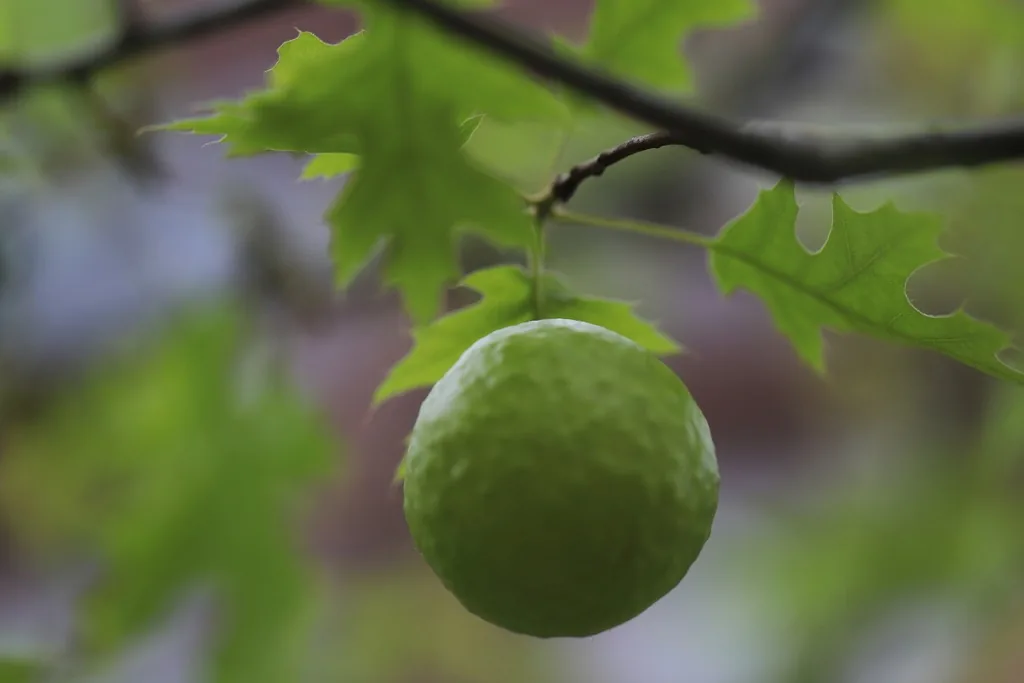
- Common oak galls include jumping oak gall, oak apple gall and oak bullet gall; more than 400 different galls have been described on oak.[3][6]
- Many insect galls hold a single legless larva, though some house several larvae, including predators and parasites of the gall maker; a large oak apple may host up to a dozen.[1][6]
- Woody twig galls such as the horned and gouty oak galls can grow to more than 2 inches across; one wasp emerges from each horn of a horned oak gall.[5][4]
- The twohorned oak gall wasp makes small brown seedlike galls with two bumps under live oak leaves in California.[2]
Look-alikes
| Look-alike | How to tell them apart |
|---|---|
| Oak twig blight and twig girdlers | These kill whole leaves in groups; twohorned gall wasps kill only parts of leaves beyond each gall, leaving the leaf partly green.[2] |
| Oak gall midges | Vein pocket galls and marginal leaf-fold galls on oak are made by tiny fly (midge) larvae, not wasps; several larvae may share one fold, and the grown larvae drop to the ground.[5] |
Where it lives
Gall wasps are the most common gall-making insects, usually on oak and rose. Penn State reports horned and gouty oak gall wasps from southern Canada to Georgia, and the twohorned oak gall wasp affects coast live and interior live oak in California. GBIF holds about 190,000 US records of the family since 1990 from 45 states, counting the District of Columbia, most from California, Texas and Virginia.[3][4][2][9]
Biology and life cycle
Galls form as new leaves and shoots grow in spring, when the insect's feeding and secretions push the plant to grow abnormal tissue; once a gall is formed the insect feeds only on gall tissue.[3][4][5]
Gall wasps usually have one or two generations a year, and many oak gall wasps alternate a sexual and an all-female generation that make different galls.[1][7]
Jumping oak gall wasps overwinter in seedlike galls that drop to the ground, where the larva's movement makes the gall jump; females emerging in spring lay eggs in opening buds.[6][5]
Woody twig galls take two or more years to mature.[4][5]
The twohorned oak gall wasp alternates a catkin-gall generation in late winter with a leaf-gall generation and overwinters as pupae in the galls.[2]
Galls stay on plants for more than one season, since they're noticed only when full size.[3]
Oak gall wasps make up a tribe of about 1,000 species that gall trees in the beech family, mainly oaks.[8]
Damage and signs
- Insect galls are usually curiosities or cosmetic problems and seldom threaten plant health.[1][3][4]
- Woody twig galls can girdle branches or make them droop from the weight, and heavy infestations can injure or even kill a tree; in Oregon white oak, one gall wasp's seedlike galls under the bark often girdle and kill branches.[5][4][6]
- Very heavy twohorned gall wasp populations scorch live oak leaves, and some leaves drop early.[2]
Health risk
Gall wasps affect plants only, and the sources describe no risk to people.[1][3][4]
Control
Prevention
Control usually isn't needed; gall numbers swing naturally from year to year.[3][2]
Sanitation
Some gall makers overwinter in fallen leaves, so collecting and destroying infested leaves may help.[4]
Traps and physical control
Prune and destroy woody twig galls while they are small and just starting, and remove leaf or twig galls before adults emerge; this helps on lightly infested trees but is impractical on large, heavily infested ones.[1][4][5]
Biological control
Fungi, parasites, predators and competing insects living in galls naturally kill many gall wasps.[2][7]
Pesticides
Sprays rarely work: galls protect the insects once they form, and timing is hard to get right.[3][5][4]
Where sources disagree
Do galls hurt the tree? UC IPM and the University of Minnesota say insect galls seldom threaten plant health. Penn State and the University of Kentucky agree for leaf galls but say woody twig galls can girdle branches and heavy infestations can injure or kill a tree.[1][3][4][5]
Is spraying worth it? The University of Minnesota says it is too late once galls form, and Penn State says insecticides help little unless applied while the wasps are flying. The University of Kentucky says control of leaf galls is rarely justified but that a spray at bud break may reduce some.[3][4][5]
How far do jumping galls jump? The Pacific Northwest handbook says an inch or more; the University of Kentucky says several inches.[6][5]
Common questions
- What are the round balls on my oak tree?
- Most likely oak galls, such as oak apple or bullet galls, made by tiny gall wasps. Large oak apples can reach 1 to 4 inches or more.[3][6]
- Will galls kill my oak?
- Leaf galls rarely affect tree health. Heavy infestations of woody twig galls, such as horned or gouty oak galls, can kill branches.[1][3][4][5]
- Should I spray for oak galls?
- Usually not. Once galls form it's too late, and the lack of serious damage from leaf galls argues against insecticides.[3][4]
- Why do the galls on the ground jump?
- Those are jumping oak galls: the tiny wasp larva moving inside makes the seedlike gall hop.[6][5]
Sources
- University of California Statewide IPM Program, “Gall Makers (Pests in Gardens and Landscapes).” ipm.ucanr.edu/PMG/GARDEN/PLANTS/INVERT/gallmakers.html (accessed 2026-11-11)
- University of California Statewide IPM Program, “Twohorned Oak Gall Wasp (Pests in Gardens and Landscapes).” ipm.ucanr.edu/PMG/GARDEN/PLANTS/INVERT/twohornedwasp.html (accessed 2026-11-11)
- University of Minnesota Extension, “Insect and mite galls (Yard and garden insects).” extension.umn.edu/yard-and-garden-insects/insect-and-mite-galls (accessed 2026-11-11)
- Penn State Extension, “Galls on Oak.” extension.psu.edu/galls-on-oak (accessed 2026-11-11)
- University of Kentucky Entomology, “Common Oak Galls (ENTFACT-408).” entomology.ca.uky.edu/ef408 (accessed 2026-11-11)
- Pacific Northwest Pest Management Handbooks (Oregon State University, Washington State University, University of Idaho), “Oak (Quercus): Oak gall wasp.” pnwhandbooks.org/insect/hort/landscape/hosts-pests-landscape-plants/oak-quercus-oak-gall-wasp (accessed 2026-11-11)
- Annual Review of Entomology, via PubMed, “The population biology of oak gall wasps (Hymenoptera: Cynipidae) (Stone et al. 2002).” pubmed.ncbi.nlm.nih.gov/11729087/ (accessed 2026-11-11). Cited from the PubMed abstract.
- Evolution, via PubMed, “Speciation in Nearctic oak gall wasps is frequently correlated with changes in host plant, host organ, or both (2022).” pubmed.ncbi.nlm.nih.gov/35819249/ (accessed 2026-11-11). Cited from the PubMed abstract.
- Global Biodiversity Information Facility (GBIF), “Cynipidae: US occurrence records since 1990 by state (GBIF occurrence search API).” api.gbif.org/v1/occurrence/search?taxonKey=4339&country=US&hasGeospatialIssue=false&occurrenceStatus=PRESENT&year=1990%2C2026&facet=stateProvince&facetLimit=400&limit=0 (accessed 2026-11-11). State counts are records reported (iNaturalist research-grade, museum specimens, surveys), not abundance.
- iNaturalist, “Amphibolips confluenta taxon page (order and family).” www.inaturalist.org/taxa/135271 (accessed 2026-11-11)