On this page
How to identify it
- The mite itself is about 0.2 mm long, roughly 1/125 inch, and is barely visible to the naked eye.[1][4]
- Under magnification it is elongated, reddish tan and shiny; females swollen with developing offspring are much larger than newly mated ones.[1]
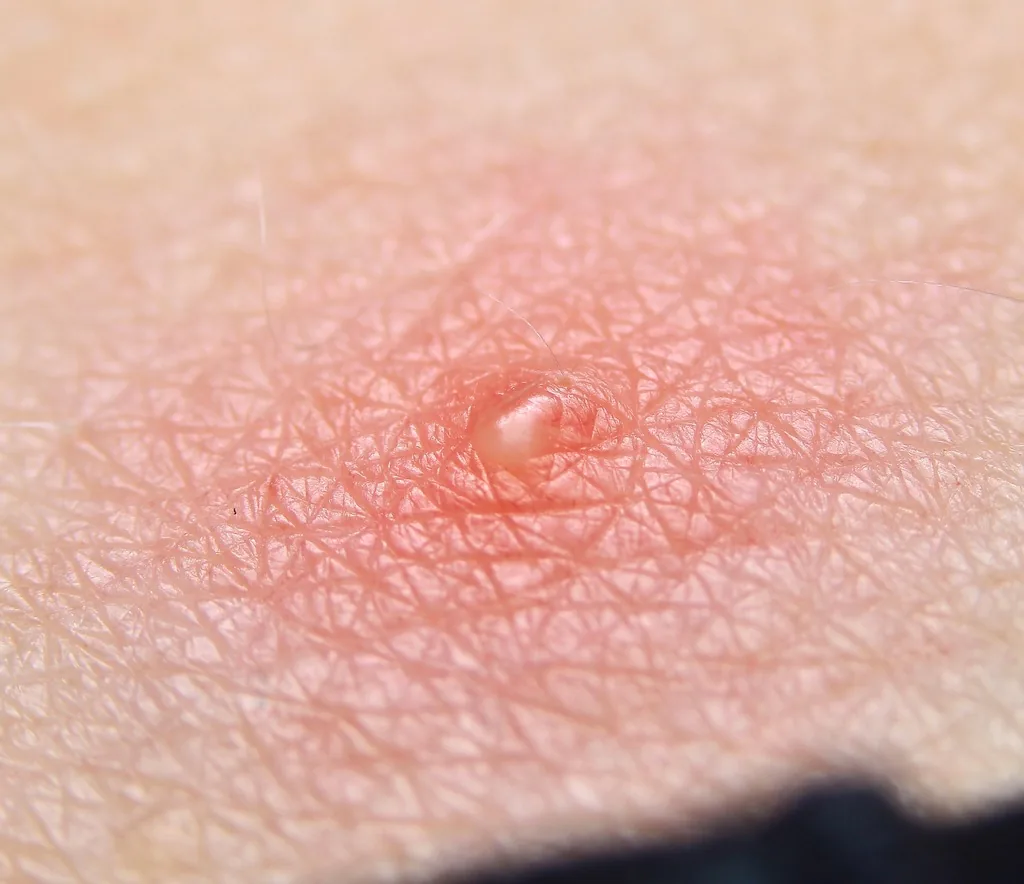
- You usually notice the bites, not the mite: raised, reddened bumps, often with a small blister in the center, that start itching 10 to 16 hours after contact. In the 2004 Kansas outbreak, most rashes examined were red, well-defined raised bumps.[4][5]
- Kansas State says the bites show up where clothing is loose, usually the neck, shoulders and chest; in CDC's Kansas investigation the rash was mainly on the limbs, face and neck, with 48% of respondents reporting it on the neck and 37% on the arms.[4][5]
Look-alikes
| Look-alike | How to tell them apart |
|---|---|
| Chiggers | Chigger bites are commonly restricted to areas under tight clothing, such as belts, underwear and socks, while oak leaf itch mite bites appear where clothing is loose, usually at the neck, shoulder and chest.[4] |
| Bird and rodent mites | Bird mites and scabies cause bites with different clinical signs on different parts of the body, and they are usually localized rather than striking a whole community at once.[4] |
Where it lives
Thought to come from Europe, it is a mite new to North America. It was first recognized in Kansas in 2004, when cases were also reported from Missouri, Nebraska, Oklahoma and Texas, and has since been reported from Illinois, Ohio, Tennessee, Pennsylvania and Wisconsin.[1][2][5][6]
Biology and life cycle
Mated females slip into the marginal leaf-fold galls made by a midge on pin oaks and other red oaks, paralyze the midge larva with venom, and feed on it.[1][2]
Offspring develop inside the mother's swollen abdomen, up to about 250 of them, and males mate with emerging females, then die without ever feeding.[1]
A generation can take as little as one week, so populations build very fast; up to 84 percent of galls on sampled pin oak leaves held mites.[1]
Mites can fall from trees at up to 370,000 per day and may even pass through window screens; their small size and high capacity for wind dispersal make them hard to avoid.[1][2]
It also attacks other insects in sheltered spots, including cicada eggs beneath tree bark. Once separated from its insect prey, it may bite other animals, including people.[3]
Damage and signs
Health risk
In the Kansas outbreak, people consistently described the rash as extremely itchy, 42% of those who scratched said scratching caused pain, and most rashes went away within 1-7 days. The mites cannot live on humans and are not known to transmit disease; see a health care provider when mites are suspected as the cause of skin irritation.[5][3]
Control
Prevention
Limit time spent under oaks or other trees known to be infested, especially while raking or handling leaves in late summer and fall.[1][4]
After yard work near infested trees, promptly remove and wash your clothes and shower with soap and water.[1][4][5]
Repellents are a maybe: CDC's Kansas report suggested using a DEET-containing product before going outdoors, because DEET repels some mites, but noted it might not give complete protection; Penn State and Kansas State say DEET has given mixed results.[5][1][4]
Pesticides
Tree sprays aren't effective, because the mites are protected inside leaf galls.[1][4][2]
Easing the itch
CDC's Kansas report says calamine lotion, an oral antihistamine, or an over-the-counter hydrocortisone product can help reduce the itching; in that outbreak the rash typically resolved after a few days with topical steroids.[5]
Scratching doesn't help much: in the Kansas investigation, 42% of people who scratched said it did not ease the itch and 42% said it caused pain. Seek medical attention when mites are suspected as the cause of a skin rash.[5][3]
Common questions
- Why did I get itchy bites after raking leaves when I never saw a bug?
- Oak leaf itch mites are nearly invisible, and most bites happen to people handling infested pin oak leaves in fall; the itching doesn't start until 10 to 16 hours later.[1][4]
- Can I spray my oak tree to stop itch mites?
- No. Sprays don't reach mites hidden inside galls; avoiding the trees and washing up after exposure works better.[1][4]
- When do oak leaf itch mites go away?
- Bites run from late summer into fall: Kansas State says the mites emerge in late July and continue through the summer, with bite problems intensifying in fall as people handle infested leaves.[4][1]
- Can itch mites get into my house?
- Mites can pass through window screens, and in Wisconsin in 2023 itch mites on donated pet food bags caused rashes in seven people at an animal shelter. But the mites do not survive indoors and cannot live on people.[1][6][3]
Sources
- Penn State Extension, “Oak Leaf Itch Mite.” extension.psu.edu/oak-leaf-itch-mite (accessed 2026-11-12)
- Journal of Medical Entomology 2006, via PubMed, “Pyemotes herfsi (Acari: Pyemotidae), a mite new to North America as the cause of bite outbreaks.” pubmed.ncbi.nlm.nih.gov/16739423/ (accessed 2026-11-12)
- Illinois Department of Public Health, “Mites Affecting Humans.” dph.illinois.gov/topics-services/environmental-health-protection/structural-pest-control/mites-affecting-humans.html (accessed 2026-11-12)
- K-State Research and Extension, Johnson County, “Oak Leaf Itch Mites (agent article).” www.johnson.k-state.edu/programs/natural-resources/agent-articles/home-insect-control/oak-leaf-itch-mites.html (accessed 2026-11-12)
- Centers for Disease Control and Prevention, MMWR, “Outbreak of Pruritic Rashes Associated with Mites --- Kansas, 2004 (MMWR 54(38)).” www.cdc.gov/mmwr/preview/mmwrhtml/mm5438a3.htm (accessed 2026-11-12)
- International Journal of Environmental Health Research 2026, via PubMed, “Dermatitis outbreak associated with Pyemotes herfsi mites among animal shelter workers and volunteers in Wisconsin, a case study from September 2023.” pubmed.ncbi.nlm.nih.gov/40525394/ (accessed 2026-11-12)
- iNaturalist, “Pyemotes herfsi taxon page (order and family).” www.inaturalist.org/taxa/505686 (accessed 2026-10-06)