On this page
How to identify it
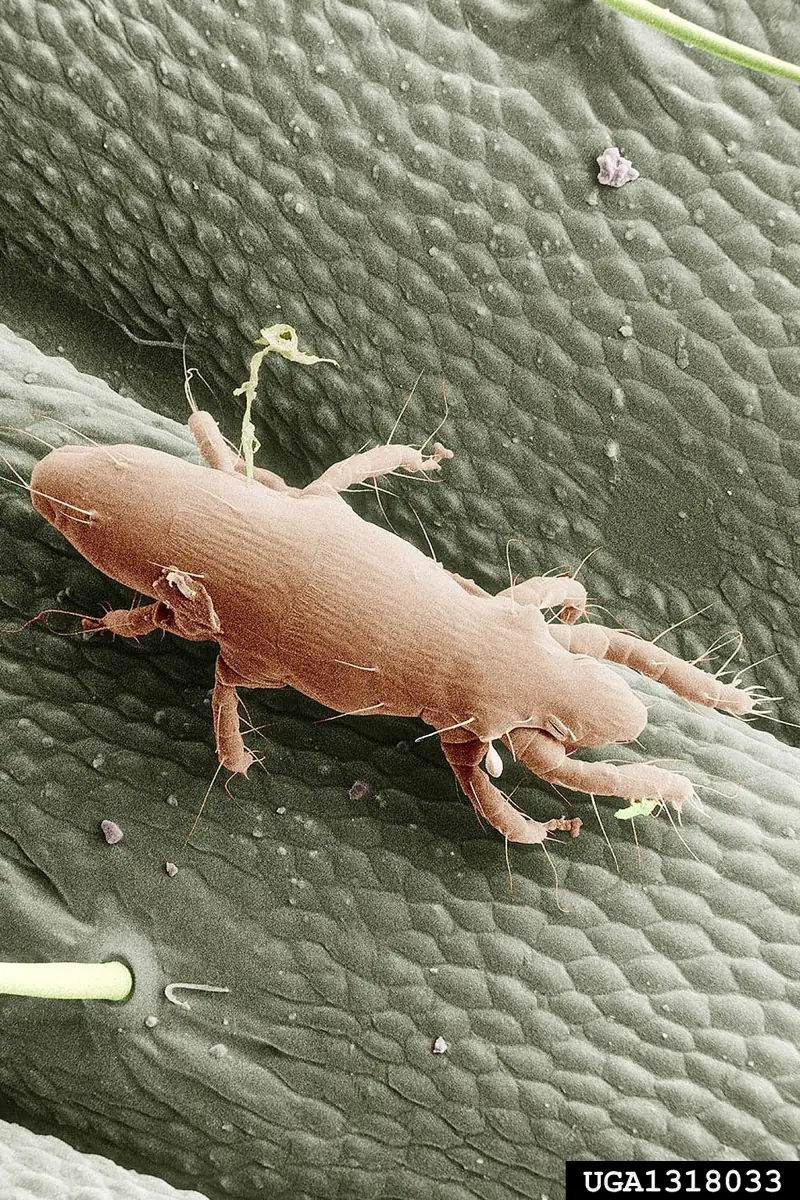
- Too small to see without magnification: about 0.2 mm long. SDSU gives about 0.16 mm for males and 0.22 mm for unfed females.[3][1]
- After feeding on an insect host, a female's abdomen swells and she can reach 2.0 mm long.[1]
- Under magnification the front pair of legs points forward, and females have needle-like mouthparts for piercing hosts and injecting venom.[1]
- You usually know them by the bites rather than the mites: intensely itchy red welts, often overlapping and with a small fluid-filled blister in the center, on skin that touched hay, straw or grain. Unlike some other biting mites, no mite is found in the middle of the bite.[1][3]
Look-alikes
| Look-alike | How to tell them apart |
|---|---|
| Flea bites | The Bohart Museum describes straw itch mite bites as itchy red lumps resembling flea bites. Straw itch mite bites show up 11 to 18 hours after contact, on the parts of the body that touched hay, straw or grain, and the mites do not stay on the skin.[3] |
| Pyemotes ventricosus | A related mite that older publications wrongly called the straw itch mite because its bites and skin reactions are similar. It preys on wood-boring beetle larvae, carpet beetles and some insect colonies.[1] |
Where it lives
Found worldwide. Problems come with infested material: SDSU reports that nearly all the cases it hears about in South Dakota come from handling contaminated hay, and NC State gets calls every fall from people who handled or sat on straw bales used for decorations, hay rides or covering new lawns.[1][2]
Biology and life cycle
Straw itch mites are predators and parasites of insects that infest stored grain and dried plant material, including Indian meal moth caterpillars, wheat stem maggots and tumbling flower beetle larvae, so they are considered beneficial.[1][3][2]
They breed in stored grain, dried beans and peas, wheat straw, hay, brome seed and other dried grasses. Their numbers follow the insects they feed on, so a mite problem usually means the material had an insect infestation first. SDSU notes that in a 1950 outbreak, storing new grain on top of old boosted Angoumois grain moths and made attacks on people worse.[2][3][1]
A female attaches to an insect, paralyzes it with a venom strong enough to paralyze insects 166,000 times her size, and feeds on its blood (hemolymph) until her abdomen swells. Her eggs develop all the way to adults inside her, and she gives birth to live young that mate as soon as they emerge.[1]
It takes about four days from mating to birth. Females average 43 offspring per birth, fewer than one in ten of them males, and keep producing young for about 15 days on average (4 to 33 days), so populations can build very quickly when prey is plentiful.[1]
Only the females have venom, and they are the ones that bite.[1]
Damage and signs
- Straw itch mites feed on the insects in hay, straw and grain, which is why they are considered beneficial there. The trouble is their bites on people and animals that come in contact with the infested material.[3][2]
- Livestock can be bitten too. SDSU cites a report of bites on the neck and back of a horse fed contaminated straw.[1]
Health risk
Female mites bite people who handle, carry or sit on infested hay, straw or grain, usually on the arms, chest, back, neck and waist where the material touched the skin, and the rash usually appears 11 to 18 hours after contact. Medical reports describe each bite as an intensely itchy hive-like wheal capped by pinpoint blisters, often scratched open, favoring the back, the belly and the inner forearms; the mites stay on people only briefly and are usually gone by the time the itching starts, so doctors do not find them during an exam. In an outbreak at a veterinary hospital, the straw itch mite in newly delivered alfalfa hay caused a rash of small bumps (papules) in 12 horses and many of their handlers, which cleared once the hay was used up. A review of Pyemotes cases found doctors mainly used topical steroids and antihistamine drugs. For bites in general, MedlinePlus advises washing the site with soap and water, using an antihistamine or anti-itch cream if needed, and watching over the next several days for signs of infection such as increasing redness, swelling or pain; CDC's report on the related oak leaf itch mite names calamine lotion, an oral antihistamine or an over-the-counter hydrocortisone product to reduce itching.[1][2][3][4][5][6][7][8]
Control
Prevention
There is no way to tell whether hay or straw carries the mites before you buy it, so protect yourself when handling bales or stored grain. SDSU reports that DEET repellents greatly reduce or prevent bites, and NC State suggests applying repellent to shirts, pants and arms. CDC, writing about the related oak leaf itch mite, is more cautious: reports from a Kansas outbreak suggest DEET might not provide complete protection, and it also advises washing clothes and showering with soap and water after exposure.[1][2][8]
For hay rides and displays, NC State suggests a plastic tarp over the bales before anyone sits on them, which may help somewhat.[2]
Sanitation
The best long-term fix is to get rid of the infested material, or at least the insects the mites live on, and to clean storage areas thoroughly.[3][2]
Traps and physical control
In South Dakota, letting infested material freeze often reduces mite numbers, and research has also used heat or sulfur. In one study in an insect rearing facility, dusting sulfur on infested logs greatly reduced the mites and eventually eradicated the infestation.[1][9]
Pesticides
Treating bales is hard. Few products are labeled for it, sprays of soapy water or horticultural oil are off-label, and the mites live deep inside the bales, so surface treatments do not reach them. Cleaned storage areas can be treated with a labeled pesticide (NC State names cyfluthrin), which helps but is unlikely to stop the problem entirely.[2][3]
When to call a professional
Stored grain and similar commodities can be fumigated to kill both the mites and their host insects, but only licensed pest control professionals should do it. In a Swiss outbreak traced to decorative wheat, fumigating the storage facilities ended the problem.[2][3][4]
Common questions
- Why did I get itchy bumps after a hay ride or handling straw bales?
- Straw itch mites in the bales are a common cause, especially in fall when bales are used for decorations, hay rides and covering newly seeded lawns. The bites show up on the arms, trunk and other skin that touched the straw, usually 11 to 18 hours later.[2][3]
- Do straw itch mites live on people?
- No. They bite but do not feed on humans or stay on the skin. They live in the infested hay, straw or grain and on the insects in it, so getting rid of that material is the best fix.[3]
- Do straw itch mites spread disease?
- Medical reports describe the rash as self-limiting: in a review of Pyemotes outbreaks, symptoms most commonly ended within a week, and in a veterinary hospital outbreak the rash in horses and handlers went away once the infested hay was used up. Doctors treated it mainly with topical steroids and antihistamines.[6][5]
- How strong is a straw itch mite's venom?
- For insects, very strong. SDSU says a female's venom can paralyze insects 166,000 times her size; she then feeds on the paralyzed insect's blood until her abdomen is enlarged, and she gives birth to live, already-adult young.[1]
Sources
- South Dakota State University Extension, “Straw Itch Mites, P-00402 (A.J. Varenhorst, P. Wagner, P. Rozeboom; July 2026).” extension.sdstate.edu/sites/default/files/2026-07/P-00402.pdf (accessed 2026-11-12)
- NC State Extension, Department of Entomology and Plant Pathology, “Itch Mite Problems (M. Waldvogel, October 2015).” entomology.ces.ncsu.edu/2015/10/itch-mite-problems/ (accessed 2026-11-12)
- Bohart Museum of Entomology, University of California, Davis, “Straw or Hay Itch Mites, Information No. 043.” bohart.ucdavis.edu/sites/g/files/dgvnsk4616/files/media/documents/note_43_hay_itch_mites.pdf (accessed 2026-11-12)
- Der Hautarzt, via PubMed, “Grain mites. A small epidemic caused by Pyemotes species (Grob, Dorn and Lautenschlager 1998).” pubmed.ncbi.nlm.nih.gov/9879483/ (accessed 2026-11-12)
- Journal of the American Veterinary Medical Association, via PubMed, “Dermatitis in horses and man caused by the straw itch mite (Kunkle and Greiner 1982).” pubmed.ncbi.nlm.nih.gov/7130009/ (accessed 2026-11-12)
- Infectious Disease Reports, via PubMed, “Pyemotes ventricosus Dermatitis: A Case Report and an Extensive Review of Outbreaks and Clinical Cases (Vellere et al. 2022).” pubmed.ncbi.nlm.nih.gov/36136822/ (accessed 2026-11-12)
- MedlinePlus, U.S. National Library of Medicine, “Insect bites and stings (Medical Encyclopedia).” medlineplus.gov/ency/article/000033.htm (accessed 2026-11-12)
- Centers for Disease Control and Prevention, MMWR, “Outbreak of Pruritic Rashes Associated with Mites --- Kansas, 2004 (MMWR 54(38)).” www.cdc.gov/mmwr/preview/mmwrhtml/mm5438a3.htm (accessed 2026-11-12)
- Journal of Economic Entomology, via PubMed, “Control of the straw itch mite (Acari: Pyemotidae) with sulfur in an insect rearing facility (Hanks et al. 1992).” pubmed.ncbi.nlm.nih.gov/1619104/ (accessed 2026-11-12)
- iNaturalist, “Pyemotes tritici taxon page (order and family).” www.inaturalist.org/taxa/396112 (accessed 2026-11-08)