On this page
How to identify it
- Adults are tiny wasps: the Hawaii Department of Agriculture gives 1.5 mm for females and 1.0 mm for males, and PestNet 1 to 1.5 mm, with females larger.[4][2]
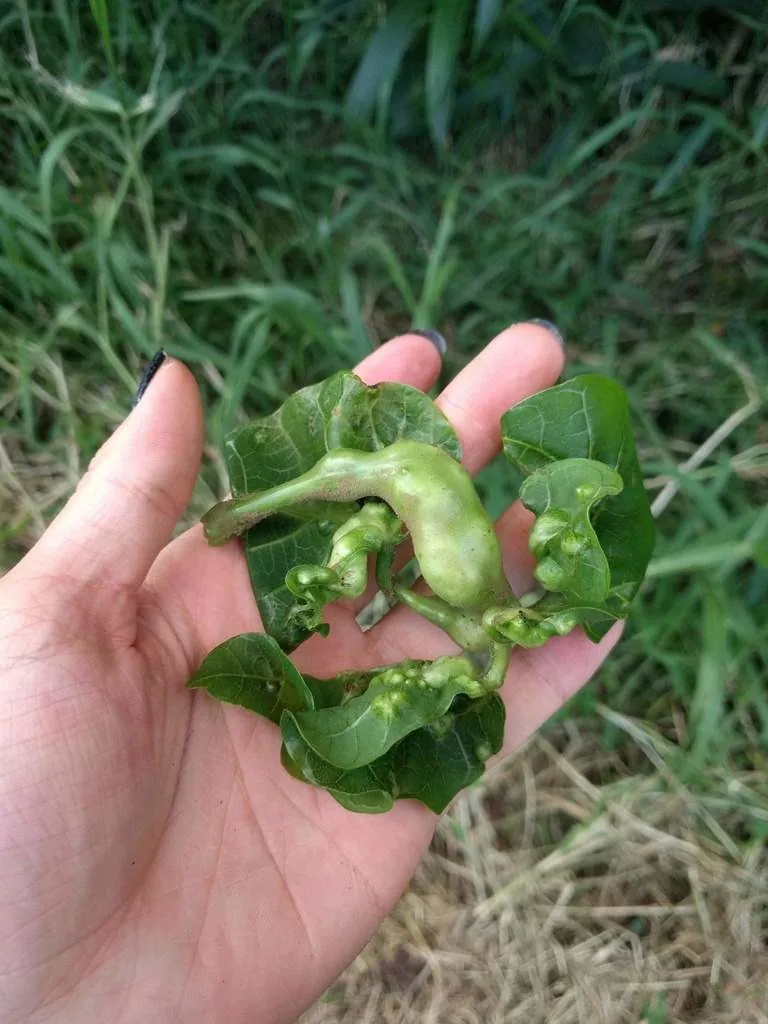
- The easiest sign is the galls: leaves, leaf stalks and young shoots become swollen and deformed and look nothing like the leaves of a healthy tree.[2][1]
- Galls that adults have left show the small exit holes the wasps cut to get out.[2][4]
Where it lives
First described in 2004 from specimens from Singapore, Mauritius and Reunion and thought to come from East Africa. In Hawaii it was first collected in Manoa, Oahu, on April 19, 2005, and by October 2005 had been seen on the Big Island, Kauai, Maui, Molokai, Kahoolawe and Lanai; it is now on every major island. The Hawaii Department of Agriculture also lists reports from Taiwan, Hong Kong, mainland China, India, Thailand, American Samoa, Guam and Okinawa, and PestNet adds Fiji, Samoa and Tonga and restricted areas of the Americas and the Caribbean.[4][1][2]
Biology and life cycle
Females insert eggs into young leaf and stem tissue; the larvae make the plant form galls, pupate inside them, and the adults cut holes to emerge, completing the life cycle in about 20 days.[1][2]
Its hosts are Erythrina species, a genus of more than 100 tropical and subtropical trees used as ornamentals, living fences and shade trees.[2]
It spreads short distances by flying, on the wind and perhaps on clothing, and long distances probably on fallen infested leaves carried by boats or planes.[2]
In Hawaii it attacks the coral tree Erythrina variegata (including the tall windbreak form and the variegated 'sunshine tree'), E. crista-galli and the native wiliwili, E. sandwicensis. Females prefer very young terminal leaves and stems over mature leaves, and a day-old female carries about 60 mature eggs.[4]
Damage and signs
- Heavy infestations cause loss of growth and vigor, defoliation and dieback; trees often die as repeated cycles of regrowth and attack use up their reserves, and seedlings are killed outright.[1][2]
- Estimates of the losses differ. PestNet says about 95 percent of Hawaii's wiliwili and Indian coral trees have been killed; the Hawaii Department of Agriculture's 2023 environmental assessment cites wiliwili mortality above 40 percent in some affected populations, and Department researchers write that thousands of Erythrina trees in Hawaii have died since 2005.[2][5][7]
Health risk
It is a plant pest, and no cited source describes any risk to people or pets.[1][4]
Control
Keep them out
Don't move Erythrina plants from places where the gall wasp is present to places where it hasn't established.[2]
Traps and physical control
Pruning has been tried without success, and no cultural control is recommended.[2]
Biological control
A parasitoid wasp from Tanzania, Eurytoma erythrinae, was first released on November 25, 2008, after host-specificity testing. The state's 2023 assessment reports that by the second year more than 60 percent of young wiliwili shoots were free of galls and by 2011, 90 percent of sampled trees had full canopies. Department researchers say it established in under a year and prevented tree deaths where infestations were heavy, but parasitism stays low on lightly galled leaves, flowers and seed pods, and the assessment notes 54 percent of sampled wiliwili seeds were not viable.[4][5][7][1]
A second parasitoid, Aprostocetus nitens, can develop in the smaller galls on flowers, pods and seedlings. In Hawaii Department of Agriculture containment tests it showed no preference for any of seven non-target gall-forming insects and was highly specific to the gall wasp; its regulatory status is under Regulatory status below.[1][8]
Pesticides
Sources disagree on trunk injection. A 2009 field study found imidacloprid trunk injections controlled the wasp better than abamectin or dinotefuran, while soil drenches did not work; PestNet says injection has been trialed but is recommended only for highly valued ornamental trees because of the cost; the state's 2023 assessment says systemic injections of priority trees gave ultimately unsatisfactory results. Follow the label of any product used.[9][2][5]
Regulatory status
The Hawaii Department of Agriculture published a final environmental assessment for releasing Aprostocetus nitens in February 2023, as a step toward the state and federal permits needed for release.[5][1]
USDA APHIS issued an environmental assessment and finding of no significant impact for releasing A. nitens in Hawaii and says it will review permit applications for its environmental release, with a consultation period with the state before a final decision.[6]
The Hawaii Invasive Species Council says an application with the Department for final import permits is in progress, and that the Department of Agriculture and Biosecurity scheduled a public hearing for October 27, 2026 on proposed rule amendments that add A. nitens to its List of Restricted Animals (Part A).[1]
Common questions
- Why are my coral tree's leaves swollen and twisted?
- Swollen, deformed leaves and shoots on an Erythrina are the galls of the erythrina gall wasp, where its larvae develop.[2][1]
- Can I save a coral tree with erythrina gall wasp?
- Pruning doesn't work. In Hawaii a released parasitoid wasp has greatly reduced infestations, and a second one is going through permitting; trunk injections of imidacloprid have been tried on valuable trees with mixed results.[2][1][5][9]
Sources
- Hawaii Invasive Species Council, “The Target: Erythrina Gall Wasp (Quadrastichus erythrinae) (Biocontrol Hawaii).” dlnr.hawaii.gov/hisc/info/biocontrol/latest-biocontrol/erythrina-gall-wasp/ (accessed 2026-11-13)
- Pacific Pests, Pathogens & Weeds (ACIAR and the Pacific Community), “Erythrina gall wasp, Fact Sheet 268 (Pacific Pests, Pathogens & Weeds; G. Jackson, from Hawaii Department of Agriculture New Pest Advisory 05-03 and CABI).” apps.lucidcentral.org/pppw_v13/text/web_full/entities/erythrina_gall_wasp_268.htm (accessed 2026-11-13)
- Global Biodiversity Information Facility (GBIF), “Quadrastichus erythrinae Kim, 2004 (GBIF Backbone Taxonomy).” api.gbif.org/v1/species/1388541 (accessed 2026-11-13)
- Hawaii Department of Agriculture, Plant Pest Control Branch, “Erythrina Gall Wasp, Quadrastichus erythrinae Kim, New Pest Advisory No. 05-03 (updated December 2008).” dab.hawaii.gov/pi/files/2013/01/npa05-03-EGW.pdf (accessed 2026-11-13)
- Hawaii Department of Agriculture, “Final Environmental Assessment and Finding of No Significant Impact: Biological control of the Erythrina gall wasp with Aprostocetus nitens (February 2023).” files.hawaii.gov/dbedt/erp/Doc_Library/2023-02-08-ST-FEA-Erythrina-Gall-Wasp-Biological-Control.pdf (accessed 2026-11-13)
- USDA Animal and Plant Health Inspection Service, “APHIS Issues Environmental Assessment and Finding of No Significant Impact for Erythrina Gall Wasp Biological Control.” www.aphis.usda.gov/news/program-update/aphis-issues-environmental-assessment-finding-no-significant-impact-erythrina (accessed 2026-11-13)
- Insects (via PubMed), “Reproductive parameters and host specificity of Eurytoma erythrinae, a biological control agent of the erythrina gall wasp (Nagamine et al., 2023) (abstract).” pubmed.ncbi.nlm.nih.gov/38132597/ (accessed 2026-11-13)
- Insects (via PubMed), “Aprostocetus nitens, an ectoparasitoid proposed for biological control of the destructive erythrina gall wasp in Hawai'i (Ramadan et al., 2025) (abstract).” pubmed.ncbi.nlm.nih.gov/40429232/ (accessed 2026-11-13)
- Pest Management Science (via PubMed), “Efficacy of systemic insecticides on the gall wasp Quadrastichus erythrinae in wiliwili trees (Xu et al., 2009) (abstract).” pubmed.ncbi.nlm.nih.gov/18833544/ (accessed 2026-11-13)