On this page
How to identify it
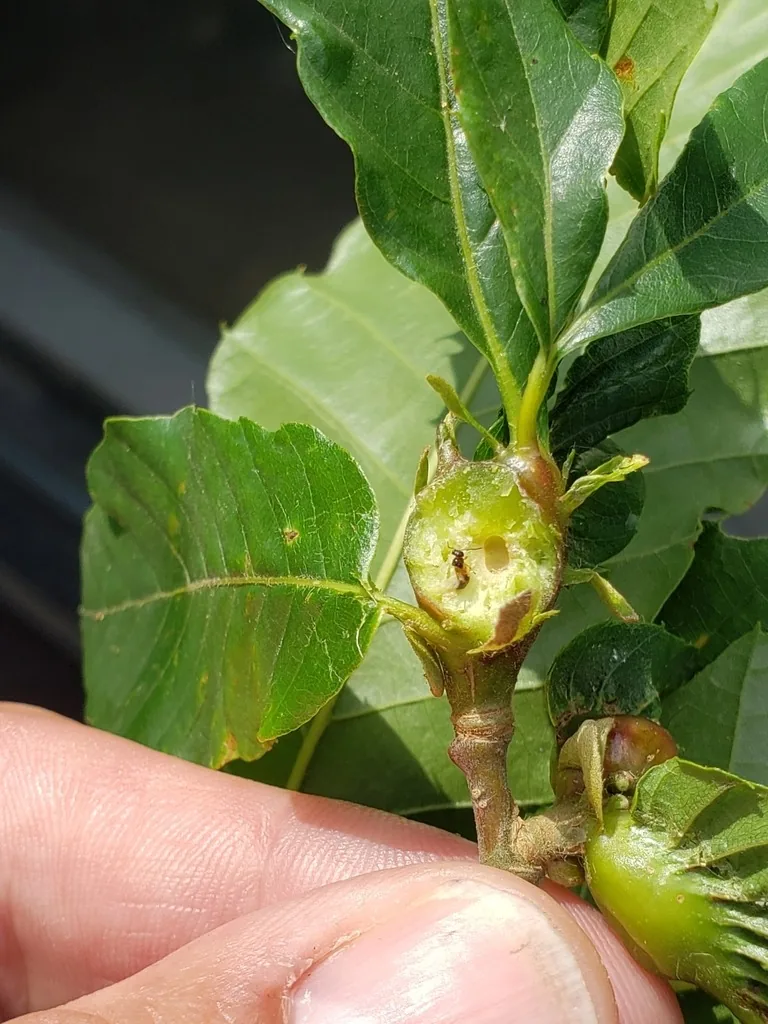
- Look for round green to red galls on new chestnut shoots, leaf stems, leaves or catkins in spring. Sources give different sizes: Kentucky says 1/2 to 1 inch, and UMass says 5 to 20 mm, some up to 30 mm, with 1 to 25 larval chambers.[2][1][4]
- After the wasps leave, galls dry, turn woody and stay on the tree for several years; small dead leaves still attached in winter make infestations easy to spot.[2][3][4]
- Adults are tiny wasps about 1/8 inch (2.5 to 3 mm) long. Only females are known; they reproduce without mating.[1][2][3]
Where it lives
Native to China. It reached the US in 1974 in Georgia, where the Connecticut Agricultural Experiment Station says a grower grafted Japanese chestnut cuttings imported without a USDA permit. Kentucky said in its fact sheet that it was in 12 states east of the Mississippi; Missouri Extension lists 17, from Connecticut and Massachusetts to Georgia, Alabama and Michigan, but not Missouri.[1][2][3][4]
Biology and life cycle
There is one generation a year. In early summer females lay eggs inside buds: UMass says up to 300 per female, and the Connecticut Agricultural Experiment Station and Missouri say 3 to 5 in a cluster, with up to 25 eggs in a bud when several wasps use it. Eggs hatch in 30 to 40 days (UMass) or about 40 (Missouri), and larvae overwinter in the dormant buds, where they can't be seen.[1][2][3][4]
At budbreak the larvae trigger rapid gall growth; Connecticut says galls form in 7 to 14 days and larvae feed 20 to 30 days before pupating. Sources differ slightly on emergence: Connecticut and Missouri say late May to early June, UMass says spring to mid-summer depending on latitude and altitude, and Kentucky says early summer.[2][3][4][1]
Damage and signs
- Chinese, Japanese, European and American chestnuts are all attacked. Sources differ on chinquapins: Kentucky says all Castanea species are susceptible, UMass says chinquapins are only rarely galled, and the Connecticut Agricultural Experiment Station found Ozark chinquapins rarely galled and Allegheny and Chinese chinquapins seemingly resistant, and is breeding them into chestnuts.[1][2][3]
- Galling stunts shoots, cuts flowering and nut production and kills twigs and leaves; UMass says smaller trees can die when other stresses add up, and Missouri says severe infestations kill interior parts of the canopy and whole trees. Connecticut says it nearly eliminated Georgia's Chinese chestnut industry.[1][4][3]
Health risk
It lives inside chestnut buds and galls, and no cited source describes any risk to people or pets.[1][2]
Control
Prevention
Moving infested plants and grafting wood spreads it, and infested buds are very hard to detect. Missouri advises against buying seedlings or scion wood from nurseries where the gall wasp has been found.[2][4][3]
Traps and physical control
On small trees, scout for green galls in June and prune them out before adults emerge; Missouri says pruning and burning infested material may slow its spread.[1][4]
Biological control
Torymus sinensis, a parasitoid wasp introduced in the 1970s, has followed the pest. UMass calls it very effective and says it usually keeps damage low on established trees, so leave old galls late in the season for it to develop. Kentucky adds that a native parasitoid, Ormyrus labotus, also attacks the gall wasp but may parasitize Torymus too and suppress it in some places.[1][2]
Pesticides
Insecticides don't help: Kentucky says they're ineffective, partly because of the gall tissue, the Connecticut Agricultural Experiment Station says no pesticides control it, UMass doesn't suggest them because the parasitoid works, and Missouri says chemical control isn't feasible on trees whose nuts are eaten.[2][3][1][4]
Regulatory status
The European and Mediterranean Plant Protection Organization (EPPO) has had it on its A2 list of pests recommended for regulation since 2003. EPPO's database records it as a protected-zone quarantine pest in the EU and on the A1 lists of Chile, Russia, Serbia, Ukraine and the Eurasian Economic Union.[5]
For US plantings, the Connecticut Agricultural Experiment Station says the original 1974 introduction came from chestnut cuttings imported without a USDA APHIS import permit.[3]
Common questions
- What are the red-green balls on my chestnut tree?
- Most likely galls of the Asian chestnut gall wasp.[1][2]
- Should I spray my chestnut for gall wasps?
- No. Kentucky, UMass, Missouri and the Connecticut Agricultural Experiment Station all say sprays don't control it; pruning young galls and the introduced parasitoid are the tools.[2][1][4][3]
- Is the Asian chestnut gall wasp a regulated pest?
- In Europe and some other countries, yes: EPPO lists it on its A2 list and records quarantine listings in the EU, Chile, Russia, Serbia and Ukraine. None of the sources cited here describes a current US federal quarantine for it.[5]
Sources
- UMass Extension Landscape, Nursery and Urban Forestry Program (Landscape Insect & Mite Guide), “Dryocosmus kuriphilus (Asian Chestnut Gall Wasp).” www.umass.edu/agriculture-food-environment/landscape/publications-resources/insect-mite-guide/dryocosmus-kuriphilus (accessed 2026-11-13)
- University of Kentucky Entomology (ENTFACT), “Asian Chestnut Gall Wasp (ACGW) in Kentucky.” entomology.ca.uky.edu/entfact/asian-chestnut-gall-wasp-acgw-kentucky (accessed 2026-11-13)
- The Connecticut Agricultural Experiment Station, “Asian Chestnut Gall Wasp on Connecticut Chestnut Trees (fact sheet, S. L. Anagnostakis).” portal.ct.gov/-/media/caes/documents/publications/fact_sheets/plant_pathology_and_ecology/asianchestnutgallwasponconnecticutchestnuttreespdf.pdf (accessed 2026-11-13)
- University of Missouri Extension, “Asian Chestnut Gall Wasp (PA100, reviewed March 2026).” extension.missouri.edu/publications/pa100 (accessed 2026-11-13)
- European and Mediterranean Plant Protection Organization (EPPO Global Database), “Dryocosmus kuriphilus (DRYCKU): Categorization.” gd.eppo.int/taxon/DRYCKU/categorization (accessed 2026-11-13)
- Global Biodiversity Information Facility (GBIF), “Dryocosmus kuriphilus Yasumatsu, 1951 (GBIF Backbone Taxonomy).” api.gbif.org/v1/species/1309652 (accessed 2026-11-13)