On this page
How to identify it
- They're oval to pear-shaped and 1/25 inch (1 mm) or less, best seen with a 10X hand lens. UC IPM says they're bright yellow on young or healthy roots and light brown, olive, orange or yellow-green on older ones; UKY says that unlike aphids they have no cornicles.[1][2]
- Infested root tips swell, turn yellowish and bend into clubbed shapes, and dead spots form where they feed. UKY calls root galls knot-like swellings on the rootlets.[1][2]
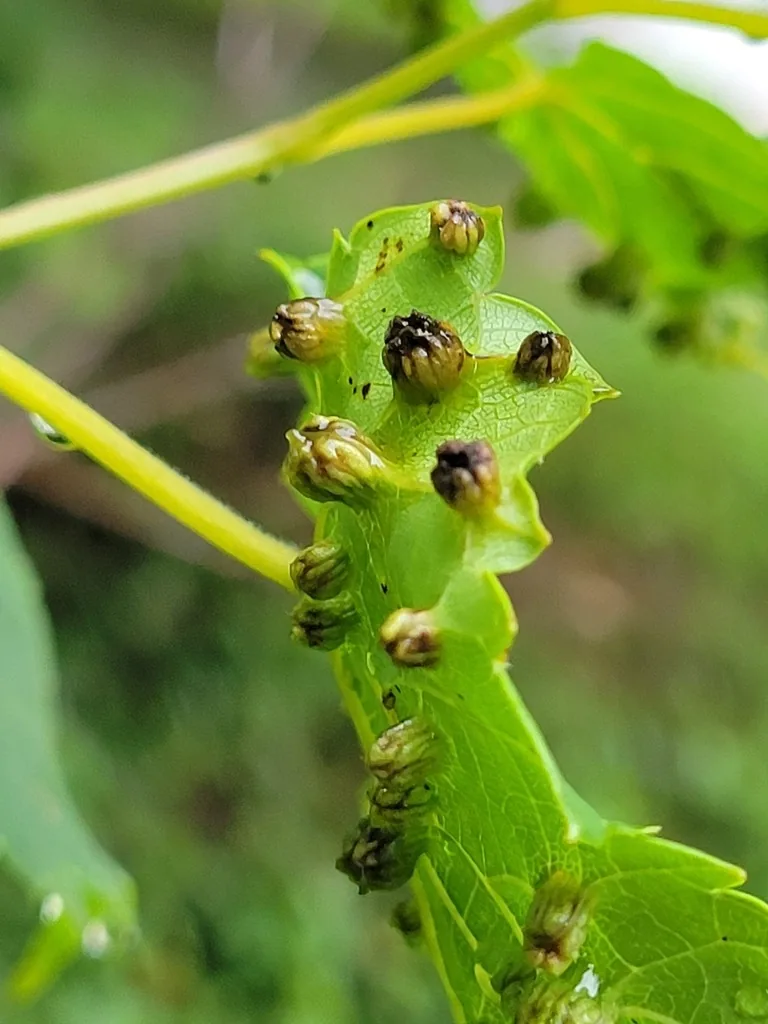
- Leaf-galling forms, common in the eastern U.S., raise warty galls on leaves, sometimes dozens per leaf. UKY says the galls are about 1/4 inch across, and Ohio State says the only opening is on the upper leaf surface.[1][2][4]
Where it lives
Native to the eastern United States, it has spread to other U.S. grape regions and to most grape-growing areas of the world, including Europe. Oregon State says it was first found in Oregon in 1955 and now occurs in every major Oregon grape region except Umatilla County; in California, UC IPM says root feeders do the most harm in heavy clay soils of cooler regions such as Napa, Sonoma and Mendocino, and are not a pest in sandy soils.[2][3][1]
Biology and life cycle
Young nymphs overwinter on roots and start feeding in spring when soil passes 60 °F; UC IPM says females lay up to 300 eggs.[1][3]
Crawlers move through soil cracks, across the soil surface or up the vine to be blown by wind, and are also spread on boots, equipment, tools and cuttings.[1][3]
UC IPM gives 3 to 5 generations a year on roots, more in warm regions. In the eastern U.S., UKY says root forms can produce winged females in late summer that lay eggs on the stems, starting the leaf-galling generations the next spring; root forms can keep cycling without any leaf forms.[1][2][4]
Damage and signs
- Vines grow slowly with short internodes, pale leaves and nutrient or water-stress symptoms; UC IPM says North Coast vines often show potassium deficiency.[1]
- Secondary fungal infections at the feeding sites girdle roots and kill large parts of the root system. UKY says root galls stunt or kill European grape varieties, while American varieties, hybrids and European grapes grafted onto American rootstock tolerate the root form.[1][2]
- To check a struggling vine, UC IPM says to dig near the trunk under the drip emitters and look with a hand lens for hooked, swollen yellowish feeder roots; live phylloxera are easiest to see in spring and late summer.[1]
Health risk
It feeds on grapevines. UC IPM, UKY, Ohio State and Oregon State describe vine damage only and don't mention any risk to people or pets.[1][2][4][3]
Control
Prevention
Plant on phylloxera-resistant rootstocks, or in sandy soil. UC IPM says to avoid rootstocks with any Vitis vinifera parentage, which virulent biotypes commonly damage, and to choose resistant species such as V. riparia and V. rupestris or their hybrids.[1][3]
Sanitation
Clean boots, tools and equipment that touch infested vines or vineyard soil, and don't move cuttings from infested plants. Oregon State says phylloxera rides on soil and root pieces carried by boots, picking totes, tires and animals.[1][3]
Pesticides
Insecticides are a judgment call; see where the sources disagree below.[1][4]
Where the sources disagree
Insecticides: UC IPM says they're believed to be not very effective on home-grown vines and that numbers can rebound quickly. Ohio State says they can work well against it when applied at the right time; UKY says foliar sprays depend on the variety and how heavy the infestation is.[1][4][2]
Leaf galls: UKY says leaf galls are unsightly but do little damage. Ohio State says heavily infested leaves can drop early and shoot growth can slow.[2][4]
Native grapes: Ohio State says native American grapes tend to resist phylloxera and don't need specific monitoring. Oregon State says some American species, V. labrusca among them, are susceptible, while V. rupestris, V. berlandieri and V. riparia are resistant.[4][3]
Eggs: UC IPM says females lay up to 300; Oregon State says up to 400.[1][3]
Regulatory status
Oregon's Grape Pest & Disease Quarantine (OAR 603-052-0051) names grapevine phylloxera as a harmful organism and covers all grapevine planting stock, including potted and bare-root plants, cuttings, bench grafts, tissue-culture plants and seeds. Since January 1, 2023, Vitis plants and parts entering Oregon must come from an approved certification program (currently California and Washington) with a phytosanitary certificate.[5]
EPPO's database lists it on the EPPO A2 list (since 1975), as a regulated non-quarantine pest and a protected-zone quarantine pest in the EU (2019), as a regulated non-quarantine pest in the United Kingdom (2020), and as a quarantine pest in Canada (2019), Mexico (2018) and China (2021), among others.[6]
Common questions
- What are the warty bumps on my grape leaves?
- Probably galls of the leaf-galling form of grape phylloxera, common in the eastern U.S.; UKY says they're about 1/4 inch across and do little damage on their own.[1][2]
- Can I spray for phylloxera?
- UC IPM says sprays aren't very effective on home vines and resistant rootstocks are the real fix; Ohio State says well-timed insecticides can work. See where the sources disagree.[1][4]
Sources
- University of California Statewide IPM Program, “Grape Phylloxera (Pests in Gardens and Landscapes).” ipm.ucanr.edu/PMG/GARDEN/FRUIT/PESTS/grapephylloxera.html (accessed 2026-11-13)
- University of Kentucky Entomology, “ENTFACT-222: Grape Phylloxera.” entomology.mgcafe.uky.edu/ef222 (accessed 2026-11-13)
- Oregon State University Extension Service, “Grape Phylloxera: Biology and Management in the Pacific Northwest (EC 1463-E; P. Skinkis, V. Walton and C. Kaiser, revised June 2009).” extension.oregonstate.edu/sites/extd8/files/documents/ec1463.pdf (accessed 2026-11-13)
- The Ohio State University CFAES, Buckeye Appellation (Ohio Grape-Wine program), “Grape Phylloxera, Daktulosphaira vitifoliae (Fitch) (Ohio grape IPM: insects).” ohiograpeweb.cfaes.ohio-state.edu/ipm/insects/grape-phylloxera (accessed 2026-11-13)
- Oregon Department of Agriculture, Plant Health Program, “Grape Quarantine (Oregon's Grape Pest & Disease Quarantine, OAR 603-052-0051).” www.oregon.gov/oda/plant-health/pages/grape-quarantine.aspx (accessed 2026-11-13)
- EPPO Global Database, European and Mediterranean Plant Protection Organization, “Daktulosphaira vitifoliae (VITEVI): Categorization.” gd.eppo.int/taxon/VITEVI/categorization (accessed 2026-11-13)
- Global Biodiversity Information Facility (GBIF), “Daktulosphaira vitifoliae (Fitch, 1855) (GBIF Backbone Taxonomy).” api.gbif.org/v1/species/2049512 (accessed 2026-11-13)
- iNaturalist, “Daktulosphaira vitifoliae taxon page (order and family).” www.inaturalist.org/taxa/324587 (accessed 2026-10-06)