On this page
How to identify it
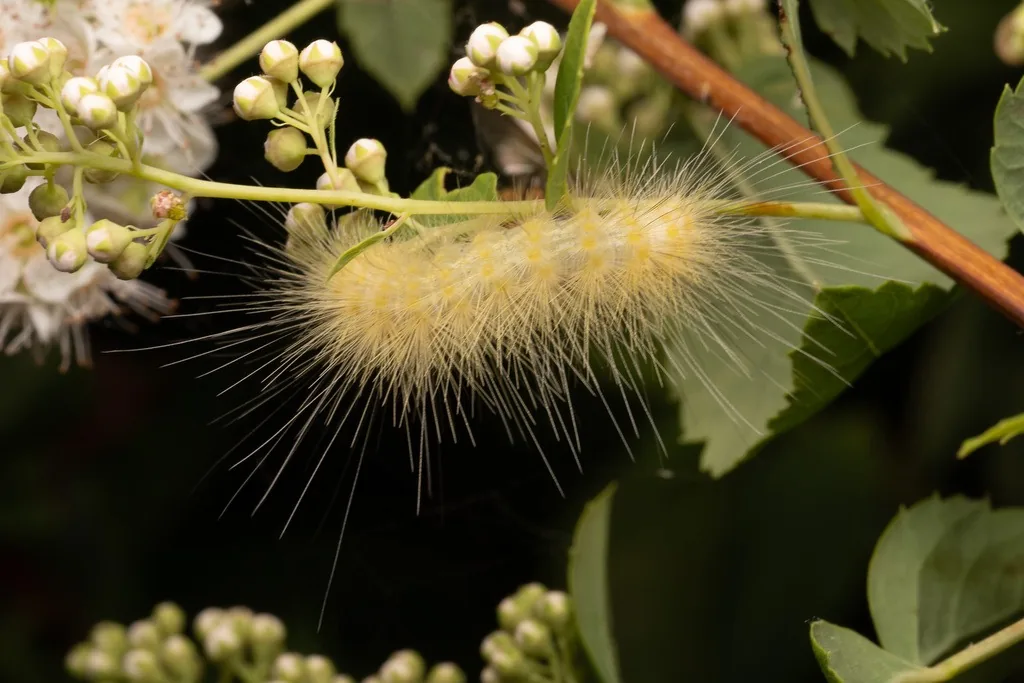
- Tufts of hair grow from small, often pale bumps, and most tufts include some hairs nearly twice as long as the rest. Hair color is most often yellow but ranges from beige or cream to orange-red, reddish brown or black.[1][2][3]
- There is a dark line along each side of the body and the spiracles (breathing pores) are white.[1]
- The adult is a snow-white moth about an inch long with a wingspan of about 1 1/2 inches, with colored front legs and markings on the abdomen it shows when alarmed. Females, as caterpillars and moths, are a little bigger than males.[3]
Look-alikes
| Look-alike | How to tell them apart |
|---|---|
| Banded woolly bear | The banded woolly bear, caterpillar of the Isabella tiger moth, has stiff hairs that are black at both ends and rusty red or brown in the middle, and it often rolls into a ball when disturbed. The yellow woollybear's fine hairs range from beige or yellow to dark reddish brown.[2][4] |
Where it lives
The UW-Milwaukee Field Station says the Virginian tiger moth is found across North America, coast to coast and from northern Canada to the Rio Grande, except for a few western Great Plains states. Ohio State calls the yellow woolly bear one of two very common woolly bears in Ohio. GBIF holds about 28,000 US records since 1990 from 46 states, counting the District of Columbia, most from Texas, Ohio and Illinois.[3][2][7]
Biology and life cycle
Caterpillars are around from spring to fall. Females lay eggs in groups of 20 to 100 on the undersides of leaves, and the young caterpillars feed together, skeletonizing leaves, before they spread out.[1][3]
Ohio State and UW-Milwaukee give two generations a year, with the bigger generation of caterpillars usually in August and September in Ohio; MU Extension gives two to three.[2][3][1]
It eats low-growing plants, both woody and herbaceous, including grasses, clovers, milkweed, dandelion, plantain, honeysuckle, cherry and some crops.[3][6]
In a lab study, caterpillars raised on narrowleaf plantain, which is high in defensive iridoid glycosides, had lower activity of one gut enzyme than caterpillars raised on dandelion.[6]
Woolly bears wander in fall, crossing roads in search of sheltered spots such as under bark or plant debris where they spend the winter.[2][4]
Damage and signs
- Host plants include more than 100 vegetable, field crop, fruit, flower and weed species.[1]
- The caterpillars chew large, irregular holes in leaves. How much it matters depends on the number of caterpillars and the size and looks of the plant: Ohio State says soybean defoliation is never an issue, but a few woolly bears on a young canna can make it look unsightly.[2]
Health risk
The hairs aren't venomous, but tiger moth caterpillar hairs can irritate people with sensitive skin, and Ohio State says such people may develop dermatitis. A dermatology review says most skin reactions to caterpillars are mild and go away on their own, though some people react more strongly, and that prompt removal of the hairs is part of treatment.[3][1][2][5]
Control
Prevention
Leave hairy caterpillars alone or handle them with care if your skin is sensitive. The Missouri Department of Conservation advises caution with any fuzzy caterpillar you can't identify, since some other species' hairs or spines can sting.[2][4][1]
Where sources disagree
Generations: MU Extension reports two to three generations a year; Ohio State and the UW-Milwaukee Field Station say two.[1][2][3]
Winter stage: most sources say the fall caterpillars spend the winter as larvae, feed briefly in spring and then pupate, but the UW-Milwaukee Field Station notes that David Wagner's Caterpillars of Eastern North America says the species overwinters as a pupa.[3][2]
Common questions
- What is the fuzzy yellow caterpillar in my garden?
- Likely a yellow woollybear, the larva of the white Virginian tiger moth. Its color varies, so a cream, orange or rusty one may be the same species.[1][2][3]
- Do woollybears sting?
- No, the hairs aren't venomous, but they can irritate sensitive skin. Some other hairy caterpillars do sting, so caution makes sense with any you can't identify.[3][1][4]
- Why are woolly bears crossing the road in fall?
- They are looking for sheltered spots to spend the winter.[2][4]
- Does the yellow woollybear predict the winter?
- The weather folklore is about the banded woolly bear, not this one, and Ohio State says research shows its black bands vary with the caterpillar's age and moisture where it grew.[2][4]
Sources
- University of Missouri Extension (Caterpillars in Your Yard and Garden, IPM1019), “Caterpillars in Your Yard and Garden, page 54: Yellow woollybear.” extension.missouri.edu/publications/ipm1019-54 (accessed 2026-11-11)
- Ohio State University Extension, Butler County, “Woolly Bear Caterpillars (November 10, 2015).” butler.osu.edu/news/woolly-bear-caterpillars (accessed 2026-11-11)
- University of Wisconsin-Milwaukee Field Station, “Virginian Tiger Moth, Bug of the Week (K. Redmond, 'the BugLady').” uwm.edu/field-station/bug-of-the-week/virginian-tiger-moth/ (accessed 2026-11-11). University field station's natural-history column
- Missouri Department of Conservation, “Isabella Tiger Moth (Woolly Bear; Woolly Worm) (field guide).” mdc.mo.gov/discover-nature/field-guide/isabella-tiger-moth-woolly-bear-woolly-worm (accessed 2026-11-11)
- Dermatologic Therapy, via PubMed, “Caterpillars and moths (Hossler 2009).” pubmed.ncbi.nlm.nih.gov/19580579/ (accessed 2026-11-11). Cited from the PubMed abstract.
- Journal of Insect Physiology, via PubMed, “Influence of iridoid glycoside containing host plants on midgut beta-glucosidase activity in Spilosoma virginica (Pankoke et al. 2010).” pubmed.ncbi.nlm.nih.gov/20727899/ (accessed 2026-11-11). Cited from the PubMed abstract.
- Global Biodiversity Information Facility (GBIF), “Spilosoma virginica: US occurrence records since 1990 by state (GBIF occurrence search API).” api.gbif.org/v1/occurrence/search?taxonKey=1811948&country=US&hasGeospatialIssue=false&occurrenceStatus=PRESENT&year=1990%2C2026&facet=stateProvince&facetLimit=400&limit=0 (accessed 2026-11-11). State counts are records reported (iNaturalist research-grade, museum specimens, surveys), not abundance.
- iNaturalist, “Spilosoma virginica taxon page (order and family).” www.inaturalist.org/taxa/60839 (accessed 2026-11-11)