On this page
How to identify it
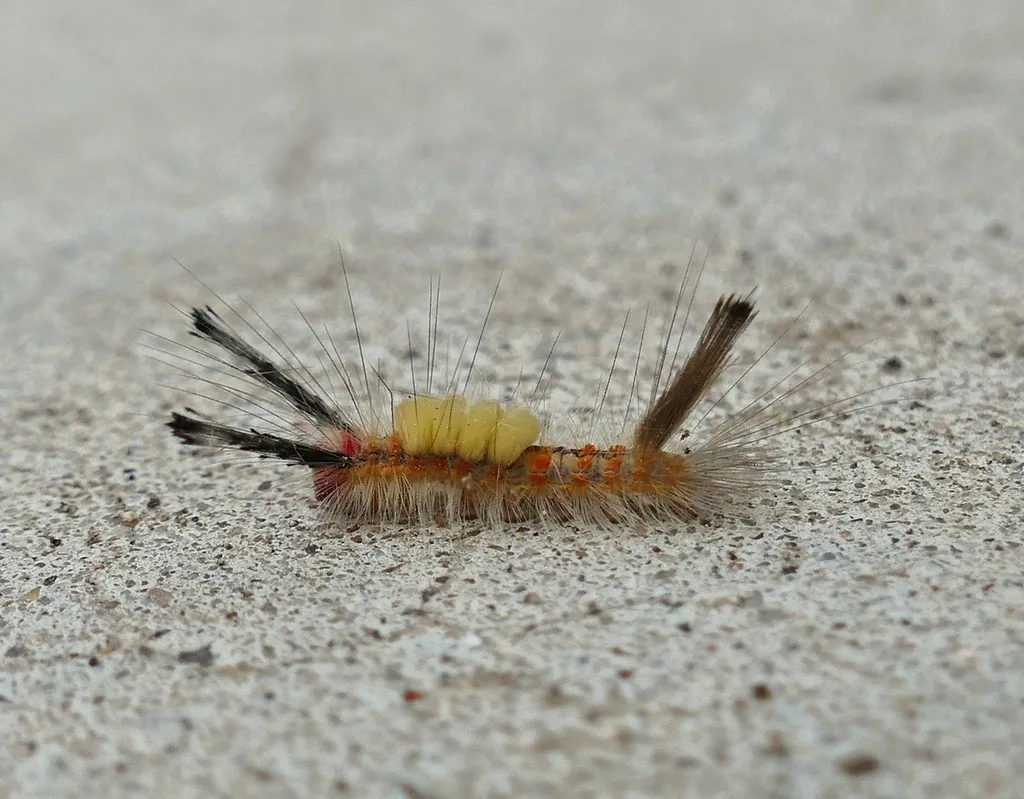
- A mature caterpillar is about 1.25 to 1.5 inches long, with two long tufts of black hair pointing forward from the head, a similar black tuft pointing backward from the rear, and four dense patches of hair midway along the back. UF/IFAS gives the length as 1 to 1.5 inches and adds a bright red head, orange glands in the middle of the back on abdominal segments six and seven, and bright orange spots along the back and sides. In Florida the sides come in a dark gray form and a light gray to light yellow form.[5][11]
- Females are flightless and stay on their cocoons, where they also lay their eggs. UF/IFAS says the females are actually short-winged rather than wingless. Males are small, rather dull moths with prominent comb-like (bipectinate) antennae that rest with their front legs held outstretched, the pose behind the genus name Orgyia, and Orgyia wingspreads run 2.0 to 3.5 cm (0.78 to 1.4 in).[4][11]
- Cocoons are made of silk mixed with the caterpillar's hairs. UF/IFAS says to look in bark furrows, on the undersides of limbs, in tree cavities, under loose bark, often under the soffits of buildings, and in dense masses among Tillandsia air plants such as ballmoss.[11]
Look-alikes
| Look-alike | How to tell them apart |
|---|---|
| Whitemarked tussock moth | Its caterpillar, also 1 to 1 1/2 inches long with black hair pencils at the front and rear, has four dense white clumps of short hairs on the first four abdominal segments and two bright red bumps on segments six and seven. It is the species CDC linked to rash outbreaks at Florida child care centers. UF/IFAS says the whitemarked caterpillar has a white or yellow line beside the dark midline, yellow rather than orange spots, and bright red rather than orange glands on segments six and seven; fresh males have a purplish tint and a whitish spot near the hind corner of the forewing, both lacking in the fir tussock moth.[7][1][11] |
| Definite tussock moth (Orgyia definita) | UF/IFAS says its caterpillar has a tan or yellow head instead of a red one, pale yellow glands on segments six and seven and a lighter body overall; it is rare in Florida.[11] |
Where it lives
It is typically found on the Coastal Plain from Florida and the Gulf states west to Texas, and north of Florida to Long Island, New York, becoming less common northward. In New York it was rediscovered in 2019 when a larva was found on Long Island. Butterflies and Moths of North America gives the range as the Atlantic coast from Long Island to Florida and west to Texas. UF/IFAS likewise gives the Coastal Plain from Long Island to Florida and the Gulf States west to Texas, uncommon in the northern part of the range.[4][9][11]
Biology and life cycle
In Florida, the eggs spend the winter. Soon after the larvae hatch, they spin silk that carries them to new places. UF/IFAS says there is one generation a year, while Florida's other two Orgyia species have two. In Florida the overwintering eggs begin to hatch in late February, and the young larvae eat what is left of the egg mass before ballooning away on silk threads; because the females cannot fly, ballooning is the main way the species spreads.[4][11]
In Florida it has been found in swamp forests of cypress, white cedar and hardwoods, but it doesn't seem to need any rare habitat.[4]
By the time homeowners notice leaf damage on their oaks, most caterpillars have stopped feeding and are entering the pupal stage.[5]
Researchers identified two mirror-image forms of a long-chain alcohol as the main components of the female sex pheromone. In field trapping, the two together, but not either one alone, drew significant numbers of males.[2]
Fun fact: in New York the fir tussock moth is so rare that it had been listed as only historically present until a single caterpillar turned up on Long Island in 2019.[4]
Young larvae chew holes in leaves and older ones feed from the leaf edges. In early April in Florida, grown caterpillars wander off to find cocoon sites, often on buildings, fences and other structures, and the moths emerge from mid-April to early May.[11]
The flightless female stays on her cocoon and releases a sex pheromone to attract males. After mating she lays her eggs right on the cocoon, coats them with a secretion and rubs hairs from her body onto it; the eggs spend the winter there.[11]
UF/IFAS lists birds, large ground beetles and Polistes paper wasps among the enemies of tussock moth caterpillars, and those killed by nuclear polyhedrosis virus are typically found hanging limp by their prolegs. Parasitoids of this species have not been well studied, but UF/IFAS says there is little doubt it has many; in one count in 2000, only 70 of 730 cocoons (9.6%) had egg masses, suggesting high mortality.[11]
Damage and signs
- In the Galveston area of Texas, residents have reported major spring outbreaks on oaks, though the caterpillar occurs in low numbers in most springs. Texas A&M AgriLife says a healthy tree can generally tolerate a total defoliation without permanent damage. In Florida, UF/IFAS says Orgyia feeding usually doesn't harm large trees, though now and then the caterpillars are numerous enough to strip large trees completely, and large numbers blown onto small landscape trees can severely defoliate them.[5][11]
- UF/IFAS says the caterpillars become a problem in some years when they leave their host trees in search of places to spin cocoons, often on buildings, fences and other structures.[11]
Health risk
Texas A&M AgriLife says these caterpillars are not regarded as stinging caterpillars, but people shouldn't handle them: some aren't bothered, while others get a mild to fairly severe rash. Poison Control explains that most caterpillar problems come from tiny hairs that break off in the skin, and suggests pressing tape sticky side down on the skin and pulling it up to remove them. For tussock moth rashes in children in Hillsborough County, Florida (traced to the related whitemarked tussock moth), CDC's report lists stripping the hairs off with adhesive tape, washing with soap and water, ice packs and a low-potency steroid cream, and says to contact a health-care provider if the eyes are involved, the person has hay fever, asthma or allergies, or an allergic reaction develops. Poison Control's number is 1-800-222-1222. A 2025 dermatology study of 32 people with caterpillar dermatitis (lepidopterism) found itch, pain, hives and scratch marks the most common findings; 6 of them had symptoms without touching a caterpillar, and body-wide symptoms were less common.[5][6][1][10]
Control
Prevention
Keep people, especially children, from handling the caterpillars and cocoons. After the 2011 rash outbreaks at Florida child care centers and a school, which were linked to the related whitemarked tussock moth, the health department also recommended power-washing playground equipment to remove caterpillars, cocoons and their hairs.[1]
Keep children from touching the caterpillars; Texas A&M AgriLife advises parents to watch toddlers outdoors so they don't make contact, and CDC's report recommended preventing contact with caterpillars and cocoons.[5][1]
Traps and physical control
On shrubs and small trees, UC IPM says removing tussock moth egg masses, newly hatched caterpillars and cocoons may give some control.[8]
Biological control
If young caterpillars must be treated, UC IPM says Bacillus thuringiensis (Bt) controls tussock moth larvae, especially when most are young, and kills only caterpillars that eat sprayed leaves; it suggests a second application 7 to 10 days later because Bt breaks down quickly. Spinosad also works but can harm bees and some natural enemies.[8][7]
Pesticides
NC State, writing about the related whitemarked tussock moth, says spraying mature caterpillars that are already wandering is a waste of time, since they tolerate pesticides; young caterpillars are also susceptible to garden-center pyrethroids, but getting a spray into a tall tree's canopy safely is hard. UC IPM says tussock moths generally don't warrant insecticide unless the plants are young or otherwise unhealthy. UF/IFAS agrees control is difficult because by the time the caterpillars are migrating from the trees it is too late; if control is needed, the insecticide or Bacillus thuringiensis treatments recommended for other caterpillars should work, and the local UF/IFAS Extension office has current recommendations.[7][8][11]
Where sources disagree
Food plants: New York's status assessment lists oaks, bald cypress, swamp loosestrife, white cedar and black tupelo, while Texas A&M AgriLife's Galveston report describes it only on oaks, as the live oak tussock caterpillar. UF/IFAS, citing a 1978 monograph, gives oaks and bald cypress as the only documented hosts.[4][5][11]
Caterpillar length: Texas A&M AgriLife gives about 1.25 to 1.5 inches for a mature caterpillar, while UF/IFAS gives 1 to 1.5 inches.[5][11]
Common questions
- Why is it called the fir tussock moth if it lives on oaks?
- The name doesn't fit well. New York's status assessment lists its documented food plants as oaks, bald cypress, swamp loosestrife, white cedar and black tupelo. UF/IFAS, citing a 1978 monograph, gives oaks and bald cypress as the only documented hosts.[4][11]
- Should I spray the caterpillars on my oak tree?
- Usually not. Texas A&M AgriLife says a healthy tree can generally survive total defoliation, and by the time the damage is noticed most caterpillars have stopped feeding. NC State, writing about the related whitemarked tussock moth, says spraying mature, wandering caterpillars is a waste of time; the time to treat is while they are young and feeding, when even Bacillus thuringiensis can work.[5][7]
- Can these fuzzy caterpillars give you a rash?
- They can. Texas A&M AgriLife says some people get a mild to fairly severe rash from handling them, and CDC's report on the related whitemarked tussock moth linked both caterpillars and cocoons to rash outbreaks in children.[5][1]
- Can I get a rash without touching the caterpillar?
- Yes, it can happen. In a 2025 dermatology study, 6 of 32 people with caterpillar dermatitis had symptoms without direct contact, and CDC's report on the related whitemarked tussock moth recommended power-washing playground equipment to remove caterpillars, cocoons and their hairs.[10][1]
- Why are there fuzzy cocoons under my eaves?
- In early April in Florida, grown fir tussock moth caterpillars leave the trees to look for sheltered spots such as soffits and fences, spin cocoons of silk mixed with their hairs, and the flightless females later lay their eggs right on those cocoons.[11]
Sources
- Centers for Disease Control and Prevention (MMWR), “Caterpillar-Associated Rashes in Children - Hillsborough County, Florida, 2011 (MMWR 61(12): 209-212, March 30, 2012).” www.cdc.gov/mmwr/preview/mmwrhtml/mm6112a3.htm (accessed 2026-11-12)
- Journal of Chemical Ecology (via NCBI PubMed), “Enantiomers of (Z,Z)-6,9-heneicosadien-11-ol: sex pheromone components of Orgyia detrita (R. Gries et al.; Journal of Chemical Ecology 29(10): 2201-2212, 2003; abstract).” pubmed.ncbi.nlm.nih.gov/14682506/ (accessed 2026-11-12)
- iNaturalist, “Orgyia detrita taxon page (order and family).” www.inaturalist.org/taxa/49016 (accessed 2026-11-12)
- New York State Department of Environmental Conservation, “Species Status Assessment: Fir Tussock Moth, Orgyia detrita (2025).” extapps.dec.ny.gov/fs/programs/dfw/SWAP2025/Butterflies%20and%20Moths/Orgyia%20detrita.pdf (accessed 2026-11-12)
- Texas A&M AgriLife Extension Service, Galveston County, “Caterpillars Attack Oak Trees (2015).” galveston.agrilife.org/files/2012/03/04-22-2015-Caterpillars-Attack-Oak-Trees-by-Dr.-William-M.-Johnson.pdf (accessed 2026-11-12)
- Poison Control (National Capital Poison Center), “Are caterpillars poisonous?.” www.poison.org/articles/caterpillar-stings (accessed 2026-11-12)
- NC State Extension, “Whitemarked Tussock Moth.” content.ces.ncsu.edu/whitemarked-tussock-moth (accessed 2026-11-12)
- University of California Statewide IPM Program, “Tussock Moths (Pest Notes).” ipm.ucanr.edu/home-and-landscape/tussock-moths/ (accessed 2026-11-12)
- Butterflies and Moths of North America, “Fir Tussock Moth Orgyia detrita.” www.butterfliesandmoths.org/species/Orgyia-detrita- (accessed 2026-11-12)
- Archives of Dermatological Research 2025;317(1):221, via PubMed, “A study on the clinical manifestations in lepidopterism.” pubmed.ncbi.nlm.nih.gov/39792279/ (accessed 2026-11-12). Cited from the PubMed abstract.
- University of Florida IFAS Extension, EDIS (Featured Creatures), “Fir Tussock Moth, Orgyia detrita Guérin-Méneville, EENY588/IN1032 (D. W. Hall and L. Buss; Featured Creatures).” ask.ifas.ufl.edu/publication/IN1032 (accessed 2026-11-14)