On this page
How to identify it
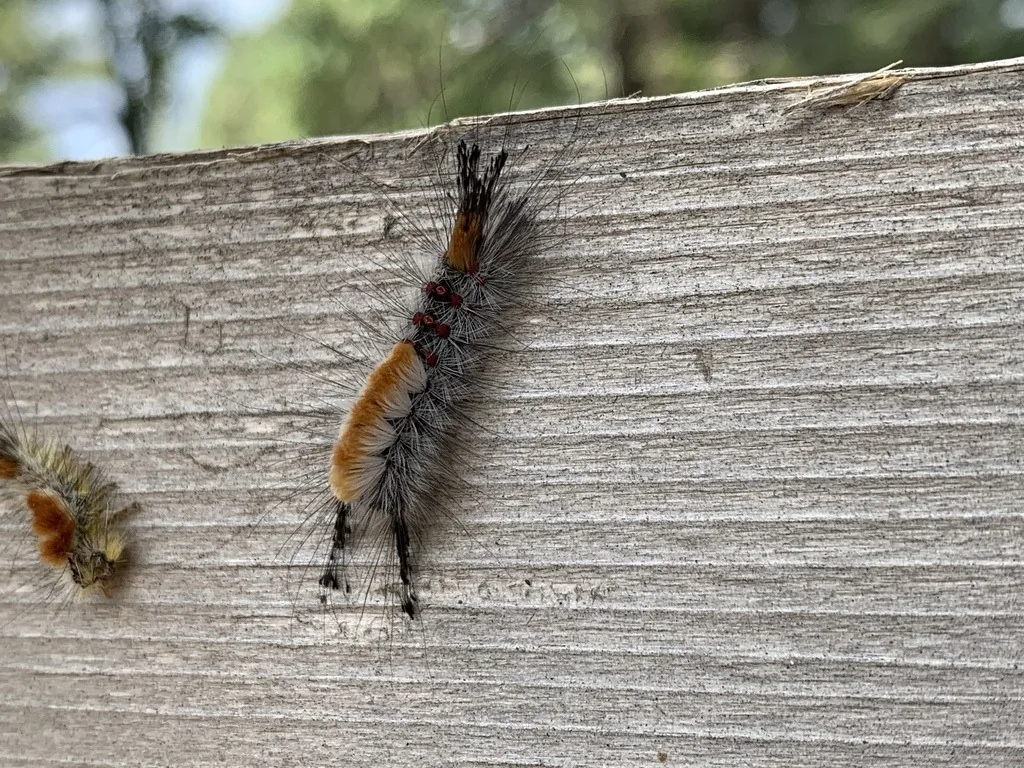
- Mature caterpillars are gray to brown with a shiny black head, two long black tufts pointing forward and one pointing back. Sizes vary by source: CSU gives 1.2 to 1.4 inches, Utah State about 1 2/5 inches, the Forest Service up to 1 1/4 inches.[2][3][1]
- They carry dense light brown hair patches with red spots and an orange stripe along each side.[2]
- Females are thick-bodied and wingless and stay on the cocoon they came out of; males fly well and have feathery antennae. CSU describes rusty forewings and a wingspan of about 1 inch; the Forest Service describes mottled gray-brown forewings and a wingspan of about 1 1/4 inches.[2][1]
- Egg masses sit on the female's cocoon, about 1/2 inch across, with white eggs under a gray, hairy coating that dries leathery. CSU says about 300 eggs; the Forest Service up to 350, fewer in the north.[2][1]
- In heavy infestations, larvae leave silken 'caps' in the upper crown that are easy to see from the ground, and cocoons may turn up on trunks, walls and doorways near infested trees.[1][2]
Where it lives
It is native to western North America. Preferred hosts vary by region: Douglas-fir in British Columbia and northern Washington, Douglas-fir and grand fir in central and southern Washington, Douglas-fir, grand fir and white fir in Oregon and Idaho, and white fir in California, Arizona and New Mexico. In urban settings it is a pest of Colorado blue and Engelmann spruce, and CSU covers outbreaks in Front Range landscapes near forests.[1][2]
Biology and life cycle
Eggs overwinter and hatch around bud break, between mid-May and late June depending on the source and location. Tiny caterpillars spin down on silk and ride the wind to new trees, usually less than about 1/4 mile; since females can't fly, this is the main way it spreads.[2][3][1]
Larvae are full grown by mid-July or August and pupate on or near the host tree. Sources differ on adult timing: CSU and Utah State say moths emerge late July to mid-August, while the Forest Service says late July into November, peaking in September. There is one generation a year.[2][3][1]
In the Pacific Northwest, the Forest Service says outbreaks come about every seven to ten years and usually end after one to four years; urban spruce and fir are often defoliated a year or two before a major forest outbreak.[1]
Egg masses on construction materials or other items can carry it to new places, CSU notes.[2]
Damage and signs
- Feeding starts at the top of the tree on new growth, then moves to older needles; tops can die after a single season of severe defoliation, and Utah State notes this top-down pattern helps separate it from Ips bark beetle damage. Needle loss can leave trees open to bark beetles and canker fungi.[2][3][1]
Health risk
The caterpillars' urticating hairs can lodge in skin and mucous membranes, and the Forest Service says people and pets often react during outbreaks with itchy skin, watery eyes, rashes and sneezing (tussockosis). In a New Mexico summer camp outbreak, 55% of campers reported itch, rash or hives; direct contact with caterpillars raised the risk, and all recovered. Studies of people exposed during a heavy infestation in Oregon forests found itching skin and eyes, runny nose, cough and sometimes trouble breathing, from both irritant and allergic effects of larvae or cocoons.[1][4][5][6]
Control
Prevention
Survey host trees for egg masses in winter or early spring; few egg masses mean little risk next year. Even when egg masses are easy to find, confirm feeding larvae after bud break before treating.[2][3]
Biological control
Natural enemies usually end outbreaks within a season or two: parasitic wasps and flies, spiders, ants and birds, and above all a virus that causes wilt disease, which kills larvae and pupae.[2][1]
Pesticides
If treatment is needed, spray the new growth, covering the treetop well, soon after egg hatch while larvae are small; Utah State includes Bacillus thuringiensis var. kurstaki among the options.[2][3]
Monitoring in Utah
Utah State recommends keeping trees healthy, checking for egg masses in early spring and watching from mid-May for egg hatch and young larvae.[3]
Common questions
- Can I touch tussock moth caterpillars?
- Avoid it. The hairs can embed in skin and cause itching, rashes and other reactions; in one camp outbreak, campers who touched or flicked caterpillars were more likely to get a rash. Staying away from heavily infested areas lowers the risk.[1][4]
- What are the caterpillars hanging limp from my spruce?
- They're likely 'hangers' killed by a virus that often ends tussock moth outbreaks.[2][1]
Sources
- USDA Forest Service, “Douglas-fir Tussock Moth (Forest Insect & Disease Leaflet 86, revised 2020).” www.fs.usda.gov/foresthealth/docs/fidls/FIDL-86-DouglasFirTussockMoth.pdf (accessed 2026-11-13)
- Colorado State University Extension, “Douglas-fir Tussock Moths (Fact Sheet 5.542).” extension.colostate.edu/resource/douglas-fir-tussock-moths/ (accessed 2026-11-13)
- Utah State University Extension, “Douglas-fir Tussock Moth.” extension.usu.edu/planthealth/ipm/ornamental-pest-guide/arthopods/moths/douglas-fir-tussock-moth.php (accessed 2026-11-13)
- J Am Acad Dermatol 2007;56(6):952-955, via PubMed, “Outbreak of lepidopterism at a Boy Scout camp (2007).” pubmed.ncbi.nlm.nih.gov/17368636/ (accessed 2026-11-13)
- Arch Environ Health 1977;32(5):206-210, via PubMed, “Health hazards to timber and forestry workers from the Douglas fir tussock moth (1977).” pubmed.ncbi.nlm.nih.gov/143915/ (accessed 2026-11-13)
- Ann Allergy 1976;36(5):302-307, via PubMed, “Tussockosis: reactions to Douglas fir tussock moth (1976).” pubmed.ncbi.nlm.nih.gov/132879/ (accessed 2026-11-13)
- Global Biodiversity Information Facility (GBIF), “Orgyia pseudotsugata McDunnough, 1921 (GBIF Backbone Taxonomy).” api.gbif.org/v1/species/8720118 (accessed 2026-11-13)
- iNaturalist, “Orgyia pseudotsugata taxon page (order and family).” www.inaturalist.org/taxa/48907 (accessed 2026-10-06)