On this page
How to identify it
- Look for reddish-brown or orange-tan boring dust in bark crevices and pitch streams on the trunk. Oregon's forestry department says attacks are most plentiful midway up the tree and the bottom 10 to 15 feet may escape the first year; the USDA Forest Service leaflet notes sampling in Idaho and western Montana was done at about 12 feet up.[4][1][2]
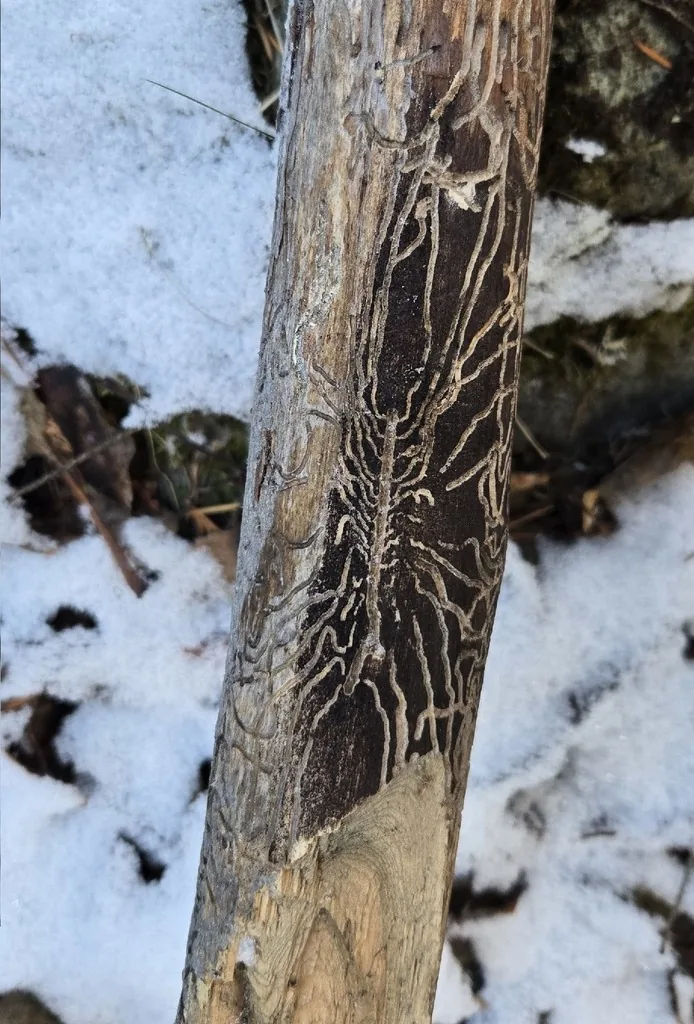
- Under the bark, eggs are laid in niches alternating on opposite sides of the egg gallery, with larval galleries etched into the inner bark on both sides, a distinctive pattern.[2]
- About a year after attack, conks of the pouch fungus Cryptoporus volvatus may grow out of the beetle exit holes, and Idaho notes conks of a sapwood-rot fungus.[2][1]
- Adults are stout, dark beetles; agencies give 4 to 6 mm (USDA Forest Service, Colorado State Forest Service) or 4 to 7 mm (Oregon). Woodpeckers stripping bark from the trunk is another sign of attack.[2][5][4]
Where it lives
Native to western North America and found throughout the range of Douglas-fir, from Oregon, Washington and Idaho to Montana and Colorado. Oregon State University Extension says it is seldom an issue below 3,000 feet in interior southwest Oregon.[2][1][5][6]
Biology and life cycle
There is one generation a year, with most beetles overwintering as adults. Oregon describes two flights, the heaviest from April to early June and a second in July and August; Colorado says beetles emerge in April and May once temperatures pass 60 degrees F, with a second attack period from late June to August.[1][4][5]
Larvae feeding in the phloem girdle the tree, and once a tree is infested it can't be saved.[1]
Beetles build up in freshly downed trees and then attack standing trees. Oregon says they generally won't attack trees that have been dead for more than a year; the USDA Forest Service leaflet says outbreaks last about a year on the coast and about three years in northern Idaho.[4][2]
Sources differ on the larval stages: the USDA Forest Service leaflet says larvae go through four stages, while the Colorado State Forest Service guide says three.[2][5]
Damage and signs
- It prefers large Douglas-firs, but sources give different sizes: Idaho says trees over 14 inches in diameter are attacked first, Oregon says downed trees over 10 inches are preferred, and Oregon State University Extension says it can kill trees 8 inches and larger.[1][4][6]
- Trees stressed by root disease, fire injury, drought or defoliation are less able to fight off attacks with resin.[1]
- Sources also differ on larch: Idaho and the USDA Forest Service say it can breed in windthrown western larch (the leaflet adds not in live larch), while the Colorado State Forest Service calls Douglas-fir its only host.[1][2][5]
- Attacked trees fade to yellow and then red; Idaho says they fade the spring after attack and are red by late summer, and Colorado says fading shows about a year after attack.[1][5]
Health risk
It breeds in Douglas-fir, and no cited source describes any risk to people or pets.[1][2]
Control
Prevention
MCH, a naturally occurring beetle repellent, applied before the spring flight protects high-value trees and stands: Idaho calls stapled pouches very effective for one season, and Oregon and Colorado also recommend it. A field study of a new bead formulation is summarized below.[1][4][5][7]
Thinning crowded, older Douglas-fir stands reduces their susceptibility, and the USDA Forest Service leaflet says well-managed stands have never been known to sustain outbreaks.[1][2]
Sanitation
Remove windthrown, damaged and infested Douglas-firs before the beetles fly. Oregon advises removing windthrow over 10 inches in diameter before the first April after a storm (or at least the second), and removing fire-damaged trees with more than half the crown scorched or more than a quarter of the cambium damaged; Oregon State University Extension suggests keeping blowdown to fewer than four large Douglas-firs per acre.[1][4][6]
Biological control
Oregon calls predatory beetles and parasitic wasps important natural controls; the USDA Forest Service leaflet lists clerid beetles, long-legged flies and parasitic wasps but says they don't prevent outbreaks, and Colorado says natural enemies have little effect during outbreaks.[4][2][5]
Pesticides
Approaches differ. The Colorado State Forest Service says preventive carbaryl or pyrethroid sprays applied by a certified applicator can protect individual high-value trees, while the Idaho and Oregon fact sheets rely on prompt cleanup, thinning and MCH. Idaho says an attacked tree can't be saved, and advises asking a forest entomologist.[5][1][4]
What the research says about MCH
MCH has been used operationally since 2000. A 2026 study of a new bead formulation found no infested trees on treated 0.4-hectare plots in 2023, compared with 13.8 percent of trees fully infested on untreated plots.[7]
A 2016 study in Idaho and Montana found no difference in wild bee abundance, richness or diversity between MCH-treated and untreated plots.[8]
Common questions
- Why are Douglas-firs dying near me a year or two after a windstorm?
- Douglas-fir beetles breed in trees blown down by wind and then attack nearby standing trees; Oregon advises removing large windthrow before the April flight following the storm.[1][4]
- How can I protect my Douglas-firs?
- Clean up windthrown and infested trees before the spring beetle flight, and apply MCH to valuable trees before the beetles fly; Colorado also lists preventive sprays by a certified applicator for high-value trees.[1][4][5]
Sources
- Idaho Department of Lands, “Douglas-fir Beetle (Forest Pest Fact Sheet, 2020).” www.idl.idaho.gov/wp-content/uploads/sites/2/2020/03/2016-single-pest-fact-sheet-Douglas-fir-Beetle_3_19_2020.pdf (accessed 2026-11-13)
- USDA Forest Service, “Douglas-fir Beetle (Forest Insect & Disease Leaflet 5, rev. February 2014; M. M. Furniss and S. J. Kegley; copy hosted by Montana DNRC).” dnrc.mt.gov/_docs/forestry/Forestry_Assistance/Forest_Pests/Douglas-firBeetle-FIDL.pdf (accessed 2026-11-13)
- Global Biodiversity Information Facility (GBIF), “Dendroctonus pseudotsugae Hopkins, 1905 (GBIF Backbone Taxonomy).” api.gbif.org/v1/species/1228029 (accessed 2026-11-13)
- Oregon Department of Forestry, “Douglas-fir Beetle (Forest Health Fact Sheet, March 2017).” www.oregon.gov/odf/Documents/forestbenefits/Douglas-fir-beetle.pdf (accessed 2026-11-13)
- Colorado State Forest Service, “Douglas-fir Beetle Quick Guide (FM 2016-1).” csfs.colostate.edu/wp-content/uploads/2016/01/Douglas-Fir-Beetle-QuickGuide2016.pdf (accessed 2026-11-13)
- Oregon State University Extension Service, “Douglas-fir insect pests in drought-stressed trees (2018, reviewed 2024).” extension.oregonstate.edu/forests/health-managment/douglas-fir-insect-pests-drought-stressed-trees (accessed 2026-11-13)
- Journal of Economic Entomology (via PubMed), “Efficacy of a bead formulation of MCH for protecting live Douglas-fir from infestation by Dendroctonus pseudotsugae (Ross et al., 2026) (abstract).” pubmed.ncbi.nlm.nih.gov/42384847/ (accessed 2026-11-13)
- Journal of Economic Entomology (via PubMed), “Wild bee response to application of the Douglas-fir beetle anti-aggregation pheromone, 3-methylcyclohex-2-en-1-one (Foote et al., 2021) (abstract).” pubmed.ncbi.nlm.nih.gov/34260727/ (accessed 2026-11-13)