On this page
How to identify it
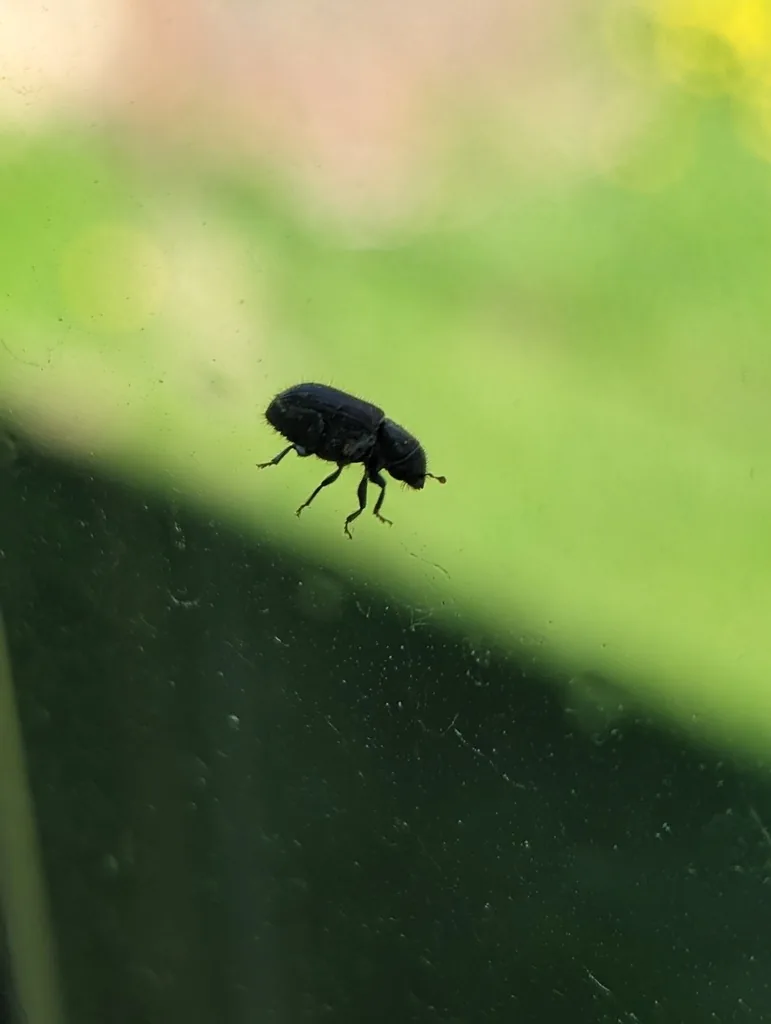
- Adults are cylindrical, about 1/8 to 1/4 inch (4 to 7 mm) long, dark brown to black with reddish-brown or black wing covers; many other bark beetles look much the same.[1][3]
- Look for reddish-brown boring dust in bark crevices and at the base of the tree, plus pitch tubes or streams of resin on the trunk. B.C. says attacks are often at or below eye level, and pitch tubes may not form in stressed trees or late-fall attacks.[1][2][3]
- Woodpeckers flaking off bark, and galleries running along the grain under the bark, also point to infestation; see where the sources disagree on needle color.[1][2][3]
Where it lives
Transcontinental, from Alaska to Newfoundland and through the Rocky Mountains; populations in New England and eastern Canada have stayed low in recent decades. All North American spruces are hosts, and B.C. adds ornamental Norway and Colorado blue spruce.[1][3]
Biology and life cycle
The life cycle takes one to three years depending on temperature, most often two; CSFS says the two-year cycle is most common in Colorado spruce above 9,000 feet, and B.C. reports a shift toward a one-year cycle in the Omineca region.[1][2][3]
Adults fly in late spring and summer to attack new trees, and females release pheromones that draw mass attacks able to overwhelm healthy trees; see where the sources disagree on timing.[1][2][3]
Outbreaks often start in windthrown spruce, then shift to standing live trees once the downed wood is used up.[1][2][3]
Damage and signs
- Large, mature trees are preferred; in Colorado it attacks Engelmann spruce and occasionally Colorado blue spruce, and B.C. says it also attacks smaller, injured or stressed trees.[1][2][3]
- Warm, dry decades have driven large outbreaks in Alaska, western Canada and the Rocky Mountains; B.C. says outbreaks typically last five years or more.[1][3]
Health risk
It feeds on spruce. The USDA Forest Service, Colorado State Forest Service and B.C. government describe tree damage only and don't mention any risk to people or pets.[1][2][3]
Control
Prevention
Packets of MCH, the beetle's anti-aggregation pheromone, can reduce attacks on standing spruce, though they work less well when beetle numbers are high; B.C. says to place them before the spring flight.[1][2][3]
Trap trees, healthy spruce felled in shade to draw beetles, can reduce local populations if they're removed and destroyed before the brood emerges.[1][2]
Sanitation
Remove and destroy infested trees, windthrow and large slash before beetles emerge in spring: haul to a mill, burn, chip, debark or solarize under clear plastic, and keep stumps low. B.C. says to peel or burn infested firewood before spring and not stack it near living spruce.[1][2][3]
Biological control
Woodpeckers can destroy up to 99 percent of the brood in a standing tree, and checkered beetles, long-legged flies and parasitoid wasps also attack it.[1]
Pesticides
Preventive bark sprays, only on trees not yet attacked, can protect individual high-value trees; the Forest Service names bifenthrin, carbaryl and permethrin, and CSFS recommends spraying only trees near homes, businesses or recreation sites. Follow the label.[1][2]
Where the sources disagree
Needle color: CSFS says needles turn pale yellowish-green and rarely turn rust-colored before dropping; B.C. says they usually turn red-brown after a couple of years, and the Forest Service says needles held longer turn red-orange.[2][3][1]
Flight season: the Forest Service says generally May through August, CSFS late May through July, and B.C. early May to early July.[1][2][3]
Stump height: B.C. says under 30 cm (about 12 inches) when removing infested trees; the Forest Service says under 18 inches during thinning.[3][1]
Common questions
- How can I tell if spruce beetles are attacking my spruce?
- Look for reddish boring dust in bark cracks and at the trunk base, pitch tubes or resin streams, and bark flaked off by woodpeckers; check low on the trunk.[1][2][3]
- Can I protect a spruce near my house?
- Yes, before it's attacked: preventive bark sprays or MCH pheromone packets can protect individual high-value trees, and removing infested trees nearby before spring helps.[1][2][3]
Sources
- USDA Forest Service (Forest Insect & Disease Leaflets), “Spruce Beetle (FIDL 127, April 2026).” www.fs.usda.gov/foresthealth/docs/fidls/FIDL-127-SpruceBeetle.pdf (accessed 2026-11-13)
- Colorado State Forest Service, “Spruce Beetle (Common Forest Insects and Diseases).” csfs.colostate.edu/forest-management/common-forest-insects-diseases/spruce-bark-beetle/ (accessed 2026-11-13)
- Government of British Columbia, Ministry of Forests, “A Guide to Managing Spruce Beetles on Private Property (March 2020).” www2.gov.bc.ca/assets/gov/farming-natural-resources-and-industry/forestry/forest-health/bark-beetles/7455_sprucebeetles_factsheet_flnro_print.pdf (accessed 2026-11-13)
- Global Biodiversity Information Facility (GBIF), “Dendroctonus rufipennis Kirby, 1837 (GBIF Backbone Taxonomy).” api.gbif.org/v1/species/1228053 (accessed 2026-11-13)
- iNaturalist, “Dendroctonus rufipennis taxon page (order and family).” www.inaturalist.org/taxa/218221 (accessed 2026-10-06)