On this page
How to identify it
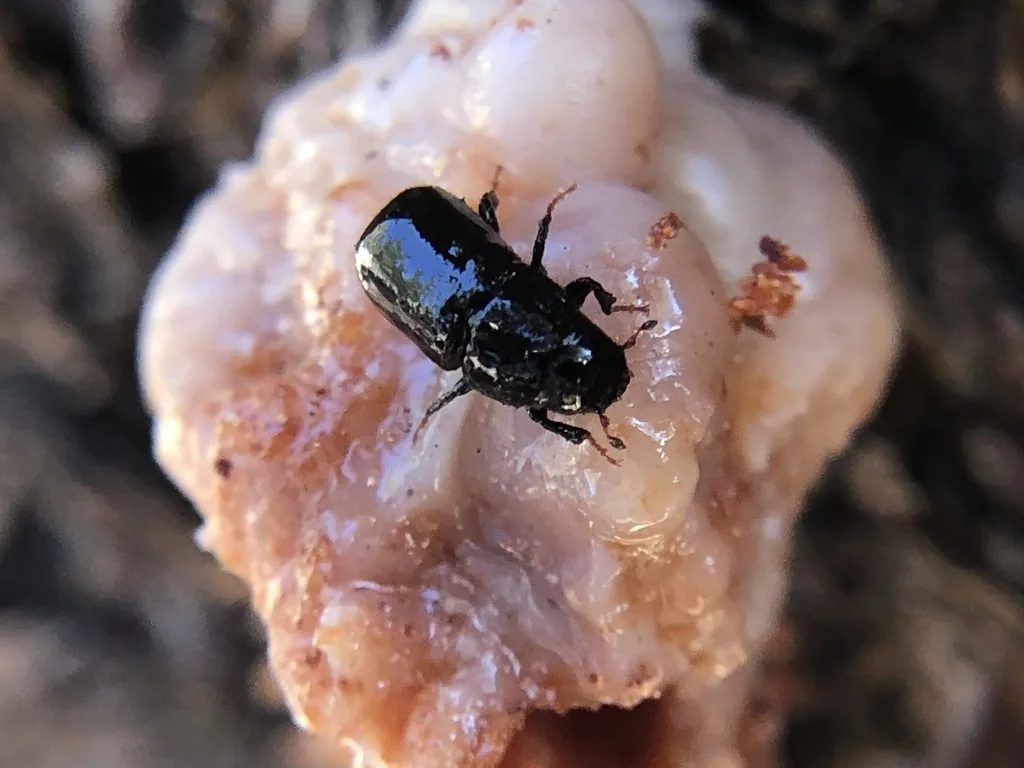
- Popcorn-shaped masses of resin called pitch tubes, brown, pink or white, form on the trunk where beetles bore in.[1]
- Boring dust collects in bark crevices and at the tree base, and the crown turns yellow to red about 8 to 10 months after a successful attack.[1]
- Under the bark you'll find vertical egg galleries and blue-gray stained sapwood.[1]
Look-alikes
| Look-alike | How to tell them apart |
|---|---|
| Ips (engraver) beetles | Ips have a sharply spined rear end; Dendroctonus beetles such as mountain pine beetle have a gently curved one.[1] |
| Red turpentine beetle | A relative that attacks injured pines, mostly the lower trunk and root collar.[1][2] |
Where it lives
It's native to western North America. In Colorado it affected 3.4 million acres of forest from the late 1990s through 2013, mainly lodgepole pine, and in the early 2010s it moved into Front Range ponderosa pine; in California, UC IPM says it attacks lodgepole and sugar pines, mostly in high-elevation landscapes such as the Tahoe Basin and San Bernardino Mountains.[1][3][2]
Biology and life cycle
Adults leave dead trees from mid-June through September, mostly in late July from lodgepole and mid-August from ponderosa pine, and mass-attack large living pines; each pair lays about 75 eggs in a vertical gallery. UC IPM says it attacks the mid-trunk, about 5 to 30 feet up.[1][2]
Larvae overwinter under the bark using glycerol as antifreeze. Sources differ on generations: CSU says one a year in Colorado, while UC IPM's table gives one to two a year in California.[1][2]
Beetles carry bluestain fungi that help kill the tree.[1]
Damage and signs
- Hosts include ponderosa, lodgepole, Scotch and limber pine, less often bristlecone and pinyon (CSU), and lodgepole and sugar pine in California (UC IPM). Once a tree is infested, nothing practical can save it.[1][2]
- In an outbreak, beetles from one infested tree can kill two or more trees the next year.[1]
- In the 1990s-2013 Colorado epidemic, the Colorado State Forest Service says beetles killed up to 80 to 90 percent of trees in some lodgepole pine forests in Summit, Grand, Eagle and Routt counties.[3]
Health risk
It attacks pines, and no cited source describes any risk to people or pets.[1][2][3]
Control
Prevention
Thinning crowded stands to well-spaced, healthy trees is the long-term remedy; stressed trees are attacked first.[1]
Sanitation
Infested logs can be peeled, burned or scorched in a pile (preferably with snow on the ground), buried under at least 8 inches of soil, or chipped before beetles emerge in summer; CSU also describes solar treatments that must heat the wood under the bark to at least 110°F. Trees that beetles have already left don't need treatment, and CSU says beetles carried in infested firewood can kill landscape pines far from the mountains.[1]
Biological control
Woodpeckers and predatory insects such as clerid beetles feed on adults and larvae under the bark, but CSU says they often fail to stop attacks during outbreaks.[1]
When to call a professional
Sources differ on who should spray and when. CSU says certain formulations of carbaryl, permethrin and bifenthrin are registered as preventive bark sprays on living green trees, applied each year between April 1 and July 1, protect through one beetle flight, and that property owners may benefit from a licensed applicator; the Colorado State Forest Service recommends spraying only high-value trees. UC IPM says products available to home users don't work against bark beetles, that protective spraying must be done by a licensed applicator, and that timing is late winter to early spring in warm areas and late spring in cooler, higher areas. UC IPM says trunk-injected or soil-applied systemic insecticides haven't been shown to prevent attacks, and CSU says no pesticides are labeled for use on larvae. Follow the label.[1][3][2]
Common questions
- What are the popcorn-like resin blobs on my pine trunk?
- They're pitch tubes, a classic sign of mountain pine beetle attack.[1]
- Can I save a pine that mountain pine beetles have already attacked?
- No; CSU Extension says nothing practical can save an infested tree.[1]
- Will a cold winter kill mountain pine beetles?
- Only a hard, well-timed freeze. CSU says it takes temperatures of at least 30 below zero (°F) for at least five days in midwinter, or a severe freeze in fall before larvae build up glycerol or in late spring as they molt to pupae.[1]
Sources
- Colorado State University Extension, “Mountain Pine Beetle (Fact Sheet 5.528).” extension.colostate.edu/resource/mountain-pine-beetle/ (accessed 2026-11-13)
- University of California Statewide IPM Program, “Bark Beetles (Pest Notes).” ipm.ucanr.edu/home-and-landscape/bark-beetles/ (accessed 2026-11-13)
- Colorado State Forest Service, “Mountain Pine Beetle.” csfs.colostate.edu/forest-management/common-forest-insects-diseases/mountain-pine-beetle/ (accessed 2026-11-13)
- Global Biodiversity Information Facility (GBIF), “Dendroctonus ponderosae Hopkins, 1902 (GBIF Backbone Taxonomy).” api.gbif.org/v1/species/1228026 (accessed 2026-11-13)