On this page
How to identify it
- Look for yellowish or reddish-brown boring dust in the bark crevices and around the base of the tree, and for small shot-hole exit holes in the bark.[2][3]
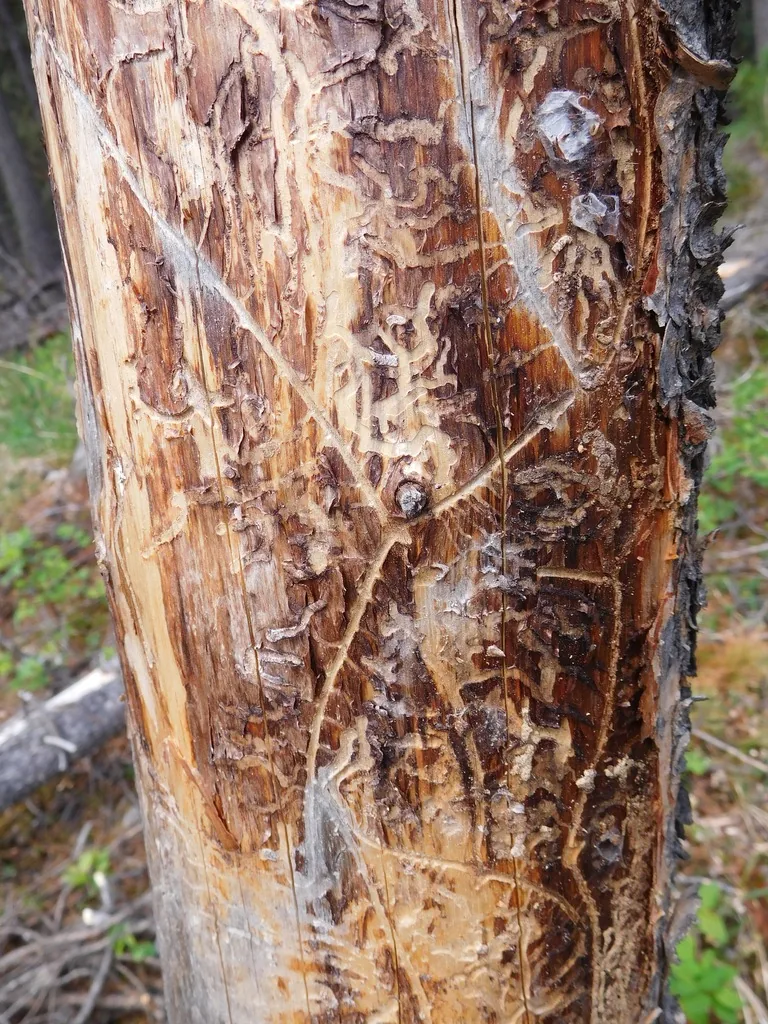
- Under the bark, the beetles leave branching tunnels etched into the inner bark where they lay eggs and the larvae feed.[2][3]
- Needles on attacked parts of the tree fade and turn red, often first in the top third of the crown; dieback at the top of the tree is a typical sign.[4][2]
- The adult beetles are small, about 3 to 5 mm long.[4]
Look-alikes
| Look-alike | How to tell them apart |
|---|---|
| Mountain pine beetle and other Dendroctonus bark beetles | Ips beetles are generally less destructive and aggressive than Dendroctonus bark beetles such as the mountain pine beetle, and they often attack the tops of trees rather than the main trunk.[3][4] |
Where it lives
Oregon's forestry department describes the pine engraver as transcontinental. State fact sheets treat it as an important pine pest in Wisconsin, Colorado (where it is the most common Ips on ponderosa and lodgepole pines) and Oregon.[4][1][3]
Biology and life cycle
Adults overwinter under the bark, and in Oregon pine-infesting Ips begin their attack flights in April; the larvae feed in galleries around the egg-laying areas.[2][4]
Oregon's forestry department says development takes 4 to 6 weeks, with 2 to 3 generations a year; Montana State says there can be up to four generations a year.[4][2]
Populations build in fresh slash and other recently cut pine, which Wisconsin's guide says the beetle infests down to about 2 inches in diameter and Oregon's says it prefers at 3 to 8 inches, then can attack nearby standing pines, especially in drought.[1][4]
Damage and signs
Health risk
It attacks trees only; none of the sources reports any harm to people or pets.[2][3]
Control
Prevention
Keep pines vigorous: water them during drought and avoid root injury and soil compaction, since stressed and newly planted trees are the ones attacked.[3][1]
Sanitation
Don't leave fresh pine slash or firewood near live pines. Wisconsin's guide advises cutting pine from October through February and removing pines that die suddenly before April 15; Oregon's says slash cut from October through December can be left to decompose before the beetles fly. Pines dead long enough for the bark to loosen no longer support the beetles.[1][4][3]
Pesticides
Once the beetles are in a tree it is hard to kill them or correct the damage, though Colorado State notes an attack does not necessarily kill the whole tree. Preventive trunk sprays applied before beetles arrive can protect valuable uninfested pines; Colorado State names permethrin, bifenthrin and carbaryl (Sevin) as the active ingredients used.[2][3]
Common questions
- Why is the top of my pine turning red?
- A pine whose top fades to red, with yellowish or reddish-brown boring dust in the bark crevices or at the base, may be under attack by pine engravers.[2][3][4]
- Can I save a pine with engraver beetles?
- Once the beetles are in a tree it is hard to kill them or correct the damage, though an attack does not always kill the whole tree. Removing infested trees and fresh slash protects nearby pines, and preventive trunk sprays can protect valuable uninfested trees.[2][3][1]
Sources
- Wisconsin DNR Forest Health Protection (hosted by UW Forestry Extension), “The Pine Engraver Bark Beetle (Ips pini) in Northern Wisconsin (FHP-2).” forestry.extension.wisc.edu/files/2017/09/FHP-2.pdf (accessed 2026-11-12)
- Montana State University Extension (Urban IPM), “Engraver Beetles (Ips spp.).” urbanipm.montana.edu/entomology/resources/fact-sheets/engraver-beetles.html (accessed 2026-11-12)
- Colorado State University Extension, “Ips Beetles (Fact Sheet 5.558, W. Cranshaw).” extension.colostate.edu/resource/ips-beetles/ (accessed 2026-11-12)
- Oregon Department of Forestry, “Ips beetles (Forest Health Fact Sheet).” oregon.gov/odf/documents/forestbenefits/ips.pdf (accessed 2026-11-12)
- iNaturalist, “Ips pini taxon page (order and family).” www.inaturalist.org/taxa/222278 (accessed 2026-10-06)