On this page
How to identify it
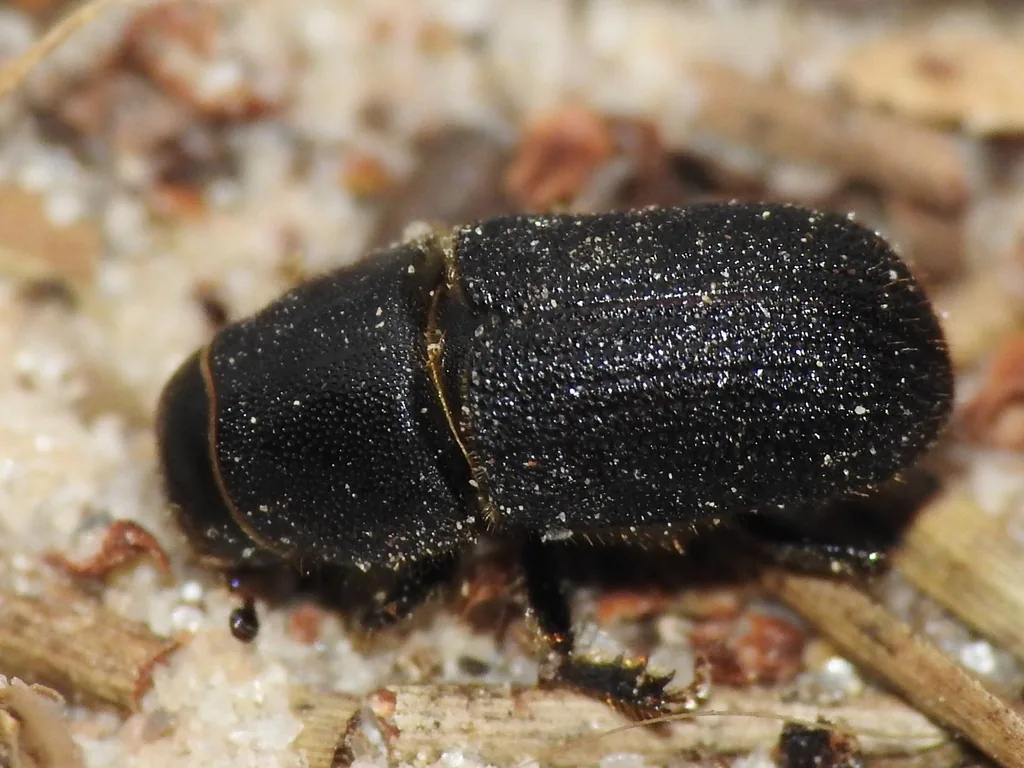
- Adults are stout, cylindrical, dark reddish brown to black and 5 to 10 mm long. The rear end is rounded, without the spines that pine engraver beetles have. UF/IFAS gives 5 to 8 mm and calls it the largest bark beetle in the southeastern U.S. Its head is exposed and convex in front, with clubbed antennae, and the shield behind the head is much narrower at the front than at the rear.[1][9]
- Pitch tubes are large, about 1 inch across, often with a big hole in the center after a successful attack. Fresh tubes are white to reddish (resin mixed with boring dust and frass) and turn grayish red with age. Red and white boring dust and hardened resin collect around the base of the tree.[1]
- Most attacks are in the lowest 2 to 3 feet of the trunk. Scattered attacks reach 6 feet, and on loblolly pine up to 15 feet. Beetles may also bore into the root collar, and occasionally into large roots below the soil.[1]
- Larvae are legless and yellowish white with a reddish brown head, up to 12 mm long. Feeding together, they hollow out a fan- or D-shaped patch of inner bark up to 10 inches wide.[1]
- UF/IFAS lists the signs of attack: pinkish-white, reddish-brown or purplish-gray pitch tubes 2 to 5 cm wide on the lower trunk, sometimes with an entrance hole 3 to 5 mm wide; crystallized pitch pellets on the ground at the base; large vertical or fan-shaped galleries in the inner bark; and a crown that gradually fades from green to yellow to red to brown. Pitch tubes of dried resin without reddish sawdust mark failed attacks.[9]
- The larvae feed side by side in one shared cavity, which UF/IFAS says is unique among bark beetles (in most species each larva bores its own tunnel), so a communal fan-shaped gallery identifies this beetle.[9]
Look-alikes
| Look-alike | How to tell them apart |
|---|---|
| Southern pine beetle | Often shares trees with the black turpentine beetle. The southern pine beetle has to kill its host to reproduce, while the black turpentine beetle can live in a living tree as a parasite and only occasionally kills trees. UF/IFAS says it is the only other Dendroctonus in Florida, similar in shape but just 2 to 3 mm long.[3][1][9] |
| Red turpentine beetle | A slightly larger relative whose range overlaps the black turpentine beetle's in the Northeast. UF/IFAS says the red turpentine beetle ranges from Alaska to Mexico and east to New England but not into the Southeast, so the two occur together only in a narrow zone.[1][9] |
| Southern pine coneworm | Its caterpillars also make pitch tubes, but these are usually higher on the trunk and much larger, with sap running down the bark, and often sit on callus tissue such as a fusiform rust canker.[1] |
| Ips and Orthotomicus engraver beetles | Also common in pines, but UF/IFAS says their heads are hidden under the shield behind the head, and the rear of the abdomen is flattened or dished rather than rounded.[9] |
Where it lives
The USDA Forest Service gives its range as New Hampshire and Maine south to Florida and west to Missouri, Arkansas and eastern Texas, matching the ranges of its main host pines. GBIF has about 340 U.S. records since 1990, most from Texas and Florida, followed by Pennsylvania, Missouri, Massachusetts and South Carolina, plus a single record from Canada. UF/IFAS describes the range as coastal New Hampshire south through Florida and west to Texas and Missouri, the part of the continent the red turpentine beetle does not occupy.[1][4][5][9]
Biology and life cycle
Its main hosts are pitch, loblolly, shortleaf and slash pine, but any southern pine in its range can be attacked, as can red spruce. In the Northeast, Japanese black pine and Scots pine are frequent hosts.[1]
It usually breeds in fresh stumps and in trees weakened by drought, fire, storms, logging or other bark beetles. When a disturbance leaves lots of such material, numbers build, and it can then attack and sometimes kill apparently healthy trees.[1][2]
Beetles find trees mainly by smell, and turpentine is very attractive to them. A female starts each attack and releases frontalin, which draws males. Trees that have already been attacked are 12 times more likely to receive new attacks than uninfested pines.[1]
Its pheromones also attract the southern pine beetle, and it often arrives on a tree first, so researchers think it may help southern pine beetles find living hosts.[3][1]
Each pair cuts an egg gallery 8 to 12 inches long that curves down toward the roots. The female lays about 100 eggs over about two weeks, larvae hatch in 10 to 14 days, and pupae mature in another 10 to 14 days.[1]
The life cycle takes 2.5 to 4 months. There is one generation a year at the northern edge of its range and 2.5 to 3 in the Southeast. It has no dormant stage: adults can be caught year round, though most new attacks happen from spring through fall.[1]
UF/IFAS says turpentine, a mixture dominated by alpha- and beta-pinene, attracts it and can be used to monitor it, but it does not respond to simple lures of those two compounds without the remaining trace volatiles.[9]
Florida has up to three overlapping generations a year, with all life stages present year-round; in North Florida, trap catches peaked in March, July and October.[9]
It can carry blue-stain fungi into the sapwood, but because attacked trees often survive, UF/IFAS says the fungus may do less harm than it does with southern pine beetles and engravers. Tree deaths usually come from attacks piling up over several generations or years.[9]
Besides southern pines and red spruce, recorded hosts include pitch, eastern white, black and Scots pine. It caused significant losses of non-native Japanese black pine, which ceased to be planted in New England in the 1990s, and UF/IFAS notes concern that it could become invasive overseas.[9]
Damage and signs
- Attacks on a tree continue for 4 to 7 months, averaging 28.6 per tree, and up to 75 percent of beetles get pitched out by resin. As successful attacks add up, larval feeding girdles the inner bark, and the blue-stain fungus the beetles carry blocks water and nutrient flow. Heavily infested trees usually die within 3 to 6 months.[1]
- With the decline of the old naval stores industry it has become mainly an urban problem, attacking ornamental pines stressed by soil compaction, drought or pollution. On Long Island and Cape Cod it became a primary pest of landscape Japanese black pines, and over 70,000 pines there were infested and removed.[1]
- In forests, about 10 percent of a stand may be attacked when beetle numbers are high, and up to 25 percent after heavy logging or storm damage. Outbreaks usually die down after 1 to 2 years but can last 3 to 5.[1]
- Historically it was a major pest of pines wounded or treated with herbicides for naval stores production. In the 1950s it damaged 37 million board feet of timber and contributed to the financial collapse of turpentine farms.[9]
- In typical forests it does not spread rapidly the way the southern pine beetle does, and losses are scattered and patchy. Where stress is frequent or persistent, though, it can become a chronic pest that kills many trees over a long period.[9]
Health risk
The USDA Forest Service leaflet and the 2019 research review describe a pest of pines and don't mention any risk to people or pets.[1][2]
Control
Prevention
Keep landscape pines vigorous: water during droughts without overwatering, avoid soil compaction and root damage, keep mowers and string trimmers off the trunk, and use mulch instead of turf in the root zone. Plant so the root flare shows at ground level and don't pile soil over the roots of existing trees. UF/IFAS adds: keep pavement off the root zone, space trees 4 to 6 m apart, keep competing vegetation down under pines, use an acidic pine-needle or pine-bark mulch, don't routinely water turf under pines, and deep-water during long droughts.[1][9]
In woodlots, thin in the cooler months if possible, keep damage to remaining trees low during thinning, and harvest damaged or declining pines quickly. UF/IFAS also suggests planting species suited to the site, thinning overstocked stands before growth declines (but not while bark beetles are active in or next to the stand), keeping stumps low, keeping logging slash and fresh pine firewood away from live pines, and removing infested trees carefully so nearby pines aren't injured.[1][9]
Traps and physical control
If a high-value pine has only a few fresh pitch tubes, scrape away the pitch and open the gallery to remove the parent beetles before the female lays eggs.[1]
Pesticides
To protect high-value pines, use an insecticide labeled for pine bark beetles; some products require a certified applicator. The Forest Service suggests two bark sprays a month apart in spring, just before adults become active, covering the lower six feet of the trunk and the buttress roots. On trees already attacked, spray up to the highest pitch tube as soon as attacks are seen. UF/IFAS says treating the lower 2 to 3 m of trunk may be warranted for high-value landscape trees, and that trees with fewer pitch tubes than their diameter in inches are more likely to survive and make better candidates. It suggests contacting your local UF/IFAS Extension office for current insecticide recommendations.[1][9]
In a Georgia field test on stressed loblolly pines, bark sprays of bifenthrin or carbaryl both greatly reduced colonization by bark and woodboring beetles, with no difference between the two.[6]
When to call a professional
For help, private landowners can contact their county Extension agent, state forestry department or state agriculture department.[1]
In forest stands, UF/IFAS says small or scattered infestations are usually best left to die out on their own. Unlike with southern pine beetle, cutting isolated infested trees is not recommended, because it creates fresh host odors, breeding material and injury that can make things worse; if losses become unacceptable, a clearcut or block removal of the infested area is preferable. Traps have not controlled infestations.[9]
Why it shows up after storms and logging
Infestations are most frequent where trees have been hit by other insects, logging, fire, drought or storms. Deaths are usually scattered, though small groups of pines can be killed.[1]
A 2019 review found that its basic biology is well known, but its effects on forests and ways to monitor and manage it have been only partly studied.[2]
Where the sources disagree
How often it kills trees: the Forest Service says heavily infested trees usually die within 3 to 6 months and that it has become a primary invader of landscape Japanese black pines in the Northeast; the 2024 study says it infrequently kills trees and can live in a living tree as a parasite, and the 2019 review says it sometimes kills apparently healthy trees.[1][3][2]
Management: the Forest Service gives specific prevention, removal and bark-spray steps and notes that routine widespread spraying has been discontinued because control cost more than the losses; the 2019 review says ways to monitor and manage it have been only partly studied.[1][2]
Size: the Forest Service gives 5 to 10 mm; UF/IFAS gives 5 to 8 mm.[1][9]
Pitch tubes: the Forest Service describes them as about 1 inch across; UF/IFAS gives 2 to 5 cm.[1][9]
Attack height: the Forest Service says most attacks are in the lowest 2 to 3 feet and suggests spraying the lower six feet of trunk; UF/IFAS says attacks usually hit the lower 1 to 2 m of the trunk or large roots and suggests treating the lower 2 to 3 m.[1][9]
Common questions
- What are the reddish blobs at the base of my pine?
- Most likely pitch tubes from black turpentine beetle attacks: resin mixed with reddish boring dust, about an inch across, on the lowest few feet of the trunk. Larger pitch masses higher up with sap running down are more likely from coneworm caterpillars.[1]
- Will my pine die?
- A few attacks may only weaken it. As attacks pile up over the following months, the larvae and blue-stain fungus can girdle the tree, and heavily infested pines usually die within 3 to 6 months, so treat high-value trees as soon as attacks are seen.[1]
- Should I cut down a pine with a few pitch tubes?
- Not necessarily. UF/IFAS says small, scattered infestations usually die out on their own, that cutting isolated infested trees can make things worse, and that a tree with fewer pitch tubes than its diameter in inches is more likely to survive.[9]
Sources
- USDA Forest Service (Forest Insect & Disease Leaflets), “Black Turpentine Beetle (FIDL 12).” www.fs.usda.gov/foresthealth/docs/fidls/FIDL-12-BlackTurpentineBeetle.pdf (accessed 2026-11-13)
- Environmental Entomology, via PubMed, “A Review of the Ecology and Management of Black Turpentine Beetle (Munro et al. 2019).” pubmed.ncbi.nlm.nih.gov/31145799/ (accessed 2026-11-13)
- Journal of Economic Entomology, via PubMed, “Potential for a minor pine bark beetle pest, Dendroctonus terebrans, to mediate host location by a major pine killer, Dendroctonus frontalis (Sullivan et al. 2024).” pubmed.ncbi.nlm.nih.gov/38555592/ (accessed 2026-11-13)
- Global Biodiversity Information Facility (GBIF), “Dendroctonus terebrans: U.S. occurrence records since 1990 by state (GBIF occurrence search).” api.gbif.org/v1/occurrence/search?taxonKey=1228056&country=US&hasGeospatialIssue=false&occurrenceStatus=PRESENT&year=1990%2C2026&facet=stateProvince&facetLimit=400&limit=0 (accessed 2026-11-13). Exact count at access: 338 U.S. records since 1990 (Texas 108; Florida 74; Pennsylvania 26; Missouri 24; Massachusetts 21; South Carolina 20; Georgia 13).
- Global Biodiversity Information Facility (GBIF), “Dendroctonus terebrans: occurrence records since 1990 by country (GBIF occurrence search).” api.gbif.org/v1/occurrence/search?taxonKey=1228056&hasGeospatialIssue=false&occurrenceStatus=PRESENT&year=1990%2C2026&facet=country&limit=0 (accessed 2026-11-13). Exact count at access: 339 records (United States 338; Canada 1).
- Pest Management Science, via PubMed, “Efficacy of two insecticides for protecting loblolly pines from subcortical beetles (Burke et al. 2012).” pubmed.ncbi.nlm.nih.gov/22359265/ (accessed 2026-11-13)
- Global Biodiversity Information Facility (GBIF), “Dendroctonus terebrans (A.G.Olivier, 1800) (GBIF Backbone Taxonomy).” api.gbif.org/v1/species/1228056 (accessed 2026-11-13)
- iNaturalist, “Dendroctonus terebrans taxon page (order and family).” www.inaturalist.org/taxa/218222 (accessed 2026-10-06)
- University of Florida IFAS Extension, EDIS (Featured Creatures), “Black Turpentine Beetle, Dendroctonus terebrans (Olivier), EENY-356/IN636 (Featured Creatures).” ask.ifas.ufl.edu/publication/IN636 (accessed 2026-11-14)