On this page
How to identify it
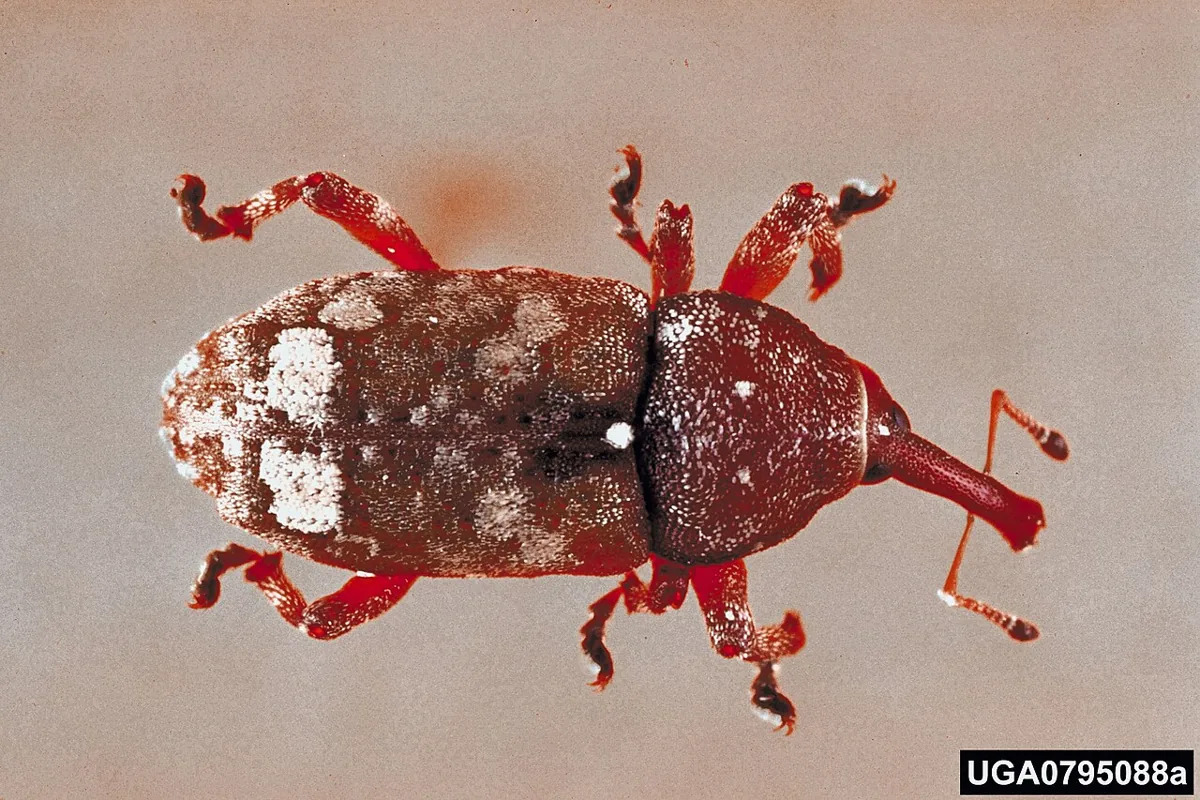
- Adults are about 1/4 inch (6 to 8 mm) long with a long, curved snout, gray to reddish brown or black, with small white spots on the thorax and larger pale spots toward the rear of the wing covers.[1][3][4]
- Grubs are plump, white, curved and legless with brown to orange heads; UGA says they reach 6 to 12 mm. They pupate in 'chip cocoons' of wood fibers under the bark, which Mississippi State calls the most definitive sign of an infestation.[1][3][4]
Look-alikes
| Look-alike | How to tell them apart |
|---|---|
| White pine weevil | A close relative in the same genus, Pissodes.[2] |
| Pine bark beetles | Deodar weevil attacks often come with bark beetle attacks on stressed southern pines. Mississippi State says deodar larval tunnels are much larger than those of Ips engravers and southern pine beetle, and the adults are much larger too.[3][4] |
| Black turpentine beetle | Mississippi State says adult deodar weevils are about the same size as the black turpentine beetle; the weevil's long snout with antennae sets it apart from other wood-boring insects.[4] |
Where it lives
Native to North America; UGA says all native southeastern pines are susceptible. UMass says it has been accidentally introduced elsewhere, including South Africa in 1942, where it has damaged pine plantations.[2][3]
Biology and life cycle
Adults emerge in spring, are mostly inactive in summer heat and become active again in fall, which NC State and Mississippi State call the peak time for feeding and breeding. Sources differ on emergence: NC State says from March but mostly in May, UGA March to April, Mississippi State April to May, and UMass April or May in the North.[1][3][4][2]
Females lay one to a few eggs in each puncture in the inner bark, and the grubs mine under the bark through fall and winter. NC State, UGA and Mississippi State say there is one generation a year; UMass says the life cycle can take one to two years depending on climate.[1][4][3][2]
Damage and signs
- Grubs feed under the bark, mostly in the bottom 10 feet of the trunk, and can girdle and kill trees; NC State reports trees up to 36 feet tall killed. Adults also feed on shoots and tops, which can kill terminals.[1][4][2]
- It prefers dying or stressed trees, fresh stumps and windblown trees. Sources differ on healthy trees: Mississippi State says deodar weevils don't kill healthy pines, while UMass says a high local population can kill even healthy or recently transplanted trees.[1][2][3][4]
- Fading crowns in fall or winter and browning shoots are common signs. Mississippi State says crowns that fade in late spring and summer are more likely caused by something else.[2][3][4]
- Deodar weevils can spread the pitch canker fungus. Mississippi State says not all weevils carry it, and that together they have caused 40 percent top dieback and 30 percent mortality in a single year in some pine plantations.[1][2][3][4]
- Sources list different hosts. NC State says almost all eastern pines plus Douglas-fir and spruces; UGA names loblolly, longleaf, shortleaf, slash, spruce and sand pines; UMass also lists Atlas, Lebanon and deodar cedars. NC State and Mississippi State say trees younger than about 5 years are rarely attacked.[1][3][2][4]
Health risk
It feeds on conifers, and no cited source describes any risk to people or pets.[1][2][3][4]
Control
Prevention
Keep trees vigorous. NC State suggests watering specimen trees during long dry spells, and Mississippi State and UGA suggest thinning stands once yearly diameter growth falls below 5%, since egg-laying females avoid faster-growing pines.[1][4][3]
Sanitation
Remove stumps and woody debris that serve as breeding sites. Mississippi State suggests thinning before or after the September to November peak breeding season, since trees damaged during thinning become targets.[2][4]
Biological control
Woodpeckers eat the larvae and pupae; Mississippi State says ripped-open chip cocoons are a sign of it. UMass also cites a braconid wasp parasitoid and disease as natural enemies.[4][2]
Pesticides
For specimen trees where weevils are present, NC State suggests a pyrethroid in fall as weevils become active, and possibly in April or May, kept away from pools, ponds and streams. UGA says treating recently attacked and neighboring trees is an option but isn't practical in a rural forest stand. Follow the label.[1][3]
Common questions
- Why are my pine's lower trunk and crown dying after a drought?
- Drought-stressed pines are prime targets for deodar weevils and bark beetles. Look for chip cocoons under the bark of the lower trunk.[1][3][4]
- Should I worry if I find deodar weevil signs in my pines?
- Sources differ. Mississippi State says signs on a few suppressed trees are normal and not a major concern, since healthy pines resist attack, while UMass warns that a high local population can kill even healthy trees.[4][2]
Sources
- NC State Extension, “Deodar Weevil / Eastern Pine Weevil (PDIC Factsheet).” content.ces.ncsu.edu/deodar-weevil-or-eastern-pine-weevil (accessed 2026-11-13)
- UMass Extension Landscape, Nursery and Urban Forestry Program (Landscape Insect & Mite Guide), “Pissodes nemorensis (Northern Pine Weevil).” www.umass.edu/agriculture-food-environment/landscape/publications-resources/insect-mite-guide/pissodes-nemorensis-also-sometimes-considered-pissodes-approximatus (accessed 2026-11-13)
- University of Georgia Integrated Pest Management Program, “Deodar Weevil (Eastern Pine Weevil), Pissodes nemorensis (2020).” ipm.uga.edu/2025/09/19/deodarweevil/ (accessed 2026-11-13)
- Mississippi State University Extension, “What Is Attacking My Pine? The Case of the Deodar Weevil (Publication 3057, POD-05-26).” extension.msstate.edu/sites/default/files/publications/P3057.pdf (accessed 2026-11-13)
- Global Biodiversity Information Facility (GBIF), “Pissodes nemorensis Germar, 1823 (GBIF Backbone Taxonomy).” api.gbif.org/v1/species/1223050 (accessed 2026-11-13)