On this page
How to identify it
- Wilted leaders curl into a shepherd's crook, and needles pale before dying and dropping. Earlier, in spring, glistening resin droplets on the leader mark adult feeding and egg-laying punctures.[1][2][4]
- Inside the dead leader, pupae form in chip cocoons of shredded wood under the bark, and new adults leave small round exit holes slightly larger than a pencil lead. Chip cocoons can stay on the tree for years as a sign of past attack.[1][4][2]
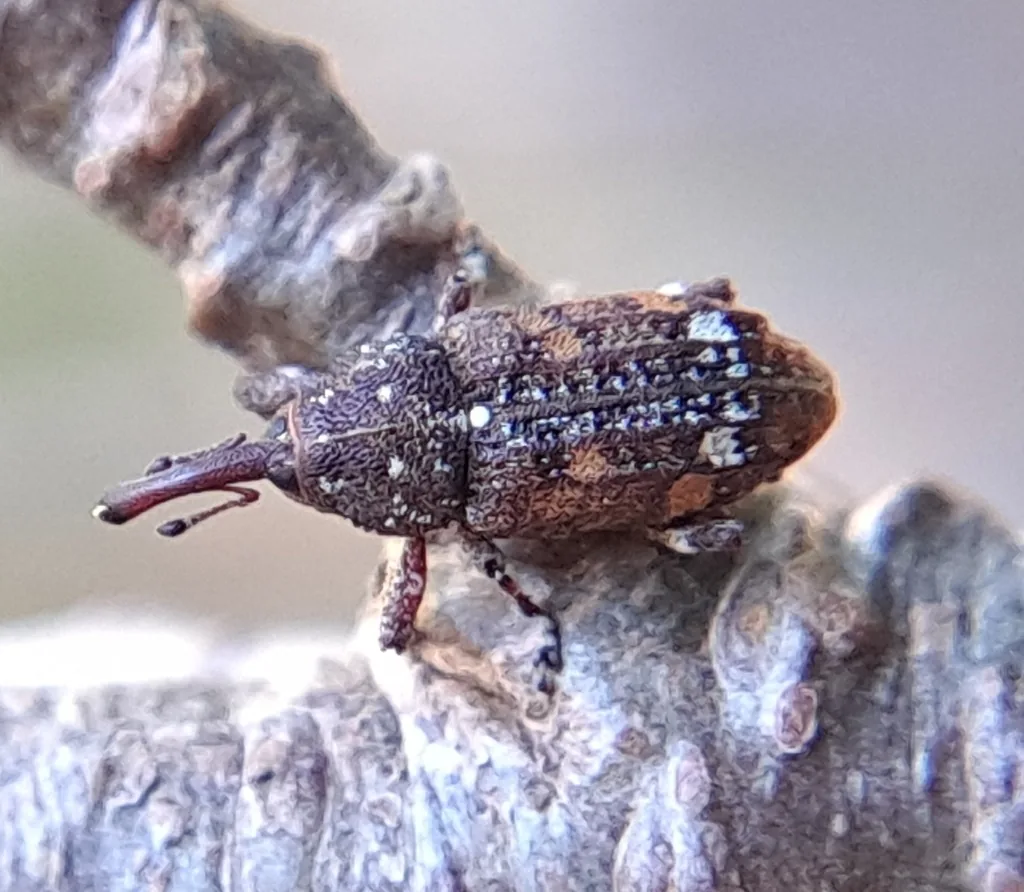
- Adults are small rust-brown to dark brown weevils with a long snout and patches of white and tan scales. Sizes differ: Penn State says 4 to 6 mm, Natural Resources Canada 6 to 7 mm. Larvae are legless white grubs with a brown head, about 7 mm (Penn State) or 9 to 10 mm (Idaho, Natural Resources Canada) when grown.[2][3][4]
Look-alikes
| Look-alike | How to tell them apart |
|---|---|
| Lodgepole pine terminal weevil | Pissodes terminalis causes similar injury to lodgepole pine in the western mountains. Natural Resources Canada says it attacks the current year's leader and feeds upward, while the white pine weevil attacks the previous year's leader and feeds downward.[1][3][4] |
Where it lives
Native across Canada and south into the eastern United States, the mid-Atlantic and Lake States, the Pacific Northwest and the Rockies to Colorado. In the East and Midwest its main hosts are pines, especially eastern white pine; in the West, spruces such as Engelmann, Sitka and blue spruce. In Colorado injury is almost entirely at higher elevations and in the foothills, reaching into Colorado Springs.[3][4][1]
Biology and life cycle
Adults overwinter in leaf litter near host trees. On warm spring days, mid-March through April in Pennsylvania, they crawl or fly to leaders to feed; CSU says some fly when it's above 70 F. Females chew pits just below the terminal bud and lay eggs in them, one or two per pit by CSU's count and one to five by Penn State's, and the eggs hatch in about a week.[1][2][4]
Larvae feed downward under the bark, in heavy infestations side by side in a ring, girdling the leader. They pupate in chip cocoons by mid to late July, and adults emerge from late July into early fall and feed for a while before going back to the litter. There's one generation a year, but Natural Resources Canada says adults can live up to four years.[2][3][4][1]
Damage and signs
- Trees end up stunted and bushy, with several competing leaders and permanent crooks. Penn State says damage on eastern white pine is usually confined to the previous year's leader but can run two or three years down on Scots pine and Colorado blue and Serbian spruce; Idaho says the dead tops can let in decay fungi. Infested trees are seldom killed.[1][2][4]
- It favors young, open-grown trees in full sun. Penn State says trees become susceptible at about 3 feet and eastern white pine is most attractive under 20 feet; Idaho says trees over 30 feet are seldom attacked, and Natural Resources Canada says attacks are most common on trees under 6 m tall with leaders thicker than 4 mm.[2][4][3]
Health risk
It feeds inside conifer leaders. CSU, Penn State, Idaho Department of Lands and Natural Resources Canada describe tree damage only and don't mention any risk to people or pets.[1][2][4][3]
Control
Prevention
Because it prefers open, sunny sites, planting close together or under a canopy of taller trees reduces attack. Natural Resources Canada describes regenerating white pine under an overstory and white spruce under aspen.[4][3]
Sanitation
Cut out infested leaders before the new adults leave, removing only the infested part, and destroy the prunings, since weevils can finish developing in them. Timing advice varies: CSU says between first wilting and the appearance of exit holes, Idaho at the first sign of wilting, and Penn State before mid-July.[1][4][2]
Traps and physical control
Restore the tree's form by keeping one live side shoot just below the dead top as the new leader and pinching or pruning the competitors.[1][2]
Biological control
Birds, parasitoids and predators such as the fly Lonchaea corticis feed on it, but Penn State says natural enemies don't prevent damage, and Natural Resources Canada says ways to boost the fly haven't been developed.[2][3]
Pesticides
Sprays target adults on the leader before they lay eggs, and only the leader needs covering. Timing differs by region: Penn State says late March through April when resin droplets first appear, CSU sunny April days above 70 F with a second spray two weeks later, and Idaho the first dry weekend in April in the north, using a product labeled for bark beetles. CSU adds that a fall soil application of imidacloprid can prevent injury the next spring.[2][1][4]
Hosts beyond white pine
Penn State calls it the most destructive insect pest of eastern white pine in North America. It also attacks Colorado blue, Norway and Serbian spruces; Scots, red, pitch, jack and Austrian pines; and occasionally Douglas-fir.[2]
Common questions
- Why is the top of my spruce bent over like a cane?
- A wilted shepherd's crook leader on a young spruce or pine is the classic sign of white pine weevil. Look for chip cocoons under the bark of the dead top to confirm it.[1][4][2]
- When should I prune infested spruce tops?
- As soon as the leader starts to wilt and before exit holes appear. Penn State says to prune and destroy infested leaders before mid-July.[1][4][2]
Sources
- Colorado State University Extension, “White Pine Weevil.” extension.colostate.edu/resource/white-pine-weevil/ (accessed 2026-11-13)
- Penn State Extension, “White Pine Weevil.” extension.psu.edu/white-pine-weevil (accessed 2026-11-13)
- Natural Resources Canada, Canadian Forest Service: Trees, insects and diseases of Canada's forests, “White pine weevil (V.G. Nealis, revision 2024).” tidcf.nrcan.gc.ca/en/insects/factsheet/1847 (accessed 2026-11-13)
- Idaho Department of Lands, Forestry Assistance Bureau, “White Pine Weevil (Insect and Disease No. 11, April 2022; Tom Eckberg).” www.idl.idaho.gov/wp-content/uploads/sites/2/2023/12/ID-11-White-Pine-Weevil_2022.pdf (accessed 2026-11-13)
- Global Biodiversity Information Facility (GBIF), “Pissodes strobi Say, 1831 (GBIF Backbone Taxonomy).” api.gbif.org/v1/species/7782408 (accessed 2026-11-13)
- iNaturalist, “Pissodes strobi taxon page (order and family).” www.inaturalist.org/taxa/208537 (accessed 2026-10-06)