On this page
How to identify it
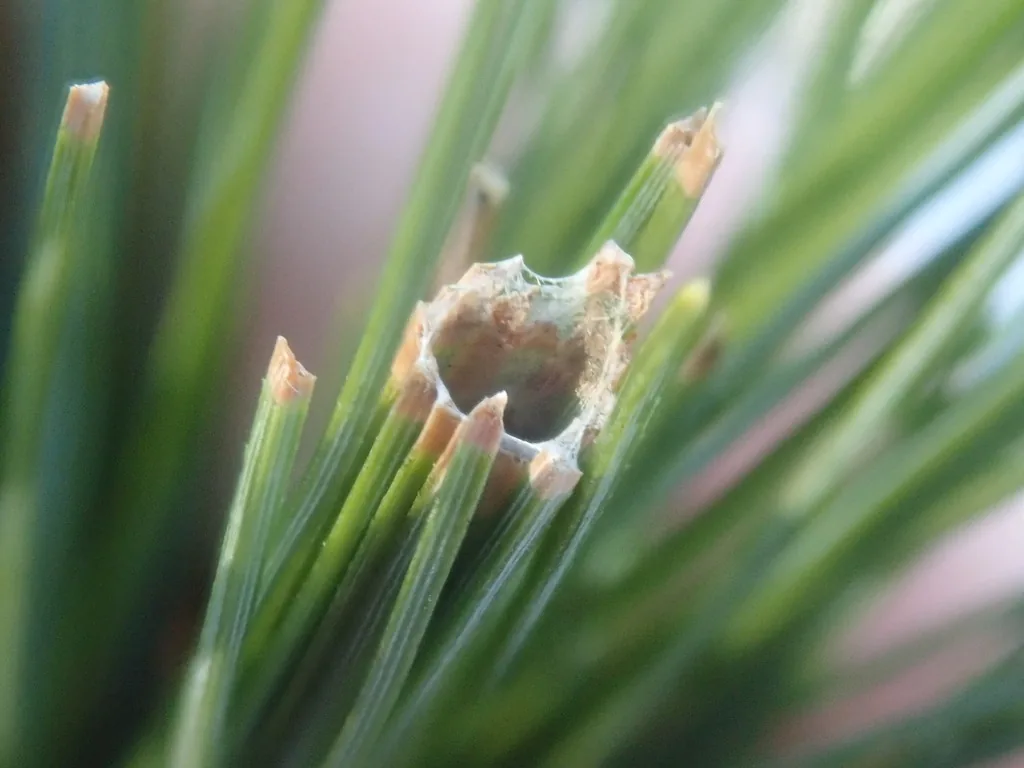
- Look for a tube of 5 to 20 eastern white pine needles webbed together, with the caterpillar surrounded by silken webbing inside. Caterpillars of this genus eat the end of the tube they make, which UMass says sets them apart from other tube-making caterpillars on pines.[1]
- The caterpillar has a yellowish-green body and an orange to yellow-brown head capsule, which may have brown markings. Caterpillars are fully grown by about mid-June and reach up to 0.6 inch long.[1]
- The adult is a small, slender, grayish moth with a wingspread of 14 mm, according to the 1972 USDA Forest Service manual Eastern Forest Insects. Its forewings carry broad orange to reddish-ochreous patches crossed by two whitish oblique lines, and the hindwings are smoky. UMass says adults appear from about early May.[5][1]
Look-alikes
| Look-alike | How to tell them apart |
|---|---|
| Jack pine tube moth | A related and similar species, Argyrotaenia tabulana, may be found on jack pine, pitch pine and possibly other hard pines rather than eastern white pine.[1] |
Where it lives
It is native and found throughout the range of eastern white pine. The 1972 USDA Forest Service manual gives its range as southern Canada, the Northeastern States, Florida and Louisiana. GBIF holds 1,279 U.S. records since 1990; 674 of them come from Massachusetts, followed by New York (127) and Vermont (98).[1][5][2]
Biology and life cycle
Eastern white pine is the main host and may be the only one, though its full host range is not known. Much of its life cycle is still not well understood.[1]
It overwinters as a pupa in the tube it builds. Adults emerge by about early May and lay eggs on the needles, and the young caterpillars feed on the needle tips.[1]
A new generation of adults emerges in July and lays more eggs on white pine needles; presumably those caterpillars feed, form new tubes and pupate and overwinter in them. In southern New England the second generation of caterpillars appears in September and October.[1]
The 1972 USDA manual says it feeds on various conifers, mostly white pine. The caterpillar lives inside a tube it makes by drawing five to 20 needles together with silk and feeds on the tips of those needles; winter is spent as a pupa in the tube, and there may be two generations a year.[5]
Damage and signs
- It is usually not a serious pest and often goes unnoticed. When it is abundant, needles can turn brown and several tubes may be webbed together.[1]
- In southern New England the injury is often not noticed until the second generation of caterpillars appears in September and October.[1]
- Heavily infested pines often have a ragged appearance, which the 1972 USDA manual says may be objectionable where valuable ornamentals are involved.[5]
Health risk
UMass Extension and the USDA Forest Service describe it only as a needle-feeding caterpillar of pines and mention no harm to people.[1][5]
Control
Prevention
Management is rarely, if ever, needed. The moth seldom affects the overall health of the tree, and UMass Extension suggests leaving this native insect in the landscape, where it adds to local biodiversity.[1]
Traps and physical control
If control seems necessary on a small tree, pinch the tubes to crush the caterpillars or pupae inside.[1]
Biological control
Predators, parasitoids and possibly diseases are presumed to keep numbers low, although the natural enemies of this species have not been studied in detail.[1]
When to look
Check eastern white pines for tube-making caterpillars in May and June, and again in September and October.[1]
Where the sources disagree
Range and hosts: UMass describes it as found throughout the range of eastern white pine and says white pine may be its only host; the 1972 USDA manual says it feeds on various conifers, mostly white pine, and lists Florida and Louisiana in its range; GBIF's U.S. records since 1990 also reach Alabama (7), Georgia (5) and Texas (3).[1][5][2]
Record counts: more than half of GBIF's 1,279 U.S. records since 1990 (674) come from Massachusetts, so the counts reflect where people record moths as much as where the moth lives.[2]
Caterpillar: UMass describes a yellowish-green body with an orange to yellow-brown head and gives up to 0.6 inch; the 1972 USDA manual's key describes a greenish-brown body and head with dark patches on the sides of the head, and gives full-grown larvae as 10 to 14 mm.[1][5]
Common questions
- What are the little tubes of webbed needles on my white pine?
- Tubes of 5 to 20 white pine needles webbed together with silk, with the end of the tube chewed off, are the shelters of pine tube moth caterpillars.[1]
- Do I need to spray for pine tube moth?
- Almost never. UMass Extension says chemical control is rarely if ever necessary because the moth seldom reaches outbreak levels and the damage is minor; crushing the tubes on a small tree is enough if you want to act.[1]
- Does the pine tube moth attack pines other than white pine?
- Possibly. UMass says eastern white pine is the main host and may be the only one, though its full host range is not known; the 1972 USDA Forest Service manual says it feeds on various conifers, mostly white pine.[1][5]
Sources
- UMass Extension Landscape, Nursery and Urban Forestry Program (University of Massachusetts Amherst), “Argyrotaenia pinatubana, Landscape Insect & Mite Guide.” www.umass.edu/agriculture-food-environment/landscape/publications-resources/insect-mite-guide/argyrotaenia-pinatubana (accessed 2026-11-14)
- Global Biodiversity Information Facility (GBIF), “Argyrotaenia pinatubana: U.S. occurrence records since 1990 by state (GBIF occurrence search).” api.gbif.org/v1/occurrence/search?taxonKey=1747166&country=US&hasGeospatialIssue=false&occurrenceStatus=PRESENT&year=1990%2C2026&facet=stateProvince&facetLimit=400&limit=0 (accessed 2026-11-14)
- Global Biodiversity Information Facility (GBIF), “Argyrotaenia pinatubana (Kearfott, 1905) (GBIF Backbone Taxonomy).” api.gbif.org/v1/species/1747166 (accessed 2026-11-14)
- iNaturalist, “Argyrotaenia pinatubana taxon page (order and family).” www.inaturalist.org/taxa/214161 (accessed 2026-11-09)
- USDA Forest Service, “Eastern Forest Insects, Miscellaneous Publication 1175 (W. L. Baker, 1972; scanned copy).” archive.org/details/easternforestins1175bake (accessed 2026-11-14)