On this page
How to identify it
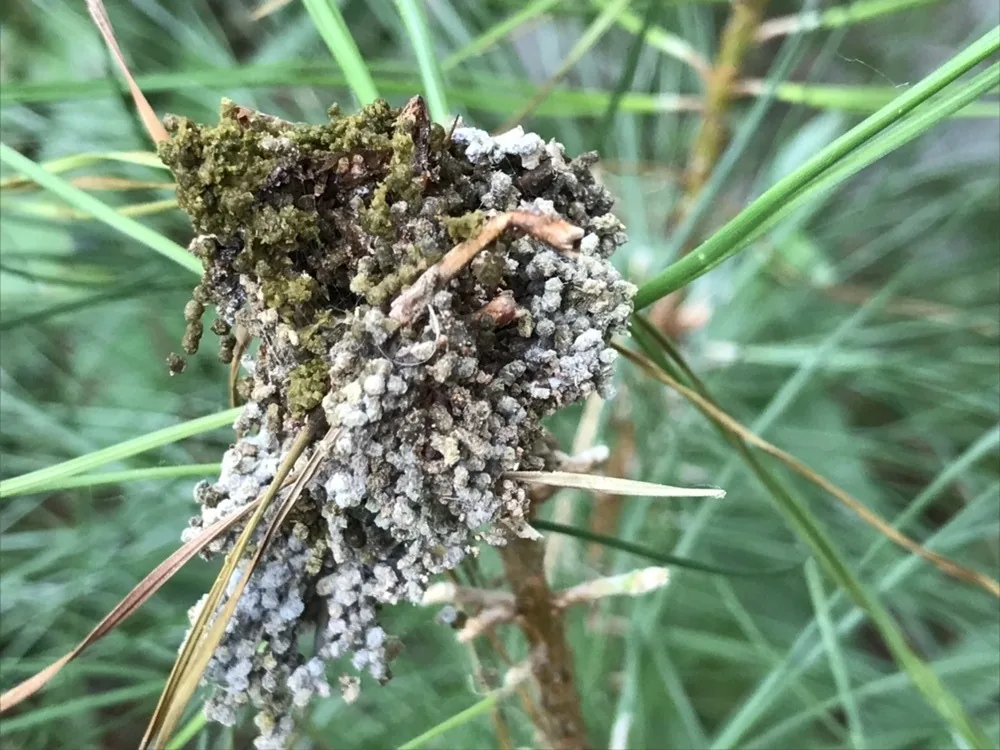
- The nest is the giveaway: a loosely webbed, messy mass of brown frass pellets and silk, roughly 2 to 6 inches long, on the twig, with the caterpillars feeding on the needles inside. A nest may hold a couple of caterpillars or as many as 78. The USDA Forest Service's Eastern Forest Insects says older larvae live in silken tubes that run through the globular masses of coarse brown frass.[1][17]
- Full-grown caterpillars are 0.6 inch long and yellowish brown with darker brown stripes. Eastern Forest Insects puts them at about 18 mm, with two dark-brown lengthwise stripes on each side.[1][17]
- Adult moths are attracted to lights and may be light-trapped at night. The moth has a wingspread of about 25 mm; the base of the forewing is purple-black, the middle grayish and the outer part blackish.[1][17]
Look-alikes
| Look-alike | How to tell them apart |
|---|---|
| Pine tube moth | Its larva draws five to 20 needles together with silk into a tube and feeds on their tips, mostly on white pine, and it spends the winter as a pupa inside the tube. There is no globular frass nest.[17] |
| Pine needleminer | Its pinkish larvae, about 6 mm long, stay inside the needles and kill the tips beyond their entrance holes, without building a frass nest. Young pine webworms also mine needles before they start webbing.[17] |
Where it lives
BAMONA gives the range as southern Canada and the eastern United States from Minnesota to New England and south to Florida. UMass lists jack, loblolly, longleaf, mugo, pitch, red, Scotch, shortleaf, Virginia and white pines as hosts, with slash pine a host in the southeastern United States. GBIF holds about 680 U.S. records since 1990 from 27 state-level areas, the most from Virginia (102), Florida (61), North Carolina (59) and Alabama (56). Eastern Forest Insects lists jack, red, white, Scotch, pitch, Virginia, shortleaf, longleaf, loblolly and slash pine, and says jack pine is preferred in the Lake States and adjacent Canada and pitch pine in the Northeast.[2][1][3][17]
Biology and life cycle
The caterpillar overwinters in a cocoon in the soil and pupates in spring. Moths may first be seen in June, and emergence can continue into July and possibly early August. Eastern Forest Insects says pupation takes place in a cell in the soil.[1][17]
Females lay their tiny eggs in single rows along pine needles, up to 20 eggs on one needle. The young caterpillars spin loose webbing around a cluster of needles and then mine inside a needle; once too large to mine, they feed within loosely webbed, messy nests of frass and silk.[1]
Nests are present from late June through July in the northern part of the range, and the caterpillars keep feeding on the needles inside them; full-grown caterpillars may be present from August to October and crawl or drop to the soil by late September to spin their cocoons.[1]
There is one generation a year in the northern part of the range. UMass reports two from Virginia to Florida and even three in some Florida locations. Eastern Forest Insects says there may be two in the South.[1][17]
Damage and signs
- UMass says the pine webworm is usually considered a pest on seedling pines in plantations and managed landscapes.[1]
- On Christmas trees and landscape pines the problem is the unsightly nests of dead needles, silk and brown frass on the terminal twigs. The damage is usually noticed only after the caterpillars have finished feeding and left. Eastern Forest Insects adds that ugly nests on young pines grown for the Christmas tree trade sometimes make them impossible to sell.[1][17]
- On pitch pine, UMass says, the nests may be found mostly near ground level.[1]
- Eastern Forest Insects calls the pine webworm often troublesome in pine plantations: young seedlings up to 2 feet tall are sometimes completely defoliated and killed by the larvae in a single nest.[17]
Health risk
It is a plant pest. UMass and BAMONA don't mention any risk to people or pets. Eastern Forest Insects doesn't mention any either.[1][2][17]
Control
Prevention
Look for nests on the shoots from late June onward; on pitch pine they may be mostly near ground level. UMass says the insect is usually a pest on seedling pines in plantations and managed landscapes.[1]
Traps and physical control
Hand-pick or prune out the webbed nests while caterpillars are still inside and destroy them. Removing empty nests after the caterpillars have gone to the soil will not reduce next year's population, although it tidies up the tree.[1]
Biological control
Parasitic wasps and flies attack the caterpillars, including the ichneumonid wasp Syzeuctus elegans and flies in the genus Eufrontina, and chickadees and nuthatches may rip nests apart to feed on the caterpillars.[1]
Pesticides
UMass lists acephate, azadirachtin, Bacillus thuringiensis subsp. kurstaki, bifenthrin, carbaryl, cyfluthrin, deltamethrin, indoxacarb, malathion, permethrin, pyrethrins with piperonyl butoxide, and horticultural oil (against the eggs) as active ingredients with products labeled for this use in Massachusetts; EPA's product database still lists active registered products for each. UMass says to apply after bloom to protect pollinators and to confirm that the site and pest are on the product label.[1][4][5][6][7][8][9][10][11][12][13][14][15]
Where the sources disagree
Hosts: BAMONA says only that the caterpillars feed on the needles of various pines; UMass names ten pine species plus slash pine in the Southeast.[2][1]
Name: GBIF's English name is pine webworm; BAMONA calls the adult the pine webworm moth.[16][2]
Moth season: UMass says moths first appear in June and may keep emerging into July and possibly early August; Eastern Forest Insects says adults are present from June to August.[1][17]
Southern generations: UMass reports two from Virginia to Florida and even three in some Florida locations; Eastern Forest Insects says only that there may be two in the South.[1][17]
Common questions
- What is the ball of brown pellets and webbing on my pine?
- Most likely a pine webworm nest: a loose, messy mass of frass pellets and silk a few inches long, with caterpillars feeding on the needles inside.[1]
- Will pine webworms kill my tree?
- It can kill very small trees. Eastern Forest Insects says seedlings up to 2 feet tall are sometimes completely defoliated and killed by the larvae in a single nest. On landscape pines and Christmas trees, UMass says, the problem is the unsightly nests.[17][1]
- How many generations are there?
- One a year in the north; UMass reports two from Virginia to Florida and up to three in parts of Florida.[1]
Sources
- UMass Extension Landscape, Nursery and Urban Forestry Program, University of Massachusetts Amherst, “Pococera (formerly Tetralopha) robustella, Pine Webworm, Insect & Mite Guide (Professional Guide for IPM in Trees and Shrubs).” www.umass.edu/agriculture-food-environment/landscape/publications-resources/insect-mite-guide/pococera-formerly-tetralopha-robustella (accessed 2026-11-14)
- Butterflies and Moths of North America (BAMONA), “Pine Webworm Moth, Pococera robustella (Zeller, 1848).” www.butterfliesandmoths.org/species/Pococera-robustella (accessed 2026-11-13)
- Global Biodiversity Information Facility (GBIF), “Pococera robustella: U.S. occurrence records since 1990 by state (GBIF occurrence API).” api.gbif.org/v1/occurrence/search?taxonKey=1870721&country=US&hasGeospatialIssue=false&occurrenceStatus=PRESENT&year=1990%2C2026&facet=stateProvince&facetLimit=400&limit=0 (accessed 2026-11-13). 679 records from 27 state-level areas; Virginia 102, Florida 61, North Carolina 59, Alabama 56; fetched 2026-11-13.
- U.S. EPA Pesticide Product Label System, “Pesticide Product Label System: product-name search 'Acephate'.” ordspub.epa.gov/ords/pesticides/cswu/ProductSearch/partialprodsearch/v2/riname/Acephate (accessed 2026-11-13). 156 product-name rows, 84 Active, including 70506-8 ACEPHATE 97UP INSECTICIDE; saved 2026-11-13.
- U.S. EPA Pesticide Product Label System, “Pesticide Product Label System: product-name search 'Azadirachtin'.” ordspub.epa.gov/ords/pesticides/cswu/ProductSearch/partialprodsearch/v2/riname/Azadirachtin (accessed 2026-11-13). 8 rows, 6 Active; saved 2026-11-13.
- U.S. EPA Pesticide Product Label System, “Pesticide Product Label System: product-name search 'Bacillus thuringiensis'.” ordspub.epa.gov/ords/pesticides/cswu/ProductSearch/partialprodsearch/v2/riname/Bacillus%20thuringiensis (accessed 2026-11-13). 86 rows, 19 Active, including 4-226 BONIDE BACILLUS THURINGIENSIS (BT) MOTH LARVAE (CATERPILLAR) CONTROL; saved 2026-11-13.
- U.S. EPA Pesticide Product Label System, “Pesticide Product Label System: product-name search 'Bifenthrin'.” ordspub.epa.gov/ords/pesticides/cswu/ProductSearch/partialprodsearch/v2/riname/Bifenthrin (accessed 2026-11-13). 328 rows, 249 Active; saved 2026-11-13.
- U.S. EPA Pesticide Product Label System, “Pesticide Product Label System: product-name search 'Carbaryl'.” ordspub.epa.gov/ords/pesticides/cswu/ProductSearch/partialprodsearch/v2/riname/Carbaryl (accessed 2026-11-13). 546 rows, 36 Active; saved 2026-11-13.
- U.S. EPA Pesticide Product Label System, “Pesticide Product Label System: product-name search 'Cyfluthrin'.” ordspub.epa.gov/ords/pesticides/cswu/ProductSearch/partialprodsearch/v2/riname/Cyfluthrin (accessed 2026-11-13). 35 rows, 19 Active; saved 2026-11-13.
- U.S. EPA Pesticide Product Label System, “Pesticide Product Label System: product-name search 'Deltamethrin'.” ordspub.epa.gov/ords/pesticides/cswu/ProductSearch/partialprodsearch/v2/riname/Deltamethrin (accessed 2026-11-13). 65 rows, 45 Active; saved 2026-11-13.
- U.S. EPA Pesticide Product Label System, “Pesticide Product Label System: product-name search 'Indoxacarb'.” ordspub.epa.gov/ords/pesticides/cswu/ProductSearch/partialprodsearch/v2/riname/Indoxacarb (accessed 2026-11-13). 40 rows, 40 Active; saved 2026-11-13.
- U.S. EPA Pesticide Product Label System, “Pesticide Product Label System: product-name search 'Malathion'.” ordspub.epa.gov/ords/pesticides/cswu/ProductSearch/partialprodsearch/v2/riname/Malathion (accessed 2026-11-13). 3,334 rows, 414 Active; saved 2026-11-13.
- U.S. EPA Pesticide Product Label System, “Pesticide Product Label System: product-name search 'Permethrin'.” ordspub.epa.gov/ords/pesticides/cswu/ProductSearch/partialprodsearch/v2/riname/Permethrin (accessed 2026-11-13). 499 rows, 212 Active; saved 2026-11-13.
- U.S. EPA Pesticide Product Label System, “Pesticide Product Label System: product-name search 'Pyrethrins'.” ordspub.epa.gov/ords/pesticides/cswu/ProductSearch/partialprodsearch/v2/riname/Pyrethrins (accessed 2026-11-13). 307 rows, 42 Active; saved 2026-11-13.
- U.S. EPA Pesticide Product Label System, “Pesticide Product Label System: product-name search 'Horticultural Oil'.” ordspub.epa.gov/ords/pesticides/cswu/ProductSearch/partialprodsearch/v2/riname/Horticultural%20Oil (accessed 2026-11-13). 21 rows, 18 Active, including 10404-66 LESCO HORTICULTURAL OIL INSECTICIDE; saved 2026-11-13.
- Global Biodiversity Information Facility (GBIF), “Pococera robustella Zeller, 1848 (GBIF Backbone Taxonomy).” api.gbif.org/v1/species/1870721 (accessed 2026-11-13). ACCEPTED; order Lepidoptera, family Pyralidae; vernacular name Pine Webworm
- USDA Forest Service (scan at Internet Archive), “Eastern Forest Insects, Miscellaneous Publication 1175 (W. L. Baker, 1972).” archive.org/details/easternforestins1175bake (accessed 2026-11-14)