On this page
How to identify it
- Mined needles turn brown and die, typically one needle of each pair. Under magnification the entrance hole on the flat side of the needle is often plugged with resin, and an overwintered larva leaves a round exit hole near the needle base when it moves on in spring.[1]
- The caterpillar is tiny, about 6 mm when mature, with a brown body and a dark brown head and prothoracic shield. It is found inside the needle, never exposed on the foliage. The Forest Service's 1972 manual Eastern Forest Insects describes full-grown larvae as pinkish and about 6 mm long.[1][3][4]
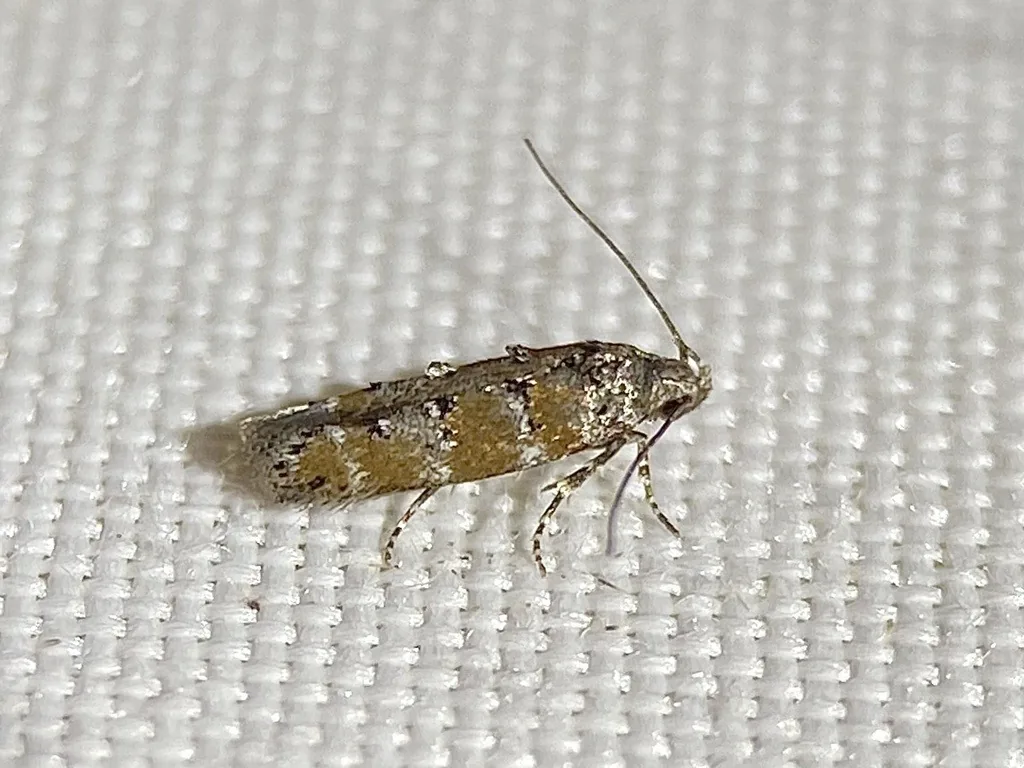
- The adult is a very small moth with a wingspread of about 9 mm. The forewing is reddish to golden brown and crossed by four narrow grayish bands, and the hindwings are wider than the forewings, the Forest Service says.[4]
Look-alikes
| Look-alike | How to tell them apart |
|---|---|
| Spruce needleminer | Works on spruce, and its caterpillars cut off mined needles and tie them into messy nests of silk, dead needles and frass; the pine needleminer works on pines and stays inside single needles with no webbing.[5][1] |
| Pine webworm | Its young caterpillars also mine pine needles, but once too large they stop mining and feed in loose, messy nests of silk and frass on the shoots; the needleminer stays inside the needles.[6][1] |
Where it lives
Native to the East, widely distributed from southern Ontario through the Atlantic States to Georgia (1954 Canadian Entomologist paper). UMass lists jack, loblolly, mugo, pitch, red, Scotch and Virginia pines as hosts, with pitch pine preferred, and notes it may be more common in coastal New England than inland. GBIF holds 342 U.S. records since 1990 from 23 state-level areas, the most from Maryland (74), New York (32) and North Carolina (32). The Forest Service's Eastern Forest Insects gives a range from southeastern Canada south to Georgia and Texas, with jack, pitch and shortleaf pines preferred and Virginia, Scotch, scrub, longleaf, loblolly and red pines also fed on.[2][1][7][4]
Biology and life cycle
Eggs are laid in spring; in southern Quebec jack pine plantations, Finnegan found females laying in late June and early July. The newly hatched caterpillar enters the flat side of a new needle. The Forest Service says females lay their eggs in recently vacated, mined needles from May to July depending on location, and young larvae bore into the bases of current-year needles, killing them within 2 or 3 weeks.[1][3][4]
The caterpillar feeds in that first needle until its second instar, then moves to a fresh needle, where it feeds and spends the winter. In spring it mines to the base of the needle, cuts a round exit hole and enters a third needle, where it finishes feeding and pupates inside the mine.[1][3]
Mature caterpillars are present from April through June, there are at least four larval instars, and UMass reports a single generation a year. UMass gives 448-802 growing degree days (base 50F, from March 1) as a monitoring window.[1]
It is one of several pine needleminers: UMass says at least five other needleminer species occur on pine in North America, and a 1954 Canadian Entomologist paper counts at least seven pine needle miners in all.[1][2]
The moths lay eggs on the same trees year after year, so infestations stay local: one part of a stand can be heavily infested while the area next to it stays clean for years.[2]
Damage and signs
- Each mined needle browns and dies, and the insect typically kills one needle in each pair. Older larvae mine both old and new needles and kill the part of the needle beyond the entrance hole, the Forest Service says.[1][4]
- UMass says it is typically not a problem in the landscape but can occasionally be a serious defoliator, and the browning matters on nursery stock and Christmas trees grown for sale. The 1954 paper calls it a persistent, annoying pest of trees of all ages, from nursery transplant beds to mature stands, and Finnegan found it in large numbers in southern Quebec jack pine plantations. The Forest Service says forest-grown trees are occasionally infested heavily but seldom seriously injured, while heavy infestations on ornamentals or in plantations may be serious.[1][2][3][4]
Health risk
It feeds inside pine needles, and no cited source describes any risk to people or pets.[1][3][2]
Control
Prevention
In most landscapes no treatment is needed: UMass calls the pine needleminer a minor pest of ornamental trees whose native natural enemies usually keep it below damaging levels. Check browned needles on pitch and other hard pines in spring and dissect a few under magnification to confirm caterpillars or pupae before acting.[1]
Biological control
Three parasitoid wasps (Achrysocharis, Copidosoma and Dicladocerus species) caused roughly 8, 3 and 3 percent larval mortality in 1962 studies reported by Finnegan, and UMass lists many more wasp parasitoids collected in Maine and Massachusetts. Strong wind and rain while the moths fly, mate and lay eggs also knock populations down. The Forest Service adds that the mite Pediculoides ventricosus appears to be an effective predator in some areas and was reported to destroy over 75 percent of late-instar larvae in North Carolina infestations.[1][4]
Pesticides
For nursery or Christmas tree plantings, UMass's Massachusetts list of labeled active ingredients (last updated September 27, 2024) includes horticultural oil, insecticidal soap, neem oil, spinosad, malathion, pyrethrin plus sulfur, abamectin, acetamiprid, cyantraniliprole and emamectin benzoate, with abamectin, acetamiprid and emamectin benzoate as trunk injections and chlorantraniliprole or neem oil as soil drenches. UMass says to apply after bloom to protect pollinators, that neonicotinoids are state restricted use on trees and shrubs in Massachusetts since July 1, 2022, and that the list may not be up to date, so confirm the label.[1]
Where the sources disagree
Egg laying: UMass says eggs are laid in the spring, while Finnegan found females laying in late June and early July in southern Quebec.[1][3]
Larval instars: UMass says at least four larval instars are recorded, while Finnegan's abstract says larvae overwinter after moulting to the fourth instar and moult again the following spring before pupating in a third needle.[1][3]
How serious: UMass says it is typically not a problem in the landscape, while the 1954 paper calls it a persistent and annoying pest of trees of all ages, from nursery transplant beds to mature stands.[1][2]
How many pine needleminers: UMass says at least five other needleminer species occur on pine in North America, while the 1954 paper counts at least seven pine needle miners in all.[1][2]
Generations: UMass reports one generation a year, while the Forest Service's 1972 manual says there may be two or more.[1][4]
Common questions
- Why is one needle in each pair on my pitch pine brown?
- That pattern, with a tiny resin-plugged hole in the needle, is typical of the pine needleminer, a 6 mm caterpillar that feeds inside the needle and kills it.[1]
- Does the pine needleminer kill trees?
- Rarely. UMass says it is typically not a problem in landscapes, though it can occasionally be a serious defoliator, and the browning is a cosmetic problem on trees grown for sale. The Forest Service likewise says forest-grown trees are seldom seriously injured, though heavy infestations on ornamentals or in plantations may be serious.[1][4]
- How many generations are there each year?
- One, according to UMass. The overwintering caterpillar finishes feeding in spring and pupates in its third needle. The Forest Service's 1972 manual says there may be two or more a year.[1][3][4]
- Is it harmful to people or pets?
- It lives and feeds inside pine needles, and no cited source describes any risk to people or pets.[1]
Sources
- UMass Extension Landscape, Nursery and Urban Forestry Program, University of Massachusetts Amherst, “Exoteleia pinifoliella, Pine Needleminer, Insect & Mite Guide (Professional Guide for IPM in Trees and Shrubs).” www.umass.edu/agriculture-food-environment/landscape/publications-resources/insect-mite-guide/exoteleia-pinifoliella (accessed 2026-11-13)
- The Canadian Entomologist 1954;86(2):49-54 (Entomological Society of Canada), via Cambridge University Press, “The Effect of Needle Structure upon the Susceptibility of Hosts to the Pine Needle Miner (Exoteleia pinifoliella).” doi.org/10.4039/Ent8649-2 (accessed 2026-11-13). Published extract read
- The Canadian Entomologist 1965;97(7):744-750 (Entomological Society of Canada), via Cambridge University Press, “The Pine Needle Miner, Exoteleia pinifoliella (Chamb.) (Lepidoptera: Gelechiidae), in Quebec.” doi.org/10.4039/Ent97744-7 (accessed 2026-11-13). Abstract read
- USDA Forest Service, “Eastern Forest Insects, Miscellaneous Publication 1175 (W. L. Baker, February 1972; scanned copy).” archive.org/details/easternforestins1175bake (accessed 2026-11-14). Scanned copy of the USDA Forest Service publication on the Internet Archive; text read from the archive.org full-text (djvu.txt) file.
- UMass Extension Landscape, Nursery and Urban Forestry Program, University of Massachusetts Amherst, “Taniva albolineana (spruce needleminer): Insect & Mite Guide.” www.umass.edu/agriculture-food-environment/landscape/publications-resources/insect-mite-guide/taniva-albolineana-formerly-endothenia-albolineana (accessed 2026-11-13)
- UMass Extension Landscape, Nursery and Urban Forestry Program, University of Massachusetts Amherst, “Pococera (formerly Tetralopha) robustella (pine webworm): Insect & Mite Guide.” www.umass.edu/agriculture-food-environment/landscape/publications-resources/insect-mite-guide/pococera-formerly-tetralopha-robustella (accessed 2026-11-13)
- Global Biodiversity Information Facility (GBIF), “Exoteleia pinifoliella: U.S. occurrence records since 1990 by state (GBIF occurrence search).” api.gbif.org/v1/occurrence/search?taxonKey=1848639&country=US&hasGeospatialIssue=false&occurrenceStatus=PRESENT&year=1990%2C2026&facet=stateProvince&facetLimit=400&limit=0 (accessed 2026-11-13). Fetched 2026-11-13: 342 U.S. records since 1990 from 23 states; Maryland 74, New York 32, North Carolina 32.
- Global Biodiversity Information Facility (GBIF), “Exoteleia pinifoliella (Chambers, 1880) (GBIF Backbone Taxonomy).” api.gbif.org/v1/species/1848639 (accessed 2026-11-13)