On this page
How to identify it
- Dead brown or reddish shoots, visible from a distance, are the main symptom; up close you'll see silk and boring frass.[1]
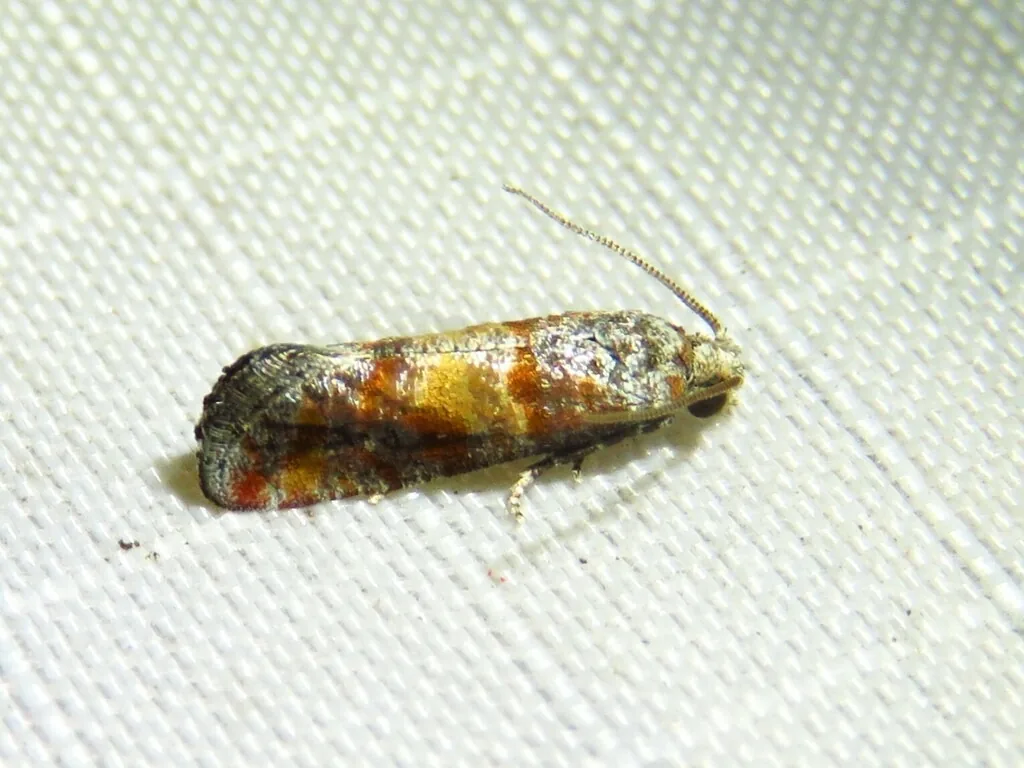
- Adults are small reddish-brown or copper moths with silver-gray markings: UC IPM says about 2/5 inch long, UMass about 1/4 inch for the Nantucket pine tip moth.[1][3]
- Young larvae are whitish or cream with a dark head; older larvae are yellow to light brown or orange. UMass gives about 3/8 inch for a grown Nantucket larva.[1][3]
- Pupae are brown, about 1/4 inch, and spend the winter in hollowed shoots, cones or buds (or, for some species in California, in ground litter).[2][3][1]
Look-alikes
| Look-alike | How to tell them apart |
|---|---|
| European pine shoot moth | Illinois says it attacks red, mugo, Scots, Austrian and ponderosa pines, has one generation a year and overwinters in the injured tissue, while the Nantucket pine tip moth has several generations. UMass also lists Zimmerman pine moth and pitch pine tip moth as lookalikes.[4][3] |
Where it lives
The Nantucket pine tip moth ranges from Massachusetts to Florida and is an important pest of southern pine plantations; it also occurs in California with the Monterey and ponderosa pine tip moths, mainly in the south. Utah State Extension covers related tip and shoot moths in the Intermountain West.[3][2][1][5]
Biology and life cycle
Moths come out on warm days in late winter, from January in Southern California and in January or February in North Carolina, and lay eggs on new or one-year-old shoots, needles and buds. Larvae feed outside at first, then bore into buds and shoots for about 3 to 4 weeks.[1][2][3]
Generations vary a lot by place and species. UMass gives two a year in the north and up to five in Florida, NC State at least three in North Carolina, and UC IPM about four for Nantucket in Southern California but one or two for the Monterey and ponderosa species; Utah State says the tip moths it covers have one.[3][2][1][5]
Damage and signs
- Larvae tunnel in buds, needles and shoot tips, which exude pitch, discolor and die; UMass says shoots can be killed back almost a foot, and female flowers and young cones can be killed too.[1][3]
- Killing the leader leaves trees bushy, crooked or forked and slows growth. Most attacks are on trees up to about 15 feet tall; very small trees can be killed, but older pines are less affected.[1][2][3]
- Hosts differ by region. In North Carolina loblolly and shortleaf are favored and slash pine is rarely attacked; UMass names pitch, Scots and Virginia pine as preferred and longleaf, eastern white and slash pine as more resistant; Illinois says it attacks all two- and three-needle pines grown in the Midwest.[2][3][4]
Health risk
Pine tip moths feed only in pine shoots and buds; none of the extension sources consulted (UC IPM, NC State, UMass, Utah State, Illinois) describes any risk to people or pets.[1][2][3][5][4]
Control
Prevention
Plant pines suited to the site and keep them free of stress. UC IPM says to avoid highly susceptible pines if you can't tolerate damage, and UMass notes that sunny, open sites are favored and that dense spacing or overstory cover helps.[1][3]
Traps and physical control
Prune off and destroy infested tips; UC IPM suggests October through January in California, and Illinois advises removing dead tips as they appear.[1][4]
Biological control
More than 30 parasitoid species, plus predators and birds, attack it. The introduced wasp Campoplex frustranae has reduced Nantucket pine tip moth in many places in California, and sprays can kill it.[2][3][1]
Results differ on releasing parasitic wasps. A Virginia Christmas tree study found that releases of Trichogramma egg parasitoids didn't raise parasitism or cut damage, likely because predators ate many of the released wasps, while UC IPM credits the introduced Campoplex wasp with reducing populations.[6][1]
Pesticides
In the same Christmas tree study, treating only the top whorl worked about as well on most measures as treating the whole tree, with far less time and pesticide.[6]
When to call a professional
Insecticide is rarely justified outside high-value trees; NC State says spray only when natural control fails. UC IPM notes some effective products are available only to licensed applicators, and Utah State says timing depends on knowing which species you have.[1][2][5]
Nurseries, Christmas trees and timing
Utah State says minor damage needs no treatment and injury is usually worst in nurseries; resin, frass and webbing may mark the damaged tips.[5]
NC State's timing tip: put a few infested tips in a dry plastic bag kept in the shade, and watch for the first moths to emerge before planning any treatment.[2]
Common questions
Sources
- University of California Statewide IPM Program, “Pine Tip Moths (Pests in Gardens and Landscapes).” ipm.ucanr.edu/home-and-landscape/pine-tip-moths/ (accessed 2026-11-13)
- NC State Extension, “Nantucket Pine Tip Moth.” content.ces.ncsu.edu/nantucket-pine-tip-moth (accessed 2026-11-13)
- UMass Amherst Extension Landscape, Nursery and Urban Forestry Program, “Rhyacionia frustrana (Insect & Mite Guide).” www.umass.edu/agriculture-food-environment/landscape/publications-resources/insect-mite-guide/rhyacionia-frustrana (accessed 2026-11-13)
- University of Illinois Extension, “European Pine Shoot Moth | Nantucket Pine Tip Moth.” extension.illinois.edu/insects/european-pine-shoot-moth-nantucket-pine-tip-moth (accessed 2026-11-13)
- Utah State University Extension, “Pine Tip Moths.” extension.usu.edu/planthealth/ipm/ornamental-pest-guide/arthopods/moths/pine-tip-moths (accessed 2026-11-13)
- Journal of Economic Entomology, via PubMed, “Evaluation of biological and biorational control tactics for suppression of Nantucket pine tip moth damage in Virginia pine Christmas trees (Philip, Orr & Hain, 2005).” pubmed.ncbi.nlm.nih.gov/15889732/ (accessed 2026-11-13)
- Global Biodiversity Information Facility (GBIF), “Rhyacionia frustrana (Scudder, 1880) (GBIF Backbone Taxonomy).” api.gbif.org/v1/species/1739364 (accessed 2026-11-13)
- iNaturalist, “Rhyacionia frustrana taxon page (order and family).” www.inaturalist.org/taxa/343662 (accessed 2026-10-06)