On this page
How to identify it
- Damage is the usual clue: around mid-June the outer 6 to 8 inches of a new shoot droops and discolors (see where the sources disagree on color), and the shoot often breaks over or falls off, leaving a flat stub. Some shoots, especially on Douglas-fir, wilt and droop into a shepherd's crook before yellowing, and Minnesota Extension describes the same crook on pine.[1][3]
- Split an infested shoot and you will find the pith hollowed into a tunnel 6 to 8 inches long, with a round exit hole near its base once the caterpillar has left.[1]
- The full-grown caterpillar is dirty white to gray and about 1/2 to 3/4 inch long, with a yellowish-brown head marked by a round blackish spot and a pale yellow shield behind the head.[1]
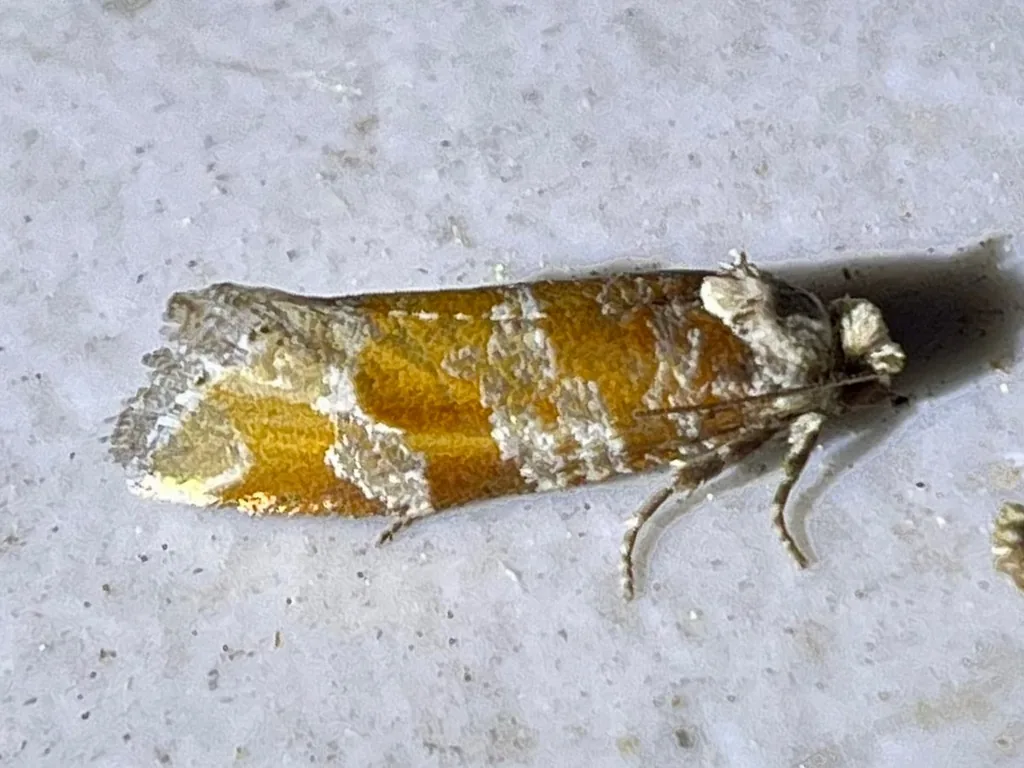
- The moth is small, with a total wingspread of about 1.5 cm (5/8 inch). Its forewings are coppery red crossed by two shiny lead-gray bands, and its hindwings are gray-brown.[1]
Where it lives
It occurs from Maine west to southern Manitoba and south through the Lake States to northern Ohio, Pennsylvania and New Jersey; Natural Resources Canada says it occurs throughout the range of white pine, mainly on young trees in open areas and plantations.[1][2]
Biology and life cycle
Hosts are mainly pines. Eastern white and Scots pines are preferred, but jack, red, Austrian, pitch and mugo pines are also attacked, and occasionally white spruce and Douglas-fir.[1][2][3]
Moths emerge in spring (see where the sources disagree on timing), around the time pine buds break. They are rarely seen by day and hide among the needles near the needle sheaths; mating and egg laying happen at night, and each female usually lays one egg on the needle sheaths of each of several new shoots.[1][2]
Within two weeks the caterpillar hatches and bores into the shoot, mining down through the pith. Usually there is one caterpillar per shoot, though up to six have been found in heavy infestations.[1]
By mid-June the grown caterpillar turns back up the tunnel and cuts into the wood near its base, which weakens the shoot so it breaks when touched or in strong wind. Between mid-June and early July it chews an exit hole, drops to the ground and spins a soil-covered cocoon in the litter or topsoil, where it spends the winter as a pupa.[1][2]
Damage and signs
- Both leaders and side shoots are attacked. Killed leaders leave crooks and forks, the crown loses its shape when side shoots die, and the broken shoot can be an entry point for disease organisms.[1][2]
- Young trees about 3 to 8 feet tall suffer most, although trees up to 30 feet can be attacked.[1][2]
- Severe attacks do not kill trees. The main loss is on Christmas trees: affected trees are left with 2- to 4-inch leaders instead of the 8- to 12-inch leaders growers want, and their marketability suffers in the year of attack.[1][2]
Health risk
USDA Forest Service, Natural Resources Canada and University of Minnesota Extension describe it only as a pest of pine shoots and don't mention any risk to people or pets.[1][2][3]
Control
Traps and physical control
Prune out and destroy wilted or yellowing shoots before the caterpillars leave them and drop to the ground (by mid-June to early July).[2][1]
Pesticides
Sprays are hard to time because moths emerge over a long period and the caterpillars are hidden inside shoots. If control is necessary, the USDA leaflet says to treat about the second week of May to kill caterpillars before they bore in, and to get current product advice from your state agricultural experiment station or county agricultural agent.[1]
Where the sources disagree
Shoot color: the USDA leaflet says attacked shoots droop and turn yellow; Natural Resources Canada describes reddening and wilting; Minnesota Extension says the needles turn yellow and then reddish-brown.[1][2][3]
Caterpillar size: the USDA leaflet says 1/2 to 3/4 inch when full grown; Minnesota Extension says about 1/2 inch.[1][3]
Moth flight: the USDA leaflet says late April to mid-May depending on locality; Natural Resources Canada says May.[1][2]
Name: the USDA leaflet, Natural Resources Canada and Minnesota Extension use Eucosma gloriola; GBIF's backbone taxonomy treats that as a synonym and accepts Eucopina gloriola.[1][2][3][4][5]
Common questions
- Why are the new tips on my white pine drooping and turning yellow in June?
- In the Northeast and Lake States that is a classic sign of the eastern pine shoot borer. A caterpillar inside the shoot has hollowed out the pith, and the shoot often breaks off at a flat stub. Look for a small exit hole below the dead section.[1][3]
- Will the eastern pine shoot borer kill my pine?
- No. Natural Resources Canada says even severe attacks do not kill trees. The damage is to shape and growth, which matters most on Christmas trees and young plantation pines.[2][1]
- How do I control it on a few trees?
- Clip out and destroy the damaged shoots while the caterpillars are still inside, before they drop to the ground in early summer.[2]
Sources
- USDA Forest Service, “Eastern Pineshoot Borer, Forest Insect & Disease Leaflet 134 (L. F. Wilson, revised November 1978; scanned copy).” www.fs.usda.gov/foresthealth/docs/fidls/FIDL-134-EasternPineshootBorer.pdf (accessed 2026-11-13)
- Natural Resources Canada, Canadian Forest Service, “Eastern pine shoot borer, Trees, insects and diseases of Canada's forests.” tidcf.nrcan.gc.ca/en/insects/factsheet/11035 (accessed 2026-11-13)
- University of Minnesota Extension, “What's wrong with my plant? Pine: wilted shoots.” apps.extension.umn.edu/garden/diagnose/plant/evergreen/pine/shootswilted.html (accessed 2026-11-13)
- Global Biodiversity Information Facility (GBIF), “Eucopina gloriola (Heinrich, 1931) (GBIF Backbone Taxonomy).” api.gbif.org/v1/species/9894912 (accessed 2026-11-13)
- Global Biodiversity Information Facility (GBIF), “Eucosma gloriola Heinrich, 1931 (status: synonym) (GBIF Backbone Taxonomy).” api.gbif.org/v1/species/5103296 (accessed 2026-11-13)
- iNaturalist, “Eucopina gloriola taxon page (order and family).” www.inaturalist.org/taxa/511568 (accessed 2026-11-10)