On this page
How to identify it
- The clearest sign is a popcorn-like mass of pitch over a feeding wound, usually at a branch whorl. Iowa State says the masses can be 2 to 4 inches across; fresh ones are white, soft and shiny, and old ones turn gray, hard and dull.[1][2][4]
- Caterpillars are dirty white or gray, sometimes tinged pink or green, and often sit under fresh pitch. Iowa State says full-grown larvae are about 3/4 inch long with a brown head; Wisconsin says up to an inch.[1][2][3]
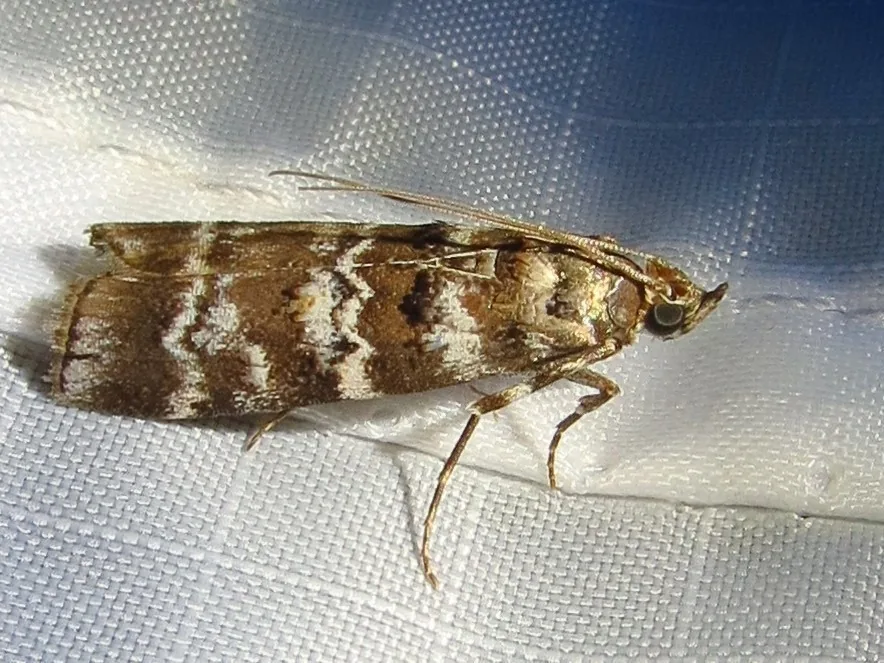
- Adults are rarely seen. They are mid-sized moths with gray wings mixed with red-brown and marked with zigzag lines, and they are hard to tell from related Dioryctria moths.[1][3]
- Early on, new needles and shoots may wilt and yellow, then turn brown.[4]
Where it lives
Wisconsin Extension says it was first found in the US in 1879 and is now established across the northern states east of the Rockies. Iowa State calls it a long-time pest of Midwestern pines, and in Colorado it was accidentally introduced and has become established in several areas.[3][2][1]
Biology and life cycle
Young caterpillars spend the winter in tiny cocoons on the bark or under bark scales. Between mid-April and early May they come out and tunnel into the tree, first at shoot tips and later into the branch whorls.[1][3][4]
Larvae feed into July and pupate in the tunnel or in the pitch mass. Moths fly from late July through mid-August and lay eggs near wounds, old pitch masses and sapsucker holes. Eggs hatch in about a week, and there is one generation a year.[3][2][1][4]
Damage and signs
- Austrian and Scots pines are hit hardest. Iowa State adds red pine, Wisconsin adds eastern white and mugo pines, and South Dakota notes ponderosa pine is attacked too.[1][2][3][4]
- Repeated tunneling weakens branches and trunks, which may break in ice, snow or wind. Trees are rarely killed, but they lose their shape as branches die.[2][3]
- The moths tend to build up on one or a few trees in a planting.[2]
Health risk
It feeds inside pine bark. None of the Extension or state forestry sources cited here describes any risk to people or pets.[1][2][3][4]
Control
Prevention
Keep trees healthy and avoid wounding them. Drought stress and injuries make pines more attractive to egg-laying moths, and South Dakota advises against pruning pines in August, when moths are active.[3][4]
Sanitation
Removing the one or two heavily infested brood trees can be practical. Wisconsin suggests doing it before July so fewer moths emerge nearby, and South Dakota says before late July.[2][3][4]
Traps and physical control
On small or lightly infested trees, pull away fresh pitch in midsummer and dig the caterpillar out with a knife.[1][2]
Pesticides
Sprays work only while caterpillars are on the bark, and once they tunnel in, insecticides no longer reach them. The trunk and bark need a thorough soaking; Wisconsin says branches and foliage don't need spraying.[1][2][3]
Colorado State lists chlorantraniliprole, bifenthrin and permethrin as suitable, and says only permethrin comes in a retail product. Wisconsin's older article says homeowners can buy both permethrin and bifenthrin. Read the label to make sure your use is listed.[1][3][4]
When to spray: the sources differ
Everyone agrees on mid- to late April, when overwintered caterpillars leave their cocoons. Colorado State says spring is often the better of the two windows.[1][3][4]
Colorado State, Iowa State and South Dakota also give a late-summer window around egg hatch, about mid-August. Iowa State times it by plants: Grandiflora hydrangea in pink bloom and Canada goldenrod in bloom.[1][2][4]
Wisconsin Extension disagrees on the late-season treatment. It says sprays in early September aimed at small larvae have only spotty success and aren't recommended.[3]
For the spring window, Iowa State's indicator plants are magnolia in pink bud and sugar maple starting to bloom.[2]
Common questions
- What are the yellow sap blobs on my Austrian pine?
- Popcorn-like pitch masses at branch whorls are the classic sign of Zimmerman pine moth. Soft, shiny white pitch means the caterpillar is still active.[1][2]
- Why did a branch snap off my pine?
- Caterpillars tunneling at the base of a branch can weaken it until it breaks, especially under ice, snow or wind.[1][2]
- Can I spray after I see the pitch?
- Not usefully. By then the caterpillar is inside the tree, where sprays can't reach it. Dig it out by hand or plan a bark spray for the next spring.[1][2]
Sources
- Colorado State University Extension, “Zimmerman Pine Moth (Fact Sheet 5.591).” extension.colostate.edu/resource/zimmerman-pine-moth/ (accessed 2026-11-13)
- Iowa State University Extension and Outreach, “Zimmerman Pine Moth.” yardandgarden.extension.iastate.edu/encyclopedia/zimmerman-pine-moth (accessed 2026-11-13)
- University of Wisconsin-Madison Extension, Wisconsin Horticulture, “Zimmerman Pine Moth (XHT1164, Pellitteri, revised 2012).” hort.extension.wisc.edu/articles/zimmerman-pine-moth/ (accessed 2026-11-13)
- South Dakota Department of Agriculture and Natural Resources, Resource Conservation and Forestry, “Zimmerman Pine Moth (Forest Pest Bulletin 8, revised 2019).” danr.sd.gov/Conservation/docs/InfoPubs/Zimmerman%20Pine%20Moth%202021.pdf (accessed 2026-11-13)
- Global Biodiversity Information Facility (GBIF), “Dioryctria zimmermani (Grote, 1877) (GBIF Backbone Taxonomy).” api.gbif.org/v1/species/1877353 (accessed 2026-11-13)